Thursday, August 30, 2018

Elena Georgiou's Letter to a Not-So-Young Writer

In the 17th in a series of posts from authors of 2018 books entered for The Story Prize, Elena Georgiou, author of The Immigrant's Refrigerator (GenPop Books), offers advice to those who might feel like they're late to the party.


Dearest Not-So-Young Writer,

Perhaps you’ve had children to raise, or parents to take care of, or some other of life’s many obstacles has stood in your way, so it is only now in your late 30s or your 40s or 50s, that you have the space/time to write. Don’t worry; you’re not “behind.” What you might have missed in writing years, you will have certainly gained in lived experience. The most difficult adjustment will be putting yourself first, after so long of not doing so. My advice to you is to use every trick in the book. For me, the most effective trick has been lying to myself—specifically, by telling myself that I was not writing for myself but doing it for others. (Okay, well, this is not a total lie; it’s 50% for myself, 50% for others.) So if it helps, tell yourself that you are not doing it for you, but doing it for X (fill in the blank).

Once you’ve done that, then you might want to try the following:

  1. Divide your day into sections and find one two- to three-hour section that belongs to your writing and reading.
  2. Do this six days per week. (Give yourself a day of rest.)
  3. Don’t worry if you don’t write all six days, but make sure you do at least five. (Okay four. But not less.)
  4. If you don’t have a Room of Your Own, again, don’t worry. (Who has?) There are libraries. In a pinch, or if you prefer to be surrounded by noise, you can buy a coffee/tea and write in fast-food establishments or 24-hour convenience stores with places to sit. (I am currently doing a combo of library/convenience store and it is working well for me.)
  5. Or you can ignore everything that I’ve said so far and find your own way to work.
  6. The most important thing is to snatch any part of your day, for any amount of time, at any location that works for you. 

I know that writers who have come before me have offered eloquent advice about the need to “see the world” before you can write. But I prefer to call on William Blake’s version of seeing the world—that is, to see it in a grain of sand. You don’t need to travel far: Sand can be found at a construction site near you. 

I also know that writing advice is divided over “writing what you know” versus “writing what you don’t know.” Why this split? Why not both? How do I feel about these ideas? Honestly? Whatever. I just know that you should write about what you must write about. Writing is obsessive. Writing is mysterious. Embrace your obsession. Embrace the mystery.
Toni Morrison: What She Said

I’ve also found it useful to study the life of a writer I admire. My inspiration has been the life and work of Toni Morrison (who published her first book at age 40). She has said, “The work is in the work itself. If you write a lot, that's good. If you revise a lot, that's even better. You should not only write about what you know but about what you don't know. It extends the imagination.” My experience has taught me that this extension of the imagination is contagious. It can link you to your readers. It can open minds, hearts, and form a oneness (community). Which means that writing can also make magic happen.

So, my dear Not-So-Young Writer, there is only one thing that you need to do: Take the urgent words out of your body and put them on paper (or in a computer). And then treat these words carefully: Love them like offspring, tend to them like a nest, feed them like baby birds, dress them in their best feathers, then release them into the air.

Yours with faith in writing,

Elena

Friday, August 24, 2018

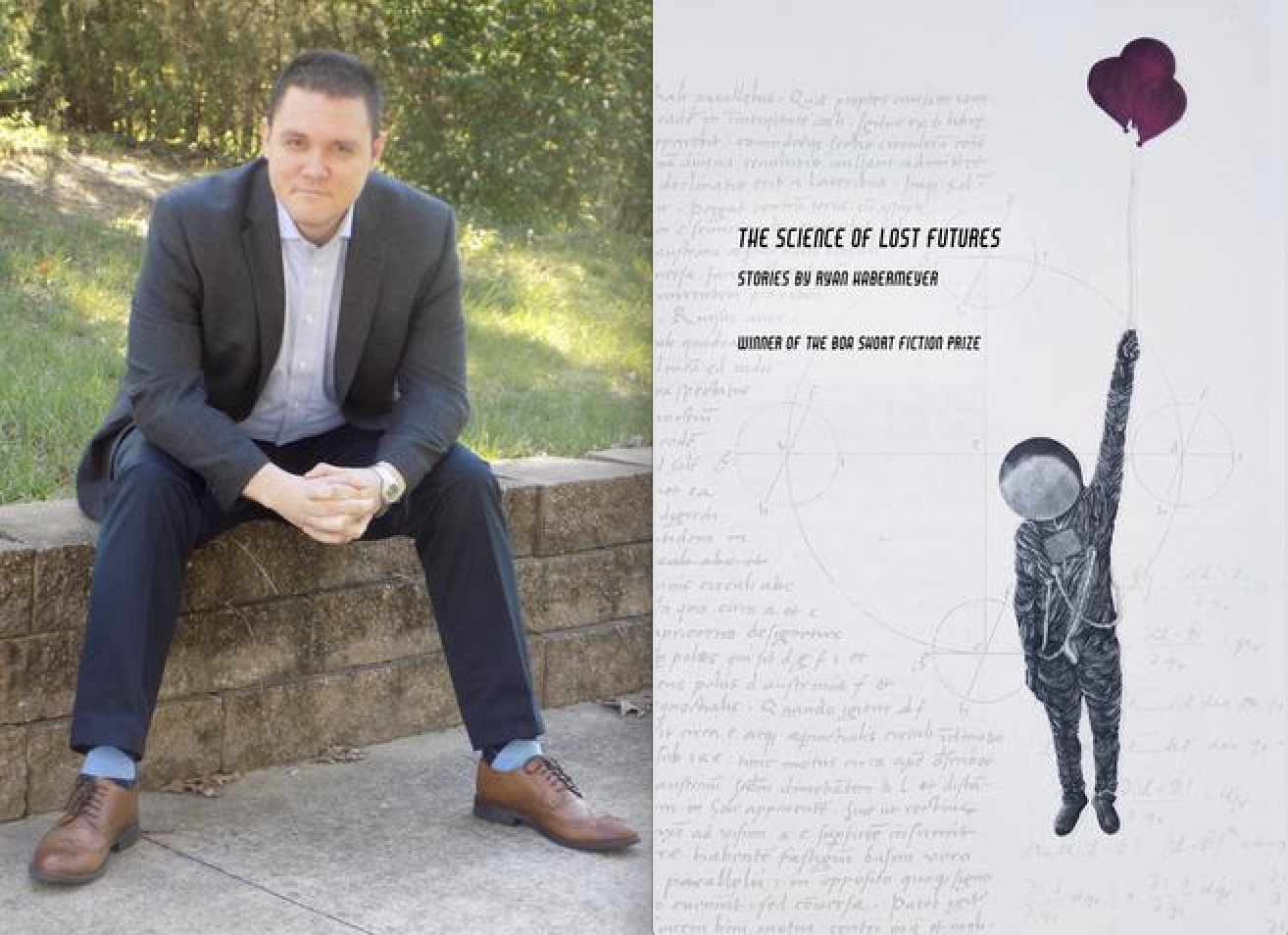
Ryan Habermeyer on (Re)Upholstering a Story

In the 16th in a series of posts from authors of 2018 books entered for The Story Prize, Ryan Habermeyer, author of The Science of Lost Futures (Louisiana State University Press), extolls the benefits of slowing down.


My wife is a self-taught seamstress. Somehow this factoid escaped me until after we were married. I came into the living room of our cramped apartment one day and found it a minefield of fabric bolts. At first she sewed little things: curtains, tablecloths, the occasional skirt. Over the last few years, she’s graduated to reupholstering couches and chairs, which should be required training in theological seminaries because reupholstery is a kind of resurrection—stripping the furniture to its frame and then painstakingly reconstructing it in a new fabric flesh. It’s a tremendous art and fascinating to watch. 

And watch I do. I’ve grown accustomed to seeing my wife spend hours sitting on the floor staring at her fabric. Before she ever reupholsters, she’ll spread the fabric down the hallway or hang it over a door and just look at it: tilting her head one side and then another, folding and unfolding it, occasionally placing little pins in it as if she is Napoleon and the fabric is her map of Europe. One time, like a fool of a husband, I joked it wasn’t going to reupholster itself and she reminded me you can’t uncut fabric. “I’m seeing the chair,” she said.

This seems about the right moment to take a not-so-subtle metaphorical turn (bet you didn’t see that one coming) on the writing life and the upholstery life. With reupholstering, my wife often doesn’t really know where she’s going or how she’s going to re-fabric a particular chair. So she’s got to see it first--a kind of Platonic, idealized chair--before constructing the thing itself. She spends a lot of time staring, figuring out what she doesn’t yet know she knows. Donald Barthelme has extolled the virtues of not-knowing for writers, so I won’t rehash that here, and besides: It’s not not-knowing that I’m really after. It’s the looking. The pausing. The wondering. Imagining the story in the mind, tinkering with it, before giving birth to it with words on the page. A kind of daydream. I like to daydream stories. It’s preferable to actually writing (or revising) them, which I find exhausting and frustrating.

My wife’s upholstering has taught me to pause more when I’m in the thick of writing. Slow down. Look. Wait. Stare out the window. Wait a little longer. Wait for the words right. As Raymond Carver says, “That’s all we have, finally, are the words, and they had better be the right ones, with the right punctuation in the right places so that they can best say what they are meant to say.” What does that mean, exactly? I think of the opening to Jorge Luis Borges’s story “The Circular Ruins”: “No one saw him slip from the boat in the unanimous night.” Unanimous? Such a peculiar adjective, and yet a wonderful counterpoint to the story that unfolds which questions the fabric of identity and reality. Or, there’s Gabriel García Márquez’s “A Very Old Man with Enormous Wings”: “The world had been sad since Tuesday.” Really? Since Tuesday? The melancholy of that line punches me in the chest every time. Without it, I’m not sure I’d feel the angelic old man’s misery as much as I do. Or from Karen Russell’s collection, Vampires in the Lemon Grove: “Samson was seventeen and had what Nal could only describe as a bovine charm.” I’ve never met a bovine personally, but when I do I will be invariably disappointed if it isn’t charming.

When I read fiction it’s not just characters and circumstance that should intrigue; I want the words to surprise, to startle, to provoke just as much as much as I want narrative leaps that bend the limits of reality. In fact, for those of us who traffic in fabulism—or magical realism, slipstream, surrealism, speculative, or whatever else the kids are calling it these days—having inventive syntax and diction (judiciously placed, of course) is of equal importance to me as a fantastical premise. It’s not just about turning a clever phrase. It’s about creating dynamic characters who, as Chuck Palahniuk says, speak with a “burnt tongue.” To create what I call sideways reality the words themselves had better compliment (or provide rich dissonance with) the impossible worlds we conjure.

Of course, sometimes meticulously plodding along at a snail’s pace is a bad idea. So write recklessly. Write mindlessly. Indulge every impulse. But don’t forget to pause, to lean back in the chair and just stare into empty space a little. It’s isolating, this writing thing, but don’t shy away from long bouts of silence. Slow down. Daydream. Wait for the right story to come along. In those quiet moments of waiting you’re likely to find seams to follow should the story come unstitched, as they so often do.

Tuesday, August 21, 2018

Matthew Baker's Experiments with Language

In the 15th in a series of posts from authors of 2018 books entered for The Story Prize, Matthew Baker, author of Hybrid Creatures (Louisiana State University Press), finds an unlikely source of inspiration.


Before writing the stories in Hybrid Creatures, I wrote three prototype stories. Like the final stories, the prototypes experimented with artificial languages: HTML, math notations, music dynamics, and propositional logic. Yet in terms of narrative, the prototypes had nothing in common with the final stories whatsoever. The plots were different. The characters were different. The settings were different. I hadn’t planned on writing prototypes, but experimenting with artificial languages narratively proved to be an extraordinary challenge, and each of those first attempts was a failure. No matter how much I wrestled with it, I couldn’t figure out what was wrong.

The breakthrough came in February 2013. For anybody following the hacker world, that past year had been chaos. The LulzSec hacker Sabu had turned informant for the FBI, leading to the arrests of nearly every member of LulzSec, including Jeremy Hammond. Barrett Brown had been arrested. Commander X had chosen exile over incarceration and had fled to Canada. Julian Assange had taken asylum at an embassy in London and seemed just as trapped there as he would have been in prison. Aaron Swartz had committed suicide in Brooklyn the month before. If hackers were satellites, it was like a night when satellites suddenly began to fall from the sky, one after another in bright blazes of light. It was astonishing and somewhat frightening to behold.

Spirit animal: Creative hack
I spent a lot of time thinking about those hackers, especially after Aaron Swartz died. At the time, I was living in Dublin, Ireland, in a drafty studio in an old townhouse. A fox lived on the roof of the shed in the backyard; at dusk, as I was cooking dinner and the fox was climbing down from the shed to go hunt for supper, we would always give each other a glance through the window before returning to our chores. That night, though, I wasn’t there for our ritual—I was at a lecture at a museum until long after dusk. Walking back in the dark, stepping between puddles, I noticed that the fox was running alongside me, slipping from bush to bush in the yards next to the sidewalk. I don’t know why I remember that detail so clearly, but I do: that fox keeping pace with me at a distance, as if it felt a compulsion to guide or protect me.

When I got home, I turned on a lamp and heated some milk in a pot and made a mug of cocoa, and then sat down at my computer to get online. On a sudden impulse, thinking about Jeremy Hammond, I clicked over to HackThisSite, the hacking website that he had founded in 2003, offering free and legal “missions,” or training exercises, for hackers “to test and expand their hacking skills.” I hadn’t been on HackThisSite in nearly a decade.

I had already written the prototype narrated partly in HTML. But writing the prototypes, I had been thinking about the experiment solely in terms of language. By forcing me to analyze the source code of different web pages, the training exercises on HackThisSite got me thinking about structure. I suddenly realized, in a flash, that a webpage had the exact same makeup as a human—every webpage consisted of a “head,” which contained data that wasn’t displayable, and a “body,” containing the data that was displayed—and that in the same way that a story could be told in the form of a diary or a letter or a series of newspaper articles, a story could also be written in the form of an HTML document, with that exact same structure that a webpage had.

By extension, I realized the potential for the other languages to be paired with corresponding structures, too: that the math story could be divided into two sections that in terms of word count would have the approximate proportions of the golden ratio, that the music story could be arranged into four movements that in terms of thematic development would have the traditional composition of a classical symphony, that the logic story could take the form of one long philosophical proof. The realization gave me goosebumps. It took me another three years after that night to write the stories and finish the collection, but that was the moment that the book finally took form in my mind: while doing training exercises on a hacking website that had been founded by somebody who was now in federal prison. If I could, I’d thank him, but he’s still there.

Friday, August 17, 2018

Where Do Stories Come from? Ramona Ausubel's Visual Guide

In the 14th in a series of posts from authors of 2018 books entered for The Story Prize, Ramona Ausubel, author of Awayland (Riverhead Books), diagrams three of the ideas for stories in the collection: "The Animal Mummies Wish to Thank the Following," "You Can Find Love Now," and "Awayland."


(click on the image for a larger view)

Tuesday, August 14, 2018

Todd Robert Petersen's Pyramid Problems

In the 13th in a series of posts from authors of 2018 books entered for The Story Prize, Todd Robert Petersen, author of It Needs to Look LIke We Tried (Counterpoint), explains how turning to an alternative concept of story structure liberated his work.


A couple of summers ago, while I was struggling to revise two key stories in a linked collection, my twelve-year-old asked me for writing help. He had to bring a story to workshop at a writing camp for teens. He had ideas but no structure for them. I wanted to help, but I was living under the shadow of an email I’d just received from my agent, who liked the last round of revisions, in general. “But somehow,” he wrote, in as kind a way as possible, “You’ve managed to make two of these stories worse.” I re-read those stories while I stalled with my kid, and I saw immediately that my agent was correct. They were a whole lot worse, but I didn’t know exactly what I’d done to them. Individually the stories seemed to work fine, but as a group, the stories were throwing off the pace and breaking down the flow of the manuscript.

So, even though my kid needed help, I wasn’t sure what to tell him. I didn’t want to admit that I apparently had no idea what I was doing, so I boned up on the basics and walked him through the standard stuff I’d taught and been taught. He got an earful of: exposition, inciting action, conflict, climax, denouement, and resolution. I told him how stories worked like little steam engines, and I even drew a little Freytag’s Pyramid and traced it over and over again with a capped pen.

When I finished my seminar and sent my son off to write, I started doubting everything I’d just told him. Almost immediately, I asked myself, “why does action rise? I mean, couldn’t it go down, or just fall apart?” Then I started wondering why the climax is always in the middle of the diagram, suggesting a symmetry that isn’t there. The more I thought about stories, the more I started seeing problems with the pyramid, and the more I thought about these problems, the more I realized that my rotten revisions were coming from my attempts to Freytag them. Because I was working on a novel in stories, having each story fully resolve at the end kept the book from moving forward. This made the next story strain to get going. I was creating entropy instead of velocity.

Now, this was a fine enough epiphany, but it didn’t come with instructions for what to do next. The pyramid story structure was so common and natural I couldn’t see past it. I took a couple fruitless passes, then I set the revisions aside to work on some Noh theater research for another project. This reading soon led me to the concept of kishōtenketsu, a narrative structure that comes from Chinese, Japanese, and Korean literature. The more I read, the more I wished I’d learned about this twenty years ago. It was the answer to my problems, but it was also a sad indictment of the limits of my education.

Kishōtenketsu: A different kind of structure
Kishōtenketsu is a deceptively simple structure, based on four narrative units or stages represented by the syllables in the term: Introduction (ki), Development (shō), Twist (ten), and Conclusion (ketsu). Instead of relying on Western ideas of conflict and resolution, kishōtenketsu is driven by change and contrast. It provides a much more natural perspective than Freytag’s mechanical one. The first two narrative stages have you establish and develop the story, and in the third, you invert or twist what's been established, very much like the third line of a haiku. After the surprise twist, the fourth unit brings unification, connection, and possibility. Resolution isn't necessary.

Straight away, I wrote these four stages on four separate note cards with a Sharpie, flipped them over, and with a ballpoint pen re-organized the worst of the bad revisions. I kept much of the same story material, but the new structure pushed everything in new directions as I hunted for a surprise rather than a climax. The characters deepened. The plot became more interesting. The pacing grew slower but more focused.

Once I moved onto drafting, I realized kishōtenketsu also worked at progressively smaller levels. This fractal quality helped me re-structure scenes, paragraphs, and images. I rewrote the other troublesome stories this way and sent in another round of revisions. A few weeks later, my agent wrote and said he liked them and wanted to send out the manuscript. Problem solved, but by that time I’d gone crazy, using kishōtenketsu for everything: syllabi, lesson plans, Tweets, and even blog posts. It seemed like there was no problem these four steps couldn't solve. Because life so often follows art, I've begun reframing the way I think of conflict and tension in my relationships at work and at home. I’m now revisiting a lot of what I thought I knew about telling stories. Perhaps this is my midlife crisis.

This year, when my son asked for help with his writing camp pages, I didn’t give him a seminar. Instead, I took a breath and said, “Okay, you need to set up your characters, then expand. Once you have everything established, give us a big surprise. At the end, connect the dots.” He paused for a second, then he told me how his story would go.

Sunday, August 12, 2018

Ruth Joffre’s Reading Habits

In the 12th in a series of posts from authors of 2018 books entered for The Story Prize, Ruth Joffre, author of Night Beast (Black Cat), discusses bus books and finding the right reading balance.


Working a 9-5 has made me almost fanatical about making the most out of my time. On my lunch breaks, I do language practice. Instead of taking two buses to and from work, I build exercise into my commute by walking over half a mile to catch the second bus where it stops in Downtown Seattle. And I maintain at least one (if not two) bus books at all times. In the past few years, I have made an effort to read more science fiction and comics, returning to the genres that first excited me as a child, so I’ve been doing a lot of catching up.

What I read still tends to vary greatly (last month’s reading list included Rita Bullwinkel’s Belly Up, Yoon Ha Lee’s Revenant Gun, Saladin Ahmed’s Black Bolt Vol. 2, and Kim Fu’s For Today I Am a Boy—to name a few), but when I read a book depends largely on two factors: 1) when it becomes available at my local library and 2) if I’ve bought it, which usually means that I read through the first forty or so pages and then have to set it aside for a while to work through my time-sensitive stack of library books. I never forget to finish a book, though, and I always keep a record of what I’ve read so I can buy the books I borrowed when the budget allows.

All in all, I read about fifteen to twenty books a month. This is the right amount for me, I find. If I read too few, my writing suffers. That part of my brain that feeds on narrative gets tired of waiting for something new and starts picking apart whatever I’m working on, asking moronic questions like, “What if the novel is actually supposed to be an interpretive dance and the 80,000 words you’ve written so far aren’t supposed to be read but performed on the stage?” Whereas if I read too many, that same part of my brain becomes over-gorged and just wants to take a long nap instead of writing. I try to read just enough to remain inspired and engaged (and learn new tricks) without getting distracted from my primary goal (right now, to finish my novel).

This is not to say that reading is just professional development for me. On the contrary, it is one of my greatest pleasures, second only perhaps to the texture of a really good milkshake. In my reading life, I do all the things I never do in real life. I travel to places I’ve never imagined. I encounter new word combinations that excite me more than entire relationships have. Even when I know that I’m reading a book for research, it’s not about finding those little bits of information I can then use to fuel my own work. At least part of the pleasure of reading comes from knowing that there’s someone else out who took the time to find that information. To put those two words together. To imagine the impossible. I read voraciously to be reminded that I’m not alone.

Wednesday, August 8, 2018

Thomas Benz: In Defense of Elaboration

In the 11th in a series of posts from authors of 2018 books entered for The Story Prize, Thomas Benz, author of Home and Castle (Snake Press Nation), opines on the current reliance on shorthand, images, and symbols.


By its very nature, fiction helps cultivate and preserve language as the primary means of apprehending the world. Lately, however, I find myself wondering if the written word is under attack as never before from visual and social media, which also present ideas, but with a flashier immediacy. I don’t think this notion is simply nostalgia for yesteryear’s slower pace of transmission, which allowed for more in-depth forms of dialog. It is not out of mourning for the typewriter, the personal letter, for cursive handwriting and rotary phones, perhaps imbued with the aura of one’s youth. Rather, I wonder if our ever more sophisticated visual content threatens to compress and degrade the content of our speech.

Whether the attack comes in the form of movie special effects that often overwhelm the screenplay or a novel that comes with regular illustrations, the message is that words alone are not enough. Even our newspapers and magazines, once a bastion of sentences, punctuated with the occasional photo, are filling up with little films. Emojis, no matter how cute or detailed cannot transmit the rich possibilities of emotion contained in a well-chosen verb. At best, they are crude substitutes of expression, ones that require neither genuine thought nor accuracy. They seem to invite us to return to the days of painting on cave walls as a means of getting a point across.
Absolute bull: Then and now

Never has there been a time when it was more important to know the truth about what surrounds us. And yet concurrent with this, the means to deceive, based largely on the allure of speed and convenience, continue to multiply and gain acceptance. Through the use of memes that amount to slogans, and images that can be altered to any desired effect, the tools of propaganda and false persuasion have been sharpened. Hiding a lie has never been so facile, especially when the preeminence of words has been so undermined. By contrast, the use of longer-form writing usually offers many more clues about the substance and real purpose of a given point of view.

For over a hundred years, we have had cameras and movies, and there’s no question the artful use of both is a great boon to the world and the Internet greatly expands our horizons. The problem arises when the great rush of everything causes us to get ever lazier about how we absorb information, since passively watching a podcast or reading a bunch of acronyms is inherently less nuanced than a more elaborate exchange. While we all need a certain amount of convenience and entertainment, let’s be aware of the steady encroachment of oversimplified messages, which more easily lead us astray and threaten our discourse.

As anyone who has ever suffered through an interminable homily knows, longer is not always better. Yet the economy of a poet is not what I’m questioning. It is the imprecision with which complexity is often conveyed, as if a selfie could ever tell the whole tale. For example, nowadays literary fiction often seems relegated to the hinterland of a subcategory. Somehow it is just too difficult and requires an immersion that would cut us off too long from our incoming texts. The popularity of what is slick and swift and shallow appears to be on the ascendant.

Only language that is not artificially curtailed and remains relatively free of adornment enables the recipient to bring his or her full imagination to the encounter. A novel or collection of stories uniquely engages a reader to construct a world right along with the author, to infuse what’s been created with a unique filter, to make the abstract visible in one’s own mind.

I have no wish to assail the power of a sublime vista or the perfect frozen moment of a street corner, or anything else that can only be captured with the benefit of sight. And I’m not saying there is no place for Twitter or Instagram or the labyrinthine archives of YouTube. But just as taking pictures can be a way of outsourcing memory, we should be mindful of how easy it is to rely on simplistic methods of recording our experience and what gets lost in translation. If a “picture is worth a thousand words,” it cannot do quite the same thing as those words. In our rush to abbreviate, to go faster, to flood our senses, to live more and more, this might be something we should not allow ourselves to forget.