Monday, January 27, 2020

The Story Prize Longlist for Short Story Collections Published in 2019

In 2019, The Story Prize received as entries 94 books published by 72 publishers or imprints. We choose the shortlist of three finalists first, then release our longlist a few weeks later. Between the three finalists, The Story Prize Spotlight Award winner, and the longlist, we acknowledge a total of 20 books. Here then is the longlist of 16 outstanding short story collections:


Every writer who published a short story collection in 2019 accomplished something of great significance and deserves an enormous amount of credit. It's always difficult to narrow the field down, and this time was no exception.

We'll announce the winner of The Story Prize at an event co-sponsored with The New School's Creative Writing program at the auditorium at 66 W. 12 Street on March 6. At the event, finalists Edwidge Danticat, Kali Fajardo-Anstine, and Zadie Smith will read from and discuss their work. You can buy tickets in advance online or that night at the box office.

Tuesday, January 21, 2020

The Trojan War Museum by Ayşe Papatya Bucak Is the Winner of The Story Prize Spotlight Award

Beyond naming three finalists each January, we also present The Story Prize Spotlight Award to a collection of exceptional merit. Selected books can be promising works by first-time authors, collections in alternative formats, or works that demonstrate an unusual perspective on the writer's craft. The award includes a prize of $1,000. 

We're pleased to announce that the winner for books published in 2019 is The Trojan War Museum by Ayşe Papatya Bucak (W.W. Norton), a collection of ten inventive stories that through a variety of historical and contemporary settings deftly explores issues of identity, history, culture, myth, and mythmaking. 
This is the eighth time we've given out The Story Prize Spotlight Award. The seven previous winners were: Drifting House by Krys Lee, Byzantium by Ben Stroud, Praying Drunk by Kyle Minor, Killing and Dying by Adrian Tomine, Him, Me, Muhammad Ali by Randa Jarrar, Subcortical by Lee Conell, and Half Gods by Akil Kumarasamy. 

Congratulations to Ayşe Papatya Bucak and W.W. Norton for winning The Story Prize Spotlight Award for short story collections published in 2019.

Thursday, January 9, 2020

The 2019/20 Finalists for The Story Prize Are: Edwidge Danticat, Kali Fajardo-Anstine, and Zadie Smith

We're pleased to announce as this year's finalists for The Story Prize three outstanding short story collections chosen from 94 submissions representing 72 different publishers or imprints. 

The winner will be announced at The Story Prize's annual award event at the New School's Auditorium at 66 West 12th Street in New York City at 7:30 p.m. on Wednesday, February 26. Tickets to the event are $14, which goes toward supporting The Story Prize and literary programs at The New School.

That night, finalists Danticat, Fajardo-Anstine, and Smith will read from and discuss their work on-stage. After which we will announce the winner and present that author with $20,000 and an engraved silver bowl. The two runners-up will each receive $5,000.The Story Prize is co-sponsored by the Graduate Writing Program at The New School. 
Story Prize Founder Julie Lindsey and Director Larry Dark selected the finalists. Three independent judges will determine the winner:
  • Author and librarian Kristen Arnett.
  • Founder of ElectricLiterature, the Literary Hub, and Catapult--and publisher of Catapult, Counterpoint, Black Balloon, and Softskull Books--Andy Hunter.
  • Author Tiphanie Yanique.
In the weeks ahead, we'll announce this year's winner of The Story Prize Spotlight Award. We'll also publish a long list of other exceptional collections we read last year.

Tuesday, October 22, 2019

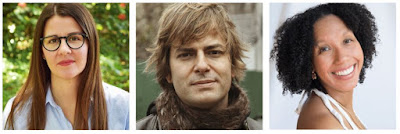
The Story Prize Judges: Kristen Arnett, Andy Hunter, and Tiphanie Yanique

Here come the judges: Arnett, Hunter, and Yanique

We're pleased to announce this year's judges for The Story Prize: author and librarian Kristen Arnett; writer, editor, and publisher Andy Hunter; and author Tiphanie Yanique.

Each year we enlist three independent members of the literary community to select the winner of The Story Prize from among the three finalists that Founder Julie Lindsey and Director Larry Dark choose from among the more than 100 short story collections submitted for the prize. We alternate years between having a librarian or a bookseller as a judge. At least one of the judges is an author and the other is most often a critic or editor.

The final deadline for 2019 entries is Nov. 15. We will announce the three finalists in early January 2020 and the winner at an event at The New School on Feb. 26, 2020.

(And don't forget that The Story Prize: 15 Years of Great Short Fiction, an anthology featuring stories from past Story Prize winners is available from Catapult books.)

About the judges:


Kristen Arnett is a research librarian, the New York Times bestselling author of the debut novel Mostly Dead Things, and a queer fiction and essay writer. She was awarded Ninth Letter's Literary Award in Fiction and is a columnist for Literary Hub. Her work has appeared at North American Review, TriQuarterly, Guernica, Buzzfeed, Electric Literature, McSweeney's, PBS Newshour, The Rumpus, and elsewhere. Her story collection, Felt in the Jaw, was published by Split Lip Press and was awarded the 2017 Coil Book Award. She is a Spring 2020 Shearing Fellow at Black Mountain Institute.

Andy Hunter is a writer, editor, and publisher interested in literary writing, the future of media, storytelling, and technology. His work is dedicated to preserving and promoting literary culture and the importance of books in the digital age. He co-founded Electric Literature in 2009, Catapult in 2014, and Literary Hub in 2015. He currently serves as publisher of Literary Hub, Catapult, Counterpoint, and Soft Skull Press.

Tiphanie Yanique is the author of the poetry collection, Wife, which won the Bocas Prize in Caribbean poetry and the Forward/Felix Dennis Prize for a First Collection. Her novel, Land of Love and Drowning, won the Center for Fiction’s First Novel Prize, the Phillis Wheatley Award for Pan-African Literature, and the American Academy of Arts and Letters Rosenthal Family Foundation Award. It was listed by NPR as one of the Best Book of 2014. She is also the author of a short story collection, How to Escape from a Leper Colony. Her writing has won a National Book Awards 5 Under 35 prize, the Bocas Award for Caribbean Fiction, the Boston Review Prize in Fiction, a Rona Jaffe Foundation Writers Award, a Pushcart Prize, a Fulbright Scholarship, and an Academy of American Poet’s Prize.

Saturday, October 5, 2019

Goodbye Guest Blog Posts, Hello Author Instagram Posts

After nine years of featuring guest posts from writers whose books have been submitted for The Story Prize (538 of them, to be exact), we've jumped to another social media platform: Instagram. So far this year, we've featured 23 guest posts. We ask every writer whose book we receive to share an image (or a few images) that inspired, informed, are essential to, or represent her or his book or a particular story in it, along with a brief explanation of the image or images. Contributors so far include Michael Carroll, Amy Hempel, Cary Holladay, Carrianne Leung, Mark Mayer, Josip Novakovich, Chris Power, and Aurelie Sheehan. To see these posts, follow @TheStoryPrize on Instagram.

Friday, March 8, 2019

Video of The Story Prize Event: Jamel Brinkley, Deborah Eisenberg, and Lauren Groff (the Winner)

What The Story Prize Judges Had to Say About Deborah Eisenberg's Your Duck Is My Duck

Photo © Beowulf Sheehan
When the three judges for The Story Prize make their choices, they provide citations for the books. This year's judges were writer Jo Ann Beard, Washington Post book critic Ron Charles, and bookseller Veronica Santiago Liu. We include the citations in congratulatory letters we present to each finalist, along with their checks ($20,000 to the winner, $5,000 to the other two finalists). To protect the confidentiality of the judges' votes and the integrity of the process, we don't attribute citations to any particular judge.

“I love Deborah Eisenberg and believe in her work and in her vision. The subject matter she chooses is fascinating, and worthwhile, and I approached each story with renewed interest and hope. She's smart and has lived, and understands the human psyche and the hopeful hopelessness with which we all (of a certain age) approach life.”

“The stories collected in Deborah Eisenberg’s Your Duck Is My Duck feel strange, and only when you begin to vibe with their rhythms do you realize that it is, in part, because she has somehow successfully embedded her characters into your head, so that you hear with their ears, shudder with their confusions, search for the answers they don’t have and aren’t likely to have by story’s end. While the characters’ voices ring in your ears, it is almost easy to forget that each story is framed around deep loss. These absences, coupled with the absurdities that unravel inside the minds of people, make for an unexpectedly humane whole in each unique story.”