Monday, December 3, 2012

Amy Willoughby-Burle's More Than Three-Ring Circus

In the 48th in a series of posts on 2012 short story collections entered for The Story Prize, Amy Willoughby-Burle, author of Out Across the Nowhere (Press 53), talks about juggling parenting, home schooling, and writing.


The lights go up in the Burle Big Top and it’s “Show time!”

“Get your peanuts. Get your popcorn.”

“Turn your attention, folks, to the center ring. What looks like any given household in America is actually the setting for an amazing chaos defying feat. Gaze upon this ordinary woman as she attempts to write a story while juggling the laundry, the dishes, and homeschooling her children. The phone rings, the dog gets loose, the baby eats a crayon. Will she be able to get the story finished? Just as she sits down one more time, the kids wants lunch, the baby starts to cry, and her best girlfriend calls to chat. It doesn’t look good for our writer, but don’t give up hope—she turns off the phone, sends the kids out to play and puts the baby down for a nap. She won’t get much time, but she’ll make the most of what she has. She throws vacuuming to the wind, the laundry will wait, and if dinner doesn’t get made—well, that’s what Pizza Hut is for. Watch her go, folks! Write, ordinary woman, write!”

Ok, so no one is selling peanuts and there’s not an MC to narrate, but it certainly does feel like I’m writing in the midst of a circus sometimes—that circus we all know as our life. I had a writing student ask me once how I find time to write. How do any of us? I thought about that question and usually when you ask a writer that, they seem to tell you what their routine is, but they don’t say how they “found” any time. It’s not hiding under the couch. Believe me, I looked. The time is right in front of you. It just might not be as luxurious an amount as you’d like. It  might not come with a peaceful office, a big desk, and beautiful view out the window. But it’s there.

Each morning, I wake before my children do, grind some coffee beans, brew my drink, open my laptop (which sits on the kitchen table) and pick up where I left off. I get a moment of that thing called silence. But just a moment. The baby wakes and I feed him breakfast and turn on Disney Junior. Yes, I let Mickey Mouse and his whole clubhouse babysit for just a while. Other writers may turn on their favorite musical muse, but not me. Instead: M-I-C-K-E-Y  M-O-U-S-E  It’s the Mickey Mouse, clubhouse, come inside, it’s fun inside.

Later, the girls stumble out of their room still clouded with slumber, looking for cereal, and hoping that this will be the morning that Mommy forgets about home schooling and writes all day long, leaving them to the freedom of parental abandon. The more they wake, the louder they get. The baby cries out for his bottle. The phone rings. The laundry buzzes. I don’t forget about school, and we pull out the books. There’s lunch to make and dishes to do. But then later the older kids go out to play and the baby takes a nap and even though the house is a wreck, there are still dishes in the sink, and I never did return that call, I open up the laptop again and pick up where I left off. Again. That’s the time I have and I’m happy for it.


The curtain closes for the night and the performers get a few hours of sleep before the crowds return for the next show. Tomorrow the sun will rise on the Burle Big Top, and it will be another chaos defying feat as that ordinary woman opens her laptop, spins a tower of plates, dodges a clown shot from a cannon, and finally finishes her story.

Saturday, December 1, 2012

Hampton Fancher and "The Plaza of Death"

In the 47th in a series of posts on 2012 short story collections entered for The Story Prize, Hampton Fancher, author of The Shape of the Final Dog (Blue Rider Press), reveals how snatching a copy of Death in the Afternoon from a library launched his writing career.


Terms like “dyslexia,” “learning disability,” and “attention deficit disorder” were not in use when I was an adolescent; what I heard was lazy, uncooperative, and incorrigible. I’d flunked the 3rd grade twice, had gone to six different schools, and was in the 7th grade for the second time when the older sister of a friend of mine told me I was an asshole but said it might help if I read a book.

She gave me a novel called The Conscientious Objector. I had no idea what “conscientious” meant and couldn’t pronounce it. It was about a young American soldier over in Korea who didn’t want to fight. At one point he got a pass to go to into town and somebody told him to make sure “to get laid.” He got laid. I’d never heard “laid” used in that way and it moved me. Until then I had no idea books could be sexy.

I wanted to read another one, with more sex maybe, but it took a while and it happened by chance, walking by a library. I’d had no experience with a library, wasn’t sure how it worked, the checking out of a book, so I stole one, shoved it through the bars of the men’s room window.

It was called Death in the Afternoon by Ernest Hemingway and it changed my life. Two years later, in 1954, I ran away, caught a Greyhound from L.A. to Phoenix then hitch-hiked to New Orleans and a month later to Galveston where I caught a freighter to Barcelona and wound up in Madrid.

Bull fodder
I tried to write a story about three bullfighters who die the same day of three different kinds of death. The best thing about it was the title. I worked on this story on and off until I was eighteen. I also illustrated it. Sent it to Hugh Hefner and got a rejection slip, but with a handwritten note. It said they had recently published a bullfight story and they had no interest in “The Plaza of Death,” but that they liked the illustrations and encouraged me to continue drawing.

Writing started with reading. The joy of my solitude was to read and in the romance of that, try and write what I read. I became a poor, but earnest student of William Burroughs and Joseph Conrad, Dostoyevsky, Walker Percy, Nathanael West. I’m still doing it. It’s never stopped.

Thursday, November 29, 2012

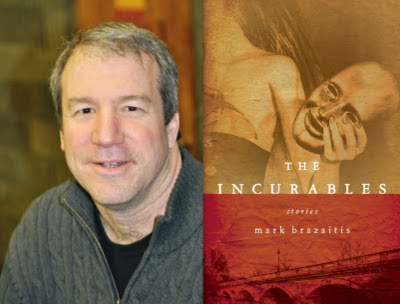
Mark Brazaitis on Influences, Conscious and Not

In the 46th in a series of posts on 2012 short story collections entered for The Story Prize, Mark Brazaitis, author of The Incurables (University of Notre Dame Press), discusses the influences he—and others—have seen in his work.


I have never been good at detecting the influences on my writing. It’s not that I don’t accept that I have been influenced by other writers; it’s that I can’t recognize where and how I’ve been influenced.

Sometimes I feel like my older daughter did when she was three years old and went Trick-or-Treating as an apple. Upon opening their doors, people cooed, “What a cute tomato!”

“I am not a tomato!” she insisted.

I would like to think my writing is always dressed up to look like Mark Brazaitis (earthy if elegant, accessible if subtle). But sometimes I notice when I’ve put on another author’s gloves or scarf or basketball shoes. Or I think I do.

After reading my short story “Gemelas,” about Guatemalan twin girls and the parallel lives they live even after one of them dies, the poet Gillian Conoley said to me, “I detect a Kafka influence.” This stunned me. (I am not a tomato!) If anything, I was sure that in “Gemelas” I was guilty of swiping Gabriel García Márquez’s guayabera and Panama hat.

But without knowing my reading history, Gillian had discerned one of my favorite writers, someone I read obsessively when I was younger and still read (and teach) today. If I had been asked to list the authors who influenced “Gemelas,” however, Franz Kafka wouldn’t have appeared in my top 100. In retrospect, however, he should have been in my top five. (The story is dark, labyrinthine, fatalistic—Pandora would have nailed the influence instantly.) As for García Márquez, as much as I love him, the most “Gemelas” has in common with his great work is a Latin American setting.

A decade ago at the West Virginia Writers’ Workshop, I read the opening of my novella “Bathwater.” A member of the audience approached me afterwards to say, “I heard an Edgar Allan Poe riff, a ‘Tell-Tale Heart’ vibe, in your story.” Like Poe’s narrator, I thought, you’re out of your mind. But when I reread “The Tell-Tale Heart” the next day, I nodded at its rhythmic similarities to passages in my novella. Prior to this, it had been years since I’d read Poe’s story, but his mad narrator evidently had been camping in my brain, waiting his chance to whisper into my words.

Reviewers of my books have been remarkably accurate in pinpointing my literary lineage. I was sure one reviewer missed the mark, however, when he detected a Raymond Chandler sway over my prose. Then I remembered the hard-boiled summer between my junior and senior years in college when I said hello to Farewell, My Lovely and every other Chandler novel I could find.

I could guess the literary influences behind the ten stories in The Incurables. Kafka might be on the scene of “The Bridge,” observing its mysterious, unnerving suicide epidemic. Jane Austen might have touched “This Man, This Woman, This Child, This Town” with her sense of courtship’s comic awkwardness, although by its end, she surely has given way to Richard Wright or Toni Morrison or William Faulkner. There’s a little of John Updike’s frankness about sex in the title story, but its ending jumps off the page and onto the screen. It’s Vertigo’s finale rewritten! Maybe!

I can state this with certainty: The biggest influence on my fiction is my life. In the case of The Incurables, I wish it were otherwise. The protagonists in my collection contend with mental illness—its humiliations, its paralyzing power, its rare moments of levity—as I have. In this, I—we—are not alone. In any given year, 14.8 million adults, or 6.7 percent of the U.S. population 18 and over, suffer from major depressive disorder. Other millions endure a range of mental illnesses, from bipolar disorder to schizophrenia. Ninety percent of people who commit suicide suffer from a mental illness.

If I didn’t know mental illness up close and personal, I never would have written The Incurables; I certainly wouldn’t have felt free to write the stories the way I did, in equal portions of black humor and sympathy. If William Styron and Kay Redfield Jamison, the authors of extraordinary memoirs about their experiences with, respectively, clinical depression and bipolar disorder, provided me in their work the courage to write honestly and unsentimentally about mental illness, Nikolai Gogol and Samuel Beckett and Lorrie Moore gave me permission to use comedy to explore dark subjects.

Did the above authors actually influence the stories in The Incurables?

Your guess is as good as—no, it’s better than—mine.

Monday, November 26, 2012

Junot Díaz on the Importance of Silence in Fiction

In the 45th in a series of posts on 2012 short story collections entered for The Story Prize, Junot Diaz, author of This Is How You Lose Her (Riverhead Books), speaks about what isn't there.

© Nina Subin  
I've always been interested in how you write silences. How do you include or mark in a piece of fiction what isn’t said between the characters, the narrative that is missing even from the characters’ perceptions of the world. How do you as a storyteller account for traces of the erased, the denied or that flat out vanished? These are concerns that sit with me always when I write stories. I often begin my stories by first sketching their primal silence and then elaborating the story around that silence. Sometimes what's missing is pretty obvious to the reader: a character or a place that’s disappeared and that the characters do not wish to confront. But other times it’s far more cryptic, a silence that I keep to myself but whose resonances power the prose, work like a dark energy on the matter of the prose.

Haruki Murakami’s novels are rich with silences. So are the early Morrison books. And of course Cormac McCarthy leaves out a whole lot more than he puts in. (See Blood Meridian for a masterwork in lacuna studies.) If you haven’t read Terrence Holt’s In the Valley of the Kings please rush to do so. Another great master of elision; the collection's title story is a seminar on narrative gaps. Rushdie on the other hand is one of my favorite writers in the world, but he’s not all that awesome at silences. Or if he is I haven’t noticed; my failure. 

In my novel Oscar Wao the silences are many and intentionally so. The book is organized around various unrecoverable absences. One of the most obvious is of course Oscar de León himself. Some readers might not notice that for all of Oscar’s “presence” in the book he is never actually present. We always receive him through the mediation of the narrator, Yunior. We never hear directly from him, which is odd, no, consdering that he is a writer after all. All of Yunior’s narrative muscles hide the fact that Oscar is not there at all. And when one discovers that one should always ask: why? 

Then there’s the silence at the heart of Yunior’s character—he is the protagonist of sorts of all three of my books—a silence which defines so much of what he is and what he bears witness to and why he connects with the women and people that he connects with. A silence he has yet to confront. 

We live in a culture whose expression baseline is the over-confessional mode. The compulsive over-confessional mode. We’ve all gotten so damn loud and you don’t need David Foster Wallace to tell you that. At times it feels like too much information is no longer an exception but the order of the day. One of my favorite stories in the world is an Octavia Butler tale where the narrator suffers from a malady that in its final stages compels its victims to tear themselves apart; when the disease takes over they start digging into their flesh with their own fingers, tearing themselves open as if to get at something. When I think of how compulsive many people in our culture are with their over-sharing, that story is never far. At a cultural level we’re that story’s children, suffer the same malady, tearing ourselves open for others' delectation or just because we’ve been told that’s the best way to get attention. I’m sure there are plenty of other reasons, but in such a climate silence for many people is not even a possible strategy; for me it is the substance out of which I carve my narratives. I often fragment my books because in the game of articulating the narrative pieces a reader can begin to suss out through that deliberative process what is missing; they begin to slowly form a picture of the book’s absences. This for me is one of my secret joys: I read for the silences. Or to put it more ridiculously: I may come for the story but I stay for the silences. 

Friday, November 23, 2012

Kurt Rheinheimer's Side of the Mountain

In the 44th in a series of posts on 2012 short story collections entered for The Story Prize, Kurt Rheinheimer, author of Finding Grace (Press 53), tells how a sense of place has always been essential to his work.


The thing that made me become a writer has remained the primary source of inspiration for stories ever since.

This was tenth grade, and the assignment when we returned to school was the classic “what I did on my summer vacation.”

I liked the teacher, but I didn't really have much to tell about my summer vacation. Except this one thing, from when my friend Dave got to go with us on a camping trip. The camping trip itself—with my mother and brothers and sister along—wasn't all that much to write about, I didn't think, but I kept thinking about this one place Dave and I went one evening after supper: up the side of the mountain a ways, where there didn't seem to be a real trail and while the sun was going down pretty fast, on the other side of the mountain. It got a little spooky after a time, and after a little more time, as darkness gathered, it got scary enough that Dave and I decided we were lost. This even though we knew that once we walked back downhill on the mountainside, things would become clear again and we would find the big, lighted campground. 

But for a little while, as we shared the candy Dave had brought along, we pretended the place had swallowed us up and we were lost. 

A real Life Saver™
The paper I turned in after that summer was called “The Day My Life Was Actually Saved by a Life Saver.” It was kind of a wiseguy piece, as I remember. And I remember being very pleased as I wrote it—feeling real excitement over what I was pretty much making up. 

When I got the paper back, I felt even better. Mrs. Davies gave me an F. I was an honor-roll, mostly-A’s, dorky of guy, but also had the wiseguy aspect going, and so I was pleased as I could be with the totally flunking grade. I took it home and bragged about it. Well, I was also pleased with what she had written below the F. Something to the effect that this is very good, Kurt, and it made me laugh, but you did not follow the assignment, and so you get the F. 

It was that excitement—getting a strongly positive reaction and also an F for something I had written—that made me think I could be a writer. Not that I knew then that I wanted to. But that maybe I could. And get that sort of jittery feeling again while I was writing something down. And then maybe have somebody read it and say stuff to me about it the way Mrs. Davies had about the Life Saver piece. 

And so it has gone for more decades than I care to talk about: Find a place, Kurt, that gives you some kind of emotional reaction, and you have a chance—not a sure thing by any means, but a chance—to write something other people will read and react to. 

Of course it took at least one of those decades to realize that most of the stories that worked for me—that got completed, got submitted, got accepted and published—nearly always began with the description of a place. And that the most pleasing of those—those that maybe won a prize or got republished in an anthology or collection—then had a character walk into that place and somehow, through the unfolding of the story, came to somehow embody that place. 

I think the oh-so-threatened boys on the mountainside were the first ones. 

Over the years, the two strongest veins for such place/character lucky days have been the place where I grew up and other places out on the land that I knew as a young person and saw again later in drastically altered states. 

The little peninsula where I grew up presents image after image of things like the cove, the ballfield, the Seamaster aircraft, the woods; and with so many of those images, there is an emotion that comes from within the twelve-year-old boy who loved them, an emotion that can lead to a story. Sometimes he walks into the scene, sometimes one of his parents or siblings. 

The places that have changed elsewhere—places where an interstate now rides high above formerly rural land, or where a tall bridge crosses a small, black-flow river far below, say—seem to invite more dangerous and unknown characters, as if the setting is commensurate with the person who enters it. 

Many decades after she was my teacher, Mrs. Davies wrote me a note about a story that appeared in a literary journal. She remembered the boy she’d given the F. But not nearly as poignantly and significantly, I suspect, as the boy remembered her. 

Wednesday, November 21, 2012

Karen Brown on the Spaces Stories Inhabit


In the 43rd in a series of posts on 2012 short story collections entered for The Story Prize, Karen Brown, author of Little Sinners (University of Nebraska Press), traces the sources of some of her ideas.


How often does an idea for a story occur to you, and what triggers those ideas? 
My much-perused copy of Gaston Bachelard’s The Poetics of Space, its pages stained from spilled wine, its pencil underlines, reinforces my belief that stories are built around place. “A house that has been experienced is not an inert box,” Bachelard claims. Rooms, attics, cubbyholes, and closets—the places that we inhabit and dream—are for me, intimate spaces that stories inhabit. I simply have to find my way in.

Sometimes, this path is cleared in my sleep, and ideas for stories occur as dreams, but not dreams. In them I visit my first boyfriend, long dead, and we meet outside his house where his wife and children still live. We stand in the shadows of a wooded backyard and watch a party light up the house’s windows. Family dogs come out to prowl around a swing set. I am filled with guilt for being there with someone who does not belong to me. I am afraid of being seen. But the dogs are gentle, and trot up to settle at my feet. The wife stands framed in the doorway and nods her dark head at me, and the old boyfriend takes me in his arms, into the folds of a leather jacket. In the morning, he climbs onto a motorcycle in a driveway filled with pale sun, and I warn him of the danger, how he might be hurt, and he shakes his head at me, bemused. It is cancer that kills him, of course.

I will spend all day wondering how I will use this. The images are too real to pass up. I can smell the leather of the jacket, the boy’s cologne. I have searched for his obituary online. I have found the town where his wife and children live. Somewhere in this mixture of dream and memory is their real story, and in the shuffling of all of these things will emerge the one I will make up. Can the dead lead us to our stories in dreams? Maybe my story will answer this question, or any other number of questions I have upon awakening.

A golden rain tree
Ideas for stories flit around me at all times of the day and night. They blow past, or flare up—the golden rain tree in my neighbor’s yard, its bright blooms giving way to seed pods like little orange lanterns. They are the power lines strung between houses, trembling and humming in early morning mist. Sometimes, ideas come over water—two Mute swans on Long Island Sound, rounding the point by the old cottage I see through binoculars. Its upper casement windows are open, and I imagine that inside a story of the inhabitants must be unfolding—from coffee to an argument to a sick child to a lost parent. The sun moves up the beach erasing the cold morning shadows. Later my run will lead me through a myriad of small paved roads to the one that leads past this cottage’s front door. I will stop and gaze through the shrubbery, looking for life—a tired runner pausing to catch her breath. The wild roses bloom along a nearby fence. The sea crashes on a rocky bulkhead below. If I stand long enough I will smell the way the sea mist has entered the open window and wet the cottage’s floorboards, and the way the sun has dried them, and I will imagine then the top of the bureau scattered with jingles and periwinkles and sea glass. Much later, if I am lucky—it can be days, or months, or years—someone’s footsteps will sound on the narrow stairs. A voice will call out. Someone will smooth a white table cloth.

Monday, November 19, 2012

Eugene Cross Finds His Purpose

In the 42nd in a series of posts on 2012 short story collections entered for The Story Prize, Eugene Cross, author of Fires of Our Choosing (Dzanc Books), tells how he got hooked on writing.


What I wanted to be, for a while anyway, was a pediatrician. I settled on this career the way you might pick out an entrée at a fancy restaurant where the entire menu was printed in a foreign language. It just sounded good. Never mind that most science remains far beyond my levels of comprehension or that it bores me to tears. I would administer flu vaccines, damnit. I would mend broken bones, and wear a white lab coat. I would grow old and wonderfully eccentric, disappearing to the Keys for months at a time.

All that was before Bio I. And Chem I. Both of which plucked me from the pathway to a medical career like the weed I was. Then I drifted for a bit, and that was alright too. Until it wasn’t. I wanted a purpose, a passion. I just hadn’t found one yet.

I was in school in Pittsburgh, fulfilling as many Gen Eds as the University would allow. I was preparing myself for any course of study, waiting to be bitten. I wanted to call home in a flurry of excitement and say “Mom! Dad! Guess what? I want to be a _____!!!”

Somewhere along the way I took a creative writing course. My instructor, a young grad student named Bill Kirchner, would surely shudder at the clichéd sentence that precedes this one. But that’s really what happened. (He’d shudder at that response as well.) He strode into the cramped classroom in the towering stone Cathedral of Learning and gave us our reading list: Lewis “Buddy” Nordan, Ray Carver, Yusef Komunyakaa, Etheridge Knight. This list might embody his aesthetic, or it might not. Either way I was hooked. We were an hour north of Morgantown, West Virginia, and somehow the literature of that place seeped into our studies as well. Someone handed me a copy of Breece D’J Pancake’s story “Trilobites,” and that was really it. I reread it over and over, and have done so periodically ever since. It seemed to be about everything: fathers and sons, war, love, violence, sex, mothers and sons, limitations, the earth the sky. Everything. 

The narrator, a young man named Colly, has been left in charge of the family farm in West Virginia after his father’s death, and he’s no farmer. The whole crop has gone to blight. His mother wants to sell and move near family in Ohio, but Colly can’t come to terms with it. His high school girlfriend, Ginny, has returned for a visit from Florida, and she’s changed. Everything has changed. Everything but Colly. The story felt so familiar.

I took every writing and literature class I could fit into my schedule. I read Munro, and O’Connor, and Ford, and Erdrich, and Wolff. I wrote really bad stories. Lots of them. I kept working at it. I’m still working at it. My parents finally got that call, only this time, the blank was filled in. “Writer,” I said. “I want to try to be a writer.” That was a long time ago. I’m still trying.