Thursday, July 3, 2014

Kelly Cherry Makes a List

In the eighth in a series of posts on 2014 books entered for The Story Prize, Kelly Cherry, author of A Kind of Dream (Terrace Books), discusses her interest in linked stories.


My first husband borrowed something I'd written and showed it to his friend. "Is she," he asked the friend, "talented enough for me to marry her?" As you might guess, the marriage didn't last, and when it ended, I felt I had lost five years of writing time (the marriage plus recovering from the divorce). I published a first book of poems with a small press and a first novel with Viking. Then I found myself thinking about what else I wanted to write.

I made a list. I thought of it as my bookshelf.

Not every book title I had on that list came to fruition, and editors changed a few of my titles despite my protests. But in between writing books on the list, other titles revealed themselves, as if they'd been lying behind some other book on the shelf.

This was not compulsive. I never felt I couldn't make room for another book, and at least twice I had to acknowledge that a book had failed, or, rather, I had failed the book, and I dumped it. But I had a lot of ideas. They are all around us, you know. All you have to do is reach up for one and it drops into your hand.

Publishers are not so plentiful and after a while, I no longer had an agent, so I couldn't submit to the big houses. My work was better, but I was older, which meant, to publishers, not new. Instead of novels, I took to writing linked stories, or novels-in-stories, a form I love. I've written a trilogy of linked stories. I call it "A Divine Comedy," which is what the ex-wife of a main character says when she describes the off-Broadway play she has written about him. "It's such a divine comedy!" she chirps.

To some degree, writing linked stories is like making a collage. Pieces need to be usefully shaped and carefully placed. It is also, and more, like orchestrating a symphony, as is a novel: Characters and events need to enter and leave quite like various instruments or instrumental sections.

I was born into a family of musicians. My late younger sister used to tell me that my poetry is my music, and I admit I liked to hear her say that. But I think that different genres require different musics because their fundamental elements differ: the sentence for the story, the scene for the novel, the paragraph for the essay, and the line for poetry. (I recognize that other people have other views, so I won't try to push mine here.)
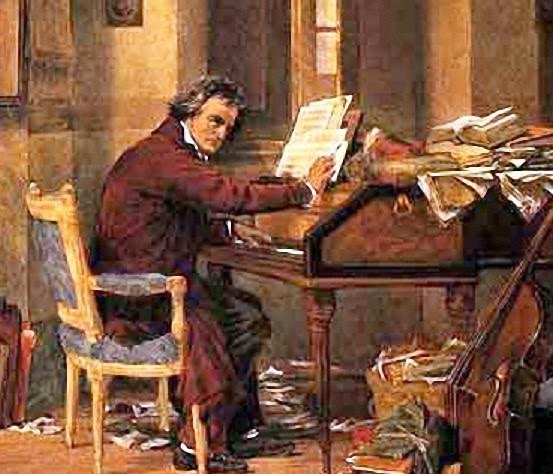
Ludwig van Beethoven
The biggest influence on my work is not a literary figure, although there are a number of literary figures, past and present, who have influenced me or sent me in this direction or that; it is Beethoven, especially in his late string quartets and piano sonatas. I feel I've learned a great deal from him, and if I'm not Beethoven, it's not Beethoven's fault.

My second husband (much nicer than the first!) and I recently discussed what books might have been within our compass to write if only we'd thought of them before their authors did, if only we were capable of writing them: what books we'd read that we felt closest to and, maybe, almost able to write. I chose The Magic Mountain and Grace Paley's stories. Where stories are concerned, on another day I might have picked "A Still Moment" by Eudora Welty or Chekhov's "The Kiss." I suggested Heart of Darkness for him, and he smiled.

About stories I want to say this: The wonderful fictionist Fred Busch may have been correct when he said that short stories are about death; that is, about their endings. Lorrie Moore may be right when she says the ending of a story should subvert what came before. Russian absurdists may have been right when they dreamed up preposterous, and often hilarious, plots. But I think Fred Busch wrote the endings that came to him. I think Moore has looked at her work and noticed that she tends to subvert the beginnings of them. And I think Russian absurdists knew very well what it was like to live under an absurd regime. The doing comes first, theory after. Never trust a theory too far. What counts is the doing.

As for what I hope to do? I hope to complete my bookshelf. There are at least two more books of short stories on it.

Tuesday, July 1, 2014

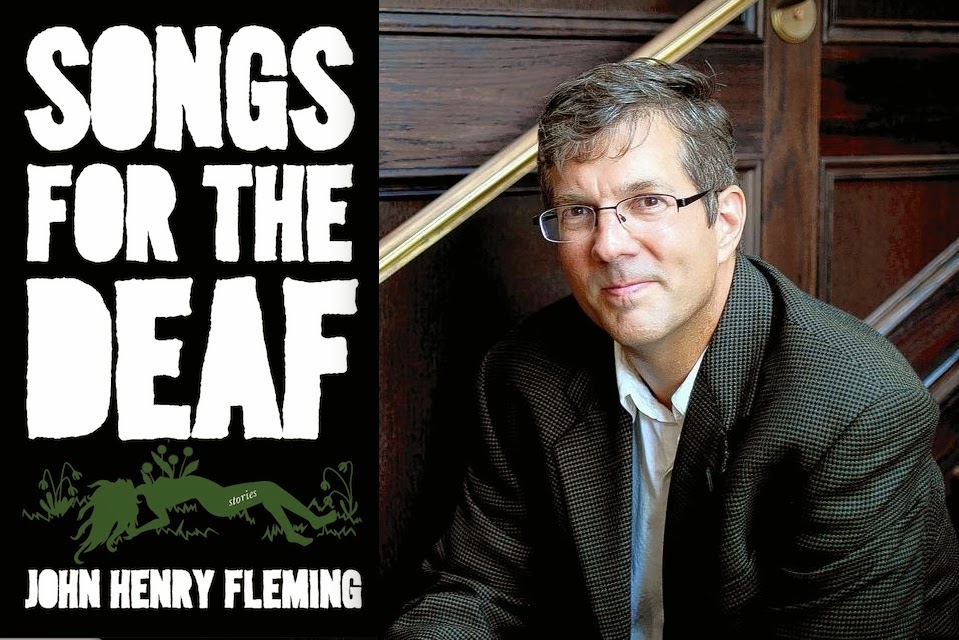
John Henry Fleming's Writing Tips for the Tip Averse Writer

In the seventh in a series of posts on 2014 books entered for The Story Prize, John Henry Fleming, author of Songs for the Deaf (Burrow Press), suggests writing both for a potential audience of aliens and for oneself.


Writing tips are like fresh raspberries—so beautiful and enticing on the grocery store shelf, so moldy the next day. That’s my experience anyway. Still, they can give you a way of thinking about your work, a charge that gets you from one synapse to the next and keeps the words flowing. I offer advice in that spirit, hoping you’ll refute every statement with your own stories.

  1. Write like it’s true. Even when you’re faking it and have no idea what you’re talking about, pick out the one or two things that are true and make the story about those things.  
  2. If you’re playing around, write like playing around is important to you. If you pull it off, playing around will be important to the reader, too.
  3. Write jagged. If things are interesting enough, the reader will make connections and supply meanings for you. If things aren’t interesting enough, no amount of explaining will fix that.
  4. Still, it’s best to keep the story under the frustration curve, best pictured as the arc of a book as it flies across the room toward the garbage can.
  5. Write like your story will be the only one to survive the apocalypse. Your small post-apocalyptic audience will want to know what things were like. And don’t assume they aren’t aliens.
  6. Write like no one cares what you write. Be honest, it’s not such a stretch. The truth is, most people don’t care what you write, probably even most of the people you know. That fact is depressing only if you’re writing for the wrong reasons. If you’re writing for the right reasons, it’s liberating.
  7. Just write. Forget everything else. The antidote to not writing is to write. The antidote to not feeling inspired is not expecting to.
  8. Stop repeating yourself. Try new things—new forms, new character types, new styles and tones. You’re never going to do that one thing perfectly, so stop trying and move on.
  9. Don’t be afraid to smash up your story and assemble something new from the pieces.
  10. Don’t ever forget that you’re writing for an audience, but think of yourself the first member of that audience; write things you want to read.
  11. Write each work like it’s your last. It could be; you never know.  
  12. Above all, be interesting. Henry James said so, and he was right.

Monday, June 23, 2014

Don't Call It a Comeback

Over at The Quivering Pen blog, David Abrams has published his extensive and knowledgeable Great Big Roundup of 2014 Short Story Collections, as well as an addendum to that list, which together cite more than sixty short story collections. And Abrams has something interesting to say about each one of them. Even more short story collections have been or will be published in 2014—probably well over a hundred altogether. And you'll see posts on this blog from authors whose books we will be considering for The Story Prize throughout the year.

Please, please, please don't say that the short story is enjoying a renaissance or anything along those lines. It isn't. This is consistent with the output I've seen over ten years of reading story collections for The Story Prize. Just because someone is only noticing it now doesn't mean it's only happening now. The short story comeback piece is one of two no one should ever write again, in my opinion. Nor should it be the preamble to a review by a reviewer who clearly hasn't been keeping up.

The other piece that I hope to never see again is the one on the death of the short story. It hasn't happened, and isn't going to happen, because writers will always be interested in exploring the many artistic and storytelling possibilities inherent in the form. Period. Established writers will continue to write stories or return to them. And emerging writers will start out writing them—and in many cases will continue to do so throughout their careers.

Two other angles that are equally dubious are taking potshots at MFA programs and bemoaning what someone might perceive to be a dominant style (past or present). Writing students aren't tabla rosas subject to the imposition of a particular style or approach. Most have already established their own approaches and are in a studio program to gain time to write and to hone their skills. And no one style has predominated in the past hundred years or more, despite perception. Examples to the contrary abound.

The big publishers have done a very good job of supporting short fiction. I speak to agents and editors who truly have a passion for short fiction. But the support commercial publishers can offer to short story collections does have practical limits. While some story collections have made the best-seller lists (Junot Diaz, George Saunders, and Lorrie Moore, to name a few), most won't break into the black. Commercial publishers are supporting the form because they are supporting authors they are committed to and because they know it's smart to get in on the ground floor of potentially great writing careers. What has been a particular boon to the form has been the support of both established independent publishers and small presses, old and new, which together help publish and promote a great many other deserving books each year.

Whether you like short fiction or not (another tired reviewing approach is the "I generally don't like short story collections but I like this book" approach), it's not going anywhere. Anyone who follows the form knows this, and anyone who doesn't should inform him or herself before resorting to sweeping generalizations and tired observations about the so-called state of short fiction. The story is bigger than any of us.

Thursday, June 5, 2014

Molly Antopol Embraces Solitude

In the sixth in a series of posts on 2014 books entered for The Story Prize, Molly Antopol, author of The UnAmericans (W.W. Norton) discusses her writing habits and how her family history has inspired her.


Where do you do most of your work?
I write on days I don’t teach, and always at home—because I love having my dog at my feet while I work, and she’s not allowed in coffee shops or libraries. I get my best work done in the mornings, before the day fills up with obligations, and I don’t have any particular rituals aside from coffee—no magic pen or lucky hat or anything like that. The only rule is to turn off the phone and block the Internet—I have a terrible addiction to the Internet, and I’ll go off to research one tiny detail and three hours later come up for air having read ten articles about something totally unrelated to my book, like the history of pasta. So I keep the Internet turned off and, as I write, I make a list of all the things I need to look up when I’m finished working. It becomes a kind of treat to go through the list when I’m done. Then I go on a run. I find that when I make myself focus on one specific problem I’m struggling with in my story when I’m running, I’m able to untangle things much more easily. Though I probably look insane, jogging through the streets, talking to myself.

What advice do you have for aspiring writers?
I’m not sure I’m at a place yet in my writing career to offer up advice, but I do often tell my students that once writing became central to my life, it was really important to embrace the solitude that came along with it. Even when things are incredibly hard, I find comfort sitting alone in a room, trying to shape a narrative that makes sense of—and sometimes even controls—the most painful parts of life.

What else (beyond books and writing) informs or inspires your work?
My family. My relatives are among the best storytellers I know, and as a kid, I always knew that when it was my turn to talk at the dinner table, I’d better have something interesting to say. I grew up hearing my family’s stories, many of them about their involvement in the communist party. I heard so many tales of tapped lines and dinnertime visits from the FBI, and many of the stories in my collection grew out of my desire to understand what it might have been like for my mother and her siblings to have grown up under such intense surveillance, knowing that their most intimate moments were being recorded and catalogued.

My story collection took me ten years to write, and during the first year, two things happened that helped shape the book. The first had to do with Antopol, the Belarusian village my relatives came from, which was virtually destroyed during World War II. My family could find humor in even the darkest parts of their history, but Antopol was a topic no one went near. I was living in Israel then and wound up at a party in Haifa, where I met a woman from Antopol who remembered my family. It was incredible, sitting in the kitchen and hearing stories about relatives I’d known so little about that they’d always seemed almost mythical to me. At the end of the night, the woman told me about an oral history book of the village, an enormous tome written in Yiddish, Hebrew, and English. It was right when I finished reading it that I began working on my collection.

The second thing that happened that year was that my family gained access to my grandfather’s FBI files. I didn’t know him well—sadly, he died when I was a kid. The reports followed him across the years and across the country, starting in the 1930s, when he first joined the Party in New York and began organizing at a cardboard box factory. In the files, I was able to see exactly what the FBI was looking for, but nothing else. They showed nothing of what being watched does to a person psychologically and emotionally. They showed nothing of the devastating impacts that one person’s efforts to improve the world can have on the people closest to them. And they showed nothing of the pain that led my grandfather to leave the Party, and how heartbreaking it was for him to learn of Khrushchev’s revelations about Stalin—for him to realize that the movement he’d dedicated his life to was so flawed and corrupt. Since the files left all this out, I found myself addressing these questions in my stories instead.

Tuesday, June 3, 2014

Vanessa Blakeslee Hits a Nerve

In the fifth in a series of posts on 2014 books entered for The Story Prize, Vanessa Blakeslee, author of Train Shots (Burrow Press) cops to basing her characters on people she has met.


I am guilty of writing about real people fairly often in my fiction. Is that bad? The stories in Train Shots, my debut collection, are largely drawn from the co-workers, relatives, and lovers of my twenties. Thankfully, the drafting process and the demands of creating drama do wonders, because even if you’re hell-bent on rendering an exact sketch of someone you’ll likely be forced to stray somehow. Often I find myself blending characters from a certain “cast”—say, the Tex-Mex restaurant in “Clock In” (a setting which reappears in the title story). Mostly this is for sheer economy or a certain artistic effect, character traits that I want heightened or diminished, rather than a moral sense of not exposing people that I know, or once knew.

Should this bother me, and why doesn’t it? Is my not being perturbed a sign that I’ve done my job fictionalizing these portraits? Or a sign of the dark and sinister—writer-as-sociopath?

One thing’s for sure: I don’t like limiting the world from which I draw upon. I see my vocation as a calling to experience, observe, and render the people and the culture of my time. This doesn’t mean friends and neighbors are sacrificial lambs to the cause. But it does mean that art can’t help but draw upon life, is bound to, in fact, and that means those you interact with stand a good chance of infiltrating your imagination and working their way into your fiction.

And while writing isn’t straight-up therapy, I do think when we write about what matters, when we’re really hitting that nerve of what bothers us or even a trauma we’re grappling to reconcile with or understand, we’re drawing upon the emotional territory of our lives. Sometimes that territory emerges as more veiled and fantastical—my story, “Ask Jesus,” falls into that vein. The events center around a couple’s disintegrating relationship and the husband’s obsession with a vinyl-Magic 8 Jesus doll, all of which are made up with the exception of the doll. Contrast that with “Princess of Pop,” a day-in-the-life of a fictionalized Britney Spears, which veers more into the territory of stealing from real life. Celebrities are public figures; you have free rein to write about them. But again, the events and particulars of this story are made up—the Froot Loops and hair dye, the Janis Joplin motif. These imagined details are what anchor the story as fiction.


Other times the nerve we tap into is much more close-to-home. My story “Don’t Forget the Beignets” is one of the most unapologetically autobiographical “fictions” I’ve ever written and dared publish. In my twenties, I was dating an older man who got arrested by the FBI on a trip to New Orleans; unbeknownst to me, he was involved in a white collar stock scheme. I hadn’t been there for his arrest but easily could have, through another course of events. Not too long after, I wrote about it—imagined myself into the story as Merly, imagined what I might have done suddenly alone in New Orleans and in shock, grappling with to what extent our life together had been a lie. For dramatic weight I made “Alan,” the character based on my ex, the ringleader instead of the fall guy, which also let me explore what his boss’s wife must have gone through, to some extent. I added a fictionalized cousin as an outside voice on the circumstances. But much of the story remains true—the bail and terms of release, that his arrest happened in New Orleans and the scam occurred when we were living as expats in Costa Rica. I simply had to write my truth, safely behind the third-person mask of a fictional female protagonist.

Publishing the story, I had to do, too. Heartfelt fiction requires an almost dogged honesty; shining a light on the humanity of the situation struck me as essential. What surprised me most in closely rendering such poignant, tense events was the humor that bubbled up—a reminder, perhaps, that even the gravest mistakes and failures of judgment are hardly unforgiveable. Foolishness, when reflected upon, is often just that: funny.

Has anyone ever confronted me about this, been angry or pleased? My ex, after reading the copy of Train Shots I’d sent to him at the federal prison where he’s serving out his sentence, was as excited as other friends and family members about the book. He crops up throughout the collection in different incarnations. He sounded proud and grateful to have played such a role, inadvertently, in the inception of my zany fictions; his copy has been passed around the cell block, the stories read by fellow inmates. And perhaps any contempt he might have for my artistic liberties has paled in significance to what really matters. For his recurrent cancer is back. He may not live to see the other side of prison. Sometimes I’m asked, how can I bring myself to still talk to this man, why bother sending him a copy in prison? Only through reliving the emotional minefield of our lives, sometimes, can we find our way to compassion and forgiveness. Had I not done that for myself, those stories would not exist in his hands nor anyone else’s. What do we write for but to bring about those quietly shattering epiphanies and small delights—for ourselves, for loved ones, for strangers in a cell block?

Saturday, May 31, 2014

One Story's Storied Literary Debutante Party

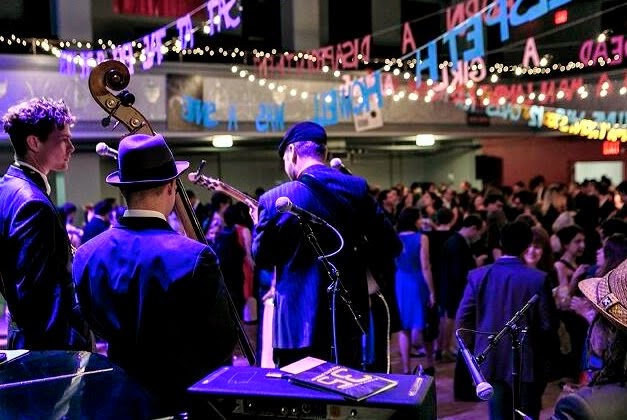
The Blue Vipers performing at the One Story Literary Debutante Ball
By Nick Fuller Googins
Brooklyn, NY, May 22, 2014

Hannah Tinti, co-founder and editor-in-chief of literary magazine One Story, is also a best-selling author and a teacher at Columbia’s MFA program. She’s a literary personality who wears many hats, and on the night of May 22, at funky Brooklyn performance space Roulette, her hat was of the miniature Edwardian ringmaster variety, bedazzled with black sequins and festooned with glittery silver butterflies. Her Converse All-Stars matched the butterflies, flashing smartly as she crossed the stage, stepped up to the microphone, and, politely, asked everyone to please shut up. Time for the debutante ball to begin.

But let me back up for a moment: One Story’s annual Literary Debutante Ball is a celebration of One Story authors who have published their debut books in the past year. The process of announcing these authors (seven of them this year, including Ben Stroud, whose collection, Byzantium, earned him the 2013 Story Prize Spotlight Award), their metamorphosis from mere mortals into literary debutantes, in no way resembles a traditional literary reading. It’s much, much more fun. As soon as I checked in, I was invited to grab a “Let the World Spin,” the evening’s custom, Colum-McCann-inspired cocktail (more on the man later).

This is how a proper Literary Debutante Ball warms up: Live band on stage. Tables of appetizers. Two open bars. A bartender dancing to swells of music. Garden lights strung overhead, along with strands of cut-out letters spelling the first line of each debutante’s recently published book. Clusters of elegantly dressed writers, editors, and lovers of literature. Burlesque-costumed women weaving through the crowd hawking framed commas, semicolons, and exclamation marks at $10 a pop.

It was quite a lot to take in.

I ate some appetizers, stood in line at one of the bars, walked the floor looking for debutantes, trying to match faces to what I remembered from author photos. I moved over to the other bar and struck up a conversation with a young guy who turned out to be a former student of Tinti’s at Columbia. (“Still writing?” I asked him. “Of course, you have to,” he said, as though it were an absurd question.) I was curious why people had come to the debutante ball, in what capacity. I asked another woman. We were standing side by side, admiring the wall of advice—framed, hand-written bits of writing-based knowledge and guidance from established writers and debutantes alike, available for purchase as part of a silent auction. The woman told me she was an agent. I asked if she represented any of the debutantes. She said she did not. Anyone, then, whom I may have heard of? "Jonathan Franzen?" she said. "Oh, sure," I said, "I’ve heard of him."

The Golden Thread

Jonathan Franzen’s agent and I parted ways. I continued down the wall of advice, examining the handwritten words of encouragement and inspiration from the likes of this year's Story Prize winner George Saunders and, yes, Jonathan Franzen. I especially liked Hannah Tinti’s advice, not only because of its mythological lyricism, “Your story is a puzzle—a maze. But your mind created it—so the answer, the key, the golden thread leading out is inside you. Unspool it and meet your minotaur,” but also because she’d encircled it in cartoony, serpent-like monsters. Elsewhere on the wall, interspersed with the words of encouragement and inspiration, were words of caution. From the pen of Lynne Tillman: “Don’t expect that being published will make you happy.” Other authors mined their personal role models for wisdom, such as debutante Molly Antopol, who quoted Grace Paley. Someone else cited John Updike. Michael Cunningham quoted a slightly less literary figure, but it was still excellent advice: “Don’t panic! (remember what Marilynn Monroe said—‘I wasn’t the prettiest, I wasn’t the most talented, I just wanted it more than anybody else’).”

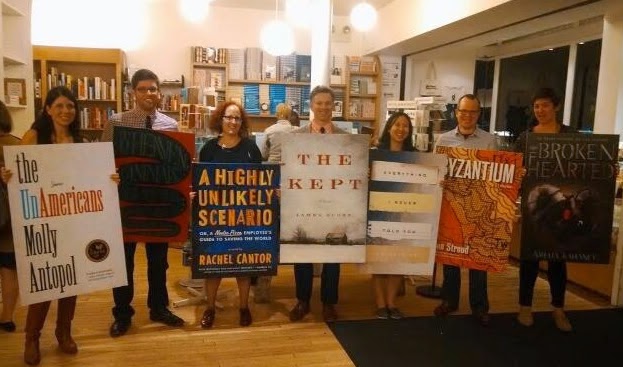
At this point, I discovered that the debutantes’ books, arranged in handsome piles on tables throughout the theater, were not merely showcase pieces but meant for the taking, by us, the guests (meaning me). But I was not alone in my discovery. Books were going fast, flying off the tables. I had to move quickly. Luckily, I’d already read Ben Stroud’s Byzantium and Molly Antopol’s The UnAmericans, allowing me to skip those particular stations. I snagged Rachel Cantor’s A Highly Unlikely Scenario, James Scott’s The Kept, and Celeste Ng’s Everything I Never Told You. I stopped to say a quick hello to Tin House editor, Rob Spillman and did a double-take at the sight of author John Hodgman. Hodgman’s story, “Vilanova: Or How I Became a Former Professional Literary Agent,” has the distinction of comprising the debut issue of One Story. This evening he was dressed like unbearably snobbish author Louis Green, whom he played in HBO’s Bored to Death. I then nabbed David James Poissant’s The Heaven of Animals and Amelia Kahaney’s The Brokenhearted, completing my debutante reading list. It was good timing. Hannah Tinti had just taken the stage, tapped the mic, asked us in her own charming way to please quiet down.

To kick things off, Tinti and fellow co-founder Maribeth Batcha said a few words about One Story, now in its twelfth year of existence. (“Sort of our bar mitzvah,” Tinti said. “We are a man now!* An active participant in the world!”) One Story, which publishes a single short work of fiction every three weeks, and never publishes the same author twice, maintains a special commitment to encouraging writers at the beginning of their careers, a commitment that Tinti and Batcha said they were pleased to have strengthened over the years. With that, the One Story co-founders sat cross-legged on the side of the stage, making room for the honorees of the evening.

One Story's literary debutante's (L to R): Molly Antopol,
David James Poissante, Rachel Cantor, James Scott,
Celeste Ng, Ben Stroud, and Amelia Kahaney
The ceremony itself was brief yet meaningful. The debutantes were announced one by one, escorted down the “aisle” (parallel strands of rope held waist-high by glamorous volunteers) by a respective mentor, in some cases an editor, such as Amelia Kahaney’s escort, Sarah Landis. In other cases an established author, such as Rachel Kantor’s escort, Robin Black, a One Story alum and 2011 literary debutante herself, did the honors. As each debutante took the stage, the first line of his or her new book was read aloud, followed by general whooping, hollering, applause, and hoisted cocktails, all to celebrate the authors’ entrance into the literary community, to acknowledge thier current success, and to wish for them many future years of inspiration and sales. Amid this frenzy of jubilation, optimism, and cheer, came the gimlet-eyed first line of Ben Stroud’s collection: “I was born a disappointment.” It brought down the house.

Confusing Debs

Directly after the literary debutantes were announced and celebrated, One Story presented its 2014 “Mentor of the Year Award” to literary rock star Colum McCann, who teaches at Hunter College and is deeply involved in numerous literary organizations. McCann, keeping with the theme of the evening, devoted the majority of his acceptance speech to discussing his own literary heroes and mentors, one of whom was memoirist Frank McCourt. McCann recounted a visit to McCourt in a late stage of his life, when McCourt, unable to talk, communicated via white board and dry erase marker. The way McCann tells it, at one point he asked the ailing author, “Where will you go dancing next?” McCourt’s written reply: “Upstairs with the Great JC and Mary M and the twelve Hot Boys. And in the morning, all will be forgiven.”

McCann signed off, the party resumed, dancing commenced. I made a beeline to Ben Stroud, whom I wanted to congratulate and, more importantly, thank for writing Byzantium. His collection’s ten stories skip from ancient Mesopotamia to colonial West Indies to contemporary East Texas and other times and places. The first story, my favorite, follows an idle, fatherless man-child with a crippled hand (you’re correct in guessing this is the poor sap to declare himself “born a disappointment”). Summoned by the Byzantine emperor, the narrator is tasked with a top-secret mission: travel to a desert monastery outside Jerusalem, locate a particular monk, and castrate him. It sounds gruesome, and is, but more so it’s a moving, humorous, and entertaining story. I planned to relay this sentiment to Ben Stroud, but when I got to him, I didn’t have time for much more than a handshake and quick congratulations before he was swarmed by others. No matter, I knew when to move on. Anyway, I had another mission: Find Molly Antopol.

I intercepted her on her way to the dance floor. After congratulating Antopol, both on her newly anointed literary debutante status and on her recently published collection of stories, The UnAmericans, I wanted to talk about a compelling blog post of hers that I’d come across, “On Writing and Being a Parent,” which cleverly examines how parenthood affects the practice of writing, in some ways for the better. I told all this to Antopol in one long breath. She had no idea what I was talking about.

“What do you mean?” I said. “That’s not your blog?”

“I don’t think so,” Antopol said. “I’m pretty sure I’m not a mom.”

Ah! I’d mixed up debs! The most mortal of all debutante-ball sins! Had this been an episode of Gossip Girl, I would’ve been shunned from Upper East Side society for years, never again allowed to grace the Waldorf Astoria ballroom floor. Thankfully, this was Brooklyn, and Molly Antopol has a gracious way of alleviating uncomfortable situations. I believe she deserves another award for that.

Debutante Amelia Kahaney, I later discovered, is the author of the wonderful parenting-writing blog post. Sadly, I never found Kahaney in the crowd, never got to talk to her. Which brings up the only problem with One Story's Literary Debutante Ball: It's such a kick-ass party that it's impossible to talk to everyone in the room. Wisely, One Story continues the celebration through the following day, hosting a low key reading by the debutantes at Greenlight Bookstore in Fort Greene. The reading was scheduled for the evening, giving all participants eighteen-odd hours of recovery time, a good thing because after dancing through the night with Colum McCann and Hannah Tinti and seven happy literary debutantes, sure, all may be forgiven in the morning, but a hangover still hurts.

* Editor's Note: In fact, One Story will not be a man, according to Jewish tradition, until next year, when it turns 13.


Photos courtesy of One Story.

Wednesday, May 21, 2014

Kseniya Melnik's Competing Passion

In the fourth in a series of posts on 2014 books entered for The Story Prize, Kseniya Melnik, author of Snow in May (Henry Holt and Company) talks about how she gets unstuck and where she finds inspiration.


If you weren't a writer, what would you be doing?
I think I would be a medical doctor or a therapist. I was seriously interested in both professions when I was younger; both have caring and storytelling aspects to them. My grandmother was a doctor, and I worked at her clinic one summer and spent much time hanging out with the doctors. I was fascinated by medical gadgets, scalpels, and other surgical instruments. (The main character in my story “Summer Medicine” shares this early interest of mine.) I took premedical classes in college and afterward and volunteered at the emergency room at a Brooklyn hospital. Writing, of course, was the competing passion, and I felt like I wouldn’t be able to devote enough time and attention to it if I were to be a good doctor, too. I admire writer-doctors: Anton Chekhov, Mikhail Bulgakov, Conan Doyle, Janusz Korczak, Chris Adrian, and many others.

Do you ever borrow characters or situations from real life, and has anyone ever confronted you about it, been angry or pleased?
For Snow in May, I borrowed several situations from life and then developed them in new directions. These premises often come prepackaged with the main players, and I had to decide whether to substitute them with completely fictional creations or model the characters on the people. I found that sticking too closely to real life details froze my imagination; I felt pressure to tell "the true story," which is impossible anyway. I prefer to pick one or two psychological and physical traits that are most interesting to me in the real person and fill in with my imagination from there. So far only my family members have recognized facets of their lives in the book, but they knew I was using some biographical material. They are pleased that I'm interested in telling their stories. 

What's the best story idea you've had that you've never been able to write to your satisfaction?
I don't know whether it's the best idea I've ever had—in fact, it might’ve been the worst one—but for a while I was really excited about a story in which a girl begins dating the Devil in New York City. My Devil was a sort of exhausted, jaded Wall Street banker type who made deals with singularly ambitious people. It was a bit burdened by description of the mechanics of these deals and explanations of how various celebrities throughout history were connected to the Devil: Caesar, Lincoln, Bonnie and Clyde, Marilyn Monroe, Hitler, etc. I could never quite figure out why the Devil would be interested in my girl-next-door character, though, aside from the fact that maybe he needed someone to take care of him, to offer him a safe haven for respite from his difficult career. 

Where do you do most of your work?
I’ve written at office desks, in libraries and coffee shops, on planes and subways, on a ferry sailing through Alaskan and Canadian waters, and even in a car on cross-country trips. Ideally, I prefer to be alone and in a more relaxed environment, so that I can fool myself into thinking that writing is not hard work. Right now I work at home in El Paso, Texas; my love seat stands by the window from where I can see the Mexican border. I place the computer or a book on a lap desk. With a cup of coffee and my purring cat wedged between me and the computer, it's quite perfect.

What do you do when you're stuck or have "writer's block"?
I read! I have gotten the majority of my breakthroughs while reading, and I believe that most craft issues can be solved by reading a writer who does excellently whatever gives you difficulty. If you have spent enough time on the story, your brain will continue to work on it subconsciously while you do other things. Reading often engenders surprising connections, so does going for a walk or a run while listening to music that you relate to the story in some way.

What advice do you have for aspiring writers?
Keep writing, keep revising, keep reading, and keep believing in your story and the importance of telling it.

What else (beyond books and writing) informs or inspires your work?
All kinds of other arts: music, dance, painting and sculpture, film, photographs. Snowy and rainy weather always puts me in the mood for daydreaming. Looking at (not in—that would be creepy!) lit-up windows at night and imagining what kind of people might live in those houses, what kinds of lives they might lead.