Wednesday, June 29, 2016

Kathy Anderson on Beginning with the First Line

In the first in a series of posts on 2016 books entered for The Story Prize, Kathy Anderson, author of Bull (Autumn Press), discusses how a good first line inspires her.
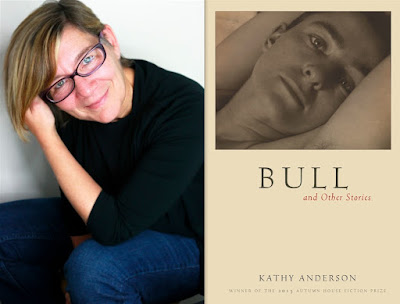


For me, a story begins when I find the elusive magical first line. I picture the first line of a story like a hanger. You drape a story on that first line like it's a loose shirt, now held in place by its underlying frame. Everything hangs on that first line. It contains the whole universe of the story in it—the distinct voice of a character, what the story is about, the point of view, the tone. My biggest thrill is when a reader says I was hooked from the first line.

A first line cannot be gimmicky. It must not try too hard. Most of all, it should feel utterly confident. You recognize an authentic first line by your feeling toward it, like falling in love at first sight or meeting a person you want to make friends with. You're excited, intrigued, attracted. You put everything else aside and stay with it.

When I'm lucky, which is very rare, the right first line pops into my head, bringing with it all the energy and information I need to write the story. Those first lines feel like a gift, arriving with a big bow and a flourish. The work comes in finding the rest of the story to fulfill the miraculous start. When a first line pops into your head, you don't have to understand it but you do have to start following the trail it lays out.

But the usual way that I find the first line is to coax it out of many notebook pages. Sometimes it hides from me for years behind the word thicket until I go back, open that forgotten notebook, see it, pounce on it, and grab it out of there. When the time is right to write the story, those words you scribbled or typed in a flood of other words will now stand out. The line that starts a story has a definite charge to it, a whipped-up energy. Pay attention to that energy.

I write down first lines from stories I love. They are a mysterious bunch, those sentences. They follow their own rules, make their own path. You can't learn to write a first line by replicating ones you love, that's for sure. They insist on their own universe, don't work in anyone else's.

When I lead short story workshops, we read first lines from great stories out loud. I hope that we can learn how to recognize what works because there's no real way to teach what works. First lines can't be analyzed or deconstructed in any real sense. They can't be summoned by logic or formula. You have to hear them, feel them land, witness the magic.

How can you learn to write a first line that sings, grabs, contains multitudes? You can't. You can only open yourself to them. You can accept that writing short stories is an art based as much on instinct and feeling as it is on technique and skill. You can cultivate your woo-woo side, the wild artist in you. You can listen for the magic.

I don't know a lot of things about first lines. I don't know why they work on us the way they do. I don't know why some land like a depth charge and others sneak up from behind and put their arms around us. I don't know why they wait in our notebooks and computers for years sometimes. Maybe they are waiting for the rest of the story to arrive, piece by piece. Then they raise their arms, take their place on the hanger, and the story begins.

Monday, April 11, 2016

John Jodzio Cracks Wise on Sunset

By Nick Fuller Googins
Los Angeles 
March 30, 2016

The Association of Writers & Writing Programs’ annual conference, which ran from March 30 to Apr. 2, represented a rare occurrence in Los Angeles: a gathering of writers who were not primarily focused on treatments, scripts, screenplays, or pilots. As the conference began, one such author, John Jodzio, read from his story collection, Knockout (Soft Skull Press), at Book Soup, on Sunset Boulevard in West Hollywood, a mere ten-mile, hour-and-a-half freeway jaunt from the Convention Center hub of AWP action.

Author Jodzio: "a trusting soul"
(photo by Brian Vernor)
Those of us who made the trek crowded into Book Soup’s narrow reading space, where Jodzio provided more than a few laughs when he read his story “The Piss Test Place.” Any one of Knockout’s seventeen stories would probably have produced a similar reaction. Jodzio's fiction falls somewhere between short and flash—all of it markedly zany. “The Piss Test Place,” at just under five pages, features three-dollar strip teases, laser light shows, a dysfunctional heavy metal band, cocaine fudge, and a drug-sniffing dog with epilepsy. Jodzio created the protagonist—a mildly corrupt, usually-stoned employee—with the help of extensive field research. He filled us in before reading: 
“I used to do a lot of temp work. And they always made me take a piss test whenever I changed jobs. The guy who worked the desk of the piss test place was clearly high. So I wrote a story about him.”
While reading, Jodzio wears a mischievous perma-grin (think Norm Macdonald) that matches the sensibility of his fiction. He had difficulty keeping a straight face, especially when delivering lines like these:
“Since I’d started working here, I’d heard many tales of woe and roofied hard lemonades. It was difficult to tell who was telling the truth and who was lying. All I knew was I’d accidentally eaten some cocaine fudge at a party a few nights before, and I knew how easily something like this could happen to a trusting soul.”
Jodzio’s reading seemed to be over too quickly, but thankfully, he'd invited author and friend Kara Vernor to read with him. Vernor, a middle school teacher by day, writes stories that take their titles from her sex-ed students’ anonymously submitted questions. The one she shared with us was “How Much Tongue While Kissing?” It isn't hard to see why she and Jodzio are friends. All in all, it felt particularly delightful to laugh in a cozy bookstore while, outside, the traffic on Sunset Boulevard inched along. 

Monday, March 7, 2016

Video: The Story Prize Event on March 2 at The New School with Finalists Charles Baxter and Colum McCann and Winner Adam Johnson

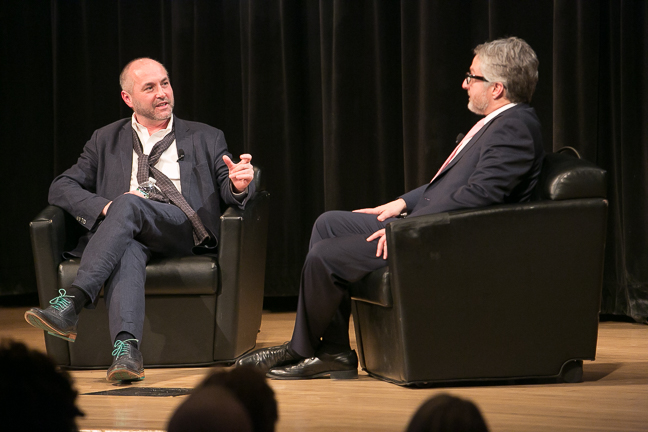
Here's the video of The Story Prize event on March 2 at The New School. That night, the three finalists—Charles Baxter, Adam Johnson, and Colum McCann—read from and discussed their work on-stage. And at the culmination of the event, we announced the winner for books published in 2015: Adam Johnson's Fortune Smiles. 

Friday, March 4, 2016

What The Story Prize Judges Had to Say About Adam Johnson's Fortune Smiles

Photo by Beowulf Sheehan
When the three judges for The Story Prize make their choices, they provide citations for the books. This year's judges were Anthony Doerr, Rita Mead, and Kathryn Schulz. We include the citations in congratulatory letters we present to each finalist, along with their checks ($20,000 to the winner, $5,000 to the other two finalists). To protect the confidentiality of the judges' votes and the integrity of the process, we don't attribute citations to any particular judge.

Here's what the judges had to say about the winner of The Story Prize for books published in 2015, Adam Johnson's Fortune Smiles:

“In ‘Hurricanes Anonymous,’ one of the six stories in Adam Johnson's Fortune Smiles, a man driving down a road in storm-struck Lake Charles notes an eerie absence: He can't see any reflections in the windows that he passes, because, after the hurricane, there are no windows left. That is a characteristic Johnson observation, astute and unsettling, and it reminded me of the stories themselves, each of which casts a character into an unbarriered darkness: illness, political unrest, natural disaster, sexual violence, imprisonment. Against that darkness (some of it remembered, some if it unfolding, some of it merely dreaded), communication keeps faltering: A father cannot understand his toddler's strange babble; an elderly man's tracheotomy keeps him from speaking with his son; a hologram of an assassinated president mock-converses in remixed fragments of speeches he gave while still alive. Yet for all the disconnect and tragedy, there is something warm and comic and bright about these stories. Johnson writes like Rembrandt painted, richly and specifically, with an inclination toward self-portrait and a gift for making it seem like a whole world carries on not only within but beyond each of these small canvasses.”
“There is not one weak story in this collection. Along with crafting prose that pulls you in and doesn’t let go until it’s finished with you, Johnson excels at creating characters that are both deeply flawed and entirely human and putting them into situations that are at once believable and surreal. Johnson does not shy away from difficult material, but instead uses it to explore the most harrowing moments of the human experience, blending elements of history, science fiction, and psychological horror. Yet, somehow, there is an undercurrent of faint hope that weaves through these stories, as though to say that people can overcome anything, but only if they are willing to face their own weaknesses. A gripping exploration into human nature as told through mesmerizing scenes that will leave you thinking long after you’ve finished reading.”

What The Story Prize Judges Had to Say About Colum McCann's Thirteen Ways of Looking

Photo by Beowulf Sheehan
When the three judges for The Story Prize make their choices, they provide citations for the books. This year's judges were Anthony Doerr, Rita Mead, and Kathryn Schulz. We include the citations in congratulatory letters we present to each finalist, along with their checks ($20,000 to the winner, $5,000 to the other two finalists). To protect the confidentiality of the judges' votes and the integrity of the process, we don't attribute citations to any particular judge.

Here's what the judges had to say about Colum McCann's Thirteen Ways of Looking:

"Part police procedural, part Ulysses, strung across the wirework of a Wallace Stevens poem, the title novella dazzles. It combines a playfulness for genre-melding with the delight of Mendelssohn’s wordplay with the author's wide-open empathy for every character—even the despicable Elliot—to open giant questions about race, aging, and especially class. And while so many layers—is the novella a retelling of Joyce’s 'The Dead'? a rumination on the culture of surveillance? do fathers bear the sins of their sons?—can be teased apart, tasted, and appreciated individually, at bottom the piece remains a gripping murder mystery, and compels a reader to consume it in a single gulp. In the three remaining stories, McCann continues to prove himself a master of sensory detail and the sentence fragment; the confrontation at the climax of 'Treaty' leaves one thrilled, nauseous, and fully-dilated. Few writers use prose this well to show how the human mind can simultaneously occupy multiple places and times."

What The Story Prize Judges Had to Say About Charles Baxter's There's Something I Want You to Do

Photo by Beowulf Sheehan
When the three judges for The Story Prize make their choices, they provide citations for the books. This year's judges were Anthony Doerr, Rita Mead, and Kathryn Schulz. We include the citations in congratulatory letters we present to each finalist, along with their checks ($20,000 to the winner, $5,000 to the other two finalists). To protect the confidentiality of the judges' votes and the integrity of the process, we don't attribute citations to any particular judge.

Here's what The Story Prize judges had to say about Charles Baxter's There's Something I Want You to Do:
“There’s a strange and very appealing unpredictability to Baxter’s imagination. He excels at menace, and he executes amazing leaps in time in these stories, like a DVD skipping forward through whole scenes. Best of all, he wrestles with huge stuff: faith, abortion, love, aging, kindness, the countervailing and intertwined forces of beauty and death. Elijah is a wonderful character: hungry, kind, and transcendent. I loved being in his company, and watching him reappear from time to time in the stories. The strong connections between and among stories amplify the significance of each profound and profane moment, all of which become part of a larger canvas of human experience.”

Wednesday, March 2, 2016

Adam Johnson's Fortune Smiles is the 12th Winner of The Story Prize

Adam Johnson, winner of The Story Prize
(photo © Beowulf Sheehan)
We're pleased to announce that Adam Johnson's Fortune Smiles, published by Random House, is the winner of The Story Prize for books published in 2015. Johnson becomes the first author ever to win the National Book Award for fiction and The Story Prize for the same book—and he's also the first author to have won The Story Prize, the Pulitzer prize, and the National Book Award. He won the National Book Award for Fortune Smiles in November 2015, and the Pulitzer in 2013 for his novel, The Orphan Master's Son.

The other finalists—winners of numerous awards themselves—were authors Charles Baxter for There’s Something I Want You to Do (Pantheon) and Colum McCann for Thirteen Ways of Looking (Random House). At the event at The New School, all three finalists read from and discussed their work on-stage. As runners-up, Baxter and McCann each received $5,000.

In the days and weeks to come, we'll post the judges' citations for the three books, photos from the event and after party, and a link to the video.