Friday, November 11, 2016

Robert Oldshue on the Probable Improbable in Fiction

In the 33rd in a series of posts on 2016 books entered for The Story Prize, Robert Oldshue, author of November Storm (University of Iowa Press), contemplates Aristotle's Poetics and America's politics.


After many years of quoting Aristotle’s Poetics, I decided, one weekend, to read it. I’m writing a novel in which a character acts in a way that he, probably, can’t, and, after two hundred some pages, I was worried. I wanted to reassure myself that Aristotle had classified dramatic action as Probable, Improbable, and Impossible and had decided, when he was finished, that the best plots made the Impossible seem Possible.

Here’s what he actually said:
It is Homer who has chiefly taught other poets the art of telling lies skillfully. The secret of it lies in a fallacy, For, assuming that if one thing is or becomes, a second is or becomes... the mind, knowing the second to be true, falsely infers the truth of the first. There is an example of this in the Bath Scene of the Odyssey. 
Accordingly, the poet should prefer probable impossibilities to improbable possibilities.

        — Aristotle, Poetics, XXIV
My first surprise, of course, was that politicians study Homer.  Proving an idea, not by proving it, but by proving the next idea and claiming that both have been proven is, for candidates, standard procedure. My second surprise was that Aristotle’s much quoted statement is, most often, quoted wrong. Specifically, he was telling writers how to distract the audience from a plot’s failings, he wasn’t telling them how to identify a plot that’s workable.

Can Aristotle’s classification be expanded?

Consider Donald Trump’s plan to build a wall with Mexico and to have the Mexicans pay for it. If, when you heard it, you thought it an attempt to make the Impossible seem Probable, you dismissed it and him. “He’s a nut,” you said and moved on. Similarly, if you thought Hillary Clinton’s speeches long on details and short on vision, you worried that she was making the Probable look, merely, Probable, which, as a strategy, was safe, but wouldn’t fire up her base. To engage people, Clinton’s staff advised her to make more promises and Trump’s staff advised him to make fewer.

If that example’s too painful, consider a magic show.

As with fiction, the audience is told that it will be tricked and, in order to be entertained, they agree. If the magician, then, says that the trick will be to pour the water in a pitcher into an empty glass until the glass is full, the audience, faced with the Probable Probable, will get up and leave. If the magician says, instead, that his or her heart, still beating, will be removed and, then, replaced by an assistant, the audience, faced with someone who thinks the Impossible is, not only, Possible, but Probable, will get up and, in this case, run. The audience doesn’t know if the magician with follow through on this promise, but it doesn’t want to find out.

Now, imagine that the magician says that the trick will be to make a small animal or bird appear from an appropriately sized hat or to name a card that someone across the room is holding or to, somehow, name the holder.

The audience knows, as it did, that it’s a trick, but the audience, now, is neither bored nor frightened. If, in addition, the magician finds a way to reassure them, early on, that he or she is skilled and respects their time and attention, they’re as engaged as they would be if someone told them a story about a whale that attacked a whaling ship or a man who made a fortune so he could buy a long, lost love. Neither Moby Dick nor the Great Gatsby have plots that are Probable, but neither are their plots Impossible. They are Improbable. They can, with the help of a Melville or a Fitzgerald, glimmer with that attention-grabbing mix of stability and instability created when a writer or a politician makes the Improbable seem Probable and, in so doing, makes a reader, or a voter, believe.

So where does this leave me?

In my novel, a schizophrenic occasionally says and does things that are sane. Is my plot Probable? No. But is it Impossible? No. It’s Improbable, and, with work, can be made Probable. Rather than abandoning my plot, I need to embrace it. I’m exactly where a novelist or a politician (or Aristotle’s poet) should be.

Wednesday, November 9, 2016

Christine Sneed on Personal and Narrative Spaces

In the 32nd in a series of posts on 2016 books entered for The Story Prize, Christine Sneed, author of The Virginity of Famous Men (Bloomsbury USA), compares the governing logic of stories with the messier logic of existence.


In the last few years, I’ve become more interested in finding solitude and silence, two things I spent much of my childhood and early adulthood trying to escape. Now, in my forties, I look back at these years and shake my head. Little did I know at twenty-five how fondly I would view, at forty-five, the quiet suburb where I grew up and where my parents still reside. For the last ten years, I’ve lived on the far northern fringes of Chicago, across the street from an emergency room and an elementary school. Tranquility and a low decibel level are difficult to find much of the time, even late at night.

My partner copes with these conditions better than I do, in part because more than twenty years of daily meditation have equipped him with a certain trait that I have found elusive: He is able to live peaceably with the frequent uproar outside our home, and more importantly, with the unoccupied spaces within him.

We all have these spaces, I think. They are vacancies where an absence of rote activity resides, and in myself, I find these empty rooms unsettling because from them the truest opportunity for self-knowledge could emerge, but only if I’m not peering at my computer or phone.
Empty room

One reason I think self-knowledge is often painful is because it requires an unsentimental reckoning with one’s flaws. In the short stories I write, the pivotal moments usually center on the point-of-view characters’ dawning awareness of their faults, and consequently, how these flaws have dictated the choices they’ve made. If there are no flaws, there are no trouble-inciting choices, and therefore no drama or conflict to describe and navigate and potentially overcome.

In a story, I try to identify my characters’ problems within the first few pages, and by the final page, to offer some kind of resolution. In the non-fictional, physical world, however, I never seem capable of confronting an emotional situation as coolly and logically as I do on the page, and perhaps this is one reason why I keep writing.

Something else that I have begun to understand after years of teaching and writing fiction is that although our bodies experience the passing of months and years in a linear, chronological fashion, our minds do not—they are sophisticated but capricious time machines, zapping us back and forth through the years, often at inconvenient moments. This phenomenon might explain why some of us spend innumerable hours talking to therapists about our experiences growing up in families whose members were better at fighting than loving each other, about residual but still-powerful disappointments or triumphs, whether related to love, work, or friendships.

The governing logic of a story is in its narrative structure, but the governing logic of a life is that there might not be any logic, other than in the most elemental sense: We are born, we live for a time, and one day, we cease to exist in any comprehensible manner.

Those quiet spaces within us—they are, as I’ve come to think of them, where the story comes from—the story of who we are, but also, the stories we are writing or hoping one day to write.

Monday, November 7, 2016

Alexander Weinstein's Letter To Himself as a Young Writer

In the 31st in a series of posts on 2016 books entered for The Story Prize, Alexander Weinstein, author of Children of the New World (Picador), shares some wisdom.


Dear Alexander,

How’s third grade? Happy to hear you’ve discovered creative writing! I wanted to share something you’ve yet to learn about your writing: Your work is going to be rejected. A lot. I’m here from the future to tell you that the number of rejections you’ll have by the time you’re thirty-five will reach well into the hundreds. Your first acceptance? It won’t come until after ninety-four rejections. And there’s only one consolation I can offer you: This is par for the course in the writing life.

What you’ll wish, of course, is that the first story you ever write will be published. As a third-grader, just now discovering writing, you think all it takes is to simply finish a book and send it to the publishing houses. They’ll then send you a huge check, the book becomes a New York Times best seller, and you retire from all other work in order to devote your time to writing. Alas, it never works this way—not for you, not for anyone.

Instead, prepare for the following:

You’ll graduate college with an undergraduate degree in creative writing—a degree which you’ll find is mostly good for restaurant work. You’ll toil in kitchens, landscaping jobs, and underpaid interning for years, where no one seems to care about your writing whatsoever. You’ll become a father, the duties of which include many important things, like changing diapers, preparing food, singing lullabies, loving well—but doesn’t include writing.
Writer-in-training


Over the years as a struggling writer, you’ll regularly wonder if you were truly meant to be a writer or if it was just a hopeless delusion you’ve foolishly nurtured. The dark nights of the soul, inherent in the artistic process, won’t be pleasurable. The stereotypical and often romanticized Life-of-The-Struggling-Writer, while seemingly idyllic in novels, won’t feel romantic or idyllic. Yes, there are always cafés, bars, and coffee shops where you can write, but it won’t feel like Paris. Instead, you’ll learn how to survive on day-old-bagels and thrift store clothes, and in the process you’ll learn to be a loving father, a dedicated partner, a devoted friend, and many other things which will make you a better human, and in turn, a better writer—but won’t necessarily get you published.

All of this is part of the job. Your only duty as a writer during the dark years: to keep writing.

For here’s something you cannot yet know: As you struggle through all the rejections of the early years, you’ll discover that the rejections will make you a stronger writer. Years later, you’ll revisit your early stories which were turned down for publication, and you’ll thank god they were never published. You’ll learn to write stories not to impress other people, or for fame, or because you want publication—but because there’s no way for you not to write. And as soon as you let go of your need for publication, you’ll find your stories unfolding in unexpected ways; they’ll surprise you by revealing things about your own heart that you never knew.

You’ll go to grad school, where you’ll learn how to teach—and you’ll discover that you love it. You’ll make friends there who will become your readers and editors for many years to come. You’ll stay up late, drinking wine and enjoying their company. All of this is good for your writing. And you’ll work on your stories for a long, long time. If we count the start of your writing life as this moment in third grade when you’re first dreaming of publication, it’ll take you over thirty years of steady dedication before your first collection is published. Don’t worry—it’s all worth it—this is what it means to be a writer. The truth is: for you, life ultimately feels better when you write.

As for the secrets of how to make it as a writer, they’re simple: Keep writing, read authors you love, edit like mad, open doors for other writers whenever you can, quiet the inner critic, be compassionate to yourself through all the challenges of the writing life, and be thankful for the stories that come knocking at your door. When you hear them waiting outside, open the door wide, welcome them in.

Friday, November 4, 2016

Greg Jackson Asks: Does Literature Have a Political Responsibility?

In the 30th in a series of posts on 2016 books entered for The Story Prize, Greg Jackson, author of Prodigals (Farrar, Straus and Giroux), explores the relationship between implicitly and explicitly political writing.


When this past summer Aleksandar Hemon explained his decision not to sign a letter by 450 prominent writers denouncing Donald Trump’s candidacy, he noted how rare it is these days for literary authors to make political news and how few books published—or published to acclaim—in the past decade of U.S. fiction endeavor to address the culture, climate, or explicit actions that have defined our political era of terminal partisanship, terminal vacuity, and interminable war. Of course an argument can be made that all literature, in what sphere of human life it illuminates and what human qualities it dignifies or indicts, takes a political stand. Very little art aspires to moral dispassion, and that which does ends up making one of the most strident moral claims of all, since art’s value, when it is good, so deeply refutes our culture’s presiding schemata of worth that its deepest political message will always be its very existence and endurance, the category of value and sanctity it keeps alive—and unrepentant art-for-art’s-sake most of all.

Must we be in the business of judging who is the more political writer between Don DeLillo and Alice Munro, Grace Paley and Ann Beattie, to take Hemon’s point? There is a difference between a book’s being political and its taking politics as its subject, and today the decided preference is for eschewing the subject itself in favor of the tacit understanding that to write fiction from a place of moral feeling is tantamount to expressing a politics. The personal is political—no less when the personal is fictional—and indeed we have had no great shortage of books dealing with our recent wars, the legacy of racial injustice, the marginalization of women, the trials and ordeals of immigrants, our divisions across lines of class and geography, our insults to the environment, the iniquities of high finance, and the terms of political belief in private life.
Author Aleksander Hemon

I say this, and still I agree with Hemon, on balance, because it is my sense that within the generous, humanistic notion that literature committed to the moral struggle of the individual soul can be just as political as the social panoramas we owe to Conrad, Tolstoy, Eliot, and Stendhal lives a contemporary belief that political art is distasteful. I feel it myself, a faint apprehension, aversion, or fatigue when I encounter the term. In an interview with Hemon for On the Media Bob Garfield remarked, “One could make the argument that if you want a formula for writing a crappy novel make it explicitly political. Society may be served by political fiction, but I’m not sure fiction is served by it.”

But again, what does “explicitly political” mean? Does it mean politics as a subject or politics as an agenda? I doubt any serious reader or writer of fiction thinks the rigors and joys of literature cooperate with partisan advocacy, or that some cod-liver-oil class of fiction exists that serves society but not art itself. Hemon clarifies his position: Writers respond to the political era, he says, “not to correct or to pontificate but rather to create a space to understand what happened to us . . . Fiction allows for conversations that cannot quite be had in public space defined by the media or social media.” And when you look at the celebrated fiction of the last decade—this is Hemon’s point—you get little, if any, sense of the nation’s political life in this period. Among the community of writers, as demonstrated by the anti Trump letter, a political consensus (and a consensus that writers have a political responsibility) obtains. Among its books, this consciousness and passion seem strangely absent. The letter Hemon wrote in response seems to call out a bad faith, a desire to use the prestige of one’s artistic career to take a political stand but not to use one’s art to elaborate and animate the point.

Explanations of course abound. Writers write what they know and find interesting; readers read for pleasure; publishers publish what they believe will sell. The fervency of online opinion meanwhile makes the expression of moral nuance and complexity more thankless than ever these days. And yet we need fiction that engages our politics, since what art does address it consigns to the realm of familiar, abbreviated, and public truth. For all that may be stacked against this effort I see mainly literature’s failure to rise to the challenge. The best political fiction—Paley, Sebald, Faulkner, Bolaño, Eisenberg, Saunders—after all knits its message foremost and most deeply in the spirit of the work itself, in its mischief, good humor, humility, and grace. It is a mistake to believe that political art must be off putting, dead on arrival, preachy, or lame. On the contrary none has succeeded while indulging the temptation to righteousness or sanctimony, and great political art exists all the same.

The absence of politics from this era’s literature—if the premise holds—to my mind reflects a growing loss of faith in the power of art itself, its potential not only to evoke, inspire, and represent, but its more fundamental capacity to transcend the cramped emotional and intellectual spaces in which the prejudices of the moment take shape. Political art does not advance a politics so much as it helps us understand ourselves politically, and it reminds us in its sensibility of the true scope of political, and human, possibility. There is a yawning gulf between moralism and moral discourse. One insists on a morality, one helps us discover our moral selves. No one wants to be told what to think. No one wants to be judged. We are in danger in this country, and on the left no less than the right, of mistaking the expression of a point of view for commitment to its values. And from there the line quickly blurs between what is truly ennobled and what is merely personally, politically, or professionally convenient.

Art stakes both its value and its status as art on a certain marginality. What is immediately well liked and widely popular has probably forgone saying anything that is hard to hear. What merely repeats the agreements of the present, or helps us float away from their compromises and snares, by definition does not move us forward. Have we grown timid or complacent? Or is the premise faulty? I wonder whether writers are taking the risks they once did, whether the risk-takers are being punished or rewarded, and why; and I wonder about the absence of politics in our literature that Hemon noted, whether it exists, in fact, and what it says about the taste of readers, writers, publishers, and editors. What I am fairly sure of is this: Art reaches its ideal when it allows privacies to whisper to one another in public, when it gives society a place to announce the evolving truth of conscience, and a vessel by which to ferry this truth past the dismal hazards of censure, ridicule, posturing, and fashionable thought. We have been fortunate in the U.S. mostly to avoid the suppression of the speech so common the world over, but explicit repression is not the only means of disempowering speech, as we know. The first step is to stop taking its power seriously enough.

Thursday, November 3, 2016

New and Improved! The Story Prize Website

The Story Prize has a spanking new website, with a cleaner look. It features more images, including a carousel of the book covers of all twelve past winners. You can find videos of past events and photos from every event and reception by year under WINNERS.

We thank Maxann Luchovic, who created our spiffy new site, and our outgoing web master, John Parsons, who also designed our logo. 

Meet The Story Prize Judges: Harold Augenbraum, Sarah Shun-lien Bynum, and Daniel Goldin

The Story Prize is pleased to announce its judges for 2016: Former National Book Foundation Executive Director Harold Augenbraum, Author Sarah Shun-lien Bynum, and bookseller Daniel Goldin of Milwaukee’s Boswell Book Company.

Here come the judges: Harold Augenbraum, Sarah Shun-lien Bynum, and Daniel Goldin

These judges will decide the winner of the $20,000 top prize from among the three books that we (Director Larry Dark and Founder Julie Lindsey) choose as finalists in January. The other two finalists will receive $5,000.

We will announce the winner at the end of an evening of readings and onstage interviews on March 8, 2017, at The New School in New York City.

About the Judges

Harold Augenbraum is a Franke Visiting Fellow at the Whitney Humanities Center of Yale University. From 2004 to early 2016, he was Executive Director of the National Book Foundation, presenter of the National Book Awards. He has published seven books on Latino literature of the United States and has translated, among other works, Alvar Núñez Cabeza de Vaca’s Chronicle of the Narváez Expedition and the Filipino novelist José Rizal’s Noli Me Tangere and El Filibusterismo. He has taught U.S. Latino literature at Amherst College, founded the Proust Society of America, and co-chaired, with Susan Shillinglaw, the 2002 National Steinbeck Centennial celebration. He often speaks and writes on the future of literary reading and publishing and is currently carrying out a research project on the business of translation in the United States under a grant from the Andrew W. Mellon Foundation. In 2015, Concordia College in Moorhead, Minnesota awarded him the degree of Doctor of Humane Letters, honoris causa.

Sarah Shun-lien Bynum is the author of two novels, Ms. Hempel Chronicles, a finalist for the PEN/Faulkner Award, and Madeleine Is Sleeping, a finalist for the National Book Award and winner of the Janet Heidinger Kafka Prize. Her fiction has appeared in many magazines and anthologies, including The New Yorker, Ploughshares, Tin House, The Georgia Review, and The Best American Short Stories 2004, 2009, and 2016. The recipient of a Whiting Writers’ Award and an NEA Fellowship, she was named one of “20 Under 40” fiction writers by The New Yorker. She lives in Los Angeles with her family.

Daniel Goldin has been the proprietor of Milwaukee’s Boswell Book Company since 2009. Previous to Boswell, he spent 23 years with Harry W. Schwartz Bookshops, primarily as a buyer, and before that, he was a publicist at a publishing house that is now part of Hachette Book Group. He has received the Christopher Latham Sholes Award from the Council for Wisconsin Writers for encouraging and supporting Wisconsin writers and a James L. Patterson bookseller bonus. He was raised in Queens, New York, and graduated from Dartmouth College with a degree in math and Russian.

Monday, October 31, 2016

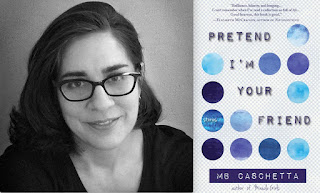
MB Caschetta's Encounters with Grace Paley

In the 29th in a series of posts on 2016 books entered for The Story Prize, MB Caschetta, author of Pretend I'm Your Friend (Engine Books), remembers the simple question Grace Paley suggested writers ask of their work.


I met Grace Paley twice when I was a teenager.

Once I heard her read at the library in my provincial hometown in upstate New York, and another time, I sat in a workshop with her. This was after I’d escaped to college, where I hoped to follow in the footsteps of famous alumnae like Edna St. Vincent Millay, Elizabeth Bishop, and Mary McCarthy.

As undergraduate students in the creative writing program (which is sadly now defunct), we met a lot of writers and tried on their styles in workshops: minimal Amy Hempel, angular Madison Smartt Bell, noble William Trevor, mysterious Carole Maso, fragile Brett Singer, bold Ellen Currie.

But Grace Paley was singular.

She inspired us to write like ourselves, even though (or especially because) we had yet to become the writers we were going to be.

By the time Paley came to campus, we’d read every story she’d written; we’d studied her collected works; we’d spoken of her in terms reserved for rock stars. Up close and personal, when she arrived on campus, we admired everything about her: her twinkle, her sneakers, the stain on her shirt. She might as well have been Jimi Hendrix.

“How do know when you’ve finished a story?” someone asked.

We were in a classroom workshop, crowded with extra teachers and students. There were probably 40 of us gathered around her, breathing in unison, waiting on answers.

She considered the question before picking up a page of her own writing. She pointed to the first word: “Is this word true?”

She looked at us, pointing to the next. “Is this word true?”

She snapped her gum and winked (At me? No, at the person behind me.) “What about this one? And this one? Is this word true?”

In that moment, I knew I was doomed, or blessed, or whatever it is that binds a person preposterously to a life of stalking the truth through fiction.

I probably didn’t stand much of a chance anyway: stories had always written me. One summer, just a kid, I penned a complete novel in a series of spiral notebooks on the front porch. I was lopsidedly verbal, terrible at everything else, obsessed with trying to get on the page what no one in my family seemed capable of hearing or seeing.

On the way out of the classroom, Paley stopped me. “Not bad, kid.”

It was my short story we’d read in the workshop.

I’ve thought of this compliment many times over the years. I still marvel that I managed to get away from my troubled childhood and land in a magical world where writing stories was offered as an attainable, respectable career. Even during the miserable times I wished I could be something else, (anything! please God!) other than a writer, thinking of Grace Paley always brought me back to being grateful and humble.

I survived a couple of rough decades thinking this way, even when the rejections piled up, the stories stumped me, the novels got sidetracked by paid writing, and publishing a book seemed impossible. Through it all, I continued to sit at my desk, searching for the next true word, and the next after that.

When I went back for a short stint to teach the short story in that very same classroom, years later, I was stunned to find that young writers “didn’t get” Grace Paley. “Too concrete,” they said.

Their rock stars were from my generation, it turned out, and just as worthy of admiration: Elizabeth McCracken and Junot Díaz.

The last time I saw Grace Paley, she was reading in Provincetown, Massachusetts, where I had been living. I reminded her of this story, but she didn’t remember it—or me.

“That’s okay,” I told her. “It only has to matter to me.”

She crackled her gum and gave me a smile.

“That’s good,” she said. “Remember that for me.”