Saturday, November 17, 2012

Marie-Helene Bertino Shares Some Story Love

In the 41st in a series of posts on 2012 short story collections entered for The Story Prize, Marie-Helene Bertino, author of Safe as Houses (University of Iowa Press), discusses what short stories in general and Symphony Space's Selected Shorts program in particular have meant to her.


I love short stories. I love the stuffy, classic ones that refuse to bow to whimsy. I love the experimental ones, when a writer tosses the form into the air and shoots it through with magic and risk. I love the feeling of coming to the end of an expertly executed story: the upshot of energy like taking a hill too fast in my car. I love short stories even though I don’t always understand how to craft them, even though they baffle me; like a cherished, elusive friend who once in a while bestows on me a stunning visit.

When I moved to New York ten years ago I had an overdeveloped dream to be a writer and an underdeveloped plan as to how. Every season I scrounged enough money together to attend “Selected Shorts” at Symphony Space on the Upper West Side. In that quiet auditorium I listened to William Hurt read Maile Meloy, Hope Davis read Jennifer Egan, Joe Morton read Jim Shepard, and countless other amazing performances. No matter what mood in which I entered Symphony Space, I always left excited to write.
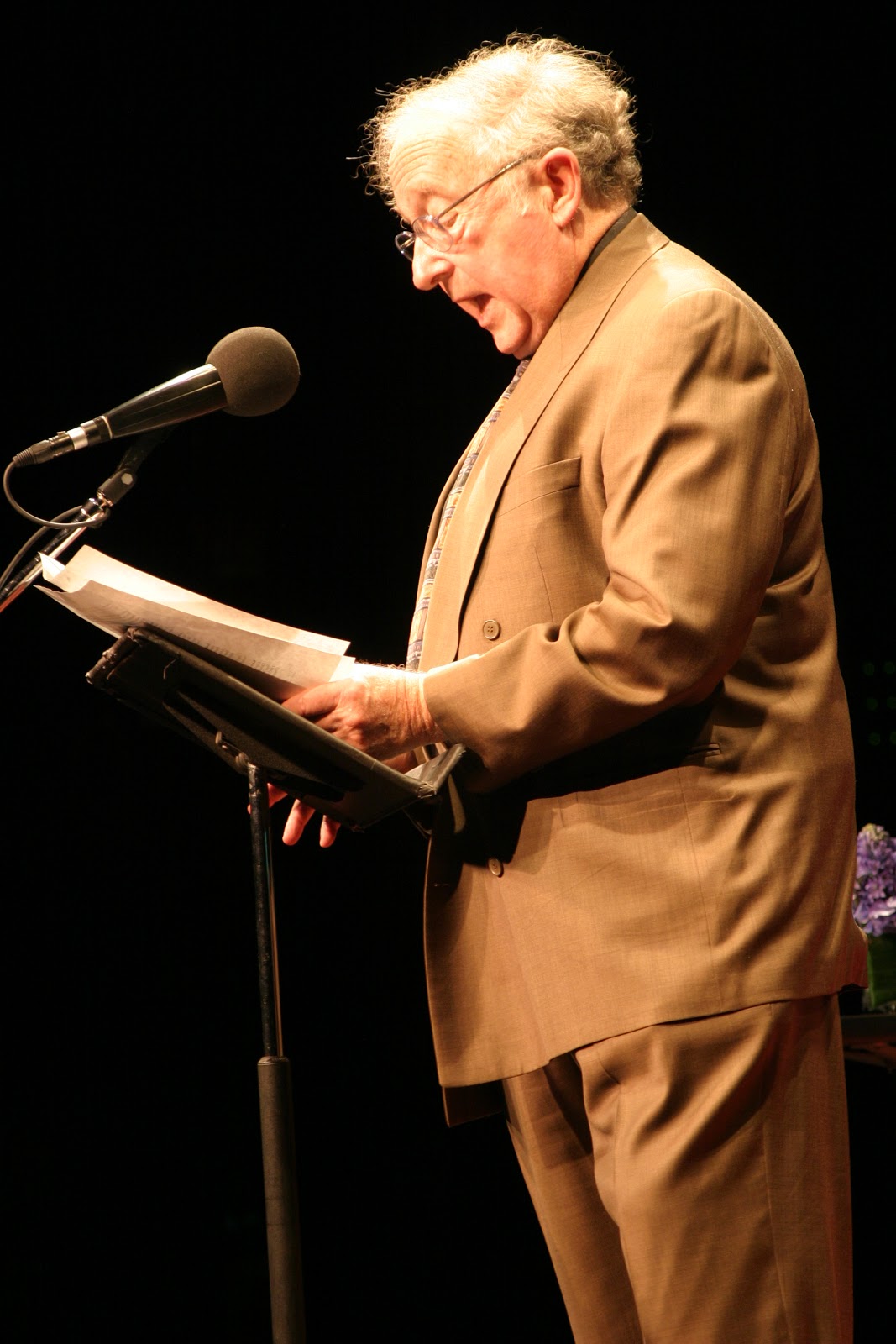
Isaiah Sheffer at the mike*
On Saturdays, “Selected Shorts” was broadcast on NPR. Every week, I listened while recording the show on cassette tapes (yep, cassette tapes). They are prized possessions—I’ve played them thin! I’ve listened to Lou Antonio reading the last paragraph of Tobias Wolff’s “The Night in Question,” fifty times or more. Every single time, the paralyzing windup to the devastating last line, “It’s okay, Franky. I’m here!” pushes tears into my eyes.

This was before my work with One Story, before my MFA, before I received the call from The University of Iowa Press. I hoped if I listened hard enough I would learn how to write a short story.

Isaiah Sheffer, the host of “Selected Shorts,” passed away last week, and the short story lost one of its best friends. I was lucky enough to meet him twice. The first time I was too nervous and couldn’t get my voice to work. The second time I was able to force out how much “Selected Shorts” means to me. He was kind and dear and oh, that voice! It is the voice I hear when I read short stories. It was thrilling to hear it in real life.

* At The Story Prize's first event, a Selected Shorts program at Symphony Space on Jan. 26, 2005.


Thursday, November 15, 2012

Steven Barthelme Aspires

In the 40th in a series of posts on 2012 short story collections entered for The Story Prize, Steven Barthelme, author of Hush Hush (Melville House), explains why he doesn't call himself a writer.


I became a writer in about 1989 but that only lasted for a brief period, a few years, until I wasn’t anymore. At first, when I was 17 and on through about 30, I would not call myself a writer because it seemed something too fine and too accomplished, something wonderful that I aspired to but didn’t qualify for. Actually it was longer than that, it wasn’t 30, I felt the same way even after publishing a book of short stories, getting a job as a professor of English teaching creative writing. The only time I ever felt that I was a writer was a brief period of a year or two, when I was about 42, after a fancy literary agent got me a contract at Random House to publish a novel and a second collection as well as to reprint the first collection in Vintage Contemporaries. I probably felt that I could stop holding my breath then. None of that ever happened, of course. I wrote the novel, which wasn’t much good, and Random politely declined to publish it; the other commitments were contingent, and so evaporated. I went back to my previous sense of things, in which, truth be told, I was more comfortable, as a person who aspired. Someday I would succeed, at writing something good, and at publishing as well.

For many years now, when people at a doctor’s office, or in the casino at a blackjack table, ask what I do, I tell them I teach school. It is, after all, how I pay the freight. The people at the university have the good grace not to ask if I’m qualified to teach what I teach, as any professor knows that almost none of us are, in God’s eyes. But my understanding about writing stories has deepened only very recently, and it’s only now that I grasp the thing better. I’m not a writer. I’m some English teacher, a guy who is fond of television and mows the lawn, likes steaks and cars and cats, sleeps badly, who sometimes plays the instrument, likes words, likes sentences, likes typing.

Of many things I wish I had written, one thing for which I hold a fixed awe and a fierce envy, and which is also germane here, is a preface James M. Cain wrote to one of his novels [The Butterfly]. The preface ends with these more or less flawless sentences: “Yes, I have actually mined coal, and distilled liquor, as well as seen a girl in a pink dress, and seen her take it off. I am 54 years old, weigh 220 pounds, and look like the chief dispatcher of a long-distance hauling concern. I am a registered Democrat. I drink.”  

Tuesday, November 13, 2012

Michael Jeffrey Lee's Stories That Will Never See the Light of Day

In the 39th in a series of posts on 2012 short story collections entered for The Story Prize, Michael Jeffrey Lee, author of Something in My Eye (Sarabande Books), discusses some story ideas he pursued that didn't work out.


What’s the worst idea for a story you’ve ever had?
I have ideas for stories all the time: I might be standing on a bridge, looking down at the freezing water, I might be walking home late at night, trying not to be murdered, or I might be getting intimate with a significant other, but no matter where I am or who I'm with, my mind is working overtime, helping me generate fresh ideas and inspirations for my fiction—that’s why I always keep a pen at the ready. There are days when I can barely jot my ideas down fast enough, and I can fill whole Moleskins without coming up for air … it’s on those days that I feel my most healthy and human.

But some of my ideas over the years have been very bad—a few of them have made me downright ashamed of my own brain. Even worse are the bad ideas I insist on laboring over for long periods, bringing them all the way to draft form. A few years ago, I spent several months writing a story about an incarcerated man. He had done something awful, his execution day was quickly approaching, and the stress was causing him to lose his grip on reality: Alone in his dark cell, he would hallucinate and see people that weren’t really there, talking and dancing and carrying on with them until the wee hours. Then, the night before the state was set to murder him, something unexpected happened: He died in his sleep, an apparent heart attack. Then the story took a turn for the humorous, and the bumbling guards, fearful of legal action, tried to carry out the execution as planned, and spent the rest of the day attempting to fool the sheriff and the chaplain and the victims’ family into thinking that the condemned man was still alive, right up to the point that the switch was flipped. I am particularly proud of the last supper scene, messy as it is, though I don’t think much else about the story works—I realize now that the idea was just not original enough. Many authors have just written that story better, and I had no business thinking I had anything new to bring to the table.

Machine dreams
And just a few months ago, I found myself working on another dud—it was a story about a woman who dreamed every night about owning a hybrid car. She wanted to use less gas and help the environment, and even though such a car was well beyond her means it didn’t stop her from thinking about it night and day. She was obsessed, and who could blame her? Also, she was very old, which I was hoping would make her more sympathetic. But then an interesting opportunity came her way: a famous game show began filming in her town, and something told her to try and get on it, so she did, and, just her luck, the grand prize of the day was a hybrid car, and through a combination of chance and skill she managed to win it. She drove it home that day, and it was the happiest day of her life. But that’s where her luck ended. She crashed the car the very next day, and before long, everything in her life was going wrong too, and sooner or later she found herself on the street. The last scene was quite ironic: a jeweled hand passing a single dollar bill out the window of a hybrid car to the protagonist, who stood shivering on a median beneath a freeway overpass. I didn’t really like the story when I began it, and I really didn’t like it when I finished it, especially because it seemed to imply that the old woman deserved a severe punishment for desiring something well beyond her means. I’m glad I lost the story when my computer got wet.    

Just the other day I had another bad idea and wrote on it; from sunup to sundown I worked on this story that will probably never see the light of day. It was a tale of two roommates. They were friends, and they were living in an apartment together. They were both working odd jobs, and, interestingly, they were both involved in romantic relationships that were eating their souls. Anyway, one night, one of the roommates finally snapped, and he packed up his car and drove to the river and then drove his car into the river, but he decided at the last minute that he wanted to live, so he rolled down the window and escaped. The next day he cut ties with his sweetheart, purchased a bike, and turned his life around. The other roommate was happy for him but still mired in his own toxic relationship, which he persisted in for a few more weeks, but one night, his anxiety became too great, and he snapped, and did the same thing with his own vehicle and possessions, and he too turned his life around. Actually, I’m not really sure if this is a bad story or not. I know these people, and I feel too close to the material to be able to judge it accurately. But I suspect that it’s bad, very bad and nasty and quite possibly my worst, and I don’t think I’ll return to it anytime soon.

Anyway, those are some bad story ideas, and if I wasn’t so excited about the one I’m working on today—it’s about a church group building toilets for some grateful villagers in Nicaragua—I’d feel much more depressed about how much of my life I spent working on them.

Sunday, November 11, 2012

Alice Petersen and the Misplaced Prediction

In the 38th in a series of posts on 2012 short story collections entered for The Story Prize, Alice Petersen, author of All the Voices Cry (Biblioasis), reveals her narrative modes.


I love family stories that have a twang of the extraordinary about them. One of the stories in All the Voices Cry has its origins in a piece of family mythology.

When my father was young, during the 1940s, his mother used to give regular card parties, together with lovely afternoon teas. One lady who often attended could predict the future. Once she wrote down a prediction for my father. He read it and put it in an envelope. He has since misplaced that envelope, somewhere in the boxes of belongings that were delivered when the family house was sold at the end of the 1970s, but he says he never threw it away. Still, Dad can’t remember what the prediction said. Now my parents have a wonderfully impossible box room—you can’t just walk in there and look for something—you would have to pull everything out—so we have yet to locate the envelope, although it must be there.

At a family reunion a few years ago we agreed that the idea of the prediction would be a good topic for a story. On that occasion, my daughter and I had just arrived in New Zealand, having totally missed Christmas Day, on account of crossing the Pacific dateline. This loss had been quite hard for my six year old. It occurred to me that you could also lose a day that you did not want to see come, which is how the central character in “Mrs. Viebert’s Prognostication” attempts to cheat his own fate.

But can you cheat fate so easily? And if you succeeded, or if you failed to read the signs properly, would there be a second event in store for you that was your real fate?  This is where the story ends.

The idea that Norman’s life has been directed by a prediction made me think about fate operating from a distance. I did not want to get too close to Norman—I wanted to set him free with his prediction and watch him scuttle about trying to evade it. The action is set either in the distant past or in a kind of limbo of airplanes and airports. Norman thinks that he is planning events, but he is a bit of a blunderer and forgets that the plane might stop on an island in the Pacific en route.

Each story in All the Voices Cry has a narrative mode, or mood, that to my mind suits the subject matter. I decided to use a narrative voice that was not always kind; one that was faintly amused by the variety of fates allotted to the players. I made unjust comparisons between secondary characters: “In 1951 General Freyberg became Baron Freyberg of Wellington and of Munstead in the County of Surrey. Nobody knew what became of Baby Viebert.” In some places I used a deliberate carelessness in phrasing to maintain this distance: “Not long after space men began to speak to Poor Gladys through the radiogram, they came and took her away.” For this reason the narrative voice is not as impassioned as some of the other voices in the book; it is possibly even disagreeable under examination.

The Lament of Icarus
I am a bit of a packrat when it comes to historical detail. It was my pleasure to add in a few remnants from my parents’ wartime childhood in New Zealand: a set of yellowed notepads printed up with grids for a game called “Smash the Nazi Navy” (much the same as a game that we played in the 1980s under the name “Battle Ship”) and a rumpled pair of khaki shorts that my father wore as a little boy.

Likewise, the playing card with the picture of Icarus on the back of it comes from a set that belonged to the same grandmother who gave the bridge parties. The picture is Herbert Draper’s “The Lament of Icarus.” We received those cards in the boxes that were delivered at the end of the 1970s, so I have looked at that picture since I was a little girl. Draper has painted a thoroughly gorgeous Icarus, with vast wings. As a child I thought that Icarus was dreaming and that the mermaids were about to wake him up. I like to think that the real Mrs. Viebert played a good hand with these cards.

Friday, November 9, 2012

Charles McLeod's Dedication

In the 37th in a series of posts on 2012 short story collections entered for The Story Prize, Charles McLeod, author of National Treasures (Outpost 19 Books), speaks to who his book is for.


This book is for the first house past the strip mall, red fabric over the windows, strangers’ shadows stamped on them by the ceiling’s bare bulb. This book is for the fifteen year old twink tricking in front of the suburban Chevron, shivering into his cigarette, underdressed, a wad of hundreds in the crotch of his briefs. This book is for people living in towns that died with the train tracks, Eisenhower’s interstates erasing, for them, everything. This book is for the homeowner weeping in her mortgaged foyer, each memento now math in an unsolvable equation. This book is for the month-to-months at the weekly motels, tan butts spilling from tiny, tin ashtrays. This book is for the black kid skating up East 14th, out toward the worst part of Oakland; this book is for what he has to do, once he gets where’s he going. This book is for the dopesick lost driving West Virginia highways. This book is for wrecked-leg Vets cloaked from the world by the walls of care wards, betting their checks from the Feds on baseball. This book is for long-haul truckers who shoot crank on the clock. This book is for widowed farmers. This book is for the sad, sick suits humping it up subway steps, trying to remember if they’re texting their mistress or children while on their way to hawk t-bills from skyscrapers. This book is for the bum I didn’t give money to. This book is for the cop who let me out of my speeding ticket, after I’d told him that I was a teacher. This book’s for the dead, as an RSVP. This book’s for the people who won’t read it.

Wednesday, November 7, 2012

Jennifer Moses: Schedule? What Schedule?

In the 36th in a series of posts on 2012 short story collections entered for The Story Prize, Jennifer Moses, author of Visiting Hours (Fomite Press), discusses her writing habits and sleeping regimen.


When I speak to audiences about my work as writer, the one question that invariably comes up concerns my schedule: “What kinds of hours do you set for yourself?”

“I don’t.”

And then the collective bewilderment. The idea is that writers, who possess god-like gifts of creativity, must also hew to a rigorous discipline of endless hours at the writing desk, a la Tolstoy, or the work simply won’t get done. But then you have to think about the likes of, say, Trollope, with his forty-seven novels, twelve collections of short stories, eighteen works of nonfiction, two plays, and life-long day-job at the British postal service, his decades-long habit of fox-hunting, his run for Parliament, and his marriage; or, to take another good example, Edith Wharton, who spent a whole bunch of time decorating, buying and selling real estate, schmoozing on an international scale, and making trans-Atlantic crossings. Come to think about it, the great Tolstoy himself, when he wasn’t writing, was busy chasing tail, gambling, fighting, impregnating his wife, launching various Utopian educational programs, volunteering to save Russia from itself, organizing food drives for various famines, suffering spiritual crises, and generally being all over the place all at once and all the time. Coffee, anyone?

Tolstoy, Trollope, and Wharton pause—momentarily—to pose
I too drink coffee, but not much, and that’s because I don’t need to. After all, the one schedule I do rigorously adhere to is my sleeping schedule, which demands no less than a full nine hours of nighty-night, every night, and without fail. If I get less than nine hours of sleep, I’m so off-kilter that anxiety creeps up on me like a tsunami and I go around the house hugging stuffed animals to myself and crying. Really. I know all about sleep deprivation, too, having experienced it both during the infancy of my and my husband’s first-born son (who is now 23), and, four years later, of our twins. Let’s put it this way: given how tired I was, it was a miracle I never dropped any of them on their heads. Or tucked one of them to bed in the freezer compartment of our family-sized Whirlpool, where I wouldn’t have to hear the kid screaming.

The point is, the one thing I did do “full time,” to use the ridiculous nomenclature of our post-industrial, hyper-wired, and over-stimulated times, was be a mommy. The job came fully loaded with a mommy mini-van complete with the scent of ancient spilled chocolate milk; a mommy tummy, crisscrossed with stretch marks; a house filled with cheap plastic toys; and endless trips, to doctors and dentists, to soccer practice, to back-to-school nights, to meetings with the principal, to cross-country meets, to eight thousand birthday parties, to school plays…

Thus one of the many lures of writing short stories. Because one of the great things about the form is: a short story is, you know, short. WHOOSH! A voice is speaking, dictating the first, and then the second, and then the third sentence and so forth and so on until I look up from my computer and gosh darn it if both twins aren’t up from their naps and screaming their lungs out, but that’s okay because, what do you know, the Eagle has landed. Or maybe it’s a rather less pleasant experience, where—KERBANG!—I get this utterly fab idea for a sweet little story, only it dies a slow and desperate death on the page, one agonizing paragraph after the next, until, by half-way through what was supposed to be a masterpiece, the thing has expired. But at least I didn’t forget to, you know, pick up my kid from school. Not to mention that I got a full load of laundry done.

Not that I waste a whole heck of a lot of time, either. Because the one thing about getting things done is: you have to do them to do them. That includes writing. There just ain’t two ways about it: If you want to write that story, or novel, or poem, you’ve got to sling your butt in the chair and put one word in front of the other.

Which I do do. I just don’t do it according to the clock.

By the time my little ones got to be bigger ones, and then, thank God, big enough to go to college, I’d long since embarked on other forms: extended essays; memoir; humor; long fiction. But by then my habit of non-adherence to a fixed schedule was long since fixed, such that to this day, Trollope-like, I make a point of regularly mounting my trusty stead to go to the foxes. Kidding! But I do spend a lot of time walking my two dogs, playing the piano, gazing at wallpaper patterns on the internet, re-arranging the knick-knacks, cooking, going to an occasional hip-hop class, meeting friends, visiting my kids, and all kinds of other things that I can’t imagine giving up. And why should I? If Edith Wharton could stay in bed until nearly noon and obsess about home décor, than surely I can, too.

Sunday, November 4, 2012

Johnny Townsend on Excommunication Versus Communication


In the 35th in a series of posts on 2012 short story collections entered for The Story Prize, Johnny Townsend, author of Marginal Mormons, tells how not fitting in has spurred his writing.


Mormons are the only religion that considers Jews to be Gentiles. Mormons are the real “chosen people,” members of the One and Only True Church. They are a separate people and have a testimony that they are superior to others.

I suppose most groups feel this type of superiority and justify it in whatever way they need to. And like many such groups, you are only one of the “good” ones if you fit in perfectly. Mormons are nothing if not religious Stepford Wives.

Only I learned early on that I didn’t fit in. I was gay, and gays were evil. I tried not to be evil, of course. I went to Seminary classes for four years. I read the Book of Mormon 11 times. I served as a missionary for two years overseas. I prayed and I fasted. I wanted to be good.

Even after being excommunicated from the Church and shunned by friends I’d known for years, I never hated the Church. There are many things about it which I still like. I simply don’t agree with it’s insistence that there is no room for diversity.

So I write about the Mormons who don’t fit in. In story after story after story, I show Latter-day Saints who slowly come to the realization that it is okay to be different and to think for themselves. In some ways, this means I have a very niche audience, but honestly, I believe these are universal issues. Almost everyone from any culture at some point has to learn to make choices based on what they personally think is right, and not just on what they are told to believe.

I first decided I wanted to be a writer long before any of these questions entered my life. While still in elementary school, I committed myself to writing books as good as that wonderful Happy Hollisters series. (I recently reread one of them, horrified to see how poorly written it was, but I was captivated as a child.)

I also read Conan Doyle’s The Lost World and later became a big fan of Robert Heinlein’s juvenile science fiction books. I wanted to bring the same kind of joy to people’s lives that these authors gave me. At the age of sixteen, having heard that Mary Shelley wrote Frankenstein while still a teenager, and having read that Edgar Rice Burroughs wrote one of his books in a week’s time, I set out to write my first novel, a science fiction adventure.

It took me a year, but I did it (and you can be grateful that I later destroyed it). I destroyed my second novel as well, another SF narrative. But in college, I started signing up for writing courses, and they all focused on short stories. I began telling tales of my missionary experiences, and a few years later, when I came out, began writing gay stories.

It took a while before I realized that what worked best for me was telling Mormon stories in general, whether gay or not. I’ve written stories in one sitting, in just a couple of hours, and other stories have taken me many weeks to complete. When I’m having trouble writing, I make myself write just one paragraph but commit myself to making sure that one paragraph isn’t boring. I can worry about the following paragraph another day.

I can get inspiration anywhere, from a phone call from my aunt, an email sent by a gay Mormon group, listening to my in-laws in Salt Lake, or simply talking with my partner, another ex-Mormon. I get ideas from newspapers or from watching coworkers. Ideas are everywhere. I usually write one story a month, sometimes two. The most important thing is belonging to different writers groups where I can both get and give feedback on writing. Few writers are good enough to get it completely right all by themselves.

I suppose I am envious sometimes when other people write something wonderful I wish I’d written. Shirley Jackson’s “The Lottery” is exactly the kind of thing I aim for but rarely achieve. If I could write a novel, it would be To Kill a Mockingbird. But I don’t have the experiences and insights of those other authors. I only have mine, so I try to create the best stories that I can write.

I want to entertain, enlighten, and give hope to people that becoming a person in their own right is something they can do, no matter what culture they come from or belong to.