Wednesday, November 23, 2016

Randa Jarrar and the Lonely Voice

In the 40th in a series of posts on 2016 books entered for The Story Prize, Randa Jarrar, author of Him, Me, Muhammad Ali (Sarabande Books), discusses who she writes for and why.


One of my favorite short story writers was also my professor in graduate school a decade ago. Peter Ho Davies assigned us Frank O’Connor’s introduction to The Lonely Voice and Gogol’s “The Overcoat” in his form and theory class. Though I’d been obsessed with short stories my entire life, these texts helped me draw a personal poetics.

My first published book was a novel. Novels are allowed to be—even encouraged to be—messy and baggy. Short stories are controlled, sexy; every sentence counts. And in the story we find the little “man,” and her appeals to be treated fairly—to be seen as one’s sister, instead of the misfit, the outcast who, because she’s relegated to the fringes of society, seems destined to stay there, or to stay outside of society and therefore not privy to its perks, to fair and kind treatment. That is what the short story means to be too; the short story is like the little man; its aim is to make an appeal, on behalf of the misfit.

The short story humanizes those whom larger society would prefer to bury, to keep on the fringes. The short story is a revolution. This is not to say that the short story has to be gentle, to murmur, “Leave me alone! Why do you insult me?” the way Gogol’s Akaky Akakievich does, but it can also shout it, scream it. When I write about queers, fatties, Arab-Americans, Muslims, I’m writing characters that have been systematically ignored, or maligned, or misrepresented, in larger society and in the narratives it tells. My main goal is to craft a good story—the way I measure a good story is not just through language, and on a sentence by sentence level, but also through verisimilitude- does this story sound true? I want to tell these characters’ loneliness, and hopefully, to move someone—a reader who’s chosen to swallow the lie that larger society tells about my characters—to move them to empathy.

I lied. I write more for the characters and the people like them than I do for the ignorant; I write for the fatties and the queers and the Arabs, etc., and if those inside the circle are moved by the way I write about those outside of it, that’s just a bonus.

Every writer I love does this, in some way, and I grasp something different from every writer I love. I love Lydia Davis for her sentences, for teaching me how much I can do in a small space. I love Katherine Mansfield for the opposite—I re-read “Prelude” every year. It’s a 17,000 word story. Bolaño taught me how much riffing a novelist can still do in a short story. I love Sam Lipsyte and Sherman Alexie for teaching me what humor can do in a short story. I love Percival Everett for his seriously playful concepts. Angela Carter is a magician who taught me you can tell a dozen stories with the same cast and setting and general set-up. So did Jamaica Kincaid, who, along with Margurite Duras, taught me that it was okay to be obsessed with my own story. Joyce and Babel taught me how to write about place and childhood and the two of those things, together. Babel threw war into the mix. James Baldwin is a prophet. Borges and Kafka taught me how to write dreams. Alice Munro taught me to always re-think where I end a story, and that female friendship is a topic worthy of literature.

Him, Me, Muhammad Ali is a love letter to loners and to short stories. It’s a book populated with marginalized characters, all yearning for pleasure, for safety, for sisterhood, for a place, both in the landscape of their lives and that of the contemporary short story.

Tuesday, November 22, 2016

April Ayers Lawson on Why She Writes

In the 39th in a series of posts on 2016 books entered for The Story Prize, April Ayers Lawson, author of Virgin and Other Stories (Farrar, Straus and Giroux), explores what motivates her.


Over the years I have often asked myself why I write, and to be honest in answering this question publicly is hard because it means admitting I Don’t Know. But I have theories and the two that together form an answer are as follows.

The first—which will probably sound terribly unromantic—is that I write out of compulsion. As a kid I began to feel the urge to make stuff, which first manifested with visual art and inventions, and when I was in my late twenties this compulsion to make things turned almost completely to writing. When I go for a while without making stuff, there’s the feeling that I should be, and sometimes a feeling of pressure in my head, of disorder, and of not being able to think clearly enough. I do still draw, but it’s mostly doodling complicated abstracts—on the corners of papers, on lesson plans for teaching, on envelopes, on disposable restaurant menus meant for kids to color on, whatever is around. In the sense I work on them until something clicks, until they feel complete and I feel right in response to them, you could call them mandalas. Sometimes I don’t even know I’m doing it until I’ve already started. Each mark I put down requires for the sake of balance another, and so on, and I’ve figured out that the way a story grows for me is a lot like this. That the stories are types of mandalas. I suspect the basic urge to be at least in part fueled by inner restlessness, anxiety, and an excess of emotion. Also, I’ve noticed that the sense of compulsion waxes and wanes; that I go through phases of feeling it intensely and then barely at all for months.

The second is that I use writing to get in touch with a place that would otherwise be out of reach. It’s not usually easy to get to. When I’m in that place, what comes out onto the page surprises me even as it seems inevitable. And when for some reason I don’t write for a while, I sometimes in my mind see the image of a blocked window—like the air and light that’s supposed to be getting in isn’t getting in and one part of me is saying to another, Why are you keeping this window that’s supposed to be open closed? Why are you cutting off the life?

Monday, November 21, 2016

Sara Majka on Starting to Write Again

In the 38th in a series of posts on 2016 books entered for The Story Prize, Sara Majka, author of Cities I’ve Never Lived In (A Public Space/Graywolf Press), discusses the importance of having time to fail.


Around this time last year, I had a baby, and though I’ve tried to read and write since then, mostly the year passed without writing. So lately I’ve been thinking about how to start writing again, and I feel tentative about it and also have that sense that so often happens—that I’ve lost the ability to write, that I’ll try and find that I won’t be able to do it anymore.

I remember once reading that if you’re stuck in your work, then it’s best to read, read something good, and soon enough, you’ll find yourself writing again. This advice seems more geared for the short time block, but I do think reading may be the most important step. When I’m not reading, my acceptance of sloppiness of thought grows—things can start seeming fine enough. Another thing that I’ve done in the past is to journal. I wrote in diaries when I was young, and it used to be a way to return to basics to start again, but I find that I do it less and less. I’m not sure why.
Pram in the hallway

I also think about my ex-husband, who was a mathematician, saying how when you’re a young mathematician, it’s best to put a lot of time into your work, so that many projects are laid out for you for the future. That reminds me of the time when I was a fellow at the Fine Arts Work Center in Provincetown. I was a fellow for seven months and nothing I wrote was very good, but I did produce a lot of it. I had stacks of printed pages on my desk. I don’t think I ever even reread that work, but its usefulness was that—during the time I spent writing it—I was actively creating an imaginary world, one I could return to later and write from. I imagine it as sort of pushing out space in my head—excavating it, or tunneling as one might tunnel mines, or laying down the tracks. It takes a lot of time, but those months of inner time could be used for years to come.

With the baby now, I don’t have that time anymore. I feel unsure how to get started again. In the past I would lie around and read, read for long hours, read lazily, read because there was nothing else to do, and slowly begin to pick at writing until I found that metronome of working again. I would then write badly until I’d written so much that a little bit could be salvaged from it, and then that little bit could grow into its own thing. One of the hardest parts about writing when you’re pressed for time is that it’s the least efficient thing in the world—I think of our electrical grid as I write this, where such a small amount of the electricity that’s created actually goes into lighting the bulb that I am writing this by.

Now that the baby is older, I could find time to write, but it would be hard to find time for all that failed writing. For me writing begins in earnest when I allow myself nothingness: allow that nothing will come out of it, that I’m moving toward nothing, that I’m gaining nothing—when I’m in full embrace of its futility, which is a way of saying when I’m able to release control. It’s a daunting practice, but certainly the most daunting part is the beginning, when you know that not today, not tomorrow, not even the day after that will you be able to write anything good.

Saturday, November 19, 2016

Kevin Hardcastle Says: Nobody Will Really Believe You Can Pull This off

In the 37th in a series of posts on 2016 books entered for The Story Prize, Kevin Hardcastle, author of Debris (Biblioasis), discusses writing as an act of defiance.


I wanted to write for a living since I was a kid, for as long as I knew what it was. I’ve been focused on it for so long that sometimes it’s worthwhile to step back from it and think on how it looks from the outside. Most writers know the range of the reactions they get when they tell someone that is what they’re trying to do for a living. Sometimes it’s a genuine interest, sometimes just the good ol’ blank stare. That kind of thing is old news to most of us, even to writing students and emerging writers. There’s a feeling that you are tapped into something that doesn’t have to be understood by everyone, whether in the motivation to write or in the actual nuts and bolts of the writing process.

There are many of us who have seen their writing reduced to a hobby or affectation in the eyes of people on the outside, and I think any good writer has found a way to plough through in spite of those who might tell you to give it up and get a real job (of course, most of us do have real jobs as well). The act of writing and all of the work that goes into it can be a valuable act of defiance, and there is something profound to that. What I’m interested in, and what I’d say to young writers, or myself as a kid, is that the doubts and disbelief will not stop with those folks who don’t write, or who think it’s not a realistic path. In fact, the further along you get the more you run into those folks, or some publishing machinery, that will try to tell you that you have certain limits, and that your aims as a writer might be impossible.

I’m still relatively new to publishing, as far as books go. My first collection of stories came out last year, and my novel will be out next year. As there were a lot of educational moments in trying to get published in journals over the years, and going through that process of rejection, perseverance, and, sometimes success, there are similar things that you learn as you navigate the publication of your books. Nobody wanted my books at first. Hell, I was essentially told that none of what I wrote was recognizable as Canadian Literature by people who are in charge of what gets published in this country. But, I felt that there was something valuable being said in my work that wasn’t being said in what we accepted as good writing in Canada, and I battled on. Eventually, I started getting support, reader by reader and story by story. I finally found the right editor (John Metcalf), and publisher (Biblioasis), and the first book did pretty well. I got my little indie tours and good reviews and the book was up for a few prizes, and won the Trillium Book Award.

Head banger: Keep on trying
At this stage, the people who place limits on you come from all over the place. Publishers start telling you what your writing is worth, and what you should write next. Agents have their own ideas about what they can sell, and how much more salable you could be. Even your peers, with books of their own, who’ve been through the wars, will tell you there is only so far you can go. That nobody will care about your book really, or that only so many will. You will not be able to do this for a living. You will not get further than being a writer who publishes some books in Canada and has a little bit of traction in that world. All of these people, anyone other than you, are to be defied and defeated much like a parent or teacher who told you to drop the imaginings and go to trade school. 

Up in Canada, we have a robust community of writers and publishers, and a history of protectionism that both solidified this community, and insulated it from a certain level of competition or ambition. My aim as a writer is to make a living at this, and to get my books into places where they have a history of reading those kind of books, and to potentially break into other markets where the writing might find readers we didn’t know were there. I’m trying to get into Cormac McCarthy, Daniel Woodrell, Donald Ray Pollock territory, and find the readers that go for those books in the U.S., and worldwide. If the Canadian market is, in itself, something that tells you that your writing will only do so much, the way that you are looked at for reaching beyond that is like you’ve told somebody you’re going to land on Mars. Nonetheless, that is where I’m trying to go.

I’ve been lucky to have found some peers who are very good writers, however different they are from each other in their work. And, the reason they are good, to some extent, is because they couldn’t give a damn what other writers are telling them their limits are, and because they are not letting it impact the aims of their work. Better yet, we are all very competitive with each other, and want to absolute destroy each other on the page, to have our writing be the best, to stand out. That is a good thing, though writers are often too precious and sensitive to behave like that. We want to be the best on the page, but are friends in real life and support the successes we all have, especially when new ground has been broken. That lifts all boats, and it is the reason I have hope for an interesting future in my country’s literature.

So, I would tell any young writer, or anyone being told what they can’t do with their writing, to keep bashing your head into that wall until something gives. You might’ve had that moment in your early writing days when you guessed that nobody, nobody, thought that you could do this but you. And when you start to prove them wrong, that is a beautiful thing. Take that with you when the stakes get higher, and aim for whatever thing you are told you can’t do. The fear of this, in Canadian Literature, is something that has discouraged many good writers and turned others into some facsimile of themselves. You might well aim high and miss, but I bet you’ll land higher than you would’ve otherwise. It must be said that I know the reality of what might happen with my writing, as do the writers I like and respect for their ambitions. I have no designs on fame and riches. But I do think that, if you write honestly and tap into something that you know has purpose, that resonates with other people, you may just be that one who breaks through and gets to do this for a living. So, with my feet firmly on the dirt, I believe that those aims are worth having. And you should too. You should believe that in your blood and bones, especially when nobody else does.

Friday, November 18, 2016

Maureen Millea Smith on the Lasting Influence of Libraries

In the 36th in a series of posts on 2016 books entered for The Story Prize, Maureen Millea Smith Oldshue, author of The Enigma of Iris Murphy (Livingston Press), on how her path to being a writer started in a library.


When I was a grade school aged child in Omaha, my father would take my siblings and me to the Old Main Library on Saturdays where Miss Adeline Proux of the Children’s Room would help us pick out books. On average my father took three children at a time on these trips. If we did not go on Saturday he would take us there on Wednesday evening, going first to the Fontenelle Park duck pond to feed stale bread to the waterfowl, and then onto the library. My mother would be at home, often blessedly alone, cooking dinner.

My parents lost two children. My younger brother was born with Down syndrome, and died at four months of age from pneumonia. Six years later my older sister, who was eleven, died of glomerulonephritis. The library routine was part of their pattern of keeping their five remaining children busy and engaged. Ice skating, gymnastics, summer school, piano lessons, baseball, my parents found things for us to do. We soldiered on.

The visits to the library were wonderful for me. Reading was my solace in a time of upheaval; it still is. Miss Proulx and her staff gave extraordinary readers’ advice. I became a fiction addict and a student of the story. The public library nursed my soul. Novels that depicted the inner workings of a character’s mind taught me about humanity. Books educated me to the mysteries that exist beyond Nebraska.
The old Omaha Public Library building

In college, I became an English major because I liked to read and I liked to write essays. When I received a hideous score on the LSAT in 1980, I felt doomed. In my day, all English majors said they were going to law school; parents liked those words.

After my LSAT debacle, I remembered what a librarian named Margaret Marrs had told me when I was a page at the Omaha Public Library:

“You should go to the University of Iowa and get your MLS. You would be a great librarian.”

When I told my advisor at the University of Wyoming, Professor Janice Harris, that I would like to be a librarian, she also believed that it would be a fine path for me. My mother was appalled when she heard about library school, certain, I am sure, that I would live a life of dire poverty, unmarried, in a hovel. Upon arriving in Iowa City I dutifully took my courses and learned all about cataloguing and reference, library boards and intellectual freedom, and met the man who would become my husband.

What became my private obsession at the University of Iowa was the Iowa Writers’ Workshop. Studying library science became my cover for wanting to become a writer. I knew more than anything else, even then, that I wanted to write fiction. I understood that if my mother ever learned that I wanted to be a writer she would jump into the family Ford and drive Interstate 80 to Iowa City to set me straight. Mom catalogued writers under “starving artists” and “adult children who live with their parents forever.” I kept this dream under wraps.

My husband’s career took me to Ohio where I would work seven years in the Fiction & Young Adult Department for the Public Library of Cincinnati and Hamilton County. Later we moved to the Twin Cities where I would go to night school for an MFA in creative writing at Hamline University. In the age of memoir, I was dedicated to fiction.

My characters open their worlds to me. They are more than me. They make me excavate the facts of their lives. They demand do-overs, re-writes, renovation, compression, and revision when it comes to their stories. They surprise me endlessly, turning my plotlines into dust. Whenever I open my laptop and begin to read a current story or chapter aloud, that incantatory process of getting back into a character’s life, I leave mine behind. Most of the time this is good.

Once though, when I was having what human resource professionals love to call “work/life stress/balance issues,” I said to a particular character,

“What if today I just wrote about me?”

Silence came over that corner of my bedroom.

My cat looked up from her place on the bed, warily.

“But I have the better story,” he said back to me.

My characters are not my imaginary friends.

I sighed, wept a little, and got on with his life.

Wednesday, November 16, 2016

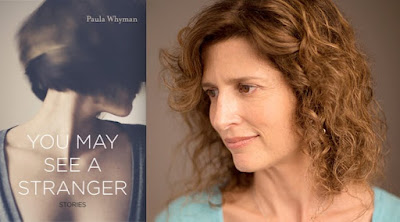
Paula Whyman's Six Steps to Conquering Your Fear of Sex Scenes

In the 35th in a series of posts on 2016 books entered for The Story Prize, Paula Whyman, author of You May See a Stranger (TriQuarterly Books), offers some advice on writing about S-E-X.


Even writers who feel competent at creating just about any kind of scene can be stymied by sex scenes. I’m often asked how I approached these scenes in my story collection. The answer is, the same way I approach any scene. I have in the past compared writing sex with writing about bowling. That is, you don’t need to describe what the bowling ball looks like unless there’s something unusual about it. You don’t need to describe every action, only the defining moments.

Here are my guidelines:

1. Relax.
Too often, writers approach a sex scene like a tornado is threatening: Red alert! Sex scene approaching! Normal writing style must cease now! The result is that we wake ourselves from the dream state in which we usually do our best work, and then we write something plodding, labored, or squirm-inducing, and by doing that we throw the reader out of the story as well. My advice? Calm down. Stop heavy breathing, and just breathe. Tell yourself these are only words, like all the other words.

2. Ask yourself: Is the scene necessary?
Practicing: Dressed rehearsal
Every scene in a story should pass this test. What work is the scene doing in your story? Does it advance the plot? Does it illuminate character? (Extra credit if it does both.) Maybe we need to know that something happened, but we don’t need to actually see it happen. Much of the time, it’s not necessary for your characters to bare all. Let the romantic couple disappear behind a closed door, 1950s-movie style. The reader can imagine what went on. Trust your reader.

3. Remember character—forget yourself.
So you do need the scene; something important is conveyed there. It can be easy to forget in one’s anxiety about writing a sex scene that your character’s actions still must be consistent and true. Remember to filter the events through your protagonist’s perceptions. What would she do in this situation? What would she notice about herself and about the other character/s in the scene? Choose your details carefully and sparingly. We don’t need to know and see everything. Don’t show the reader what he already knows or can presume; describe what’s unexpected or unusual. For instance, in my book, there’s a scene in which the female protagonist is in bed with a man who shoves her hair into her mouth and then asks her a question. She can’t answer, because her hair is in her mouth. Soon, she reveals that he came, and she didn’t, pretty much in those words. There is no abstract description of her physical state, and minimal description of the act itself. The brevity is appropriate to the act. From the few details that are provided, the reader can imagine what this encounter was like for the protagonist.

4. Avoid overzealous overearnest overwriting.
Stay away from awkward metaphors, abstraction, or description that’s too clinical in its word choice and detail. Speaking of words…try to choose the right word for the moment, as you would in any scene. There are, for instance, any number of slang terms for sex organs, and if you find you must use one of these words (note that many a convincing—and hot—sex scene has been written without any reference to a specific “private part”), there will probably only be one word that works without causing the reader to flinch. The right word depends on the situation and the character, so try it different ways. Go to a quiet place and read it aloud to yourself, like you would any scene…but maybe not when you’re at the office.

5. You can’t be serious.
Sex in real life is often funny. If you think about the mechanics in any objective detail, the whole thing seems weird and awkward. In real life, people bang glasses when they kiss or someone gets an accidental elbow in the eye or a knee in the groin. I’m not suggesting you put a humorous sex scene in your story if it doesn’t fit the tone. I am saying that the tone in your story should be consistent. There’s no need to suddenly go somber just because your characters have landed in bed. If the characters are funny with their clothes on, they’re still going to be funny—funnier, even—naked.

6. Show your work.
Choose one or two trusted readers and ask them to be honest about whether there is anything that throws them out of the story. Listen, and revise accordingly.

Now, off to the bowling alley!

Monday, November 14, 2016

Brian Booker on Taking Characters for a Ride

In the 34th in a series of posts on 2016 books entered for The Story Prize, Brian Booker, author of Are You Here for What I'm Here For? (Bellevue Literary Press), lays out an effective story strategy: putting your characters in a car.


Sometimes when my story draft is running low on gas, I try to persuade my character to get in a car and go. My characters find themselves getting picked up and taken for a ride, or being asked for one, or taking a wrong turn in middle of the night.

A car trip gives intention (conscious or otherwise) a trajectory in the world, and the world has many ways of interfering with it. It does so with gruesome fatedness in Flannery O’Connor’s “A Good Man Is Hard to Find,” which has plenty of suspense even though the opening paragraph announces where the story is headed: The Misfit, escape from the Federal Pen, headed to Florida (where the family is also headed). It’s a masterpiece of pacing: The path from beginning to end is not a straight line, and in order to stay the fated course, the family must go off course, which they do “outside of Toombsboro,” when the grandmother “recalled an old plantation that she had visited in this neighborhood once when she was a young lady.” It’s a particular type of lostness, both in place and in time, in which the discrepancy between the map (the grandmother’s memory/desire) and the terrain (the dirt road down which the family’s car races in a swirl of pink dust) generates a dislocated worry before driving the story into the promised horror. It’s hard to imagine that working so neatly in the age of GPS.
Road trip: Setting events in motion

Especially in America, the car is a metonym for the body and ego. It’s an escape pod that ushers you through an indifferent or hostile landscape, a mechanical being that, like the body, can falter and fail and die without warning. In Annie Proulx’s folktale “The Half-Skinned Steer,” the octogenarian businessman Mero is driving his Cadillac (he’s afraid to fly) from Massachusetts back to the Wyoming ranch whose depredations he fled sixty years earlier. The plot is designed to funnel old Mero into the traps set by memory and the high desert landscape, where the smallest mistakes have the direst consequence, until he finds himself alone and unsheltered in terra malcognita, “the cliffs rearing at the moon, the snow smoking off the prairie like steam.” The car is a little world, but the world outside is bigger.

The interest of car trips has something to do with the ontologically ambiguous position of the person in transit, who is here but not really here, who is on her way somewhere else.  In Joy Williams’ story “The Little Winter,” from her collection Escapes, a terminally-ill woman named Gloria travels to visit her old friend Jean and Jean’s daughter Gwendal. Gwendal, who is disconcertingly precocious, offers to write Gloria’s biography; she asks if Gloria will kidnap her. Gloria accepts the offer, picking up the girl in the middle of the night. Not until the two have set off on a strange kind of road trip to nowhere, staying in motels like stations in a bardo, do we realize the extent to which Gloria’s mind is unraveling—either that or Gwendal is a demonic figure, an emissary from Death riding shotgun.

There are different shades of kidnapping; car stories can generate suspense from the unstable balance of power between driver and passenger. If a good craft tip is to have your character pick up the person they shouldn’t, another is to have the wrong character get behind the wheel.  That’s what happens in the last section of Edward P. Jones’ story “The Sunday Following Mother’s Day.” Madeleine hasn’t seen her father for thirty years since he went to prison for murder. He shows up at her door as she’s preparing to go visit her son at the state asylum. The father offers to go with her, to drive Madeleine to the asylum in his car. She doesn’t need or want his help, but as if in a kind of dream, she consents. Wrong driver, wrong car—that’s what swerves the story onto its marvelously uncanny track.

I am glad that soon cars will be smart and drive themselves. They won’t kill us as much, or let us kill each other and the planet so easily, which is good. They will buffer us from the consequences of our erratic emotions and feeble attention. But something will have been lost for fiction, just as it was when the cell phone made it harder to get characters incommunicado, and thus to get them out of their depth or beyond the pale, at least geographically speaking.