Thursday, August 30, 2012

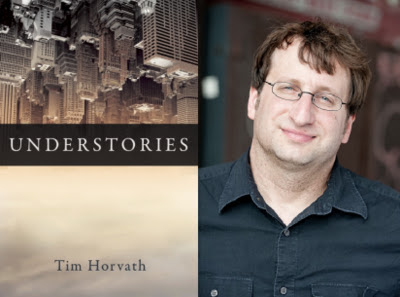
Tim Horvath and the Study of Shadows

In the 26th in a series of posts on 2012 short story collections entered for The Story Prize, Tim Horvath, author of Understories (Bellevue Literary Press), discusses how stories build in his mind and where he finds inspiration.


How often does an idea for a story occur to you, and what triggers those ideas?
My strongest stories seem to emerge not from a single epiphany but from years of long, quiet triangulation, so for me it’s not a matter of trusting a smashing first impression as much as its refusal to go away. “Planetarium” gathered itself together over a decade, if you include 1) my teaching in a school that had a planetarium that no one ever seemed to set foot in, 2) an occasion of drunken escort, and 3) camping and hiking in two jawdropping landscapes, Chiricahua National Monument in Arizona and Glacier National Park in Montana, where I finally decided to set it. My friend Rebecca Makkai uses the term “echo chamber” to describe the elements that a story needs in order to fully emerge, and I think I mean something similar by triangulation. If the points of the triangle are farther apart, so much the better—more tension, more twang.

But sometimes an instant does the trick. “The Discipline of Shadows” came into being as I was meeting with my writing group in the now-defunct Second Run Bookstore in Portsmouth, New Hampshire, sunken into the puke-green couch underneath these old exposed beams, surrounded by books. We decided to open up books at random and choose a sentence that would be our prompt for the next meeting, and the first thing I opened to was from an Antonya Nelson story: “How is it the squirrel did not slide?” What a line, I thought. My fellow writers had some imaginative takes, and as for me, I envisioned someone observing a squirrel whose shadow moved even while the squirrel itself didn’t budge, and this was a total crisis for him (the man, not the squirrel). Why was it a crisis? Well, clearly he was obsessed with shadows himself, and the reason the squirrel didn’t slide was because he was losing his mind because he was studying something outlandish. But what if it wasn’t crazy? And then I began to watch some Wayang Kulit Indonesian shadow theater and the work of a San Francisco company called Shadowlight Productions that brilliantly combines traditional work with a modern vibe, and I felt, “It’s crazy not to study this.” Hence, I invented a field I called umbrology, the study of shadows, and that got the story off and running, with shadow theater and optics and film noir all rubbing shoulders. The squirrel didn’t slide, but plenty of other things did.


What’s the worst idea for a story you’ve ever had?
“Circulation” began with the notion of having a library book tell its own story of its journeys. If it had stayed in that form, I think it would have run into insuperable difficulties, a gutterball that would probably have never seen the light of day. A blathering book seems like the kind of idea that might make you bolt upright in mid-sleep-cycle at 4 a.m. to scribble it down, convinced of its sheer brilliance, its Chekhovian profundity, only to find yourself shaking your head over breakfast, “That can’t have been it.” But even on the off-chance that I’d managed to pull that off and find a gregarious, charming book-as-narrator, the story would’ve been about something utterly different, simply couldn’t have foregrounded the father-son relationship that it now feels inevitably rooted in.

Where do you find inspiration?
Lots of places, but here are a handful:

Obsession is a most loyal muse. If I get obsessed with something, I know I can write about it, because it clings to me everywhere I go and grabs everything in reach. For instance, with shadows in “The Discipline of Shadows”—it’s fun to imagine the art and science of shadows, because they really are everywhere, lurking about in nearly every situation, and once I started researching them I realized that while I’d come up with this word “umbrology” (a word which a handful of other people have also used to describe various similar things), it really does exist in a certain way, just not under that name. Other obsessions that show up in the book: food, film, dying languages. Right now I’m obsessed with avant garde classical music.

Voices. I listen to a ton of audiobooks—I always loved being read to, and need to hear the grain of my narrator’s voice to have a clue who s/he is. In “Planetarium,” the main character is temperamentally an engineer but wants to shed that, yearns to leap his way right out of his skin and experience everything in its sensuous immediacy rather than through diagrams and schematics, craves the full-on night sky instead of the planetarium’s shell. But at some point long ago he had it drilled into him that he was a born engineer, and he capitulated to that, as, of course, sometimes happens. He glimpses that there’s something outside of that, and because it is frightening to acknowledge this he only allows it as an aspect of a distant past, and clings to it the way someone who has memorized a single poem in her whole life might let her tongue loll and linger silently on those words from time to time. I heard his voice above all, as if I were listening to someone reading aloud to me. And even more, I think he embodies a key aspect of why we’re reading and writing fiction, partly to get out of our skins, even while another part of us wants to be more fully inside them. This tension—or maybe these impulses dovetail perfectly—is an element that drives some of my favorite stories: they make us other in some way that makes us more fully ourselves, and voice is often where that plays out for me.

Dubious?
Landscape is another huge point of departure. “The Understory” was a sort of triangulation of time, space, and real and figurative storms—the fact that New Hampshire’s forests are similar in their composition to that of the Black Forest in Germany, the fact that there was a hurricane in New England in 1938 and tumult in Germany at the same time, that Heidegger was a nature-lover but also bought into some of the most nefarious aspects of human nature. “Planetarium” pivots on its two landscapes, the New York that it recalls and the Montana in which it takes place. The idea of Gauguin going to Greenland was a matter of taking the place that is always associated with him and stripping him of it and then posing, “Okay, Monsieur, what is your art really about?” Right now I’m working on a piece about the Desert of Maine, which has been dubbed a “dubious desert,” since it isn’t, technically speaking, a desert, but it looks and carries itself like one, albeit tiny. So I’m love with the place, right down to the fiberglass camel that stands guard, the only trace that there was once an actual camel roaming around there until someone decided it was acting too belligerent and was scaring away the tourists. I love stuff like that. Imagine, they were surprised that a camel wasn’t chummy and well-mannered when it was being paraded around a fifty-acre pile of sand in northern New England!

I’ve always found myself drawn to characters, too, not so much literary as real-life ones, those of whom you’d say, “He’s a real character.” Most people are once you get close enough to them, some more unabashed in it than others. In high school, my friend Dave and I spent a lot of time getting to know the cast of regulars at Yonkers Raceway, where Dave would bet and I would pretend to watch the horses while actually studying the men (mostly) and inhaling a lot of cigar smoke, noting the crudely-taped-together glasses they couldn’t afford to replace and hearing them spin the next race so that it fit whatever their pet theory was, which was, of course, a window into their beliefs about the world.

Until recently, I was working part time at a psychiatric hospital here in New Hampshire. I’ve never written about it at length, although I hope to at some point, and so much of what I learned there informs my understanding of behavior. Being there was a positive experience in so many ways, although I got punched, kicked, bitten, spit at, found myself on the floor numerous times, sang and skipped and danced my way out of harm’s way, and had to convince at least one person to hand over a knife. Working there could be like facing someone with a booming tennis serve for eight hours straight. Amazing people, though, my co-workers and the patients themselves. I often felt deeply what was at stake, which of course we always talk about in terms of short stories. When you’re interacting with a steady stream of people who have decided that maybe life isn’t worth living, you have to come with reasons on a dime that it is and hold fast to them with utmost conviction. I’m not necessarily as observant as I’d like to be, but when a single staple could be unbent by someone to hurt him or herself, you develop skills of observation that border on the preternatural, along with an abiding respect for how many layers every person and situation has. I hope I bring these back to my writing. Some of my favorite writers of radically different styles are outstanding observers of both the outer shapes of behavior and its inner gears. David Huddle and Javier Marias are two I’ve enjoyed recently. As far as that business of getting out of one’s skin—well, they are uncannily gifted at getting under others’.

Saturday, August 25, 2012

Jeffrey Ford on Storing Away the Colorful Bits and Pieces

In the 25th in a series of posts on 2012 short story collections entered for The Story Prize, Jeffrey Ford, author of Crackpot Palace (William Morrow & Co.), tells about snatching up details of things people tell him and turning them into stories (or holding on to them for later).


Q: If you've ever written a story based on something another person told you would make a good story, what were the circumstances?

I don’t think I’ve ever written a story based on someone’s recommendation that it would be a good story, but a lot of times people tell me things just in passing conversation that I'm happy to snatch up and make use of. 

A friend of mine told me that he went to pick his kid up at daycare one afternoon and found that the teachers had taken out the dress up box and all the kids were in old costumes. He noticed that there was a boy wearing a fake mustache, sitting slumped over and crying, saying he couldn't remember any more what it was like inside his mother’s stomach. My friend said the kid was trembling, like the realization had just struck him. Standing next to the boy was a girl in a gauzy pink princess outfit, holding a wand. She waved it slowly over the boy's head and said, “Forget, forget, forget....” All I can say is that the way he told it, it seemed to me that this had been an authentic experience. It didn't matter, though, as it was a little too neat to use as it was. Over a period of months this incident bubbled up in my thoughts quite often and I’d think about it. Eventually it formed itself into a story, “The Scribble Mind.”

When we lived in South Jersey, the guy who lived in the house behind mine, Jake, told me that his cousin, Bobby, was employed down by the Delaware river. His job was to dive to the bottom of the river, using only a snorkel from K-Mart and carrying an acetylene torch at the end of a few hundred feet of hose connected to canisters on shore. There was a wreck of an old yacht down there, and he was supposed to use the torch to remove the brass from it. At night, he stayed in a trailer next to the river, drinking 40s and snorting speedballs. “Bobby’s the Walking Prince of Death,” said Jake. I met Bobby eventually, and I could tell instinctively that he was a dangerous character, but he was also funny as hell. For the time that he was around, maybe a year before he wound up in jail in Camden for assaulting and robbing an old lady, the cousins would hold a poker game every Thursday night at Jake’s house. I heard a lot of stories at those games and, after all was said and done, I made a story out of them, “The Golden Dragon.”

Stories and even pieces of stories give birth to stories, like some virulent meme that uses human beings to manifest itself in the world. I keep all the interesting stuff—the colorful bits and pieces of stories people tell me stored away in my head for future use. Here are two I've been holding for a long time. Maybe there's a good reason why. 

When I taught college I had a student once who missed a lot of classes. She could have done very well in the course if she’d shown up more. Near the end of the semester, she dropped out. I got a call from her. She explained that when she would get her period, she’d suffer bouts of amnesia for a few days. She hinted it had something to do with hormones but that it wasn’t absolutely clear. It seemed outlandish, but I figured it might be possible. I told my boss about it and he laughed and said, “That’s bullshit.” I’m not convinced he was right, but either way it seems like something that belongs in a story. 

Has anybody seen Kozlavsky?
When I lived in Binghamton, in upstate New York, I had a friend, Barney, who told me to be on the lookout for Kozlavsky. In all the bars up and down Clinton Street in the first ward, in the lobbies of the two local motels, in the offices of gas stations and the check cashing place, there were oil paintings by a guy who signed his name Kozlavsky. My friend gave me a walking tour one bright Saturday of the local Kozlavskies. The painter had three basic styles, all rendered with a kind of naive approach. One was nature scenes—deer, jumping fish, a cabin in the woods by a lake. The second type was all about flying baby heads, little fat cheeked, hollow eyed heads with wings on them. They flew in various formations across a brown landscape beneath a brown sky. The last type was portraits. My friend told me that when he’d first moved to town, he had an apartment with a big Koslavsky hanging in the living room. The land lord of the place was an insanely angry man, always yelling if the rent was even a day late. Still it was a cool old place, and he and his roommate liked it and took an interest in the painting—a study of a stern looking, dark eyed man, standing in a brown landscape with three baby heads flying over him. They wondered if it was Kozlavsky’s self-portrait. Later on they discovered the proliferation of the artist’s paintings all over town. My friend said he’d inquired a few times about the painter in the local bars, and people said they knew him and that he frequented The Palace A and The Marble Grill. Sometimes Barney and his friend went down Clinton Street, hitting every bar in hopes of running into him, using their memory of the figure in the painting as a guide to maybe spotting him, but they never did. Barney and his roommate were big dart players, and he said he didn’t remember how it happened, but they were drunk and high one night and his roommate threw a dart at the Kozlavsky painting and it stuck right into the center of the figure's left eye. It was just such a perfect throw, Barney said it inspired him to throw one himself. A direct hit in the figure's lips so it looked like the dark eyed man was smoking a dart. After that, it was bombs away. In a week's time the Kozlavsky portrait was riddled with a thousand holes. At the end of that week, they were a week late with the rent and the landlord showed up. He let himself in and caught them sitting on the couch smoking a joint. He started yelling about the rent, and then he noticed the painting. He went silent, stood still, and Barney told me that in that instant he and the roommate realized the guy in the portrait wasn’t Kozlavsky, it was the landlord.

Sunday, August 19, 2012

Fred Arroyo Finds Stories in the Land

In the 24th in a series of posts on 2012 short story collections entered for The Story Prize, Fred Arroyo, author of Western Avenue (University of Arizona Press), tells of his path to becoming a writer and what inspires him.


What made you want to become a writer?
 In our house we had two or three books—a bible, a picture-book history of Puerto Rico, and a history of the Civil War, volume 7 in some colorful historical set you initially bought at a grocery store. Reading did not seem that important in my family, nor education, and maybe that was because making a living was most necessary. I was a poor student (my father only had a third grade education, had been working since forever, and I never thought of much else for myself). I do remember reading some Mark Twain (Tom Sawyer and Huckleberry Finn), The Red Bad of Courage, a biography of Wild Bill Hickok, Catcher in the Rye, and several times a book by Laura Ingles Wilder, either Little House in the Big Woods or The Long Winter. One winter we lived in an apartment next to rail lines, right next to a viaduct over the tracks. My back bedroom was not heated, and one night all the lights were off after I had finished reading a chapter of Wilder, and I tiptoed to the window and scratched off a circle in the light sheen of frost and ice covering the window: Outside the back yard seemed like a cold sea of silver from the moon pooled in the snow. I remembered Laura doing and seeing something similar in the big woods.

I'm not sure what made me want to become a writer—I had no inclination for that kind of want. At twenty-two I was working a 12 hour swing-shift in a factory, living in the top dormer apartment of a big house, with a card table set up near the pot-bellied stove and a window. It was night. Rain was falling. I had read The Sun Also Rises. I liked the smells and sounds, the images, and the physical sensations and details—there was something material in the words (regardless of the setting and storyline) that reminded me of the people in my life who worked, and of the work I had been doing. On Fridays I would wake up about 4:00 AM and drive to northern Michigan, where I would drive along the lakes, follow country roads in the woods, and walk in the town where Hemingway's family had a summer home. I stood on the steps of a library where it was noted he once gave a talk. I must have been searching for something.

Back in that room, looking out the window, the rain was falling. Memories and stories I had heard appeared, and I was overtaken by a kind of visual and musical process that looped inside of me, something I felt and now see as pre-verbal and yet very close to a form or story shape. I started writing brief paragraphs in a college ruled notebook that night. I didn't claim writing with any intention, nor did I see myself as a writer. I was only writing.
  
Where do you find inspiration?
I find inspiration in the memories that are sources of what I wrote a moment ago. Writing is still exciting, inspiring, and it makes me confront my real losses and imaginary gains.

My greatest inspiration is probably the land. I'm convinced stories are in the land, they exist within a place, and part of what I must do is listen closely to them. The lived, storied earth is more central to me than an idea or an aesthetic aspiration, as are the people who live and work the land. For some reason certain characters and peoples continue to turn to me, speak to me, and I try to tell their stories. In my fiction, I write of peoples rooted in a physical world—workers living, dreaming, and struggling in their place, even if they are often forced to migrate or question their place because of larger social pressures, or say the presence of Immigration and Customs Enforcement. These are peoples I admire greatly, even though I know they are often overlooked, and when they are recognized they are more than likely seen as not belonging, or failures. Their stories inspire me to move toward new emotional borders or regions, where fiction has the power to eliminate borders and entangle us in the drama of the human heart.

I don't feel obliged or responsible in these matters. The land itself has stories that inspire the telling of them.
  
What writer or writers have you learned the most from?
The short story form is still a territory of unlimited literary possibilities. At the same time, I've been suggesting that stories arise all the time from the most “unliterary” of places. I learn a lot from all kinds of writers for my teaching of the short story. For myself as a writer, too much of what I do exists unconsciously, mysteriously, and naturally. I feel I've learned greatly from Edgar Allen Poe, Flannery O'Connor, James Joyce, Jorge Louis Borges, and Joyce Carol Oates. That is, the short story's sources and inspirations, how modern a form it is, and how it is still in the midst of discovering itself, while recognizing its ancient antecedents. Alice Munro and Alistair MacLeod amaze me all the time with what they can do with the short story. Ha Jin too, and the young master Manuel Muñoz. Daniel Chacón's stories are composed with spectacular humor, imagination, and storytelling. I'm learning as much as I can from Brad Watson and Chris Offutt—I keep returning to their short stories. Russell Banks, Gina Berriault, Raymond Carver, Patricia Henley, Richard Ford, and Larry Brown are, I guess, writers who may seem obvious, but I keep them close and return to them often. Just that yearning to tell a story, to look at the situation straight on, and the vision to distill a series of events into a story where a character discovers the glimpse of change, reckoning, or redemption speaks to me strongly. Although I could name a dozen new writers who are doing wonderful things, and who I teach, I recently found myself enthralled once again in reading Chris Offutt's Out of the Woods, and from this experience I can't help but strive to become a better a writer, and, hopefully, a more necessary storyteller. 

Thursday, August 16, 2012

Adam Prince and the Myth of Inspiration


In the 23rd in a series of posts on 2012 short story collections entered for The Story Prize, Adam Prince, author of The Beautiful Wishes of Ugly Men (Black Lawrence Press), gets serious about writing.


What's the longest time it has taken you to write a story?
“Island of the Lost Boys” took me three or four years. I’d like to tell you that there were a lot of other writing projects I was working on in the meantime, but really, there weren’t. I think somehow I just picked up that story at the wrong end. So by the time I got done revising it, there wasn’t a single sentence, not a single character from the original draft. Only the setting and some of the thematic interests remained.

Another reason that story took so long was that I was trying to figure out some essential elements about my craft through writing it. I was trying to handle multiple time lines, yes, but I was also trying to work with more subtlety. The stories that I wrote before that are more overtly funny, more overtly quirky. With “Island,” I wanted to fold those elements into what ends up being a very serious, searching story. And then, of course, I felt like it was so important to tell Ted’s story in a way that was fair to him. And it took a lot of time to really get to know him.

Still, when I finished that story, I knew I had something, knew I’d really advanced in my writing. And I think it’s no coincidence that this is also the story in the collection that I’m the proudest of. It’s not one I do at readings, and, honestly, very few people who have read the collection have pointed it out as their favorite. Still, to my mind, it’s the best.

What's the shortest time it has taken you to write a story?
There are three pieces of first-person flash fiction that started out as poetry, and those came very quickly, but I don’t think that’s quite a fair comparison. The full-length story that came the quickest was “A. Roolette? A. Roolette?” It started out as a 6-page exercise. I wrote it in about a week and forgot about it. A year or two later, I needed to turn in something for workshop and didn’t really have anything ready. I’d always been someone who turned in work that was as good as I could get it, partly because I wanted to impress everybody, and partly because I think that the workshop serves us best when we have taken a story as far as we can take it ourselves. But I’d been finishing up several other stories and just didn’t have the time. So I pulled out this exercise, tinkered with it for a week and submitted it, thinking everyone would think me a lazy phony. But they loved it. I was so surprised—partly because all the rest of my work had involved so much more labor and partly because I couldn’t quite explain why they liked it so much. In some ways, I still can’t.

Many of the decisions I made in this revision were largely intuitive, made without any real deliberation. For instance, writing the story in the first person plural. It just seemed to fit. I didn’t think about it much because I didn’t have time to. Of course, I still put a lot of time into the story after that workshop, but all of the elements were already in place.

Where do you find inspiration?
Inspiration is just an excuse to drink too much whisky. Yes, I often have those sudden “a-ha” moments, and sometimes they happen at a bar, or while I’m stuck in traffic or falling asleep. But they don’t actually come from drinking or traffic or sleep. They come from a lot of work. I’ll be going over and over a problem in the writing, and then, in a moment of relaxation, the answer appears. You can’t produce great writing through drinking or road trips or yoga or juice cleansing any more that you can learn to snowboard by playing the kazoo. These things might be a great relaxation, and that’s wonderful, but I don’t think it does any good to fool yourself.

I think inspiration is largely a myth. It’s tied to the myth of talent, which makes writers seem like we’re special people, sage-types who channel the infinite. Of course, I’m flattered when people tell me I’m talented, but I don’t really believe it. When I started writing, my work was terrible: overintellectual, overdramatic, unclear, pompous, abstract . . . And more than anything resembling talent, what I had going for me was a great interest in writing and an even greater fear of failure. I was bad, but I was willing to work really hard to get good. So when my students turn in a story that doesn’t go over too well in workshop, I tell them not to worry—that my own writing was much, much worse.

Tuesday, August 14, 2012

John Dwaine McKenna: To Be Remembered

In the 22nd in a series of posts on 2012 short story collections entered for The Story Prize, John Dwaine McKenna, author of The Neversink Chronicles (Rhyolite Press), talks about coping with adversity.


If you’re fortunate and live a long enough life, at some point you’ll be faced with adversity because perfect lives only come in fairy tales. Real life is hard, unfair, tragic, heartbreaking, incomprehensible, competitive, joyous, unpredictable, finite . . . and somewhere along the line between birth and death, each and every one of us will deal with adversity. Then, after being annealed by it, we will be changed for the rest of our lives.

For our family adversity came with the millennium. On Friday,  February 18,  2000, at eight o'clock in the evening, our lives were changed forever when I fell about three feet and introduced my face to the hardwood floor. When I tried to move, my right side from shoulder to toe was paralyzed. I'd just become a quadriplegic.

I was fifty-three years old. June and I had been married almost twenty-four years and we were both devastated. It was inconceivable. I was athletic, 6 feet, 220, in robust health until then.

Saturday, February 19, I underwent five hours of surgery to repair my cervical spine. A plate was screwed into my third and fourth vertebrae after the cartilage had been removed, the spinal canal enlarged and bone from a tissue bank grafted in. My neck was fused. Held in a medically induced coma, I awoke Wednesday the twenty-third, in the critical care unit, a changed man, lucky to be alive.

Nine weeks later, after a ton of therapy and medical attention, I was discharged from the hospital into a whole new reality. I’d gone through a period of liminality and emerged from it . . . a disabled man, into an alternate universe . . . and it was forever: no oly oly oxen frees, hey waits!, or do-overs.

Over the next six or seven years, I grieved for my old self. It happened in stages: despondency, self-pity, grief, depression, and anger all took their turns. More than once, I thought about taking Highway .357 to heaven. But I just couldn’t; too many people loved and supported me. First and foremost was June, the woman I promised to love and honor for all of my days . . . who was suffering in silence, as much as me. Through it all, she stuck by me, and slowly, bit by bit, I recovered; some elements snapped into place somewhere in my brain and I got busy living again.

While auditing a class at the University of Colorado, I reengaged my writing talent. It wasn’t easy ‒ at first  I was so rusty I was embarrassed to share anything. I wrote a lot, revised it until I wanted to throw up, let it rest a while, reread it, then threw it all away and started over. And over. And over again. I tried entering contests. Never heard back. Wrote to agents. Same result. I got depressed again . . . but I never stopped.

Writing.

I volunteered to do a weekly book review column for a small newspaper in my hometown back in upstate New York and I reassessed my situation. But I kept writing.

Every day.

I decided that at my age, I couldn't afford ten years of submissions as James Lee Burke did, before finding a publisher, I'd not have much of a shelf life left. After a lot of talk and reflection, as well as a book called The Beethoven Factor, I put my years of business experience to work and started a publishing company called Rhyolite Press. I hired an editor, designer, formatter, photographer, webmaster and a web strategist who creates buzz, all on a contract basis. Last, I found the perfect assistant, who types four to six hours each week. She's indispensable.

We printed my first book, The Neversink Chronicles. It got favorable reviews and we sold some copies, gave away a bunch and then . . . lightning struck: it won first prize for fiction at the annual CIPA awards ceremony in Denver on May 17, 2012. Now, in mid-August, Rhyolite Press is about to publish my next book, a coming-of-age and murder mystery, which will be followed shortly after by an environmental thriller from a new author who has more than 500 magazine articles to his credit.

Am I excited? You bet!

Getting rich? Not hardly.

Will we publish more books? Absolutely.

Why . . . Because I want to leave a mark on the world ‒ proof that this life was lived, to leave a piece of myself behind and perhaps . . . be remembered for it.

Sunday, August 12, 2012

Steve Mitchell Hangs Out

In the 21st in a series of posts on 2012 short story collections entered for The Story Prize, Steve Mitchell, author of The Naming of Ghosts (Press 53), observes the world from a table outside a Winston-Salem bakery.


Camino Bakery in downtown Winston-Salem. Good coffee. Great pastries. Seating on the sidewalk. I can watch. Friday morning. Saturday morning. Late afternoons. A metal table in the angled shade of the building on the corner. 

The table is small. Everything is pushed together. The china cup, the keyboard, a fluttering page of scrawled notes. The shadow of a story. A place to begin.

There are other restaurants further down the block. Traffic grunts past. The stoplight blinks. Sometimes the sidewalks are crowded with dogs and their owners, families and couples or teenaged girls walking three abreast. I can watch. Sometimes an innocent crash or a surprised shout pulls me from the work; I blink for an instant, disoriented. Sometimes the street vanishes altogether.

A table's-eye view
The world around me opens up, or closes down; it's difficult to say which. One moment I'm relishing my condition as an unrepentant voyeur, watching everyone, everything. The next, I'm diving upward into a still pool where there is silence and coolness and only a whisper of self.

It has the aspect of a mountaintop, this inner location. It has the visceral trace of a clearer air and a breaking view, as well as the sense that time is falling behind me, its knotted path forgotten in the same way it's said we cannot truly remember pain.

A dog barks. One day I hear it as a distant voice. On another, it pulls me back into the street where I look up to find a woman frowning into her phone or three guys laughing, red-faced and sputtering, over their beers.

There's some kind of fertile space here. It shimmers between the inner silence and the jangle of the world like convection waves rising from a summer road. The passing music and the low rumble of trucks, chairs scraping the sidewalk and white china cups on black tables.

At the next restaurant, a man and a woman. There's the slight tilt of her head as she turns away from him to her menu. It's a gesture that might mean "I love you uncontrollably" or, just as easily, "I can't wait for this evening to end." His hand hangs open at his hip. In a moment he might take hers.

I fade. Words forming pictures, pictures becoming words, they take my place. They slide over each other, their light bodies rippling.

I vanish, into the space just before words. The opening into which something is said.

The sun passes behind a high cloud and a border of shadow eases up the block, leaving the air cool and damp in its wake.

Camino Bakery. I'm here on the sidewalk, I think. I can see my reflection in the window at my side. I'm holding my glasses in one extended hand. I'm staring forward, arrested by some thought I have no hold on.

A little boy wanders from his parents' table. He can't be more than three. Sandy hair. Red t-shirt. I can watch. His body shudders in a kind of loose joy, short fingers running over the table tops and the backs of chairs.

He stops to look at me. At the edge of the table he stares up to me. He stands completely still, his face innocent and fearless. I snap into my body with a sudden twitch of wonder. 

That's what I want a story to accomplish.

Friday, August 10, 2012

Michael Downs and the Fiction Writer's Reluctance

In the 20th in a series of posts on 2012 short story collections entered for The Story Prize, Michael Downs, author of The Greatest Show (Louisiana State University Press), discusses his reluctance to meet the real life survivors of a catastrophe he was writing about.


“How many of you survived the fire?” I asked.

I didn’t have to say what fire. We were all–more than 125 of us–there to talk about the same disaster. Sixty-eight years ago to the day, a circus big top, engulfed in flame, had collapsed on a crowd in the city where we now gathered. The fire had brought us together, that and the burns and animal cries and the smoke–imagined, real, remembered.

July 6, 1944. Hartford, Connecticut. On a muggy, stifling day, some eight-thousand people filled the tent for a matinee performance of the Ringling Bros. and Barnum & Bailey Circus. As the Wallendas began their aerial performance, people glimpsed a flash on one side of the tent. Within minutes, fire engulfed the entire canvas, which had been waterproofed with paraffin. Heavy flaming sections tumbled down. The injured numbered in the thousands; the dead were 168.

The July 6, 1944, Hartford circus fire
I’m a Hartford native, born two decades after the fire. Nobody I know went that day, and no one I grew up with was burned or trampled. But my dad, who was three years old, might have gone if not for a family argument. My grandparents were alive in Hartford then. The fire is in my history, its smoke an inheritance.

I wasn’t there, but I wrote about it in a book of fiction. I’ve only imagined the grease-painted faces smudged with ash, the elephants who lingered afterward on the grounds, the bodies placed on cots in the state armory for identification.

Yet people, mostly gray-haired, filled a theater to hear about the stories I’d created–and then to tell the stories they had lived.

One man spoke about his father, a police officer who had saved people by tossing them up and over cages filled with terrified animals. Another woman recalled her grandfather, a firefighter who had died in the blaze. Several talked about how, like my father, they’d nearly gone to the circus that day, but fate had intervened and spared them.

For many years, I was a newspaper reporter. For a reporter, true stories are the only ones that matter. We respect them and need them. The best leave us in awe. We revere them.

Now, I write fiction. Over the ten years I’d worked on the stories in The Greatest Show, friends and acquaintances offered to introduce me to people who had survived the fire or had been firefighters and fought it. Thank you, I’d say, and I might write down the information to be polite. But I never did talk to anyone. The journalist in me asked why not? Why not talk to people? The fiction writer shushed him.

The journalist said, “But I’ve done all this research!”

And the journalist had. He’d read oral histories and scribbled notes from Stewart O’Nan’s great nonfiction book about the circus fire. He’d searched archives and studied newspaper clippings. He’d even discovered a Red Cross brochure from the 1940s that used the circus fire as a case study for treating burn victims. The journalist-in-me was scrupulous about the truth of the event. With regard to the fire, he would allow me to neither invent nor change a fact.

The journalist held his pen and reporter’s notebook, waiting. The fiction writer shrugged: No interviews with survivors.

But now, here I was in a room full of people old enough to have known the horror inside that tent. And I asked: “How many of you…?”

Eight people raised a hand.

In that moment, I understood the fiction writer’s reluctance to meet people who had lived through the fire. If I’d met these people before I’d finished imagining my characters’ lives, I would have respected the true stories, honored them, been humbled and thus hampered by them. Imagination by necessity presumes. In its arrogance, it re-invents the world. It’s a paradox, but to respect the real pain of survivors and create something like it out of my imagination, I needed to not know them. Had I mixed reality with fiction to that extent, I would have diminished both.

Of the eight who raised a hand, none spoke. But afterward, I posed for photographs with a woman who had been at the fire, and a man named Larry showed me the burn scars laced across his left forearm. He’d spent half a year in a hospital undergoing skin grafts. Like Teddy Liszak, the boy my imagination sent to the circus, Larry had been three years old. I signed his copy of my book. He had such a wonderful laugh.