Thursday, December 10, 2015

Siamak Vossoughi Draws Inspiration from an Unlikely Source

In the 36th in a series of posts on 2015 books entered for The Story Prize, Siamak Vossoughi, author of Better Than War (University of Georgia Press), reveals what he learned from Che Guevara.


 A few years after I first set out to become a writer, I read a biography of Che Guevara. He was a man I grew to admire greatly as I read more about him. But something happened as I read about him and his life. I had written enough by that time that I was beginning to know myself a little. What I knew about myself as I read the book was that I was not a man who could believe in shooting another man. I could admire a man who had done it, but I could not do it myself.

I thought then that a man could pick up a gun or he could pick up a pen. It may sound melodramatic, but I believe that there are millions of people around the world who pick up a gun vicariously. They do it through their support of those who do it directly, whether it be armies or soldiers or police or guerrilla fighters. A person doesn't have to pick up a gun to pick up a gun.
Che it aint so

Picking up a pen was something I could do fully. I could be wholly committed to it. I could hold a pen and say, this is what I am putting my money on. There was nothing vicarious about it. I liked that notion, because one thing I admired about Che was his commitment. Once he decided that this was the tool he would use, he began to shape his mind and his body and his heart around that. There was a lot more than just target practice involved in picking up a gun, and there was a lot more than just sitting down at your desk involved in picking up a pen.

It was a way to move through the world. It was a belief that what you had to say to the world and to the people in it could be said in words, and that the saying of it mattered more than its reception. The reception mattered as well—it was wonderful to have a reception that built a connection between you and the person receiving it—but the saying of it by itself built a peace that was real even if nobody received it. It was still an extension of a commitment you had made to the tool you had decided to pick up.

I learned from Che that a man's tool required his complete commitment. Some time later, I understood what it meant for me to have a pen with me all the time. It meant that the people I was moving amongst had stories. I couldn't write all of them, but I could acknowledge the presence of all of them. It was work, but it was necessary work. It made the transition from moving amongst them to sitting down at my desk smoother.

It may seem like a pen and a gun are so far apart that my admiration for Che would have waned after many years of being committed to a pen. But that is not the case. Everybody has to choose the tool that is right for them. I still admire him just as much.

Tuesday, December 8, 2015

What Keeps Helen McClory Going

In the 35th in a series of posts on 2015 books entered for The Story Prize, Helen McClory, author of On the Edges of Vision (Queen's Ferry Press), talks about reading and writing.


What keeps you going?
I like this question more than the more common “why do you write?”—that one brings on the urge to delve into the past, to rummage out from memory old books and kindly first readers. It optimizes for twinkly-lights nostalgia. Not always unwelcome! But the question of why one keeps going looks to the future. And there is some kinship between writing and the future, however often words are settled in their comfy past tenses, dealing with subjects now long dead.

I write on a computer, the better to order my disordered thoughts, stitch up the gaps and wipe away clean the grotesquery of misspellings. What keeps me going is following a flashing black cursor, its balance of meditative white space and urgency. But if I only wrote, I would write nothing but strings of letters amounting to clichés, pinning them flimsily up like dusty old Christmas decorations brought out year on year. So I read.

What keeps me going is the reading. It buoys the imagination and shakes the heart to know that I have in front of me a supply of books that will last beyond my own lifespan. The best thing in the world for me as a writer is to read a line, or a whole book of lines (yes, the words, the phrasings, more than plot) where everything is bracing and astute and innovative, utterly beyond my talents. Read to feel smaller, to know that writing is not a dead thing. I like to read the books that fail to hit the mark, that acquiesce too much or wander off down indulgent avenues, because I can learn from them. And go down my own wrong ways.

What keeps me going is the risk of failure, which is writing’s ever-present risk. I have so little time to get it right. What keeps me going is the fear of dying, which makes me stubborn. If I don’t write what I want to, what is the best I can manage, then I will die (I will die anyway). I’ll die having failed my role models (who do not know me). I’ll die having been too afraid of having no readers—and in this not trusted that the reader will find what they need, eventually.

What keeps me going is the privileges I have in my life that support me doing something so quixotic and unwaged as writing can be. I write because my husband has a job, because I can work part time, because I have no one to support. All those who write under the conditions of life harder than my own have my deep respect.

I write because the future keeps coming at me; out of anxiety, out of stubbornness, out of a desire to communicate with the books I have read and will read and those who are out there reading on their lunch breaks and subway rides and early at their kitchen tables before their lives crank into gear. If I think about it, there’s plenty of softness to why I keep writing. Maybe the future too is full of twinkling lights. All that darkness, but in it, against it, wherever we look, some stars turning to embers, others blazing out.

Sunday, December 6, 2015

Rob McClure Smith and the Big Fish

In the 34th in a series of posts on 2015 books entered for The Story Prize, Rob McClure Smith, author of The Violence (Queen's Ferry Press), describes his impulse to write and some influences.


What do you think is the source of your impulse to write stories?
I grew up in a housing scheme in the West of Scotland. There were no books in that council flat besides the Bible and Reader's Digest compilations. The passport to my imagination was a public library card. Later, “streamed” into academic classes, I met others who had been reading all their lives. They knew the names of all Tolkien's dwarves and made me feel awful that I didn't. So I write out of resentment, always needing to prove myself against an imagined enemy, and grateful to this day that I still don't know any names of Tolkien dwarves. Of course, in a place of deprivation and violence (and Margaret Thatcher reduced the industrial belt to a scorched earth wasteland), lying is a necessary survival mechanism. And writers are consummate liars (any writer who denies it is lying); every metaphor a lie, describing a thing in terms of what it is not.

What keeps you going?
A writer is not someone who writes, but someone who can't not write.

Describe a good writing day.
A good writing day is not the day I write, but the day I have some coalescing idea. David Lynch calls it catching the big fish. I'm nowhere near a writing implement when it happens.

When does a story begin for you?
When two opposed images collide. Which is why Eisenstein's writing on montage is more useful than most writing how-to books. Coleridge said something similar about the “reconciliation of contraries,” but that could have been the opium talking.

Describe your revision process.
The hardest thing is the knowing when to leave well enough alone. Writers are obsessive, and it's hard to let go. Sometimes I have to close a file and pledge not to open it for a year. It's not going anywhere. It’ll be there, waiting to torment me more. But I'll be elsewhere.


If you teach writing, how does it affected your work? 
I teach in a department that hosts one of the best undergraduate writing programs in the country (or so AWP says), and I have never taught a writing class. It’s the best of all possible worlds. I get to work with wonderful young poets and fiction writers without having to critique their writing. My colleagues suspect I'd corrupt them anyway, by assigning Flann O’Brien novels and having them play with Oblique Strategies. They're right. Instead, I get to show them The Lady Eve and Picnic at Hanging Rock and Badlands and Chungking Express and so on, which is like being paid to eat cake.

Name or describe some hidden influences on your work.
Emily Dickinson’s aesthetic of sumptuous destitution is embedded in there. William Mcllvanney is there too, like a homeopathic trace mineral. I used to write under the influence of Denis Johnson. Then I met him and he was extraordinarily nice and genuine and had just accepted a journalist assignment in an Iraqi warzone so he’d have an excuse not to attend the National Book Awards (he won). So I decided then I needed to act more like Denis and write less like him.

Describe your collection in ten words or less.
Love hurts, and so does pretty much everything else.

Thursday, December 3, 2015

Adrian Tomine Cuts a Scene

In the 33rd in a series of posts on 2015 books entered for The Story Prize, Adrian Tomine, author of Killing and Dying (Drawn & Quarterly), explains how he eliminated a scene to preserve the clarity of a story.


What’s the best phrase, line, or passage you’ve had to cut from a story?
I’m loath to describe anything of my own as “the best” (even when I’m talking about things that ended up discarded), but here’s something that I agonized over and ultimately chose to cut from a story recently.

“Killing and Dying” was one of those stories that opened up in a variety of unexpected directions once I started getting into it, and the revision process involved more ruthless cutting than usual. One of the biggest last-minute cuts I made was a little subplot involving a group of comedy afficionados who attend the climactic open mic event. Their reaction to the performers evolves from cringing pain to ironic laughter, and they basically enjoy the event for all the wrong reasons. The character Jess misinterprets their laughter as genuine, only adding to her father’s discomfort. Here’s a very rough version of a scene that takes place when the father leaves the café and overhears these guys dissecting his daughter’s performance:

(click to see larger image)
I felt like these background characters could’ve taken on a life of their own, that I knew so much about them. I also liked the one-in-a-million possibility that Jess was actually a genius, and that maybe her performance was good in a way that her father couldn’t possibly comprehend.

In the end, I decided that this material was interesting but not crucial. And without saying too much, I felt that the excised sequence ran the risk of muddling an aspect of the story’s conclusion that was best left alone.

Wednesday, December 2, 2015

Lisa Gornick Asks: Can Writing Make You a Better Person?

In the 30th in a series of posts on 2015 books entered for The Story Prize, Lisa Gornick, author of Louisa Meets Bear (Sarah Crichton Books/FSG), looks to take the high road.


Disclaimer: Putting aside extremes—ax murderer, extortionist—anything we do with commitment and self-reflection can make us a better person. But writing is what I do these days, and here’s how it helps me.

(A list because lists go down easy, seven because lore says it’s the sweet memory spot…)

  1. To write, I have to observe. I have to push myself to see: sky beyond generic dawn or dusk, drunk beyond scruffy and stumbling. To hear: the breathing of someone so angry he might punch a wall, trees before a hurricane hits. To smell garbage on the eighth day after an apocalypse, feel a sea slick with oil, taste chicken a hallucinating mother browned with shoe polish.
  2. To write, I have to tolerate being alone at my desk, without answering the phone or checking email or looking up Black Friday sales. An act of warfare against the multitasking-google-social media-hegemony.
  3. To write, I have to be honest with myself. I have to be able to say this is not good or new or worthwhile. I have to be able to accept that this sentence, this paragraph, this chapter is not working and has to be redone or done away with. I have to recognize when I am procrastinating, in a muddle, avoiding how much I don’t know. Or afraid of pursuing a scene because of what others might think or what it might make me think about myself. And sometimes, I have to say, just to myself, this is a leap for me. This is good.
  4. To write, I have to push myself to go deeper and into more dangerous territory, and to work harder and longer than I believe I can. I have to find the courage and concentration and persistence, and then do everything in my power to become a mental tri-athlete.
  5. To write, I have to be independent: to take my work as far as I can on my own, so it reaches into my unconscious and is work only I could write. No crowdsourcing, no groupthink. I have to trust myself that with patience I can find my way out of confusion and vagueness and cliché to something that is original and true.
  6. To write, I have to accept that I have blind spots and can’t always see the big picture or hear my verbal tics or identify the places where burrowing in or paring back will make the work more luminous. I have to find readers who give honest feedback—not those who primarily reassure or those who eviscerate, but a few people who are committed to helping me make my work its own best self. And then I have to listen carefully to what my readers say, never arguing, always responding with gratitude because it is an act of love for another person to put his or her mind to my work. And, if what is said rings true, I have to make the changes, even if it takes two months or two years. And if what is said feels like it takes the work in a direction different from my own vision, I have to simply say thank you.
  7. To write, I have to believe that the work and my development as a writer, not the metrics of sales and prizes and likes and shares, is what matters. I have to resist the statistics of the marketplace, beware of how they can damage the literary soul.   

Do I achieve all of these virtues every day? Never. Do I reach any of them in a week? Sometimes. But writing points me toward the high road—and that, I know, is the best direction.

Monday, November 30, 2015

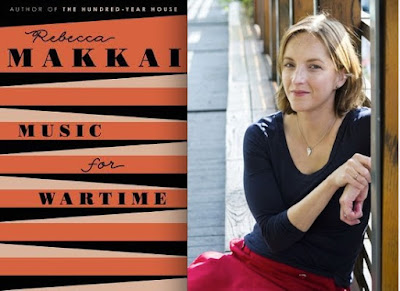
Rebecca Makkai on What Some Readers Are Missing Out on

In the 31st in a series of posts on 2015 books entered for The Story Prize, Rebecca Makkai, author of Music for Wartime (Viking), describes her frustration with some people's reluctance to read short story collections.


I’m one of three authors at a signing table at a benefit. A woman walks up, touching each book. She gets to my story collection. “What’s this about?” she says.

I say, “It’s a collection of stories, and—”

And she goes, “Oh.” Not as in, “Oh, how interesting,” but like, “Oh, I thought the hors d’oeuvre you were passing was foie gras, but it’s Spam.” A little to the left of “Oh, no thank you, I would not care for a dead raccoon.”

And so I decide to call her on it. I make sure to laugh, and I say, “Wait, what’s that about?”

I’m not a confrontational person. It’s just that this is the 300th time this has happened to me since June, and I’ve reached a breaking point.

In November of 2013, I participated for the first time in Small Business Saturday—specifically in Sherman Alexie’s initiative for authors to hand sell books in the indies. I went to Chicago’s City Lit with a list of titles to recommend. In addition to novels and nonfiction, I was pushing three story collections—chief among them Jamie Quatro’s I Want to Show You More. I told people it was beautiful and strange and important. I showed them the gorgeous cover (silvery and festive!). I did everything but cover up the word “stories” with my thumb. Which is probably what I should’ve done. Because in two hours of selling, I moved novels and children’s books and calendars and a coffee table book on horses, but I didn’t sell a single story collection until one guy came in shopping for his girlfriend, an aspiring writer.
Hard sell: Short story collection

At this point, I’d published a novel and had another due soon; but the stories I’d been writing all along had always been just as important to me. More, possibly. I knew, in theory, that a story collection would be a hard road. Yet for every person saying stories didn’t sell, there was some unhelpful optimist going “Yes, but George Saunders is on the bestseller list!” Or “But we have such short attention spans nowadays!” (I assume the latter explains the raging resurgence of the sonnet among teenagers.)

This was my wakeup call. And in plenty of time. I was still a year and a half away from the barrage of “So this one’s just stories?” and “I only read novels,” and “My book club would never go for a collection,” and “I always skip those in The New Yorker.” I had time to steel myself. I had time to remind myself to be doubly grateful this time for every reader, for every review, for every kind bookseller who made space on the shelf. Triply grateful, in fact. Is quintuply a word?

And on the one hand, I’ve made my peace with it. Because every year I watch the Oscars, and when they announce the short films, I haven’t seen a single one. I get up and refill my wine glass. I know that I should see them, that they’re important, but as a general consumer I just don’t seek them out. And I tell myself maybe it’s the same with stories: They’re important to writers, to serious readers, but they’re not for the average palate.

But NO, NO, NO, NO, NO. Good God. People don’t know what they’re missing. Scarred by some Hawthorne story they read in high school, or maybe seeking a weeks-long immersion rather than a plunge in the icy pool, they’ve turned their backs on our newest voices, our sharpest experimentation, our wildest dreams. They’re missing out on Lydia Davis and Alice Munro. They’re missing the brilliant short work of Kevin Brockmeier and Julie Otsuka. They’re missing the faceted perfection the short form can approach. They’re missing experiments of voice and form and subject that can be maintained for 5,000 words, but not 90,000. (Who wants to read a 300-page novel about a man turning into a cockroach?)

Which is why I snap and ask this woman what she means by “Oh.”

She says, “I shouldn’t have said that! I do read stories. I do. I’ll probably buy this one.” And she turns it awkwardly over, reads the back.

I assure her I was just joking, that I know stories aren’t for everyone. We have a pleasant conversation.

She moves along the table, and when she reaches the end, she looks back to see if I’m watching. I pretend I’m not. She leaves the book right there.

Friday, November 27, 2015

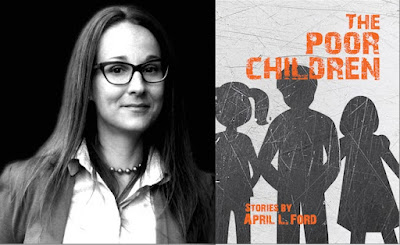
April L. Ford and the Essential Activation

In the 30th in a series of posts on 2015 books entered for The Story Prize, April L. Ford, author of The Poor Children (SFWP), describes a life-changing experience.


What keeps you going?
The threat of someone inscribing my tombstone with “Flossed daily & paid taxes on time.”

What do you think is the source of your impulse to write stories?
I nearly died at age seventeen, when I ran across an intersection on the yellow light. I got busted up inside and out, and spent four months in the hospital. The most distressing part was feeling left behind, watching family and friends leave the hospital without me; they were going on with their lives, upset though they were, while I was stuck in casts and slings (I couldn’t even “watch” visitors leave until the blood clots eventually cleared from my eyes). Have you seen Metallica’s music video for “One”? That was how I felt; and after I was discharged from the hospital, I swore I would never feel like that again. I’ve always loved telling stories, but I would say the car accident activated something within me more essential than love.


Describe your revision process. 
I revise as I write. Some sections of the novel I’m working on now, for example, have survived reader scrutiny marvelously, whereas one particularly beasty chapter took me a year to get right. (There was this one time in summer 2014 when my spouse had to force me away from a single paragraph I had been revising for five hours.) But if I have to put a number on it, then I’ll say the third draft is my happy place. If I keep going after that, there’s a good chance I’ll overreach.

What’s the best phrase, line, or passage you’ve had to cut from a story?
How about the worst passage? I can’t believe I’m sharing this; it’s from a story I wrote as an undergrad, for the sole purpose of electrifying a professor. He was a wry, middle-age poet, and I was smitten. I never actually showed him any of my fiction, though our frequent conversations about craft kept me motivated. I wrote a lot of stuff for that guy, intended some of my greatest metaphors for him… Anyway, here’s the opening paragraph of “December Twenty-First,” a story I wisely abandoned long ago:
I traipse up the steps and open the door to Alanis on the radio crooning, “You see allll my light and you loooove my dark.” The trickling bulb over the entranceway casts a urine yellow stain into my apartment, yesterday’s garbage heaps shapelessly by the door. “You dig eeeeverything of which I'm ashamed, there's not anything to which you cannnn’t relate,” continues Alanis. My boots come off with a suction sound and I hook my jacket on the door handle like a three-eyed sewer fish somebody might catch in a sea of dolphins; it’s not beautiful but it’s one of a kind, worth relishing because those don’t come around too often. 
Name or describe some hidden influences on your work.
Jeffrey Eugenides. Iris Murdoch. Jonathan Franzen (but don’t tell). Stovetop espresso. Candy bars. That epitaph I mentioned earlier.

Describe your collection in ten words or less:
Kathy Acker’esque, according to one reviewer. I’m cool with that.