Showing posts with label 2015 contributor posts. Show all posts

Saturday, January 16, 2016

An Index of Guest Posts from Authors of 2015 Short Story Collections

Popular posters: McCann (left), Campbell (top right), and Gornick (bottom right)
In 2015, we once again invited each author of a collection we received as an entry for The Story Prize to contribute a guest post to this blog. Out of 100 authors, 48 chose to participate. Since 2010, the TSP blog has featured 384 guest posts from 372 writers (some have contributed in more than one year).

According to Blogger's statistics, most 2015 guest posts received 300 or more page views. The most popular post, "Colum McCann's Letter to a Young Writer," went viral (by our standards) and has so far drawn nearly 10,000 page views—the second most ever of any TSP blog post, after "Antonya Nelson's Ten Writing Rules,"  which currently has nearly 14,000 views. The author posts with the second and third most hits this year were "Bonnie Jo Campbell's Confessions of a Story Writer" and "Lisa Gornick Asks: Can Writing Make You a Better Person?"—both with more than 600 page views to date.

When we ask the authors if they'd like to contribute, we give them several options. One is to answer any or all of a series of questions, which we change somewhat each year. The 2015 questions were:
  • Describe a good writing day.
  • What keeps you going?
  • What do you think is the source of your impulse to write stories?
  • Where does a story begin for you? 
  • Describe your revision process. 
  • What’s the best phrase, line, or passage you’ve had to cut from a story?
  • Name or describe some hidden influences on your work.
  • What surprises you most when you re-read your own writing?
  • If you teach writing, how has it affected your work?
  • Describe your collection in ten words or less.
We also suggest some possible topics:
  • A literary touchstone.
  • A letter to a young writer, a la Rilke.
  • A list of ten pieces of writing advice.
Contributors also had the option of coming up with their own ideas.

This index is in alphabetical order by last name, with author names linking to their books on IndieBound (unless a book wasn't lised on that site) and the rest of the guest post titles linking to the posts themselves.


A-B

Lauren Acampora's Good Writing Day
Jacob M. Appel Conjures the Impossible
Charles Baxter and the Restored Sentence
Karen E. Bender's Ten Ideas For Revision
Megan Mayhew Bergman's Collection in a Nutshell
Z.Z. Boone Advocates Lying
Mark Brazaitis' Orphan Stories
Austin Bunn's "Plans for Work"
Carole Burns' Free-Roaming, Imaginative Phase

C-F
Liam Callanan Sorts It Out
Bonnie Jo Campbell's Confessions of a Story Writer
Literary Stones Joy Castro Keeps Touching
Bryn Chancellor and the Girl on the Wall
Kelly Cherry and the Hard Work of Imagination
Michael Coffey's Writing Advice: Don't (Necessarily) Eschew Adverbs
Why Saadia Faruqi Turned to Fiction
April L. Ford and the Essential Activation
Kelly Fordon Loses Track of Time

G-L
Jerry Gabriel and the Crux of the Impulse
Lisa Gornick Asks: Can Writing Make You a Better Person?
Toni Graham's Writerly Inclinations
Katherine Heiny Offers Her Apologies
Patrick Hicks: 11 True Things About Writing
Tara Ison and the One Good Word
John Keene's Hidden Soundtrack
Michal Lemberger's Letter to a Young Writer Emphasizes Empathy

M
Rebecca Makkai on What Some Readers Are Missing Out on
Where Margaret Malone's Stories Began Then and Begin Now
Colum McCann's Letter to a Young Writer
What Keeps Helen McClory Going
John McManus Rebuilds from the Ground up
Margaret McMullan Learns the Importance of Seeing
Andrew Malan Milward's 25 Entreaties
Emily Mitchell: Anatomy of a Bad Writing Day

N-R
Ben Nickol's Shrubbery Epiphany
Sameer Pandya on the Intimacy of “I”
Barbara Paul-Emile and the Insuppresible Urge
Leslie Pietrzyk Gets All the Answers
Kirstin Valdez Quade: All Work and No Play...
Sandip Roy's Act of Remembrance
Mary Rickert's Letter to a Young Writer

S-W
Fatima Shaik Travels into the Unknown
Rob McClure Smith and the Big Fish
Adrian Tomine Cuts a Scene
Johnny Townsend Writes for the Record
Siamak Vossoughi Draws Inspiration from an Unlikely Source
Joanna Walsh Writes Against

Past indexes of guest posts:
2014
2013
2012


Thursday, December 31, 2015

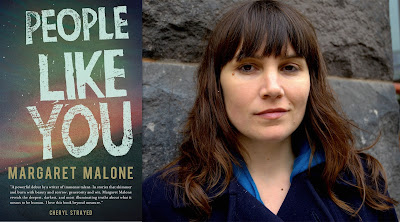
Where Margaret Malone's Stories Began Then and Begin Now

In the 48th in a series of posts on 2015 books entered for The Story Prize, Margaret Malone, author of People Like You (Atelier26), discusses how her starting point for stories has changed from a sentence to an image.


When I first started writing, I exclusively found my ideas for stories in the sudden appearance of a single, complete rhythmic sentence that would pop into my head while I was always in the middle of doing something else. I’d be walking the dog, or taking a shower, or sweeping the kitchen floor when, Bloop!, a little universe of an idea would announce itself. It typically had a person, a place, and a thing all strung together, and the sentence usually carried a particular cadence, almost as if it was a stanza from a poem I’d memorized years before.

The sentence would show up and then I’d mentally chew on it a few times to test it out, make sure it wasn’t all flash and bluster but had some real value, but was the kind of sentence you could dig claws into. If it was, I’d hurry to scribble it down in my notebook. Then, later that day or the next day, when I sat down to write, I’d find the sentence, write it down again at the top of a blank page and let fly: I’d write and write and write and keep writing until I arrived at some kind of a something that felt like it could maybe turn into the kind of thing that just might one day become a story.

I was in my late twenties and fearless: I’d started writing “so late” I wasn’t sure I’d have the time to evolve into a very good writer, so with nothing at stake, most days I’d unleash a wild rush of sentences in my notebook without much care or forethought, and I wouldn’t stop writing until the place I landed felt different than the there where I began.

***

Years passed. The writing life beat me up a little (as it does), and real life beat me up a lot (as it will), and the sudden appearances of the unasked-for perfect sentence became extinct.

I spent a whole bunch of years wondering what I was doing wrong. Why were those beautiful, sad, funny sentences not around anymore? Where did they go? Was someone else receiving them now? Who was this person? What was he or she writing? 

Still somehow I had the wherewithal (read: desperation) to keep putting words down onto the page. I wrote stories, and I wrote some essays, and I wrote some more stories. Occasionally something would be published; usually not. And somewhere in there I became aware that, without realizing it, I had started to hurriedly scribble ideas down in my notebook again. But the ideas were not born from a sentence anymore. 

Now they were born from an image. 

The image was more than that though—it was really a moment in time I’d seen or imagined that was often accompanied by a very particular feeling. The full effect was so complete I’d feel a click go off inside me, like I was taking a picture with a camera, a very special camera that could photograph image and feeling together.
Finding images that click

This picture would stay with me. I’d carry it around, this feeling picture, in much the same way that I used to mentally carry a sentence around before writing it down in the old days. 

Just like I used to chew on those early pop-up sentences, I’d pull up the memory of the picture to see if it still held the same resonance as the moment I saw whatever I saw when the snap and click of the camera went off. If it stayed with me, I’d eventually write the full feeling picture idea down in my notebook. 

It is not uncommon now for one of these feeling pictures to be so strong, so haunting, or so odd, I do not need to go looking through my notebook for the reminder of it. The image is with me all the time and I’m just waiting for the moment I can sit down and see what happens when I plant the feeling picture on paper and let it grow sentences—who are the people in this place feeling these things? 

I’d like to say I have no preference for how a story gets started, that I’ll take whatever I can get, but it’s not true. I prefer the way it is now. In the early version, the story ideas were born of logic—the crisp cadence of a string of words that I needed to pull along to the place they needed to be. Now, those feeling pictures are like windows to places that already exist, fully thriving with layers of chaos and order. The sentences were nice, but the windows are magic—I climb over the sill and through the panes and land inside a world that creates itself as I explore it. I visit the world and come back to this one with images and feelings to unpack on the page, and I know I am done when the feeling of the written story at last matches that first gut punch of the picture when the camera shutter clicked and the feeling image developed and I knew instinctively discovering the story behind the feeling picture would be worth all the days and weeks and sometimes years to make the moment make sense. So far, it always is.

Saturday, December 26, 2015

Bonnie Jo Campbell's Confessions of a Story Writer

In the 47th in a series of posts on 2015 books entered for The Story Prize, Bonnie Jo Campbell, author of Mothers, Tell Your Daughters (W.W. Norton), contrasts stories and novels.


I’ve never set out to write a novel. I’ve always tried to write a short story and then if fail in my task, if I fail to wrap it up, I might have a novel, damn it. I’ve told this as a sort of a joke, but it’s true.

A novel, after all, is a dangerous creature, nothing to joke about. A novel goes on and on, exposing rib after rib like one of those escaped pythons clogging up the Everglades. The characters in a novel have to interact with a prescribed world in a plausible way, sentence after sentence, chapter after chapter, slithering toward revelation and resolution.

Give me short stories, glorious short stories that prod and punch and kiss and leave town before everybody sobers up! 

A short story is like dating, while a novel is like a marriage, and we all know how bad those can be. No need to be honest or consistent or thorough on a date—just be interesting. Mysterious is good on a date.

That means a piece of flash fiction (there are three in Mothers, Tell Your Daughters) is like a one-night-stand, something I should have had more of before I embarked upon my marriage, now in its blissful 28th year. I won’t make that mistake in my writing life, of pursuing joy, contentment, and peaceful evenings.

No way. In my writing life, I’ll splash and screw around in any musky, murky, fish-stinking pond I stumble into, and I’ll reach down into the muck and grope for fleshy tubers, serpents, rubber boots. In my stories, I stick a finger into any honey pot, no matter the bees or bears.

Just try pulling a novel up out of the silty bottom by its tail—it will drag you back down, and you’ll be lucky if you escape. 

The readers of short stories do not live in the real world. At least not while they’re reading. I wouldn’t dare generalize this way in a book-length work, but I’m hoping you’ll just go along with me here.
Pickles: Suspended disbelief

Over coffee or wine (red, please, unless you’re afraid I’ll spill on your couch), I could make the case that the reader of a short story lives in a magical world of suspended disbelief. After finishing the story, the reader can put the book down, do the dishes or grade some papers, let the whole story simmer in the brain, ferment like a cucumber pickle, or bob like a baby fetus in a jar of formaldehyde, like the ones I studied at length in the Museum of Science and Industry in Chicago.

You can’t just sit down and read a novel. You’ll ease your way into and then dishes will call to you or papers will need grading. You’ll have to cut your way out of that novel, re-enter the bitter cold real world, leaving a bloody wound in the whole experience. Probably you’ll be trailing the novel’s blood all day. (Next to the fetuses in the science museum, there were the slices of head and torso, exactly as thick as book chapters). And worst of all, you’ll track your real world debris back into the novel.

Novels can brilliant, life-changing. But don’t try it at home, I say to students at every opportunity. Especially to my own creative writing students. A joke, but not really a joke. 

When Aimee Bender writes a story about an ogre, we are only a little surprised when the ogre eats his own children. That is one of the risks of being both a father and a child-eating ogre. I would pay a lot of money for that story by Aimee Bender, more than the price of the book. The ogre novel? Nobody needs that.

Let me confess. I do not have a drawer full of unpublished stories. I have just a couple, and I plan to finish them before I die. Stories are not practice for me, are not experiments, not playthings to be abandoned. If I wasn’t serious about a story, I wouldn’t have dragged it out of the muck to begin with. There are a few stories in Mothers, Tell Your Daughters that I worked on for twenty years.

When I tried and failed to date my husband, I admitted defeat and married him. “Gosh, I hope this works out,” I said. And if that’s not commitment, I don’t know what is.

Monday, December 21, 2015

Lenore Myka's Insatiable Curiosity

In the 46th in a series of posts on 2015 books entered for The Story Prize, Lenore Myka, author of King of the Gypsies (BkMk Books), compares her impulses to join the Peace Corps and her impulses to write.


What do you think is the source of your impulse to write stories?
At a reading several months ago, someone in the audience asked me what compelled me to join the Peace Corps. I was promoting my book at the time, much of which is set in Romania, the country where I served as a volunteer in the mid-nineties, and many of the people in the audience had come because the local Returned Peace Corps Association had advertised my event. 

I stumbled my way through an answer, saying something about how as a child watching Saturday morning cartoons, I would see those commercials of people digging trenches in Sub-Saharan Africa and took to heart the old tagline “The Toughest Job You’ll Ever Love.” I mentioned that I’d studied abroad as a junior in college and enjoyed traveling. My answer was unsurprising; the questioner looked vaguely disappointed. After a pause during which the audience seemed to be waiting for me to say more, we moved on to questions of craft. 

As is often the case for me, I was able to better articulate a truer, more accurate answer to this question weeks later; the gifts, I suppose, of time and perspective. I believe my interest in the Peace Corps is born from the same piece of me that wishes to write. In fact, writing and my interest in other cultures, other lands, dovetail quite nicely. Both ventures require an insatiable curiosity about the world. They require an interest and empathy in others who are oftentimes dissimilar from ourselves. They demand a willingness to place ourselves in foreign and uncomfortable territory so that we might learn something new about the world, but also—and more importantly—about ourselves. Both activities come from a desire to make sense of the senseless, oftentimes cruel, and frequently beautiful planet we inhabit.

I can recall as a child imagining, to the point of near physical exertion, what it might be like to be my mother. Or the neighbor down the street who was bound to a wheelchair. Or our family dog, the horse I visited during my neighborhood meandering, the toads that lived in the basement window well. I had seen the movie “Freaky Friday” and was obsessed with the idea of living another life, zipping myself inside someone else’s skin as if it were a wetsuit, if only for a day. As a family, the most exotic our vacations got was Hilton Head Island, but even as an eight- or nine-year-old I had larger aspirations. Much to the chagrin of my father, I would quite literally dig holes in the backyard, hoping to get to China.

It sounds ludicrous, digging a hole to China. Or, an alternative view: It sounds magical. Adulthood, in my opinion, comes too early and has a blunt way of beating out the imagination in most of us. And maybe this is the key to being a writer, that to do so requires some degree of arrested development. Despite being fully entrenched in midlife I frequently don’t feel much older than sixteen. Perhaps this is what keeps me going—dreaming, imagining, envisioning worlds beyond my own—this youthful clinging to imagination, to wonder. Whatever the reason, I’ll keep digging holes to China, with pen and paper, with keyboard, until I can dig no more.

Sunday, December 20, 2015

Margaret McMullan Learns the Importance of Seeing

In the 45th in a series of posts on 2015 books entered for The Story Prize, Margaret McMullan, author of Aftermath Lounge (Calypso Editions), recounts the influence an art class she took as a teenager has had on her writing.


When I was 17, I told my mother I wanted to be a painter, and she signed me up for night classes with Ed Paschke at the community center in Highland Park, Illinois. This was radical on several levels:
1. My mom was OK with my impractical career choice.
2. She was OK with me driving alone at night to another town.
3. She was OK and with me getting instructions from a man who had monthly illustrations in Playboy magazine.
Ed was never late and he never cancelled a class, even when the temperatures were subzero. Today, his paintings hang in The Whitney, The Guggenheim, Chicago’s Art Institute and New York’s MOMA, but back then, he needed money. He even took our class to his studio in Evanston, where we saw how a real craftsman works.

Ed Paschke: spacing out
What did I learn? Ed showed me how to draw a nose and a cloud. Most importantly, he taught me the importance of SEEING. “Notice everything,” he said one night. He was talking about how he still stared at railroad crossing lights because to him it looked as if the green light transformed into the red, when really, they were just going on and off. “Appreciate your own spacey-ness.” 

That year, I learned I did not, in fact, want to be a painter. But I did learn about the hard, every-day work of becoming an artist.

“Diligence is the mother of good luck.” That’s a proverb that dates back to the 16th century. Passion and hard work trump talent. 

Every day I get up, walk the dog, pour a thermos full of coffee, go to my desk, open my laptop, and get to work. Coffee and getting to the desk are important. The dog sleeping nearby is important too. I look through my notes from the previous day and begin. Framed pictures of ancestors remind me of duty, honor, compassion, and responsibility. When I get stuck, I’ll read notes on my lampshade: 
  • “The problem is not you. The problem is the problem. Work the problem,” says Steven Pressfield; Plot is a verb; 
  • “A story should be urgent, honest, and violent.” 
  • Patience; 
  • “No satisfaction whatever at any time.” Martha Graham; 
  • “You discover your book as you write it.” Frederick Bausch; 
  • Command+2=undelete.
I’ve got a picture of Paschke nearby too. And every day I try to notice everything...and get spacey.

Saturday, December 19, 2015

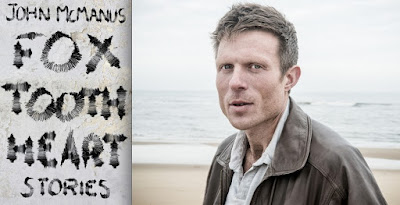
John McManus Rebuilds from the Ground up

In the 44th in a series of posts on 2015 books entered for The Story Prize, John McManus, author of Fox Tooth Heart (Sarabande Books), tells about a novel he boiled down to a story.


Describe your revision process. 
Sometimes my revision process goes as follows. Step one: I decide to write three thousand words a day for two months until I’ve got a new novel, because Faulkner wrote As I Lay Dying in six weeks and hey, I’ve learned from my mistakes the last ten times I tried writing novels this way. Two months later I wind up with 200,000 words. By now I can perceive some logic problems in the story. I rewrite the whole thing from another character’s point of view. I rewrite it again from the original point of view.

Years pass. I feel pure horror to think I might ever have showed the manuscript to anyone. What if I die and someone finds the file? I would erase it from my hard drive, but I’ve spent two thousand hours on it. By now I’m a different person, one who enjoys authors I scorned then and vice versa. Maybe the draft is worth another look, but the only way to face reading it again is to slash and burn as I go.

To my surprise, a plot starts on page 270. One sentence out of ten actually evokes the physical world instead of someone’s trite thoughts. I keep those sentences. When I’m done, I step back to see what kind of husk is left. It’s roughly the length of a short story.

That’s similar to what happened with “The Ninety-Fifth Percentile,” the seventh story in Fox Tooth Heart. I wrote a so-called novel about a closeted kid from San Antonio who drank to dampen the shame he felt about being gay. He didn’t have friends. He got high and rode the bus in loops around town. A gay couple down the street took an interest in him. They’re the ones who sold him the drugs. He kept riding buses until in a 7-Eleven parking lot he encountered a sketchily drawn tragic bad-boy figure of the sort I was always infatuated with myself. They hung out; still, nothing much happened until he turned sixteen and got his license, which was when he switched from riding buses to racing around on highways in his dad’s sports car. Here the story picked up speed, at least until a hazy and highly melodramatic disaster caused him to flee to Montana. 

Any of that sounds potentially dramatic enough when I present it in a quick summary, but my manuscript was 500 pages long. The couple down the road seemed cartoonish to me, like the boy’s mother and father and the boy from the 7-Eleven, so I got rid of all of them. I cut the long looping bus rides. I cut almost every word prior to page 250. I cut Montana. I realized a single car ride after the boy’s sixteenth birthday did a fine job of expressing something I’d spent eighty pages trying to get across when he was a passenger. I changed his name and moved him to Houston and gave him a new family and rebuilt the thing from the ground up, retaining little beyond the mood.

That meant retaining a sense of how I intended for the story to make people feel. I wanted to convey the kid’s bottomless yearning. And I wanted readers to feel the dread accumulating in him as costs accrued from the lies he told. Whatever wasn’t working toward those goals, I cut. Suddenly I had a useful formula, oddly easy to follow. Before long I had 4,000 words instead of 200,000. I added some new material to tie things together, and then I had a story I liked—which is not to tout my revision methods. This has been a cautionary tale.

Friday, December 18, 2015

Tara Ison and the One Good Word

In the 43rd in a series of posts on 2015 books entered for The Story Prize, Tara Ison, author of Ball (Soft Skull Press), provides the inspirations for her stories.


Describe your collection in 10 words or less.
Obsessive, prickly, honest, cringe-worthy, emotionally explicit, sexually explicit, apricot. Honest.

Describe a good writing day.
Writing one good chapter. Or paragraph. Or sentence. Or word. A day I get myself in the chair and get out of my own head and ego and fears just long enough to enter that alternate universe space where nothing exists but the experience I’m channeling from my characters onto the page and at some point I look up and hours have gone by, it’s now dark out, or I’ve forgotten to eat or shower, haven’t checked messages or Facebook, and there on the page is the one good, or perhaps decent, or maybe just not-dreadful chapter, or paragraph, or sentence, or word. That’s a good writing day.

What’s the best phrase, line, or passage you’ve had to cut from a story?
Not sure if this answers the question, but…in grad school I wrote a story for workshop, and my mentor—an extraordinary writer I respected enormously—circled a sentence in the opening graph, and in the margin wrote: BRILLIANT! And the following term, because I was a lazy, terrible student, I turned the exact same story in for another workshop, and my new mentor – an extraordinary writer I respected enormously – crossed out the same sentence in thick red pen and in the margin wrote: ICK! CUT! 

I tell my students that story – because that’s what grad school is all about. Well, that’s what writing is all about. Listen to the feedback, because sometimes it’s right, and sometimes it’s wrong, and how do you know? It comes back to you, the writer. You do have to question, and justify—if only to yourself—every sentence, every single word that goes in a story.

(In that case – I decided I was able to justify the sentence, and that story became “Ball,” the title story of my collection.) 

What keeps you going?
At one point I might have said: Well, I really hate writing, but I love being a writer. And if I don’t actually write anything, at some point they’ll notice.

And now—I still hate writing. But I’m grateful, or I try to be grateful, for every moment I’m able to get in the chair and sit there and do my best to write a story that gives voice to a character whose story I think must be heard, for a reader who is taking precious time out of his or her life to read something I’ve written, and to whom I owe my best.

Where does a story begin for you? (An opening line? A lst line? A plot? A character? A situation? An incident? A concept?)
All the above – each story is inspired by something different. (Although a deadline is ultimately the best inspiration!) Here’s how the stories in my collection began:

"Cactus": The fiancé of a friend of a friend was killed in a plane crash, and she went on to marry his brother. That fascinated me. (But it’s not her story.)

Fetching?
"Ball": I woke up in the middle of the night with the opening sentence in my head: “My sweet little dog, Tess, is what they call ‘apricot.’” I had to get up and write it down. That’s never happened before, or since. 

"Bakery Girl": Nerve asked me to submit a “sex story”—I was a “bakery girl,” but this is not (totally) autobiographical.

"Wig": I wanted to submit to an anthology on “Revenge Stories,” and tried to find a twisted/oblique way to depict the desire for vengeance.

"The Knitting Story": 1) I was on a deadline to complete the collection, and 2) I’m a compulsive knitter but had never written a story about it.

"Staples": Inspired by a buddy in a relationship with an older, plastic surgery-addicted woman.

"Needles": The first sentence was something I actually said to a friend, after a cross-country drive. She thought it would be a good opening line to a story. And then she challenged me to write it in less than 500 words.

"Apology": Also inspired by people I know—but again, not their story. I wanted to push the dynamic between a couple to as dark a place as I could. (I think that’s true for most of my stories.)

"Fish": Inspired by a terrifying photograph of a koi fish by Susan Unterberg.

"Musical Chairs": Pretty darn autobiographical. Had to work those demons out.

"Multiple Choice": More demons, inspired by a relationship I almost had but got out of asap. Because I’m not that crazy….

Thursday, December 17, 2015

Barbara Paul-Emile and the Insuppresible Urge

In the 42nd in a series of posts on 2015 books entered for The Story Prize, Barbara Paul-Emile, author of Mosaic (Eunoia Publishing), explores the source of her impulse to write.


What do you think is the source of your impulse to write stories?
I write stories because life is about stories. We are story-telling entities and the culture of our world is based on a composite of our stories. Through stories we define who we are. We connect with each other, build communities and shape nations. Through stories of shared experience we explore our principles, values and define existence. Human life is all about stories. 

Looking back at my early life, I recall that I started to write stories when I was quite young in an attempt at self-definition. At about twelve years old while living at a privately owned and run boarding school in Kingston, the capital city of Jamaica, in the Caribbean, I started my first collection. At that time, my stories dealt with the experiences shared by Jamaican students living at boarding schools on the island and away from home. My focus was shaped by my voluminous reading of English novels about adolescents which portrayed the experiences of girls at various boarding institutions in England and Wales. Jamaica was at that time, an English colony and as such our practices were shaped by our colonial rulers. Our academic system and its values in their entirety were based on English traditions and models as reflected in our text books and all other pedagogical influences. 

The realm that was the origin and source of these influences were entirely unknown to most of us because as young students we had never left the island. Great Britain was for the most part a land of myth and legends. We read about the mists drifting off the moors in England, the snow-capped mountains in Wales and dangerous bogs but had never seen any of these aspects. The focus of the stories that I wrote at that time followed the stock pattern of the English stories except set on a tropical island. The plots dealt with the trials and tribulations of living at Dickensian schools as reflected  in conflicted student relationships, the rigid and restrictive rules with which we had to contend and the homesickness from which we suffered. 
Kingston, Jamaica

I spent much of my leisure time writing. I soon discovered, however, that writing stories was one thing but allowing others to read them was another. While my stories were sometimes quite well received, at other times classmates found descriptions that they thought related to their own personalities and activities and this lead to arguments and much divisiveness if they were displeased. Some classmates considered it quite presumptuous of me to dare to think that I could write stories at all. For in truth, all of our books came from England and we had never met anyone who wrote those books. In fact, we had never met anyone who wrote books at all. 
 
On one occasion, in the absence of our teacher from the classroom, my stories were passed around and the class erupted with boisterous laughter as passages were read out aloud. Embarrassed and ashamed, from that day forth, I felt it best to keep my writing to myself. One teacher had, ironically, already written home to my family to report that I was doing far too much writing and reading and was not concentrating on my homework. 

Years passed, but the urge to write stories could not be stilled. I continued to write as an undergraduate adding the composition of poetry and longer literary pieces to my list of creative interests. I had, however, learned my lesson and kept my activities secret. I was admitted to graduate school, and dutifully composed academic papers but my heart was not there. The urge to continue with my creative writing could not be suppressed. Finally, there came a time when I gave up the struggle and boldly decided to devote myself to writing and publishing in the area of my first love: creative writing.     

Name or describe some hidden influences on your work.
It is my intent to share with readers my experience of life growing up in the Caribbean islands through the prism of literature. I wish to show that these islands are more than pristine beaches. They offer a varied culture rich in history, custom and tradition shaped by a multiplicity of external and internal forces. I seek to present the multi-layered and complex social relationships that exist in Caribbean society, to uncover the dynamics that shape the resourceful choices that the characters make in the context of cultural frame-works and personal values.

While much information has been disseminated about the Caribbean as a region for vacation travel, very little is known about the tenor of the lives of the people who live there. In travel brochures, glossy magazines, and TV commercials, the Caribbean is represented in beautiful color as a necklace of azure islands strung out in sparkling blue waters. The region is seen as a kind of paradise where happy and carefree people lead bucolic lives, joyous and pain-free.

Little is known of their cultural traditions, the ways in which reality is conceptualized and perspectives shaped so as to allow them to survive and overcome the challenges they face in their daily lives. Little is known of the priorities that form their values, personal and social, which in turn affect relationships creating the fabric of their society. Too little is known of the impact of the economic hardships that they face and the courage it takes to overcome. In what way does class affect private and public relationships? What is the role of the supernatural and other spiritual dimensions in people’s lives? What are the core mythic beliefs that hold the social fabric together? Mosaic explores several of these philosophical, social, and psychological terrains in the stories it presents and shows life in its panoply of colors.                                                                                           

This collection, in highlighting particular aspects of Caribbean society, explores attitudes towards parenting and child-rearing, relationships between males and females in romantic situations, roles played by both genders in family affairs and in society at-large and the place of the mystic, village obeah woman or man, as healer and mediator between the world of the living and of the dead. This collection allows me to share with readers the voices of the characters that speak in my creative fiction, giving life to their actions, personalities, interests, and priorities thereby presenting the dramas that punctuate their lives. Mosaic presents several of the different faces of the Caribbean as I have experienced, observed and envisioned them.

The character of Caribbean people, described in broad strokes, is fascinating and thought-provoking.  Resourceful, strikingly devoid of self-pity, Caribbean people are easy-going, quick to share their opinions and perspectives while rejecting victim-mentality. Resilient, enterprising, and engaging, these open-hearted islanders exhibit an infectious sense of humor and good spirits. Gregarious and optimistic, most are always looking for that second, and occasionally, third or fourth chance in life.  Economically, times are, for the most part, very hard and the road to success for many is non-existent. Yet, inherent self-confidence and belief in the ultimate beneficent running of the universe promotes and strengthens the will to survive and to prosper in difficult times.  
   
Mosaic, presents stories that focus on the vicissitudes of daily life as experienced by people in small towns and rural districts in the Caribbean islands. It seeks to uncover the dynamics that shape the resourceful choices that characters make within the context of cultural frame-works and personal values. These tales deal with personal dilemmas, psychic themes, class distinctions, and social issues as shaped by the legacy of colonialism and slavery and as expressed in the complex heritage of the region.  

Describe your collection in ten words or less.
Mosaic presents Caribbean characters in stories: passionate, sumptuous, and compelling.    


Wednesday, December 16, 2015

Leslie Pietrzyk Gets All the Answers

In the 41st in a series of posts on 2015 books entered for The Story Prize, Leslie Pietrzyk, author of This Angel on My Chest (University of Pittsburgh Press), describes her collection, a good writing day, and what sparks stories for her.


Describe your collection in ten words or less.
Unconventionally-linked, emotionally tough stories of my young husband’s sudden death. (Pro tip: If you throw in a hyphen, Word counts two words as one!)

Describe a good writing day.
I’m not a morning person, so I typically write in the afternoon, from about 2 to 6 or so. My morning is often overtaken by errands and crud (and Facebook, if I’m being honest), but the afternoons are for work. So on this imaginary “good” day, I’ll open the file from the previous day, re-save the document as a new file with the new date (obsessive much?), and start by rereading and making small corrections. And why not take this imaginary day into “ideal writing day,” which would mean that I woke up in the morning with a thrilling new insight into the story, so I’ll get to spend time integrating that new idea into my text. I’ll forge on into new drafting, and I’ll write until something surprises me, which is something one of my favorite writing teachers used to say we should do, and since this is an ideal day, this exciting surprise brings me to the conclusion of the draft right at about 6 or so as a late November sun is setting beautifully over the trees outside my window. Then it’s off to cook something fabulous for dinner, which I love as the conclusion to any writing day, to fall into an entirely different focus and method of being creative. And since we’re going for the ultimate ideal here, on this day, I have the time to watch “Jeopardy,” and every category is a variation on “American Writers” and I knock my way through the whole board, getting every single answer before Alex even reads the whole clue.

Where does a story begin for you?
I love writing short stories because they might be sparked by anything—something I’ve observed while riding the Metro into DC, or a sentence rattling in my brain. I think long and hard before diving into writing a novel, and do a lot of research, but I’ll leap into a story on about any whim. This book of stories was something a little different, though, because I gave myself a general writing assignment, which was that each story had to contain one hard, true thing from my personal experience of losing my first husband to a heart attack when I was 35. Even so, there was a lot of freedom within those parameters, so stories emerged from particular memories, remembered dialogue, feelings I had as I grieved, moments of anger, and so on.

What’s the best phrase, line, or passage you’ve had to cut from a story?
I once wrote a long and luscious description of a divey taco restaurant I loved back when I was growing up in Iowa. I’d ride the bus downtown and my friends and I headed to Taco Grande for these incredible things called “sanchos” that were sort of like a steamed burrito, except 1000 times better, made by slipping paper-wrapped burritos into a special steamer drawer. I’ve never seen sanchos served anywhere else, and it’s possible that Taco Grande invented this dish and it has nothing to do with Mexican or even Tex-Mex cuisine. Anyway, after inventing a ludicrous reason to get my characters into an imaginary-yet-so-real-to-me Taco Grande and writing several mouth-watering pages describing the sanchos, and finally maneuvering my characters to the counter to order and returning them to the table with their plastic orange trays, they could at long last EAT the sanchos. But here I rabbit-holed into many sentences to describe the exact nature of shredded iceberg lettuce after the steamer drawer, and many more sentences about the vinegary hot sauce, and on and on—and six pages later I was crafting paragraphs of the characters talking about how incredible the sanchos were…well, I finally realized this scene was utterly irrelevant to the story and I killed that darling. It was such a heartbreaking moment and I think that’s why I haven’t steered anyone else back into Taco Grande.

Monday, December 14, 2015

Joanna Walsh Writes Against

In the 40th in a series of posts on 2015 books entered for The Story Prize, Joanna Walsh, author of Vertigo (Dorothy), discusses writing in a windowless room.


Vertigo is a book against writing. I began to write the first stories in it when I had no idea of being a writer, or I had, at least, no idea of publication, except that even I had to admit that I was writing, and even I had to admit that I was writing things in shapes that made them storylike,  almost like something that might go into a book. I mean you can’t sit down at a desk or a table and write knowing nothing about it, well not entirely… For a long time before I wrote the first Vertigo stories I seem to have tried to prevent myself from doing any writing at all, perhaps even from using words or—to describe this more carefully, as I had to live in the real world—from using certain words, from voicing certain thoughts. And I might have continued to keep the idea of publication from myself, behind some sort of door, only to let it out when the moment seemed right, when the writing itself had done enough.

The door I am thinking about is a wooden one. It is the door of my dining room, the room in which I did most of the writing. I have a study, but I didn’t use it. At the time I was working as an illustrator and the studio in my attic contained my drawing materials and slanted drawing table, which sat beneath a velux window that poured onto it plenty of natural light. My dining room, on the other hand, gives onto the kitchen, which has windows, but the dining room has no windows itself. I sat turned away from the only source of light, the kitchen door, looking inward toward the dark. You can’t write without knowing something of what you’re doing, but you can look away from it.

Sometimes it’s necessary to look away from writing, which can look so simple: lines sitting on the surface of a page; a sentence with subject-verb-object; a structure with beginning, middle, and end. In looking away I must have been looking toward something, but it would be too simple to take the mirror on the wall opposite as a metaphor as, in any case, I was sitting too low down to be the subject of any reflection. What the mirror showed, darkly, was a blur of light from the kitchen window, which I saw at second—or perhaps I mean third—hand.

I kept thinking, I’ll move to somewhere better, somewhere I have a view, somewhere more comfortable, more convenient, but I didn’t. I liked to feel temporary, that I was doing something at the wrong time, in the wrong place. I was moored, for the moment, to a white table, which, when I bought it, had seemed the only colour right for this kind of room. The table was made of hard formica. Unlike wood there was no give to it. It could be scratched but you couldn’t engrave it: There was no way to have the sort of satisfaction that comes from scoring in your name into oak or walnut, that peeling away of the varnish and the yielding of the softer whitish flesh underneath. Nevertheless it felt good to be writing against something hard, something that resisted, perhaps even repelled it.

It sounds a bit rubbish, doesn’t it, to talk about wilful ignorance, to talk about resisting writing, resisting publishing it, when it’s obvious that was what happened, and what, eventually, I had to want to happen, and to make an effort to make happen, in order for it to happen at all? I’m cautious of implying that, female, I was only a conduit for meaning, naively rather than deliberately unaware. No, it was more of a kind of undressing, yes, wilfully, of what I already knew about how to write. And, once I’d stripped, I can only say that none of it seemed obvious to me at the time: It hardly seemed obvious how to put one word in front of another, or rather behind another, as story (as meaning?) is most often retrospective. As it was, I wrote forward, with the same feeling-in-the-dark as reading, and was surprised to find, on reflection, that what I had written had begun to amount to something, that the necessity of writing against, away from, was a coming toward, and a building nonetheless.