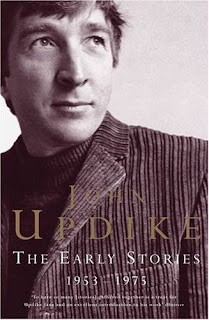
Literary giant John Updike died today. His last short story
collection--
My Father's Tears and Other Stories--will be coming out in June. It will be his twelfth book of short stories, including a retrospective,
The Early Stories: 1953-1975, published in 2003. It goes without saying that he was and will remain an important American short story writer, novelist,
memoirist, critic, and poet.
A great book to read about Updike is Nicholson Baker's 1992 book,
U and I, which chronicles Baker's near obsessive interest in the U of the title.
Readerville is a good source for links to various obituaries and articles on Updike, as well as a place to throw in your two cents about him.
The New Yorker's Book Bench blog is running a
series of reminiscences and homages that some of its regular contributors have written. It's interesting that writers such as George Saunders and T.
Coraghessan Boyle never met John Updike. I've always thought of him as very accessible, but I guess he didn't make the scene too often.
I did in fact meet Updike once. It was in early 2000 at a book party at a New York restaurant for
Best American Short Stories of the Century. My wife, Alice, and I were invited because Updike had chosen her story, "
In the Gloaming," for the anthology. We milled about before approaching him, toward the end of the evening. Alice had been eager to meet Updike but was feeling a bit reticent about elbowing her way forward. I literally pushed her toward him. He was, as you'd expect, gracious. It felt odd to be standing near someone whose face I'd seen a hundred times on the backs of books and book flaps. I almost felt like reaching out to touch his aquiline nose or shaggy eyebrows. Updike told Alice that her story was one of his favorites in the book, which bowled her over. After what couldn't have been more than five minutes, we backed out of the circle so someone else could take our place.
Believe it or not, this anecdote connects to two of this year's finalists for The Story Prize. I met a nice young writer named
Jhumpa Lahiri at the same party.
Interpreter of Maladies was out, but it hadn't yet won the Pulitzer Prize. I had included the title story in
Prize Stories 1999: The O. Henry Awards, so it was nice to chat with her for a few minutes. I imagine
Lahiri met Updike that night, too. The second connection is that Tobias
Wollf (who wasn't there) was the guest editor who had chosen "In the Gloaming" for
The Best American Short Stories 1994. Without that, we wouldn't have even been in the room.
I had corresponded with Updike before then and after. He had politely declined offers to be a judge for the the first volume of the O. Henry Awards I edited or for the first year of The Story Prize or to read at the 92
nd Street Y for the 80
th anniversary of the O. Henry Awards. He always replied politely, via typed postcards that usually included an amusing sentence or phrase. Although I always expected to get a no from him, I firmly believed that the first writer I should ask to do anything was John Updike.
In 1990, he had contributed to my first book,
Literary Outtakes (long out of print, I'm afraid)
, the original ending to his memoir
Self-Consciousness, which took the form of an imagined dialogue between Oppositional Other (O.O.) and Self. The gist of it was that O.O. felt Self was being, well, self-indulgent. Updike ultimately and wisely went with a more conventional ending. Here's the last part of the two-page outtake:
I am weary of Self-Consciousness. What I have written here discomfits me; it is indiscreet and yet inaccurate, a greedy squandering of life's minute-by-minute savings, a careless provisional raid upon the abyss of being. Fiction, which does not pretend to be true, is much truer. This stuff is embarrassing. The reviewers will jump all over it. I think I'll save myself a peck of trouble and not publish.
Self: Oh, go ahead. It was written, after all, only by Updike; it has nothing to do with me.
 We're happy to see that several short story collections have made summer reading lists. The Wall Street Journal Web site lists three: John Updike's posthumous collection, My Father's Tears, Jean Thomspon's Do Not Deny Me, and James Lasdun's It's Beginning to Hurt. I haven't read any of these yet but have high hopes for the Thompson and Lasdun books because I've admired their previous collections. (We won't be reading Updike's collection for The Story Prize because only books by living writers are eligible, sad as it is to say this.)

