In the 26th in a series of posts on 2016 books entered for The Story Prize, Valerie Trueblood, author of Criminals: Love Stories (Counterpoint), writes about a literary touchstone.


In the title essay, writing about how Katherine Anne Porter does without a certain kind of scene-setting, Welty finds nothing lacking in a story offering revelation in this degree. A character’s intense inner state has expanded to fill the space, and to Welty what matters is the story’s own path to its end. For her, nothing can hold a strong story back; it must do what it will.
In “Looking at Short Stories” she examines five in detail—by Crane, Hemingway, Chekhov, Lawrence, and Faulkner—and when she finishes, we’ve gone from technical matters into style into beauty. Speaking to us as like-minded seekers (reader and writer ought to be companionable, she says) rather than as a cohort in need of what she knows, she examines what makes us think something is beautiful. She goes into all this in an everyday voice. No gushing. Beauty is not, she says, “a blatant or promiscuous or obvious quality.”
In 1941 a reviewer struck by the beauty of the stories in Welty’s own first book refused to comment on their form, saying to do so was as hopeless as “saying a tree is right in form.” This rightness exists throughout her work and steers her criticism out of its surface matter-of-factness into vision.
Before I read The Eye of the Story I had some school-learning of her stories, often presented (as with the mysteriously oft-anthologized “Why I Live at the PO”) as comedies packed with that Southern knowledge of what people would do. “She would do that, wouldn’t she.” Asked about her progress as a writer, Welty said she improved “once I got some sense.” In the South you’re raised on the word. “He’s got no sense.” “What was the sense in that?” To a child listening to the marvelous litany of what people would do, “no sense” had an endless store of effects inside it like seeds in a pepper. Some of them were just flavor, some of them burned: desperate acts, rape and incest and murder, abrupt intensities in lives called ordinary—the ground of Welty stories. “Trouble, the backbone of literature,” she wrote. She was not a comedian at heart any more than Chekhov was. Our comic writers are funnier today, lacking her boundless sympathy. Our paranormal is thin compared to her normal, and much of our criticism, lacking her wonder, just advertisement. Not just her visionary stories but her way of reading enlarged my reading and my life. I go on and on learning from The Eye of the Story.
“If these short sentences have the look of simplicity, let no simplifier try to copy what they do.”That’s Eudora Welty, writing about Henry Green in her book The Eye of the Story, in which the essay “Henry Green: Novelist of the Imagination” is a literary education in sixteen pages. May every young writer, slow to begin or tempted by despair, find this book in time, with its adages and comforts, its revelations of a mind disciplined and enchanted by story. Just as this writer’s portraits of a plausible goodness move us in her stories, in the essays her profound respect for the books of others seems to come from another critical world, slower and more emotional than the one we have now with our fast strobes of enthusiasm and scorn. “I write about what I like.” Like! It is wonder she transmits in her reviews. In me she awakened the desire to read any book that had produced this luxurious submission, allowed her to possess its secrets as she did in all humility, and confirmed her belief in wonder as the purpose of art.
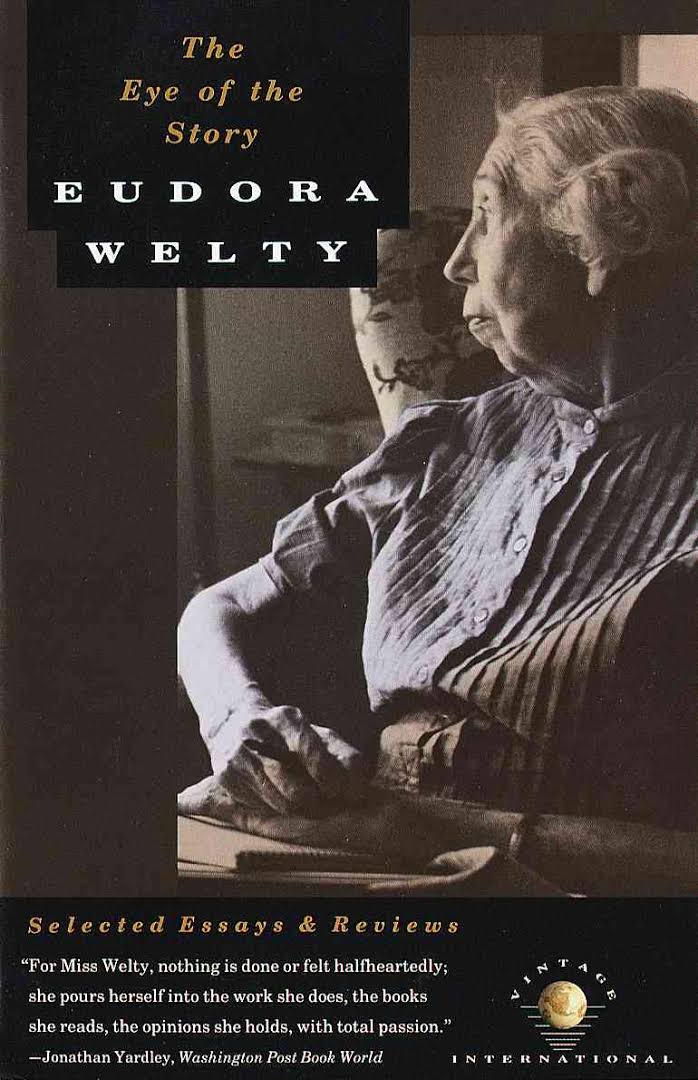
In the title essay, writing about how Katherine Anne Porter does without a certain kind of scene-setting, Welty finds nothing lacking in a story offering revelation in this degree. A character’s intense inner state has expanded to fill the space, and to Welty what matters is the story’s own path to its end. For her, nothing can hold a strong story back; it must do what it will.
In “Looking at Short Stories” she examines five in detail—by Crane, Hemingway, Chekhov, Lawrence, and Faulkner—and when she finishes, we’ve gone from technical matters into style into beauty. Speaking to us as like-minded seekers (reader and writer ought to be companionable, she says) rather than as a cohort in need of what she knows, she examines what makes us think something is beautiful. She goes into all this in an everyday voice. No gushing. Beauty is not, she says, “a blatant or promiscuous or obvious quality.”
In 1941 a reviewer struck by the beauty of the stories in Welty’s own first book refused to comment on their form, saying to do so was as hopeless as “saying a tree is right in form.” This rightness exists throughout her work and steers her criticism out of its surface matter-of-factness into vision.
 |
| Henry Green: "the look of simplicity" |


