Showing posts with label Molly Reid. Show all posts

Tuesday, April 15, 2014

“Thank You For Having Me” (You’re Welcome!): Lorrie Moore at Powell’s

By Molly Reid
Portland, Ore., April 11, 2014

Moore: Reading from Bark at Powell's
I’m obviously not the only one who goes a little fangirl for Lorrie Moore. The reading room at Powell’s Books was packed, people standing in the back and along the aisles, clutching their copies of Self-Help and A Gate at the Stairs, excitedly twittering like all the birds of America (see what I did there?).

Lorrie Moore read from Bark, her first story collection in fifteen years. Moore has written several lovely novels, but, for many, she is one of the reigning queens of the contemporary short story. (In a talk she gave years ago for Literary Arts’ Portland Arts and Lectures series, in response to a question about how she knows whether something is a short story or a novel, she likened it to knowing whether an animal is a dog or a cat: “If you throw the ball, and the creature goes eagerly after it and then brings it back to you, wanting to continue for eternity or for as long as you can stand it, whichever comes first, you’ve got a novel. If you throw the ball and the creature doesn’t budge but just looks at you as if you are out of your mind, you may have a short story – or you may just have a cat.”)

With humor that’s often described as mordant or sardonic, but feels more soft hearted than that, she handles the serious matters of life with lyric precision, offering up your very heart disguised as somebody else’s, or something elsea joke, a visit to a dead friend come to life, a dog named Cat.

Bark is what animals do in fear, in anger, in loneliness. It’s a laugh, a cough. A warning. Bark is also the protective layer, able to peel off and heal, sometimes grown rough and scabby over oozes of sap. In the last story of the collection, which she read from, the narrator tells her daughter that she saw a PBS show “that said only the outer bark of the brain — and it does look like bark — is gray. Apparently the other half of the brain has a lot of white matter. For connectivity.” In typical Lorrie Moore fashion, these multiple meanings echo and branch and contradict themselves throughout the stories of this collection. Her characters are a little older, if not wiser, have become more layered, have grown a bit more spiritually gnarled.

The title of the story she read at Powell’s, “Thank You for Having Me,” comes from one of the characters, a farmer who is playing music at his ex-wife’s wedding in Wisconsin, singing songs like, “I Want You Back,” and “I Will Always Love You.” But this character is somehow not pathetic or pitiful, or not only: 
Except he didn’t seem to want her back. He was smiling and nodding at everyone and seemed happy to be part of this send-off. He was the entertainment. He wore a T-shirt that read, THANK YOU FOR HAVING ME. This seemed remarkably sanguine and useful as well as a little beautiful. 
This is typical of the kind of dance performed in the story between humor and pathos, the push-pull of play and heart Lorrie Moore is known for.

This story doesn’t, actually, have much of a plot, at least not in the traditional sense. The only real event is that some bikers roll in and the head biker (wearing a football helmet with plush puppy dog ears glued to each side) gives a little speech about life, shooting a gun in the air. However, the bikers quickly realize they’re at the wrong wedding and speed off before anything really happens. Most of the story consists of the narrator, a woman living in the wake of her own heartbreak, a husband who left, talking to various characters, to the bride’s ex-husband, to her sassy daughter, and musing about life, and death. But the reason it works so well is simple: The writing is so f-ing funny. Every few lines, the audience erupted in laughter, and Moore knew exactly how to read with those interruptions, is obviously used to pausing as her audience continually loses control. She read: 
Aloneness was the air in your tires, the wind in your hair. You didn’t have to go looking for it with open arms. With open arms, you fell of the bike: I was drinking my wine too quickly. 
She read: 
The bridesmaids were in pastels: one the light peach of baby aspirin; one the seafoam green of low-dose clonazepam; the other the pale daffodil of the next lowest dose of clonazepam. What a good idea to have the look of Big Pharma at your wedding. Why hadn’t I thought of that? 
These lines are funny on the page, but Lorrie Moore delivers them with such sharp smoky intimacy, they feel brand-new, and even funnier.   
 
“Most of the humor I’m interested in has to do with awkwardness,” Moore says in a 2001 Paris Review interview, “the makeshift theater that springs up between people at really awkward times—times of collision, emergency, surrealism, aftermath, disorientation.” This is what prevents Moore’s stories from seeming like just a string of one-liners, wordplay, amusing musingsof which there are many. Most of the stories in this new collection have very serious backdrops: divorce, war, death, torture, psychosis. Two of them—"Referential" and “Wings”re-imagine tales by Nabokov and James. They trace the moments right before and after loss, the language play and humor inextricable from this loss, what floats to the surface when reason and safety fall away.

The story she read at Powell’s is the last story in the collection, and it feels more optimistic than the rest of the stories. Though death and loss still lurk, it takes place at that staple of comedy, a wedding. After all the heartbreak and sorrow, Moore tips the balance a bit, and ends her story, and her collection, on a hopeful note: 
I needed my breath for dancing, so I tried not to laugh. Instead I fixed my face into a grin, and, ah, for a second the sun came out to light up the side of the red and spinning barn. 
The red and spinning barn! (I just wanted to try that out, another thing Lorrie Moore can get away with and I can’t: the exclamation mark).

In the Q&A after the reading, Moore politely and thoroughly answered the audience’s questions, even the ones that seemed to me blurted unformed and absent of reason. But she had some good advice, delivered with the same kind of crackerjack humor and poise as her stories: “This is why it’s called art. There’s an element of artifice to it. You don’t write every single thing someone says. You write down the essential thing, and you get people bouncing off each other in interesting ways, and if it’s not interesting, don’t put it in,” she said about dialogue. And: “The difference between someone who is a writer and who’s not a writer is that they’re just writing things down,” in response to a question about whether there was anything in particular that influenced her to become a writer. 

I mean it when I say that’s some of the best advice about writing I’ve ever heard. If I could remember just these two things, if all writers could, what a world it would be: If it’s not interesting don’t put it in. Writers write things down.      

Sunday, March 2, 2014

Day Four at AWP Seattle: Dear Writer...

With The Story Prize event just days away, we're unable to attend this year's AWP Conference—the Association of Writers & Writing Programs' annual gathering. So we've enlisted Molly Reid, a Portland-based writer, to report from the goings on in Seattle. 

AWP Conference, Seattle, 2014: Day Four


Speaking Swaghili
My bag is heavy. Such lovely books, some as small as a postcard, others the size of a newspaper, with haunting covers in matte and gloss and simple paper, beckoning you to touch, smell the ink, read the words inside. The Saturday afternoon mob at the bookfair is a polite mob, a literary mob. There is little malice here, just the frenzied feeding on free swag. The magazines and presses are giving away their wares so they don’t have to lug it all home, if not for free then severely discounted. And even though you know you can’t fit another thing into your suitcase, it’s hard to pass up the new issue of Mid-American Review

The man in the iron horse
Not just books. There are magnets, notepads, postcards, pins, screen cleaners, oranges, candy, T-shirts, bags, broadsides, and fortune cookies. Rumors circulate: So-and-so has the best chocolate (Omnidawn by unofficial consensus). There is a table offering a shot of whiskey (I search in vain, going up and down the aisles; with 650 exhibitors, it can be hard to find what you’re looking for, especially if you don’t have the name of a journal and you’re afraid to ask, "Where is the free whiskey?"). At Iron Horse Review, you can take your picture with someone wearing a rubber horse head.  

The bookfair is a chance to actually meet the people who read and publish—or reject—your work. The process of submitting can feel anonymous and disheartening, sending out stories and poems into the void, or maw, whatever vast or violent metaphor is appropriate for the piece and the nature of the rejection. After putting everything into your work, sweating in the dark private rooms of your soul, you offer your creation to the world, to someone, probably, you’ve never met before—nameless, faceless—who more often than not rejects it, sometimes with a form letter that doesn’t even have your name, just “Dear Writer, Thank you for the opportunity to consider this. I’m sorry to say, this piece is not right for us at this time.”

The bookfair reveals these editors and interns to be actual people, who are genuinely interested in you and your work, who work so hard to put good art into the world. The bookfair joins writers with the places and people who help them reach an audience, with most of that audience roaming the aisles. It brings the community of presses and magazines and writing programs together and allows them to interact and put names to faces and meet the writers they champion. “One of the most valuable things here,” Stephanie G’Schwind, editor of Colorado Review, says, “is meeting the authors we work closely with, and meeting our potential authors, letting them see there’s a face, a human being, behind the magazine.”
 
At the tables: actual people
The bookfair is the big crooked beating heart at the center of AWP, and as I watch the interns carefully pack all their books and magazines and key chains into boxes, chocolate foils crinkled on the carpet at their feet, I feel sad this is all coming to a close, and so very grateful for these literary pioneers and architects. An editor gave me a bottle of wine she couldn’t fit, and, even though I had no room in my bag, I accepted it with pleasure—it was the least I could do.  
—Molly Reid

Saturday, March 1, 2014

Days Two and Three at AWP Seattle: A Hallucinatory Experience

With The Story Prize event just days away, we're unable to attend this year's AWP Conference—the Association of Writers & Writing Programs' annual gathering. So we've enlisted Molly Reid, a Portland-based writer, to report from the goings on in Seattle. 

AWP Conference, Seattle, 2014: Days Two and Three


Writing advice with a smile at the One Story booth (P34)
(L-R: author Marie-Helene Bertino, someone else)
It’s morning, day three of the conference, and I am hung over. But not in the traditional sense. New ideas, old friends, epiphanies, readings, and okay a little alcohol—combine to create a brand new kind of vertigo. There is a zombie quality now to the escalator throngs. The sort of daze that arrives after so much engagement. Everyone is ruffled at this point. Only Chang-rae Lee still looks dapper (at least as far as I could tell—he was on the other side of the bar surrounded by friends and fans).
 
After listening to people talk about novel structure and character-driven plot and the pure messy magic of ink, I realize I trust them, these panelists: They choose their words with such care. They say what I’ve thought but haven’t been able to articulate and also what I’ve never thought but is so true it’s accompanied by ache. Sure there are duds in the bunch, and standing-room only out the door at some panels (I was squeezed out of “Magic and the Intellect” with Rikki Ducornet, which I have a feeling would have changed my life), but I for one still feel like I’m getting my money’s worth. There is a genuine attempt to gather failure and success and impart something.    

One thing that’s great about AWP is that people don’t come to bag an agent or impress an editor, which makes it easier to see that there is such authentic warmth and support. People spend all day going to panels and manning tables at the book fair, and then they spend all night going to readings to hear people they love and those they admire and some they’ve never heard of read their work. Voluntarily. Exhausted. Hungry. They go, and they listen intently, and they clap and holler.

Literary journals host readings of the coolest writers you’ve never heard of, and their juxtaposition—these writers who live all over the country and are rarely in the same place at the same time—creates a lovely hallucinatory experience. At The Southern Humanities Review/Carolina Wren Press reading last night, a woman read an essay about a lucky dress worn to her husband’s surgery. This was immediately followed by a poet’s image of a man giving CPR to a lady gorilla. Another poet talked about the cities we build inside ourselves. Someone read from a novel about a Cuban-American family’s struggle with dreams and expectations.

As the night goes on, there is an exodus, as writers are kicked out of one place and move onto another, searching for one last piece of goodness, brilliance, laughter—from the bar to the Elliott Bay Book Company to the Hugo House, back to the bar. The Hugo House is so crowded the reading is piped in to the other rooms like commands from a submarine captain you can’t see.

Hint: His name rhymes with AWP
But it’s our submarine. We are the ones manning this ship—is it heading to the rocks, or open water? (Sorry about that metaphor, but I went to a panel yesterday called “From Sea to Sea: Poets on the Power of Water” and everything’s running together, in a good way.)
     —Molly Reid

Friday, February 28, 2014

Day One at AWP Seattle: Practical Concerns

With The Story Prize event just days away, we're unable to attend this year's AWP Conference—the Association of Writers & Writing Programs' annual gathering. So we've enlisted Molly Reid, a Portland-based writer, to report from the goings on in Seattle. 


AWP Conference, Seattle, 2014: Day One


Enlightenment? Or Oblivion?
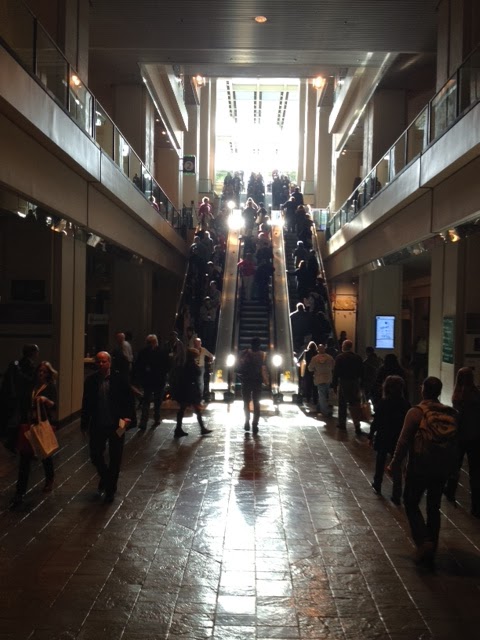
This seems familiar, doesn’t it? The dark-rimmed glasses, the lanyards (this time a bright lime-green), the endless coffee cups and totes and carefully cultivated air of discernment. Going up a series of escalators into the bright wash of light that you hope will offer enlightenment but suspect might be oblivion.

Panels like “Daydreaming at the Mini-Mart: The Suburbs and Literary Imagination,” “The Word is a Door: Contemporary Arabic Literature and the Poetics of Revolution,” and “In Your Next Letter I Wish You’d Say: Epistolary Impulse and Innovation”: When you marked them a month ago in the online planner, you felt already inspired, just like you remembered when you were younger, in grad school, when this conference, with its days dedicated to serious discussions of craft and teaching and how to live as a writer, was something you looked forward to all year.

Which is why you wanted to go this year—low on inspiration, looking for a good dance party and a few free drinks and maybe a little camaraderie, the AWP conference sounded like just the kind of charge you and your writing needed.  

However, despite your best efforts, you seem to no longer be interested in the same brand of inspiration you used to. You attend “The Third Degree: Why Writers Pursue Additional Education Beyond the Master’s” and “Beef Jerky, Bras, and Car Parts: What We Write About When We Write for Money.” You write down things like “Pitch to the holes,” and, “Quest antithetically and live to beget yourself.” Also, that writing copy for porn reviews and car commercials could be the greatest thing you never knew you wanted to do.

And—not that these panels aren’t interesting and enlightening—because they are—but you discover you’re a little disgusted with yourself that this is what you care about now: practical concerns. Not just how to be inspired, but how to live, how to be paid. You can practically hear your mother approving. When did this shift happen?  

You can’t help but think about the last time you were at AWP, or the first time, the sense of hope and possibility. When being a “real” writer, “making it,” was just a matter of time and not perspective. When you knew better than to use the second person as another cheap trick to distance yourself from the action.

Maybe inspiration is something that now you have to ease into, approach at an angle, be surprised by. Maybe you no longer trust the search of it—it’s here, just not as obvious as before. This is only the first day.

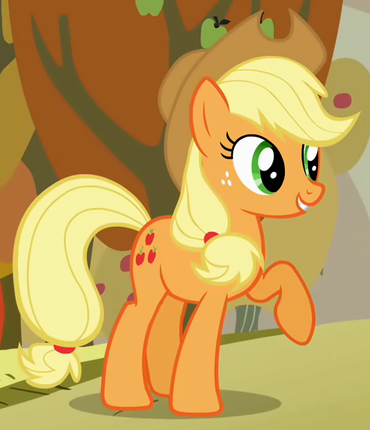
On a related note, the Mid-American Review is holding a My Little Pony writing contest, 500 words or less, poetry or prose, due by 3pm Friday. Could Applejack finally receive the recognition she deserves? Only time will tell.
—Molly Reid