Showing posts with label Daniyal Mueenuddin. Show all posts

Wednesday, March 10, 2021

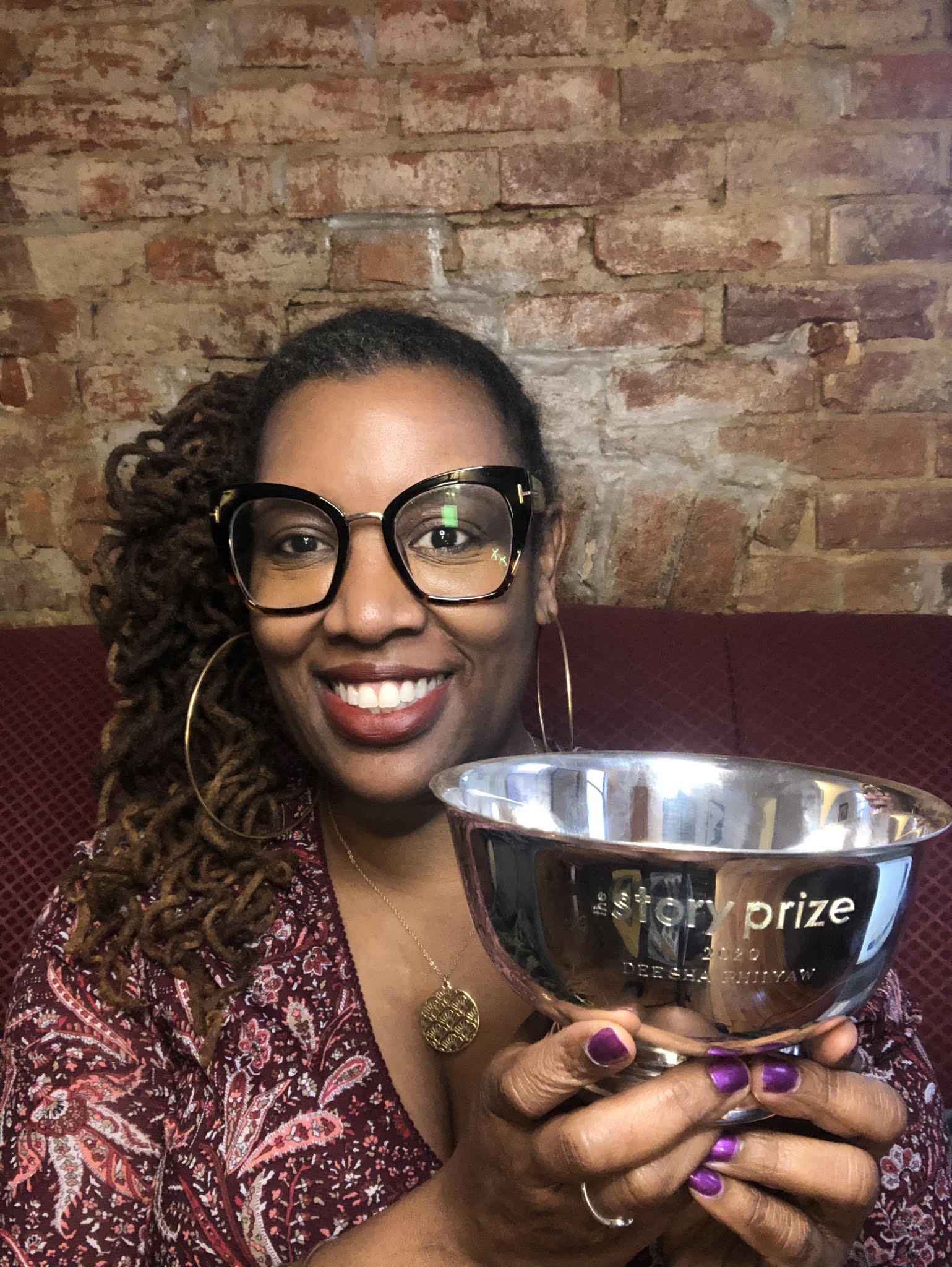
Deesha Phillyaw's The Secret Lives of Church Ladies Is the 17th Winner of The Story Prize!


The winner of The Story Prize for books published in 2020 is The Secret Lives of Church Ladies (West Virginia University Press) by Deesha Philyaw. This is the first time that The Story Prize winner has been published by a small or university press, and Philyaw is only the fourth debut writer to take the prize. The others were Patrick O'Keeffe, Daniyal Mueenuddin, and Claire Vaye Watkins.
 
A video we've posted on YouTube features readings by and interviews with Philyaw and the other two finalists for books published in 2020: The Office of Historical Corrections by Danielle Evans (Riverhead Books) and Likes by Sarah Shun-lien (Farrar, Straus and Giroux).
 
The Story Prize’s $20,000 top prize is among the largest first-prize amounts of any annual U.S. book award for fiction. Philyaw also received an engraved silver bowl, which The Story Prize presents to all winners. As runners-up, Evans and Bynum each received $5,000.

Director Larry Dark, and Founder Julie Lindsey selected the three finalists for The Story Prize, now in its 17th year, from among 121 books entered in 2020, representing 89 different publishers or imprints. Three judges—critic and author Ismail Muhammad, bookseller Margot Sage-EL of Watchung Booksellers, and writer and Williams College professor Karen Shepard—determined the winner from among the three books chosen as finalists. 

The Secret Lives of Church Ladies was also a finalist for The National Book Award for fiction and is a finalist for the PEN/Faulkner Award and a Los Angeles Times Book Award. In addition, the book is in development as an HBO series. 
 
Buy The Secret Lives of Church Ladies, Likes, and The Office of Historical Corrections from your local bookseller or on Bookshop.

Congratulations to Deesha Philyaw, and West Virginia University Press!

Wednesday, April 28, 2010

Book Award Roundup: PEN/Malamud, O'Connor, and Pulitzer

The story never sleeps. And a lot has been going on as awards season winds downs. Among the highlights:
  • The PEN/Malamud Award announced its 2010 winners on Apr. 28: Edward P. Jones and Nam Le. Both have had story collections long-listed for The Story Prize in recent years.

  • The recently renamed* Cork City - Frank O'Connor Short Story Award announced its 57 book long list on Apr. 29. Short story collections published between September 2009 and August 2010 were eligible. The award will announce six finalists in July and its winner at a short story festival in Cork in September. The prize is still €35,000. With the price of the euro sliding, that could amount to less in dollars this year.
  • The Pulitzer Prize announced its fiction winner, the novel Tinkers by Paul Harding, on Apr. 12. Of note, two short story collections were the other finalists. One was Love in Infant Monkeys by Lydia Millet. The other was Story Prize winner In Other Rooms, Other Wonders by Daniyal Mueenuddin. The latter was a strange choice, considering that the award is: "For distinguished fiction by an American author, preferably dealing with American life." In Other Rooms is a great book, but it hardly fits the bill. All but one of the stories are set in Pakistan. And the one that isn't takes place in Paris, albeit with an American protagonist. Also of note: two of the three finalists were published by independents, Bellevue Literary Press and Soft Skull Press.

There's even more going on than that, as the momentum for the story continues. Look for more posts on books we're reading for The Story Prize and about the grassroots Short Story Month, otherwise known as May.


*It was the Frank O'Connor International Short Story Award, but it appears that the Cork City Council is now sponsoring the prize. State sponsorship of book awards, not to mention corporate sponsorship, is unheard of in the U.S. but can help sustain book awards and augment prize money.

Sunday, March 7, 2010

Daniyal Mueenuddin: What The Story Prize Judges Had to Say

When the three judges for The Story Prize make their choices, they provide citations for the book or books they like best. This year's judges were author A.M. Homes, critic and blogger Carolyn Kellogg, and librarian Bill Kelly. We include the citations in congratulatory letters we present to each finalist, along with their checks ($20,000 to the winner, $5,000 to the other two finalists). To protect the confidentiality of the judges' votes and the integrity of the process, we don't attribute citations to any particular judge.

Here's what one of our judges had to say about Daniyal Mueenuddin's Story Prize winning collection In Other Rooms, Other Wonders:

In eight textured stories that stretch across decades, Daniyal Mueenuddin illuminates feudal Pakistan and its decay. Whether he's writing in the contemporary moment or of times long past, he evokes characters with empathy and a clear eye; their choices feel vital, hopeful, wrenching. Each story, on its own, shines; layered together, there is a celebration of the beauty of the landscape, humor in the everyday, the irrefutable power of family and a lingering sadness for all who have not gotten quite what they wanted.

And another judge observed:

The eight stories in In Other Rooms, Other Wonders, are woven together to create a magical, distinctly masterful, powerful debut introducing a singular voice and a truly global sensibility. It is as though Daniyal Mueenuddin arrived fully formed, his stories are well honed resonant works of art infused with a unique historical and intellectual consciousness.

Mueenuddin’s compassion for the complexity and contradiction of lives where poverty and privilege exist co-dependently is at the core of his work. In these stories one feels the tug of familial expectation, the constant juggle of social, political, personal needs and desires, the tumult of old and new worlds colliding.

These stories are written with a deep sense of knowing; as though Mueenuddin’s skin is a particular kind of porous; there is an ache, an inescapable constant melancholy, our masterful guide, knows too much, feels too deeply--if such a thing is possible. Mueenuddin is always on the outside and inside simultaneously—exposed and protected. Working in prose that is finely tuned, sparkling with sensuous clarity and authority In Other Rooms, Other Wonders draws the reader deep into a world that on the surface may seem foreign but is at it’s heart deeply familiar and human.

photo © Eric Richards

Saturday, March 6, 2010

At the Signing Table (and Other Photos from The Story Prize Event)

© Eric Richards

Before the The Story Prize event on March 3, 2010, at The New School University in New York, finalists Victoria Patterson, Wells Tower, and Daniyal Mueenuddin signed stacks of books for our bookseller McNally Jackson (which still has signed copies available). To see more photos, please visit our Web site.

Early next week we'll post the judges' citations for the three books we honored that night: Patterson's Drift, Tower's Everything Ravaged, Everything Burned, and the top prize winner, Mueenuddin's In Other Rooms, Other Wonders.

Thursday, March 4, 2010

Scenes from The Story Prize: Wells Tower, Victoria Patterson, and Daniel Mueenuddin

© Eric Richards

The finalists for The Story Prize (L to R) Wells Tower, Victoria Patterson, and Daniyal Mueenuddin (the winner), had lots of interesting things to say, both on-stage and off.

Mueenuddin for instance, told me in a private conversation that he built and oversees a school for some 200 children from around the village where his farm in the southern Punjab region is located, partly as an alternative to the fundamentalist madrasas that are popping up all over his native Pakistan.

On-stage, Patterson confessed that in her struggles to find time to write she would sometimes leave her children in the church school on Sundays and sneak out to go home to work (earning an undeserved reputation for piety).

Tower discussed seeking a magazine assignment to write about carnival people, in the hope of proving the stereotype wrong. Instead, however, he found carnies to be every bit as unsavory as they are reputed to be—maybe more so (as in his story "On the Show").

Thank you Daniyal, Tory, and Wells for being a part of The Story Prize's sixth award night.

Here are some links to coverage of the event:
Adendum: More press...

Wednesday, March 3, 2010

Daniyal Mueenuddin's In Other Rooms, Other Wonders Wins The Story Prize


Daniyal Mueenuddin has won The Story Prize for his extraordinary collection of connected stories, In Other Rooms, Other Wonders, which center around a feudal landowner in southern Pakistan. Founder Julie Lindsey presented him with the $20,000 award and an engraved silver bowl at an event that took place at The New School in New York City on Wednesday night, March 4. The other finalists, Victoria Patterson for Drift and Wells Tower for Everything Ravaged, Everything Burned, each received $5,000. All three authors read from and discussed their work onstage.

More details will follow, including the judges' citations for all three books. A Web cast will follow on FORA.tv in a few weeks. We'll post photos from both the event and reception on The Story Prize Web site in the days ahead and will also link to notable press coverage. We're grateful to all three writers for their participation and, most of all, for their wonderful books.

It was a pleasure talking to Daniyal, Tory, and Wells—and all three read beautifully and show incredible promise for more great work.

Monday, February 8, 2010

Daniyal Mueenuddin on the Experiences That Shaped His Writing

(Note: Daniyal Mueenuddin is a finalist for The Story Prize, along with Victoria Patterson and Wells Tower. All three authors will read from their work and discuss it onstage on March 3 at The New School. At the end of evening we will announce the winner of the prize. Tickets are available from SmartTix.)

For many years I have run a farm in Pakistan’s southern Punjab. Most of the stories in this book have their origins in my experiences there, and many were written there. Half-Pakistani and half-American, I have spent equal amounts of time in each country, and so, knowing both cultures well and belonging to both, I equally belong to neither, look at both with an outsider’s eye. These stories are written from that place in between, written to help both me and my reader bridge the gap.

My father was a graduate of Oxford, a member first of the Indian and then after Partition of the Pakistani civil service – and, most fundamentally, a land owner of the old Punjabi feudal class. My American mother, a reporter with the Washington Post, met my father in Washington, where he was negotiating a treaty. She was twenty seven years younger than him. They married and soon after – in 1960 – moved back to Pakistan.

We lived in Lahore, where I attended the American School until I was thirteen, my classmates the children of westernized Pakistanis or of the few foreigners pursuing their oblique lives in this marginal place. My family spent most vacations on the farm that I now manage, where I ran free day and night with the children of the village, was in and out of their houses, ate with them, explored with them, swam with them. In Lahore I was closer to the old servant who brought me up than to anyone else – thirty years after his death I still wear the bracelet he gave me when I went off to school in America. Because I was a child, the servants and the villagers were not guarded against me, unaware that I was watching; and therefore I learned the rhythms and details of their lives in a way that I never could as a grownup. I heard the women in the village calling to each other over their common walls, walked out with the boys when they took their buffaloes to be watered at the canal. These people, their gestures and intonations as I observed them in my childhood, appear throughout the stories in In Other Rooms, Other Wonders.

At thirteen I was packed off to boarding school in Massachusetts. Five years of full-dress dinners, Latin grammar, lacrosse, and daily chapel, lacquered me to a glossy Boston-Episcopalian sheen, so that by the time I arrived at Dartmouth College I more or less passed as an American. There I wrote poetry, protested against apartheid, sweated it out in the library stacks – and popped out after four years with – a degree in English literature, a debased currency. My aging father had been sending increasingly pressing letters, telling me I must return to Pakistan and take care of the family property, and so, after reflection, I complied.

My father, just turned eighty, had suffered a long series of heart-attacks. As his illness progressed, for years he had been losing control of his lands to the managers, who sent less and less money to Lahore each quarter, as they became increasingly confident that he could no longer visit the farm. In his calm and perfectly rational manner, my father explained to me soon after I returned that, if I wanted the land, I would have to go fight for it – that otherwise it would be lost.

On arrival at the farm I went through the books with the accountants, walked the lands, met with revenue officials, trying to get some sense of what we owned, what we produced, what we spent. The place was a total disaster. There were no maps, no deeds, no titles. The accountants had wound the books into an impenetrable ball. The managers were all from the same extended family, and were unified against me. I returned to Lahore five weeks later, shell-shocked, hungry for company, but hardened, sunburned, and at least now aware of the scale of the problem. I decided to stay and fight it out.

For the next seven years I lived more or less uninterruptedly at the farm. It was a tense and yet intensely happy time, long days walking across the lands, or sitting in hot rooms poring over ledgers – and then, against that, the early mornings, when I wrote poetry, looking out from the window of my study to the garden my mother had planted. In the evening I wrote letters and read endlessly, ordering crates of books from Blackwells in Oxford, who had supplied my mother’s books in the nineteen sixties.

My father died soon after my return from college, and I lost his backing, the influence he still had wielded – but I stayed afloat. Gradually I learned about the crops, about selling and buying, about fertilizer, diesel engines, the qualities of soil, the depths and shallows of the local politics, the depravity of the police. I learned to be a hard negotiator, to manage the farm rigorously, to form alliances, to deflect threats. These were very different lessons than the ones I learned as a child, much harder lessons, and equally valuable to the stories that I would be writing.

By the sixth year, I felt I had to get away and spend time in the West again. I applied to law school, got in to Yale, and spent three lively years there, my concerns far removed from Pakistan. After graduation I took a job at one of the large New York law firms.

Sitting in my office on the forty second floor of a black skyscraper in Manhattan, looking out over the East river, I gradually developed confidence in the stories I had lived through during those years on the farm. I realized that I was in a unique position to write these stories for a Western audience – stories about the farm and the old feudal ways, the dissolving feudal order and the new way coming, the sleek businessmen from the cities. I resigned from the law firm, returned to Pakistan, and began writing the stories that make up this book.
Tuesday, January 19, 2010

Story Prize Finalists Mueenuddin, Patterson, and Tower Are All Over the Place

Here are some links to essays by, interviews with, and other miscellanea from the three finalists for The Story Prize—Daniyal Mueenuddin, Victoria Patterson, and Wells Tower. Remember, all three finalists will read from their work and discuss it onstage at The New School, in New York City, on Wed., March 3 at 7:30 pm. And at the end of the evening, we will announce the winner.

Daniyal Mueenuddin
  • Ron Hogan's prescient introduction* to Daniyal Mueeduddin writing about a story by Turgenev in January 2009 on Beatrice.com.
  • An interview on NPR's Morning Edition in November 2009.
  • Tour dates for the paperback edition, Jan. 19-25.

Victoria Patterson

Wells Tower
Of course, the best way to experience these collections is to read Mueenuddin's In Other Rooms, Other Wonders, Patterson's Drift, and Tower's Everything Ravaged, Everything Burned.

* I erroneously characterized this as an interview when this was first posted.

Monday, January 4, 2010

Three Debut Writers Are Finalists For The Story Prize

After reading 78 short story collections in 2009 and seriously considering a dozen or so strong candidates, Julie Lindsey (the founder of The Story Prize) and I selected the finalists for The Story Prize in early January. It's always difficult for us to narrow down our choices to just three collections and it seems to get harder every year. But, as always, we're excited about our choices. This year's finalists for The Story Prize are:

In Other Rooms, Other Wonders by Daniyal Mueenuddin (W. W. Norton)
Drift by Victoria Patterson (Houghton Mifflin Harcourt)
Everything Ravaged, Everything Burned by Wells Tower (Farrar, Straus, and Giroux)

What's particularly exciting is that all three are debuts--a first for The Story Prize. In fact, in the previous five years of the award, only 2 of 15 finalists were the authors' first books: 2004/05 finalist
The Circus in Winter by Cathy Day and 2005/06 winner The Hill Road by Patrick O'Keeffe.

All three of these collections are exceptional and rewarding reads. Look for more about each of them here. In the days ahead, I'll also be releasing a list of other notable short story collections from 2009. In the weeks leading up to our event, I hope to spotlight some of these books in addition to the finalists.


This year's event, by the way, is at 7:30 p.m. on Wednesday, March 3, at The New School in New York City (66 West 12th Street). That night, Daniyal Mueenuddin, Victoria Patterson, and Wells Tower will read from their short story collections and discuss their work onstage. At the end of the evening, Julie Lindsey will announce the winner. 


For information on buying general admission tickets, which cost $14, go to SmartTix.com and search for "Story Prize" or contact The New School box office at boxoffice@newschool.edu or 212- 229-5488.

For those of you in New York, our official bookseller, McNally Jackson, will be giving away a limited number of tickets in the weeks leading up to the event. And for those who can’t make it, a Web cast will appear on FORA.tv several weeks later.

Thursday, October 15, 2009

Two Short Story Collections Are Finalists for the National Book Awards

Here's something I don't get tired of: More good news about short story collections. The National Book Awards announced their fiction finalists yesterday, and two of the five are short story collections: Bonnie Jo Campbell's American Salavage and Daniyal Mueunuddin's In Other Rooms, Other Wonders. Readers of this blog (who are legion) may remember that in a previous post about summer reading, I pointed out that author and NPR commentator Alan Cheuse had recommended Muenuddin's collection. Well, guess what, he'd also recommended Jayne Anne Phillips' evocative novel* Lark and Termite, which is another finalist for the National Book Awards. While Cheuse is only one of the five fiction judges, in retrospect his summer picks provided a partial preview of the NBA finalists.

As I said in that post, I can highly recommend Muenuddin's excellent collection. Yesterday, Bonnie Jo Campbell's book immediately jumped to the top of my pile and, half way through, I'd have to say it's a brilliant choice by the NBA judges. It's especially impressive because of the huge number of fiction entries (236) they read this year. One of the best things a book award can do is to shine the spotlight on deserving and underappreciated books, authors, and publishers. This group of judges obviously didn't cut any corners and gave their full attention to a university press book (Wayne State) that didn't get widespread attention. Kudos to them. That's why Julie and I make sure we read everything we get. You never know where you'll find a gem.

By the way, one of the other NBA judges is author Lydia Millet, who has a short story collection, Love in Infant Monkeys, just out from indy publisher Softskull Press. I wouldn't be surprised if she were a big advocate of Campbell's collection, but that's just a guess.

* Full disclosure, Jayne Anne is a colleague of my wife's at Rutgers-Newark, and a friend of ours.

Sunday, May 31, 2009

Updike at the Beach: Short Story Collections on Summer Reading Lists

We're happy to see that several short story collections have made summer reading lists. The Wall Street Journal Web site lists three: John Updike's posthumous collection, My Father's Tears, Jean Thomspon's Do Not Deny Me, and James Lasdun's It's Beginning to Hurt. I haven't read any of these yet but have high hopes for the Thompson and Lasdun books because I've admired their previous collections. (We won't be reading Updike's collection for The Story Prize because only books by living writers are eligible, sad as it is to say this.)

As a side note, The Journal calls all ten of it's fiction picks "novels" and mistakenly states that this is Lasdun's debut collection. In fact, his first was Delerium Eclipse in 1987 (published, I believe, as The Silver Age in the U.K. in 1985). Despite these errors, however, it's the thought that counts, and short story collections on The Journal's list are sure to come to the attention of more readers.

Elsewhere, NPR critic Alan Cheuse, includes Daniyal Mueunuddin's In Other Rooms, Other Wonders among his seven summer picks. This, I have read, and can highly recommend. It definitely lives up to the excellent reviews it has received.

So this summer, grab a short story collection to take along to the beach or the mountains (or, in my case, the NJ Transit's Montclair-Boonton line).