Showing posts with label bad stories. Show all posts

Saturday, August 17, 2013

Ramona Ausubel and the Story About the Spool Farmer

In the 16th in a series of posts on 2013 books entered for The Story Prize, Ramona Ausubel, author of A Guide to Being Born (Riverhead Books), relates the value of pursuing even a bad idea for a story.


Years ago I was driving on the stretch of freeway that climbs over the mountains between the city sprawl of Los Angeles and the Central Valley. There were low, scraggly trees and brush and the black char of an old forest fire. It was almost pretty, a little dirt and leaf after having been stuck in the car a long time with only metal and asphalt to look at. Then, in the middle of a hillside, there were several huge empty wooden spools. They seemed strange and out of place, and one of those usually dormant parts of my brain wondered if this was, perhaps, a spool farm. Quickly, logic swooped in and presented some actual possibilities: These spools were meant to hold wire or underground cables, transported by truck to this location.

I was in my first quarter of graduate school and it was my paid job to write stories (technically my salary came from teaching freshmen to write essays, but whatever). So, I decided to write a story about a spool farmer. I took great pleasure in the thought that the state of California would be paying me for this. No one could stop me. It wasn’t exactly like Robin Hood, what I was I doing, but it felt good.

The important thing about this particular short story, its real stand-out trait, was that it was bad (and not on purpose). Thanks to the gift/curse of permanent Internet storage solutions, I can provide you with an excerpt:

People who didn’t know asked: “So you grow trees and then build spools out of the wood?”

“No," Walter said over and over. "No newfangled building. We farm them the old fashioned way.”
“From seed?” the questioner wanted to know.   
“No. We mate ’em, just like pigs or sheep or any of God’s other animals.”  

Instant classic, right? Spool sex with religious overtones and notes of the heartland.  Later on it is noted that the spools eat mostly grass, “though they do enjoy a good meat sandwich.” Ah yes, the carnivorous spool.

I don’t remember giving up on the story. That it failed was not a great disappointment and I moved on to other work right away. When I thought of it a year or so later I was embarrassed for myself and disbelieving. Did I actually try to write that? Thank goodness I never showed it to anyone, I thought. I was extremely relieved that I never turned it in to my workshop.

If I had been a more experienced fiction writer I might have known immediately that writing about meat-eating pieces of wood would pose a challenge. The trouble is that I might also have “known better” than to try to write about a pregnant teenager who believes she is going to give birth to a three-headed giraffe, or about a place where everyone grows a new arm when they fall in love. Those stories did come together, by whatever magical, alchemical means fiction does and I’m grateful that I was brave/dumb enough to try those first unknowable drafts.

I am writing a new batch of stories now and I have been thinking about the spool farm. You’ll be glad to know that I have no intention of reviving it as a work of fiction, but I’m weirdly proud of it. Not what’s in it, certainly not, but proud that I tried such a silly idea. I want, every single time I sit down to write, to follow the path that that unquestioning part of my mind makes. I’ve learned things about writing fiction in the years between the spool story and now, useful things, things I’m grateful for. But I almost never feel like I know what I’m doing—sometimes the most well-thought-out, doable-seeming ideas fail while the biggest leaps succeed. And I like it that way. I like that it’s always a surprise. The image of those spools is like a talisman I keep in my pocket to remind me not to think I know better. I imagine the field of them, ready to mate, ready to eat bologna on white bread. Be brave, they tell me. Be dumb. Be willing. 

Saturday, January 5, 2013

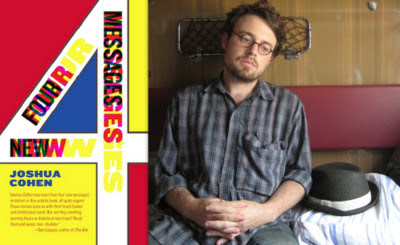
Joshua Cohen's Nine Worst Story Ideas

In the 70th in a series of posts on 2012 short story collections entered for The Story Prize, Joshua Cohen, author of Four New Messages (Graywolf Press), gives several answers to a question.


The Story Prize has asked: “What’s the worst idea for a story you’ve ever had?” Below are nine answers—from a late teens/early twenties flirtation with “scifi.”

1.  Once upon a time a machine was invented to invent every possible scifi story. It made stories of space opera, space western, interspecies romance, time travel, parallel universe, cyberpunk, steampunk, utopia, dystopia, apocalypse noir. It created literally billions of stories. This story you are reading now is #45,059,534,455.

2.  Scifi writers, at their annual convention in Newark, decide to take over Hollywood by writing nothing original anymore but by merely novelizing movies with great accuracy: describing setting, transcribing dialogue. For years no new scifi is written, while the only scifi that gets published remakes recent movies in prose. Gradually filmmakers forget this fact and begin remaking scifi into movies again: remakes of remakes, remakes of remakes of remakes. This will continue until filmmakers forget about literature entirely. Gradually.

3.  A boy reads a scifi story in a book, but the book, being old and maltreated, is missing pages, specifically the story’s last three pages, and so while the boy is under the impression that the story he’s reading has ended, really the ending has been missed. In the last three pages the hero who the boy thinks has died is revealed as actually being alive, and his death nothing but an alternate destiny. The story, then, has something of a trick ending. Too many scifi stories have trick endings…

Years later the boy’s on a date. This is the first date he’s been on in months, and he’s nervous. The girl, similarly dateless of late, is nervous, too. Over dinner they begin talking about movies, which leads to booktalk and, after they’re comfortable with one another and a smidgen drunk, their geekiness blooms (like a rose) or spurts (like a cream-filled chocolate) as they discuss scifi. The girl mentions a story familiar to the boy and proceeds to detail its plot. The boy stops her eagerly, fills in much of the rest, then adds, I thought it was so sudden though, that he died.

 She says, He didn’t die, that’s the point, he was alive the whole time.

 He says, That’s not how I remember it.

And the girl, who until now had been entertaining great prospects with this boy, frowns, thinking anyone who can’t remember an ending isn’t worth beginning with.

4.  Someone writes a scifi story that features a character called Nul. A movie’s made and is called Nul. Duly, Nul apparel appears in stores, Nul lunchboxes and actionfigures, a Nul videogame. Then, civilization crumbles (this, of course, is the funnest aspect of scifi, just saying that, just doing that—crumbling).

A million years later the alien equivalent of archaeologists discover a lost planet that worshipped a god called Nul and bring this cult of Nul back to the home galaxy, where its objects are venerated, if not religiously then for reasons of historical respect. Until, that is, a subsequent research team manages to translate what are known as “intellectual property laws,” and the alien intelligentsia, previously the most ardent servant of Nul, becomes suddenly ambivalent.

5.  A young writer of scifi outlines an elaborate story that serves as a political allegory. Alien People A are very poor and oppressed by Alien People B. The writer, who is a liberal like all young writers, obviously sympathizes with People A. The book is a smash hit, and he spends the rest of his life writing sequels. But, over the years, as he gets richer and tired, more old and conservative, he finds he agrees more with People B, and begins to suspect that People A are responsible, to some degree, for their own poverty and ignorance.

However this sense also passes, and at the very end of his life the allegory has been forgotten entirely as the writer grinds out books describing only kidnappings, rapes, and murder, in an unending war between two mutually incomprehensible selves.

6.  A man who produced scifi comicbooks was a rarity for his day: He both wrote the words and drew the pictures. One day, the day his wife left him for drinking too much and smoking marijuana and sleeping with the redhead down on the third floor, he developed a terrible problem. Everywhere he walked a bubble would follow: a thought bubble, and in it people could read each of his thoughts, floating just above his head. When the redhead left him a month later for an assistant harpist with the San Francisco Symphony, the thought bubble, which had been connected to his head by sundry puffs, became connected to his mouth by a wisp, and turned into a speech bubble, which meant that now everything he said could be heard everywhere, as if he were speaking from the clouds. Some people had begun to think he was a god, but the women in his neighborhood knew he was just an egomaniac who kept odd hours, drew dirty pictures, and never washed his pants.

7.  Once an elderly scifi writer was solicited by the new young editor of the last scifi magazine to appear in print and, in response, submitted a story that involved squid—he thought it was a squid. But then when the magazine finally printed the story—two years later in the last issue of any scifi mag to ever appear—and he received his single complimentary copy at the Westchester assisted-living facility he’d just been moved into by his daughter following his second stroke, he found that every instance of the word “squid” had been changed to “pickup truck” (though once it was just “pickup”). Other than that, the story appeared unchanged—not even copyedited, all its typos intact.

The writer spent the last two years of his decline wondering how all his squids had become trucks, and tried his hand at various fictional explanations (squid meant truck in an alien dialect into which his story had been translated before being translated back into English by the alien editors of a periodical that was, in truth, to serve as an alien constitution, and so on—because the aliens had lost the original manuscript and had to work hurriedly)—all of which attempts were failures, though his daughter, who typed every single one of these stories from his shaky handwriting on napkins, would never have admitted that to Dad.

8.  Once a literary genre was invented to relieve the psychic pressure brought to bear on human life by mechanization, and the encroachments of technology. But once that technology overtook life, and life became just one more form of mechanization, there was no more need for this genre. What formerly had been fiction now was fact, and that was perhaps the strangest story conceivable.

9.  There once was an inventor who invented a machine to invent, and categorize, every possible scifi story. His machine made stories of space opera, space western, interspecies romance, time travel, parallel universe, cyberpunk, steampunk, utopia, dystopia, apocalypse noir. It created literally billions of stories. This story you’re reading now is from category #45,059,534,456.

(The writer of the above story sat back in his chair, well satisfied. His happiness lasted until he realized he could not think of a single magazine left that would publish him.)

Monday, July 23, 2012

Jennifer Spiegel's Three Worst Stories—So Far

In the eleventh in a series of posts on 2012 short story collections entered for The Story Prize, Jennifer Spiegel, author of The Freak Chronicles (Dzanc Books) confesses to some failed efforts.

Oh, I’ve written a lot of bad stuff. Some was bad because I was too close to the material, failing to let the “trigger” or subject matter marinate or ferment: not enough psychic distance. Some was lousy because it was inauthentic: I didn’t know what I was talking about. Some sucked because I didn’t care. Playful prose, no passion. 

Here are my Top Three Narrative Calamities:

Curiosity...
1.  We don’t like to talk about this in my family. We’re pretty embarrassed. Surely, it says something about us as people. Surely, there must be criminality in our genes. Surely, we must beat the children or embezzle funds or, minimally, drink. I’m talking about the time our beloved yellow Lab bit the head off a Siamese-mix kitten, her body left limp—cast off to the side, if you must know. Even as I wrote those words, I moaned aloud—the memory too gruesome and too heartbreaking to type my way through.

I was still living at home. We had just gotten a kitten: a fluffy little kitten we promptly named Sophie. For one day, Sophie was a star. She was adorable, clamoring around the velvet recliner, purring and frolicking like a bunny, an angel. Even Hemingway, our gentle giant pup, thought her special.

But then the dawn: Sophie innocently, dumbly, pitter-pattered over to Hemingway’s dog chow on the kitchen floor and sniffed it out. Hemingway, animal that he was (may he rest in peace), didn’t hesitate. With unanticipated fury, he growled, he snapped his jaw, and he bit her head off.

It wasn’t quite this way. The head was still attached. Pandemonium truly did ensue. My mother shrieked. My father picked up the broken body and Sophie, dying, defecated. I was the one appointed to drive to the animal hospital with my mom holding the ruined kitten in a towel. My mom wept the whole way. The beautiful, beautiful kitten would be put out of her misery when we arrived. The spasms would cease.

And Hemingway remained. For maybe nine more years. There were other cats. They all lived. He liked them, actually. At first, we struggled. Especially my dad. What were we to think of this dog, this monster, this cat killer? How were we to make sense of his snap dog-decision, that resort to sudden bloody violence? How could he still be our sweet pup? Should we get rid of him?

We kept Hemmy Bemmy Man, and—later that day—I knew I had to use this violence of Flannery O’Connor proportion and turn it into a stunning metaphor for beauty, innocence, and pain.  I wrote and wrote, incorporating it into a story about a woman with inoperable cancer.

All you need to know is this: It sucked.

Why? Psychic distance. Not only do I need a measure of objectivity, I also need that lapse in time in order to be free from what actually happened. I’m only able to manipulate and shape details—for a better aesthetic purpose—when time has passed.

Something missing
2.  “Following the Dead” was going to be about the Grateful Dead because my mom’s cousin, who I knew remotely but fondly, was a Dead Head at one time—and I had this strange, lurid obsession with groupies, which might be similar to my contemporary strange, lurid obsession with Renaissance Festivals. The whole thing sounded utterly fascinating. I started smoking a pipe, I put on my thinking cap, and I came up with a Grateful Dead scenario. That band name! Following around the Grateful Dead! Talk about another metaphor!

One problem: I never listened to them. I didn’t even really like them. They seemed a little smelly. I kinda liked my boys pretty. But then the coup d’état: someone let on that Jerry was missing a finger. I never knew! I had no freakin’ clue!

I abandoned ship. Obviously, my story would lack authenticity.

What writerly virtue do I prize most? Authenticity. It isn’t that I have to live it physically, but I need to grasp that world spiritually and mentally. If I don’t know about Jerry Garcia’s missing finger, I’m not fit for this story.

3.  “Scallop.” I called my fictional town Scallop. I think it was in Upstate New York. This was an assignment by a licensed counselor. Because I was in therapy. Yeah, I’m admitting that. I had been in this near-fatal car accident, which I never like to talk about, and I hated it. I said a lot of B.S. stuff. When she asked me to write her a story since I liked to write stories, I assumed she was patronizing me—but, hey, I thought, I’ll blow her @#%*ing mind with my literary awesomeness!

Friday night in Scallop
I don’t need therapy! I’m a badass writer!

What happened in the story? I don’t even remember. Something—no doubt—about a vivacious, badass woman ending up in a small town called Scallop, where they square-danced on Friday nights and preserved fruit and sh#t. I remember how the poor therapist said, “I don’t know what it means, but I know I like it.” Patronizing! I flew out of there, and burned “Scallop.”

The problem: the machinations of craft are necessary but not sufficient for literary awesomeness. The spark, the passion, the talent, the divine grace: If it’s not there, the story is D.O.A.

I have plenty more narrative disasters, but I’ll hold back.

Saturday, July 21, 2012

Stephanie Reents' Bad Cat Stories

In the tenth in a series of posts on 2012 short story collections entered for The Story Prize, Stephanie Reents, author of This Kissing List (Hogarth Press), discusses her (so far) futile efforts at writing a story about cats.


For many years (I should be specific here – at least ten) I have been trying to write a story about cats. This is one of the worst ideas I have ever pursued, and yet, because I have been blessed with some exceptional cats as companions (Luke, Tasha, Snowball, Clementine, Delancey, Dakota, and now Lenny), I haven’t stopped trying.


Haruki Murakami is also one of my favorite writers, and he’s brilliant when it comes to cats. One of his characters reads the minds of cats; another harvests their souls (see Kafka on the Shore). The first section in The Wind-up Bird Chronicles seems to turn on a single question: What happened to the narrator’s cat?  (Never mind the nameless woman who keeps calling and trying to entice the narrator into having phone sex as he cooks spaghetti or listens to opera.)

I started my first cat story (“Cats I Have Known”) just before I began a fellowship at Stanford. I remember sitting in my new apartment, scrawling page after page about cats. The story had no purpose, but I imagined that its wandering pointlessness might seem avant-garde or at least charming. Alas. Perhaps I invested days in this story because I missed my own cat, Dakota, whom I’d shipped off to my parents because of the difficulty of finding a pet-friendly share. In graduate school, I’d written a poem about Dakota. It was about how cats were like children, beloved, spoiled, and anthropomorphized until children came along, and then cats were cats, banished back into felinehood.

Unfortunately, the poem reminded the professor of a cat he’d had in graduate school. “Eloise was in heat,” he began. He was the kind of poetry professor who liked to tell stories from his personal life only tangentially related to class. They were often about sex. “Yowled all day and night,” he continued.  “She was an indoor cat, you know, so I decided to give Eloise a little relief. I took her into my office and masturbated her with the eraser end of a pencil. From then on, we couldn’t be in the same room.”

This should have taught me that writing about cats can be risky, and yet I tried again several years later.  My next feline fiction (“Lying With Cats”) dealt with a recovering alcoholic who discovers a van full of cats parked in New York City’s Chinatown. The cats’ owner—a slightly deranged man who steals cats from suburban neighborhoods—convinces the narrator that she might be cured of her addictions if she takes the cats (much like taking the waters) and crawls into the back of the van with them. Sadly, the cats just pounce on her, scratching and biting her, and she realizes that the only person who can save her is, of course, herself.

The last cat story I attempted (“Ghost Cat, Real Mice”) chronicled a woman’s life through her cat’s misadventures. On the final page, after the cat gets hit by a car and dies and mice invade the woman’s apartment, the woman dreams the cat comes back, but as a ghost: “A ghost cat chasing real mice.  Remembering the dream the next morning, she laughs – since dreams usually create the illusion of return, and her dream has only reaffirmed the cat’s permanent departure. It is strange, though: From this day on, the mice are gone, too.” I wanted to include it in my collection, The Kissing List, but my editor ixnayed the idea. (“Maybe it’s because I’m more of a dog person,” she said kindly.)  My writing group suggested that the piece would be improved by narrating it from the animal’s perspective.

Why do I keep trying to write about cats? Is it because I am a crazy cat lady? (I have always limited myself to just one whiskered creature at a time.) My last cat, Dakota, was important to me. She moved with me from the Lower East Side of Manhattan to Tucson, from San Francisco to Lancaster, PA. She survived pit bull attacks, cross country drives, airplane trips, and my own youthful recklessness. She was an excellent companion, and one of the most consistent things during my itinerant 20s and 30s.   Maybe I keep writing cat stories to try to convey how important animals can be.

It’s also the job of writers, I think, to take improbable, tired, or even just plain old atrociously bad ideas and try to make them work—to write surprisingly moving fiction about subjects, people, ideas, and even little animals that most of us breeze by (or find distasteful or try to avoid, etc., etc.) in real life. And though I haven’t succeeded yet, this is why I still have my claws in cat tales.