Showing posts with label Junot Díaz. Show all posts

Tuesday, January 23, 2018

A Few Highlights from Past Story Prize Events

Here's a short highlight reel we've put together to promote The Story Prize event on Feb. 28 at The New School. That night, authors Daniel Alarcón, Ottessa Moshfegh, and Elizabeth Strout will read from and discuss their work onstage before we announce the winner. (You can order tickets here.)


This video includes excerpts from George Saunders, Adam Johnson, Lorrie Moore, and Adam Johnson. Sometime soon, we hope to create a longer video featuring more highlights of author readings and interviews from past Story Prize events.

Thanks to the Creative Writing Program at The New School, which co-sponsors our award events and arranges to have them recorded each year.

Thursday, March 21, 2013

Press Play: Media Coverage of The Story Prize Event

Claire Vaye Watkins, Dan Chaon, and Junot Díaz backstage
photo © Beowulf Sheehan
Here are some press accounts of The Story Prize event on March 13, at which eventual winner Claire Vaye Watkins and fellow finalists Dan Chaon and Junot Díaz read from and discussed their work onstage at The New School:


Saturday, March 16, 2013

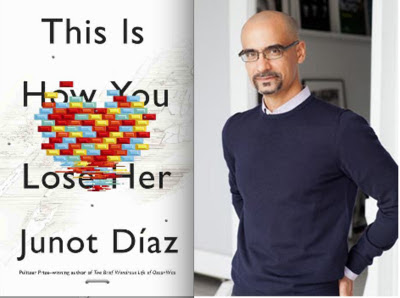
What The Story Prize Judges Had to Say About Junot Díaz's This Is How You Lose Her

photo © Beowulf Sheehan
When the three judges for The Story Prize make their choices, they provide citations for the books. This year's judges were Jane Ciabattari, Yiyun Li, and Sarah McNally. We include the citations in congratulatory letters we present to each finalist, along with their checks ($20,000 to the winner, $5,000 to the other two finalists). To protect the confidentiality of the judges' votes and the integrity of the process, we don't attribute citations to any particular judge.

Here’s what one judge had to say about Junot Díaz’s This is How You Lose Her:

“Junot Díaz is a great writer, a blessing to the history of literature and to those of us lucky enough to watch his work unfold. His stories are infused with something that seems beyond the sum of their words. It may be simply style, which Proust calls the necessary condition to art. His work is so distinctive that if I didn't read another word by him for 50 years, in one sentence I would know him again. But it feels deeper than even style, it feels alchemical. When someone tells me they don’t appreciate Junot Díaz, I feel sad for them, as if they’ve told me they don’t like puppies, children, strangers, dancing, and friendship. His books are some of the most vital, enjoyable, smart art of our day, and This Is How You Lose Her shows that his talent is deepening and unfolding still.”

Friday, March 15, 2013

Video: The Story Prize Event on March 13, Dan Chaon, Junot Diaz, Claire Vaye Watkins

In case you missed it, here's video of The Story Prize event on March 13, at which we announced the winner for books published in 2012: Claire Vaye Watkins' Battleborn.

Thursday, March 14, 2013

Pictures from The Story Prize Event on March 13

 All photos © Beowulf Sheehan


The finalists: Junot Díaz, Claire Vaye Watkins, and Dan Chaon

Dan Chaon reads from his collection Stay Awake

Claire Vaye Watkins discusses Battleborn
with Story Prize Director Larry Dark
Junot Díaz discussing This Is How You Lose Her—and more

Story Prize Founder Julie Lindsey, winner Claire Vaye Watkins, and Larry Dark

Wednesday, March 13, 2013

Claire Vaye Watkins' Battleborn Wins The Story Prize

photo © Beowulf Sheehan
The winner of The Story Prize for short story collections published in 2012 is Claire Vaye Watkins for Battleborn (Riverhead Books). Watkins takes home a check for $20,000 and an engraved silver bowl. The runners-up, Dan Chaon and Junot Díaz, each take home $5,000. All three deserve a big round of applause: They wrote great books that made our judges' decisions difficult.

Battleborn is a collection of 10 stories set in the American West. Settings range from the California Gold Rush of 1849 to the founding of Reno in 1859 to the abandoned movie set that housed the notorious Manson family in the late 1960s to recent times haunted by these past events. The collection’s title refers to the state motto of Nevada, the author’s home state, where many of the stories take place.

Claire Vaye Watkins is the ninth ever winner of The Story Prize and first woman to win since Mary Gordon for The Stories of Mary Gordon in 2007—the third year of the award. Edwidge Danticat’s The Dew Breaker was the first ever winner in 2005. Watkins is also the third debut author to win. The other two were Patrick O'Keeffe for The Hill Road in 2006 and Daniyal Mueenuddin for In Other Rooms, Other Wonders in 2010.

In the days ahead, here and on our Web site, we'll post citations from the judges, photos from the event and the after party, and links to media coverage.

Tuesday, January 15, 2013

Here Are Your Story Prize Finalists: Dan Chaon, Junot Díaz, and Claire Vaye Watkins

Dan Chaon           Claire Vaye Watkins                Junot Díaz
We’re pleased to announce the books and authors we've chosen as this year's finalists for The Story Prize:


These are all outstanding short story collection by skillful and accomplished authors, whom we're thrilled to have as finalists for The Story Prize. We read 98 short story collections from 65 different publishers or imprints in 2012. Quite a few would have made excellent finalists. It’s always hard to choose just three books, and it will be just as difficult (if not more so) to compile a short list of other notable collections we read in 2012.

We're also excited to announce something new, The Story Prize Spotlight Award, a $1,000 prize to a book submitted for The Story Prize that we believe deserves further attention. This year's winner is Krys Lee for Drifting House (Viking).

The Story Prize’s annual event will take place at the New School’s Tishman Auditorium in New York City at 7:30 p.m. on Wednesday, March 13. General admission tickets are $14. That night, the finalists will read from and discuss their work onstage. At the end, Julie Lindsey (Founder of The Story Prize) will announce which of these three deserving authors gets the top prize of $20,000—the most of any U.S. annual book award for fiction. Our three judges—critic Jane Ciabattari, author Yiyun Li, and bookseller Sarah McNally—are reading the books and will determine the outcome.

Monday, November 26, 2012

Junot Díaz on the Importance of Silence in Fiction

In the 45th in a series of posts on 2012 short story collections entered for The Story Prize, Junot Diaz, author of This Is How You Lose Her (Riverhead Books), speaks about what isn't there.

© Nina Subin  
I've always been interested in how you write silences. How do you include or mark in a piece of fiction what isn’t said between the characters, the narrative that is missing even from the characters’ perceptions of the world. How do you as a storyteller account for traces of the erased, the denied or that flat out vanished? These are concerns that sit with me always when I write stories. I often begin my stories by first sketching their primal silence and then elaborating the story around that silence. Sometimes what's missing is pretty obvious to the reader: a character or a place that’s disappeared and that the characters do not wish to confront. But other times it’s far more cryptic, a silence that I keep to myself but whose resonances power the prose, work like a dark energy on the matter of the prose.

Haruki Murakami’s novels are rich with silences. So are the early Morrison books. And of course Cormac McCarthy leaves out a whole lot more than he puts in. (See Blood Meridian for a masterwork in lacuna studies.) If you haven’t read Terrence Holt’s In the Valley of the Kings please rush to do so. Another great master of elision; the collection's title story is a seminar on narrative gaps. Rushdie on the other hand is one of my favorite writers in the world, but he’s not all that awesome at silences. Or if he is I haven’t noticed; my failure. 

In my novel Oscar Wao the silences are many and intentionally so. The book is organized around various unrecoverable absences. One of the most obvious is of course Oscar de León himself. Some readers might not notice that for all of Oscar’s “presence” in the book he is never actually present. We always receive him through the mediation of the narrator, Yunior. We never hear directly from him, which is odd, no, consdering that he is a writer after all. All of Yunior’s narrative muscles hide the fact that Oscar is not there at all. And when one discovers that one should always ask: why? 

Then there’s the silence at the heart of Yunior’s character—he is the protagonist of sorts of all three of my books—a silence which defines so much of what he is and what he bears witness to and why he connects with the women and people that he connects with. A silence he has yet to confront. 

We live in a culture whose expression baseline is the over-confessional mode. The compulsive over-confessional mode. We’ve all gotten so damn loud and you don’t need David Foster Wallace to tell you that. At times it feels like too much information is no longer an exception but the order of the day. One of my favorite stories in the world is an Octavia Butler tale where the narrator suffers from a malady that in its final stages compels its victims to tear themselves apart; when the disease takes over they start digging into their flesh with their own fingers, tearing themselves open as if to get at something. When I think of how compulsive many people in our culture are with their over-sharing, that story is never far. At a cultural level we’re that story’s children, suffer the same malady, tearing ourselves open for others' delectation or just because we’ve been told that’s the best way to get attention. I’m sure there are plenty of other reasons, but in such a climate silence for many people is not even a possible strategy; for me it is the substance out of which I carve my narratives. I often fragment my books because in the game of articulating the narrative pieces a reader can begin to suss out through that deliberative process what is missing; they begin to slowly form a picture of the book’s absences. This for me is one of my secret joys: I read for the silences. Or to put it more ridiculously: I may come for the story but I stay for the silences.