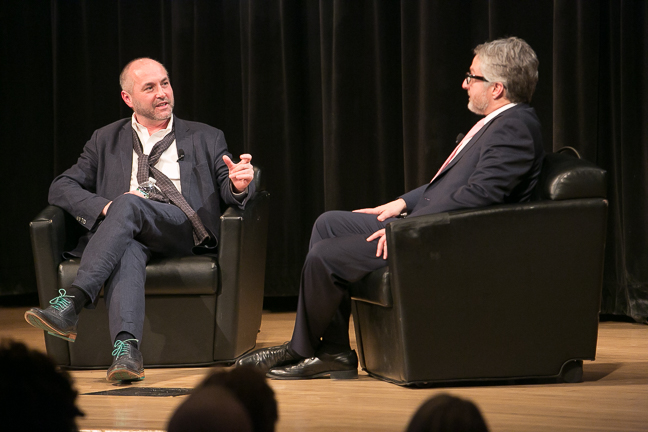
Here's the video of The Story Prize event on March 2 at The New School. That night, the three finalists—Charles Baxter, Adam Johnson, and Colum McCann—read from and discussed their work on-stage. And at the culmination of the event, we announced the winner for books published in 2015: Adam Johnson's Fortune Smiles.
Showing posts with label Colum McCann. Show all posts
Showing posts with label Colum McCann. Show all posts
Monday, March 7, 2016
Friday, March 4, 2016
What The Story Prize Judges Had to Say About Colum McCann's Thirteen Ways of Looking
 |
| Photo by Beowulf Sheehan |
Here's what the judges had to say about Colum McCann's Thirteen Ways of Looking:
"Part police procedural, part Ulysses, strung across the wirework of a Wallace Stevens poem, the title novella dazzles. It combines a playfulness for genre-melding with the delight of Mendelssohn’s wordplay with the author's wide-open empathy for every character—even the despicable Elliot—to open giant questions about race, aging, and especially class. And while so many layers—is the novella a retelling of Joyce’s 'The Dead'? a rumination on the culture of surveillance? do fathers bear the sins of their sons?—can be teased apart, tasted, and appreciated individually, at bottom the piece remains a gripping murder mystery, and compels a reader to consume it in a single gulp. In the three remaining stories, McCann continues to prove himself a master of sensory detail and the sentence fragment; the confrontation at the climax of 'Treaty' leaves one thrilled, nauseous, and fully-dilated. Few writers use prose this well to show how the human mind can simultaneously occupy multiple places and times."


Saturday, January 16, 2016
An Index of Guest Posts from Authors of 2015 Short Story Collections
 |
| Popular posters: McCann (left), Campbell (top right), and Gornick (bottom right) |
According to Blogger's statistics, most 2015 guest posts received 300 or more page views. The most popular post, "Colum McCann's Letter to a Young Writer," went viral (by our standards) and has so far drawn nearly 10,000 page views—the second most ever of any TSP blog post, after "Antonya Nelson's Ten Writing Rules," which currently has nearly 14,000 views. The author posts with the second and third most hits this year were "Bonnie Jo Campbell's Confessions of a Story Writer" and "Lisa Gornick Asks: Can Writing Make You a Better Person?"—both with more than 600 page views to date.
When we ask the authors if they'd like to contribute, we give them several options. One is to answer any or all of a series of questions, which we change somewhat each year. The 2015 questions were:
- Describe a good writing day.
- What keeps you going?
- What do you think is the source of your impulse to write stories?
- Where does a story begin for you?
- Describe your revision process.
- What’s the best phrase, line, or passage you’ve had to cut from a story?
- Name or describe some hidden influences on your work.
- What surprises you most when you re-read your own writing?
- If you teach writing, how has it affected your work?
- Describe your collection in ten words or less.
- A literary touchstone.
- A letter to a young writer, a la Rilke.
- A list of ten pieces of writing advice.
This index is in alphabetical order by last name, with author names linking to their books on IndieBound (unless a book wasn't lised on that site) and the rest of the guest post titles linking to the posts themselves.
A-B
Jacob M. Appel Conjures the Impossible
Charles Baxter and the Restored Sentence
Karen E. Bender's Ten Ideas For Revision
Megan Mayhew Bergman's Collection in a Nutshell
Z.Z. Boone Advocates Lying
Mark Brazaitis' Orphan Stories
Austin Bunn's "Plans for Work"
Carole Burns' Free-Roaming, Imaginative Phase
C-F
Liam Callanan Sorts It Out
Bonnie Jo Campbell's Confessions of a Story Writer
Literary Stones Joy Castro Keeps Touching
Bryn Chancellor and the Girl on the Wall
Kelly Cherry and the Hard Work of Imagination
Michael Coffey's Writing Advice: Don't (Necessarily) Eschew Adverbs
Why Saadia Faruqi Turned to Fiction
April L. Ford and the Essential Activation
Kelly Fordon Loses Track of Time
G-L
Jerry Gabriel and the Crux of the Impulse
Lisa Gornick Asks: Can Writing Make You a Better Person?
Toni Graham's Writerly Inclinations
Katherine Heiny Offers Her Apologies
Patrick Hicks: 11 True Things About Writing
Tara Ison and the One Good Word
John Keene's Hidden Soundtrack
Michal Lemberger's Letter to a Young Writer Emphasizes Empathy
M
Rebecca Makkai on What Some Readers Are Missing Out on
Where Margaret Malone's Stories Began Then and Begin Now
Colum McCann's Letter to a Young Writer
What Keeps Helen McClory Going
John McManus Rebuilds from the Ground up
Margaret McMullan Learns the Importance of Seeing
Andrew Malan Milward's 25 Entreaties
Emily Mitchell: Anatomy of a Bad Writing Day
N-R
Ben Nickol's Shrubbery Epiphany
Sameer Pandya on the Intimacy of “I”
Barbara Paul-Emile and the Insuppresible Urge
Leslie Pietrzyk Gets All the Answers
Kirstin Valdez Quade: All Work and No Play...
Sandip Roy's Act of Remembrance
Mary Rickert's Letter to a Young Writer
S-W
Fatima Shaik Travels into the Unknown
Rob McClure Smith and the Big Fish
Adrian Tomine Cuts a Scene
Johnny Townsend Writes for the Record
Siamak Vossoughi Draws Inspiration from an Unlikely Source
Joanna Walsh Writes Against
Past indexes of guest posts:
2014
2013
2012
Jerry Gabriel and the Crux of the Impulse
Lisa Gornick Asks: Can Writing Make You a Better Person?
Toni Graham's Writerly Inclinations
Patrick Hicks: 11 True Things About Writing
Tara Ison and the One Good Word
John Keene's Hidden Soundtrack
Michal Lemberger's Letter to a Young Writer Emphasizes Empathy
M
Rebecca Makkai on What Some Readers Are Missing Out on
Where Margaret Malone's Stories Began Then and Begin Now
Colum McCann's Letter to a Young Writer
What Keeps Helen McClory Going
John McManus Rebuilds from the Ground up
Margaret McMullan Learns the Importance of Seeing
Andrew Malan Milward's 25 Entreaties
Emily Mitchell: Anatomy of a Bad Writing Day
N-R
Ben Nickol's Shrubbery Epiphany
Sameer Pandya on the Intimacy of “I”
Barbara Paul-Emile and the Insuppresible Urge
Leslie Pietrzyk Gets All the Answers
Kirstin Valdez Quade: All Work and No Play...
Sandip Roy's Act of Remembrance
Mary Rickert's Letter to a Young Writer
S-W
Fatima Shaik Travels into the Unknown
Rob McClure Smith and the Big Fish
Adrian Tomine Cuts a Scene
Johnny Townsend Writes for the Record
Siamak Vossoughi Draws Inspiration from an Unlikely Source
Joanna Walsh Writes Against
Past indexes of guest posts:
2014
2013
2012
Tuesday, January 12, 2016
The Finalists for The Story Prize Are: Charles Baxter, Adam Johnson, and Colum McCann
 |
| Finalists: Baxter, Johnson, and McCann |
- There's Something I Want You to Do by Charles Baxter (Pantheon)
- Fortune Smiles by Adam Johnson (Random House)
- Thirteen Ways of Looking by Colum McCann (Random House)

There's Something I Want You to Do by Charles Baxter collects 10 stories, each with a one-word title representing a virtue or a vice. The title phrase resonates throughout, as several recurring characters find themselves speaking or hearing this request. The six stories in Adam Johnson's Fortune Smiles take place in territory as diverse as California, Louisiana, what was formerly East Germany, and North Korea, portraying difficult situations with sadness and humor. Colum McCann's collection, Thirteen Ways of Looking, consists of a powerful novella and three equally absorbing stories that explore how people process violence and loss.
This year's judges—Story Prize winning author Anthony Doerr, Brooklyn Librarian Rita Meade, and New Yorker staff writer Kathryn Schulz—will decide the outcome.
The annual award event will take place at the New School’s Auditorium at 66 West 12 Street in New York City at 7:30 p.m. on Wed., March 2. Tickets cost $14. That night, Baxter, Johnson, and McCann will read from and discuss their work on-stage. At the end of the event, Julie Lindsey will announce the winner and present that author with $20,000 (which remains the biggest top prize of any annual U.S. book award for fiction) along with an engraved silver bowl. The two runners-up will each receive $5,000.
In the weeks ahead, we'll announce this year's winner of The Story Prize Spotlight Award, and we'll publish an index of guest posts form 2015 authors, and a long list of other exceptional collections we read last year.
Friday, November 6, 2015
Colum McCann's Letter to a Young Writer
In the 25th in a series of posts on 2015 books entered for The Story Prize, Colum McCann, author of Thirteen Ways of Looking (Random House), shares some advice.

Do the things that do not compute. Be earnest. Be devoted. Be subversive of ease. Read aloud. Risk yourself. Do not be afraid of sentiment even when others call it sentimentality. Be ready to get ripped to pieces: It happens. Permit yourself anger. Fail. Take pause. Accept the rejections. Be vivified by collapse. Try resuscitation. Have wonder. Bear your portion of the world. Find a reader you trust. Trust them back. Be a student, not a teacher, even when you teach. Don’t bullshit yourself. If you believe the good reviews, you must believe the bad. Still, don’t hammer yourself. Do not allow your heart to harden. Face it, the cynics have better one-liners than we do. Take heart: they can never finish their stories. Have trust in the staying power of what is good. Enjoy difficulty. Embrace mystery. Find the universal in the local. Put your faith in language—character will follow and plot, too, will eventually emerge. Push yourself further. Do not tread water. It is possible to survive that way, but impossible to write. Transcend the personal. Prove that you are alive. We get our voice from the voices of others. Read promiscuously. Imitate. Become your own voice. Sing. Write about that which you want to know. Better still, write towards that which you don’t know. The best work comes from outside yourself. Only then will it reach within. Restore what has been devalued by others. Write beyond despair. Make justice from reality. Make vision from the dark. The considered grief is so much better than the unconsidered. Be suspicious of that which gives you too much consolation. Hope and belief and faith will fail you often. So what? Share your rage. Resist. Denounce. Have stamina. Have courage. Have perseverance. The quiet lines matter as much as those which make noise. Trust your blue pen, but don’t forget the red one. Allow your fear. Don’t be didactic. Make an argument for the imagined. Begin with doubt. Be an explorer, not a tourist. Go somewhere nobody else has gone, preferably towards beauty, hard beauty. Fight for repair. Believe in detail. Unique your language. A story begins long before its first word. It ends long after its last. Don’t panic. Trust your reader. Reveal a truth that isn’t yet there. At the same time, entertain. Satisfy the appetite for seriousness and joy. Dilate your nostrils. Fill your lungs with language. A lot can be taken from you—even your life—but not your stories about your life. So this, then, is a word, not without love, to a young writer: Write.

Do the things that do not compute. Be earnest. Be devoted. Be subversive of ease. Read aloud. Risk yourself. Do not be afraid of sentiment even when others call it sentimentality. Be ready to get ripped to pieces: It happens. Permit yourself anger. Fail. Take pause. Accept the rejections. Be vivified by collapse. Try resuscitation. Have wonder. Bear your portion of the world. Find a reader you trust. Trust them back. Be a student, not a teacher, even when you teach. Don’t bullshit yourself. If you believe the good reviews, you must believe the bad. Still, don’t hammer yourself. Do not allow your heart to harden. Face it, the cynics have better one-liners than we do. Take heart: they can never finish their stories. Have trust in the staying power of what is good. Enjoy difficulty. Embrace mystery. Find the universal in the local. Put your faith in language—character will follow and plot, too, will eventually emerge. Push yourself further. Do not tread water. It is possible to survive that way, but impossible to write. Transcend the personal. Prove that you are alive. We get our voice from the voices of others. Read promiscuously. Imitate. Become your own voice. Sing. Write about that which you want to know. Better still, write towards that which you don’t know. The best work comes from outside yourself. Only then will it reach within. Restore what has been devalued by others. Write beyond despair. Make justice from reality. Make vision from the dark. The considered grief is so much better than the unconsidered. Be suspicious of that which gives you too much consolation. Hope and belief and faith will fail you often. So what? Share your rage. Resist. Denounce. Have stamina. Have courage. Have perseverance. The quiet lines matter as much as those which make noise. Trust your blue pen, but don’t forget the red one. Allow your fear. Don’t be didactic. Make an argument for the imagined. Begin with doubt. Be an explorer, not a tourist. Go somewhere nobody else has gone, preferably towards beauty, hard beauty. Fight for repair. Believe in detail. Unique your language. A story begins long before its first word. It ends long after its last. Don’t panic. Trust your reader. Reveal a truth that isn’t yet there. At the same time, entertain. Satisfy the appetite for seriousness and joy. Dilate your nostrils. Fill your lungs with language. A lot can be taken from you—even your life—but not your stories about your life. So this, then, is a word, not without love, to a young writer: Write.

Subscribe to:
Posts (Atom)