Showing posts with label Nick Fuller Googins. Show all posts

Wednesday, September 20, 2017

Cutlass Press Gins up an Event to Launch KL Pereira's A Dream Between Two Rivers

By Nick Fuller Googins
Jamaica Plain, Boston 
Sept. 6, 2017

KL Pereira’s collection, A Dream Between Two Rivers, had its launch party at Boston’s Papercuts bookstore on Sept. 6, and it was a night of firsts: the first story collection put out by the independent bookstore’s publishing arm, Cutlass Press; the first stop for Pereira on her 12-city tour; and the first book launch I've been to that offered a preposterously large bottle of Tanqueray for the audience's refreshment.
Pereira at Papercuts
(photo by Katie Eelman)

There was also prosecco on ice, and most went for this chilled option after a brutally humid day and on an evening that wasn’t doing much to cut it. Plastic cups sweated in our hands as we waited for Pereira.

She appeared decked out a Ouija board-themed dress, appropriate given that the September moon was nearly full and that Pereira’s stories run the gamut from dark to darker to darkest. She read a “darker” one, her collection’s opening, “The Dark Valley of Your Lungs,” in which a girl with a killer voice (literally) finds a mentor of sorts in a woman with silver hands and feet. The story, creepy on its own, ends in a cemetery, and if that isn’t enough creep, know that it was written in one too: Pereira revealed during the Q&A that she’d penned the first draft one evening in nearby Forest Hills Cemetery. If there had been anybody in the audience wondering how one gets away with rocking a Ouija board dress, nobody was wondering it anymore.

Literary horror has long been in Pereira’s wheelhouse. She told the audience of an archeological dig through the mounds of school-work that her mother had saved. She’d recently excavated her earliest stories, composed at age nine:
  • “The Haunted School”
  • “The Secret of the Old Piano” (“pilfered from Nancy Drew,” Pereira confessed)  
  • “The Fishing Trip” (spoiler alert: a shark devours the young narrator and her father)
In response to a question regarding the generative process, Pereira explained that she’s “always been interested in the weird” and hails from a “family of storytellers.” Her ancestry stretches back to Cape Verde, Colombia, Italy, and the Azores, providing her with a rich library of folktales and legends to draw upon.

It was fitting that A Dream Between Two Rivers launched in Boston’s Jamaica Plain neighborhood because Pereira wrote most of the collection there in 2009. She lives now with the witches and the spirits up in Salem, but the audience greeted her as if she’d never left. When she admitted that she was pretty nervous, and a friend had advised her to picture the audience as cats to help, the crowd erupted in reassuring meows.

After the Q&A, I asked Pereira what she’d done earlier that day. She’d been selected for the MBTA’s “Books on the T” program, so she and her publishing team had been guerrilla-dropping copies of A Dream Between Two Rivers in subway stations around the city, she explained. What this means for the rest of us is that Pereira’s unique brand of literary horror is right now making its way through the underground arteries of greater Boston. Innocent commuting souls: beware.

Monday, April 11, 2016

John Jodzio Cracks Wise on Sunset

By Nick Fuller Googins
Los Angeles 
March 30, 2016

The Association of Writers & Writing Programs’ annual conference, which ran from March 30 to Apr. 2, represented a rare occurrence in Los Angeles: a gathering of writers who were not primarily focused on treatments, scripts, screenplays, or pilots. As the conference began, one such author, John Jodzio, read from his story collection, Knockout (Soft Skull Press), at Book Soup, on Sunset Boulevard in West Hollywood, a mere ten-mile, hour-and-a-half freeway jaunt from the Convention Center hub of AWP action.

Author Jodzio: "a trusting soul"
(photo by Brian Vernor)
Those of us who made the trek crowded into Book Soup’s narrow reading space, where Jodzio provided more than a few laughs when he read his story “The Piss Test Place.” Any one of Knockout’s seventeen stories would probably have produced a similar reaction. Jodzio's fiction falls somewhere between short and flash—all of it markedly zany. “The Piss Test Place,” at just under five pages, features three-dollar strip teases, laser light shows, a dysfunctional heavy metal band, cocaine fudge, and a drug-sniffing dog with epilepsy. Jodzio created the protagonist—a mildly corrupt, usually-stoned employee—with the help of extensive field research. He filled us in before reading: 
“I used to do a lot of temp work. And they always made me take a piss test whenever I changed jobs. The guy who worked the desk of the piss test place was clearly high. So I wrote a story about him.”
While reading, Jodzio wears a mischievous perma-grin (think Norm Macdonald) that matches the sensibility of his fiction. He had difficulty keeping a straight face, especially when delivering lines like these:
“Since I’d started working here, I’d heard many tales of woe and roofied hard lemonades. It was difficult to tell who was telling the truth and who was lying. All I knew was I’d accidentally eaten some cocaine fudge at a party a few nights before, and I knew how easily something like this could happen to a trusting soul.”
Jodzio’s reading seemed to be over too quickly, but thankfully, he'd invited author and friend Kara Vernor to read with him. Vernor, a middle school teacher by day, writes stories that take their titles from her sex-ed students’ anonymously submitted questions. The one she shared with us was “How Much Tongue While Kissing?” It isn't hard to see why she and Jodzio are friends. All in all, it felt particularly delightful to laugh in a cozy bookstore while, outside, the traffic on Sunset Boulevard inched along. 

Thursday, April 9, 2015

Colin Barrett on Writing Irish Fiction That's NOT About "Crushingly Catholic Repressed Lonely Farmers Weeping in Fields"

Authors Sam Lipsyte and Colin Barrett in conversation
at the Irish Arts Center (photo by Amanda Gentile)
By Nick Fuller Googins
New York, NY, March 31, 2015

A hundred or so of us had packed into the Irish Arts Center’s cozy Hell’s Kitchen theater to hear Colin Barrett’s read from his award-winning debut story collection, Young Skins, followed by a conversation with author Sam Lipsyte. The event, co-sponsored by publishers Grove Atlantic and Stinging Fly and literary magazine A Public Space, kicked off late because of the lousy weather. Folks lingered in the lobby, shaking rain from umbrellas, chatting, ordering early-evening drinks from the bar. When we finally did shuffle in to take our seats, the first thing Barrett said was how thrilled he was for the late start. His reasoning: “The longer we were delayed, the more drink you were going to have, and the more you drink the better I sound.”

The six stories and one novella that make up Young Skins don’t really need any help from the bar or elsewhere. Barrett crafts his sentences with precision. For example, the story “Stand Your Skin,” originally published in A Public Space, features the young Bat (other delightfully-named Young Skins characters: Arm, Tug, Tain, Heg, Nubbin, and Dympna) whose “scuzzy cascade of dark hair,” is a “crackly and stiff, an inextricable nest of flubs, snarls and knots.” A vicious attack years earlier has left poor Bat with a face “exuding all the definition of a bowl of mashed-up spuds,” and a drooping mouth, that “makes him look always a little gormless.”

To kick off the event, Barrett read from the “The Clancy Kid,” the first story in Young Skins, which also serves as a foundational piece, introducing the fictional Irish town of Glanbeigh: “My town is nowhere you have been, but you know its ilk,” the opening sentence reads. “The Clancy Kid” holds a special place for Barrett, serving the role of what he calls the “keynote story” that enabled him to write and shape the collection. “[‘The Clancy Kid’] did make me realize that I had a specific place to write about,” Barrett said, talking on stage with Lipsyte. “It seemed to access some different kind of energy, and that became a fixed point in my mind.”
Colin Barrett (photograph by Amanda Gentile)

"Fixed” indeed. Of the 210 pages in Young Skins, none stray beyond the borders of Glanbeigh, and while Barrett himself did grow up in a rural-ish Irish town, he maintains that Glanbeigh is “a composite of towns and people and attitudes.”

“I needed the membrane of fiction around it in order to just have the right perspective on it, to have that freedom to write without having to be tethered to what actually happened. Once I happened upon this town, it really was generative.”

Common setting aside, Young Skins is not linked in the traditional sense. Characters rarely spill over from story to story, and Barrett likes it that way. “What’s good with the short story form is that there can be these encompassing acts or overall threads. The stories will talk to each other and they don’t have to be overtly connected. I was confident, without knowing why, that they would talk to each other and the attentive reader would see connections and threads without having to repeat characters.”

It’s clear from Barrett’s attention to language that he incorporates a poetic ear in his writing, and Lipsyte asked him to expand upon the relationship between the genres. The short story, Barrett said, “is probably closer to poetry than the novel. They are both within the narrative form but that’s pretty much where the similarities end. You can tell people, ‘This novel gets really good eighty pages in, it’s brilliant after that,’ but you can’t really tell someone, ‘Once you get through the first five pages of this story, the next four are exquisite.’ That’s what I love about [short stories]. The high stakes. You can’t really mess it up. It all has to be the good part.”

When asked by an audience member if he wrote poetry, Barrett hesitated, laughed to himself, and answered, “I don’t. No, I don’t. And none of it’s been published. Thank God.” He went on to explain that he had taken a few late-adolescent stabs at poetry as well as novels, and that these failures eventually led him to writing short stories. “I’m a believer that you have to shed a lot of skins on your way to wherever you’re going to get.”

Influences that pushed him toward writing stories included Denis Johnson’s Jesus’ Son, old copies of The Paris Review and The New Yorker, plus fellow Irish writer Kevin Barry, whose 2007 collection There Are Little Kingdoms showed Barrett that an Irish author could write about Ireland and, as Barrett phrased it, the writing “doesn’t have to be about crushingly Catholic repressed lonely farmers weeping in fields.”

Barrett’s recipe for success? Patience. “Very slowly, lots of back and forth,” he said of his writing process, describing himself as “one of those people who work incrementally and go over things over and over again.”

It seems to be working. Young Skins scooped up the Frank O'Connor International Short Story Award and the Rooney Prize for Irish Literature, among other accolades. Amid such success, the thirty-two-year-old author maintained an almost self-deprecating air of humility on stage at the Irish Arts Center. Discussing the pain of starting a new story, he said it “resembles a prolonged feat of incompetence. It’s amazing how bad you can be at something you’ve done previously several times.”

Lipsyte, toward the end of their discussion, wanted to know what was next for Barrett. “I hate to ask you that dreaded question, but do you have something going?”

“I have something going,” Barrett said.

“A longish thing?”

“Longy. I’m attempting a novel. And it’s really fun but terrifying because I don’t know what I’m doing. So that’s an interesting place to be in.”

“Well there are plenty of amazing writers who just don’t write novels,” Lipsyte said. “There’s this pressure, this commercial pressure to write novels, but I see some people get a little trapped, maybe they’re not ready….” He petered out, then looked over at Barrett and quickly added, “I think you’re going to be fine, though.”

When the laughter died down, Barrett said, “I might show up in eighteen months time with a second book of short stories and a glassy-eyed expression and claim this conversation never happened.”

Friday, December 26, 2014

Donald Antrim's Very Once-Upon-a-Time Brand of Realism

By Nick Fuller Googins
New York, NY, Dec. 11, 2014


Dressed to the nines: Author Donald Antrim at NYU

Here's how Donald Antrim warms up a room:

“Alright, I’m just gonna read a story. So bear with me.”

The room was in the NYU Creative Writing Program’s West Village townhouse, decked out smartly for the holidays: wreath on the window, poinsettias on the mantel, heater humming in the background. Donald Antrim was decked out pretty smartly himself, wearing a sharp tweed coat, a chocolate brown vest, and a rich red tie, as though he’d perhaps moved on from his 2013 MacArthur “genius” award and retrained his sights on making the Best Dressed list. The story he’d selected to read was “The Emerald Light in the Air,” the final—and delightfully weirdest—story of his 2014 collection of the same title—narrated in his warm, hint-of-the-south accent.

“Emerald Light” begins modestly enough. Billy, a depressed, mildly-suicidal divorcé—who, like all of Antrim’s troubled male protagonists, has a past of substance-abuse issues and mental-health problems—is faced with a problem: His car has slid off the road and a storm is approaching. Rather than attempt to navigate the steep incline back to the road, Billy decides to drive his car up a nearby creek, deeper and deeper into the Appalachian woods, in search of an outlet. This is where “Emerald Light” takes an almost fairy-tale bend into the fantastic, making it, in some sense, the most Donald-Antrim-like story of his collection.

This discussion of the fantastic versus the real garnered a great deal of attention in the post-reading Q&A, moderated by Darin Strauss, author and NYU Writing Program instructor. To those familiar with Antrim’s previous work, especially his novels, the Cheever-esque realism of his short fiction might seem strange. Hearing Antrim speak on the subject, it appears as though this brand of short story realism felt strange to him too, or, at the very least, difficult to produce.

“I had written stories when I was much younger, in the eighties,” he said, “and they were dead kinda things.” Only after switching over to novels, working in the fantastic, and then returning to stories was he able to bring life to his short fiction. “I saw the thing moving away from a more conceit-driven conceptual universe to a more concretely emotional universe,” he explained, “one that the author doesn’t have to always manage and always find the distinctive logic in. Writing that is maybe less reflexively funny, in other words less driven by a narrator’s or character’s attitudes, or a writer’s attitudes, and a little more naked, and a little more direct. Just the world.”

This isn’t to say that the sharp realist fiction that drives much of Emerald Light suddenly poured forth from Antrim. Far from it. “The whole thing is so slow really,” he said, sounding deflated, as if someone had just told him to immediately hail a cab, go home, and begin work on another collection. “Each of those stories takes a long time, a couple years.” The seven stories in Emerald Light took him seventeen years from start to finish. (In response to Darin Strauss’s question if he wrote the stories concurrently: “I’ve never really done a lot concurrently. Multitasking! Can anyone really do it?”)

But the story “Emerald Light” is striking, in part, because it’s not overtly fantastical. Billy, after driving up the creek for some time, ends up grounded, stuck in the middle of the woods, at which point he is met by a boy with a tattered umbrella who asks if he is the doctor. Billy, high and definitely not a doctor, answers yes, and follows the boy to a dilapidated shack in the mountainside woods where he is faced with “treating” the boy’s dying mother. These events are neither shockingly unbelievable nor entirely fantastical in themselves, yet the story has an undeniable fantastical bent so subtle that it makes it difficult to remember where exactly Antrim departed from the more-or-less strict realism of the story’s beginning. Speaking on this juncture, Antrim called it “a bit of a leap of faith, this idea that the language, as it were, of that trip up into the woods. I mean, it’s full of associations for us, it’s very once-upon-a-time. I think the idea was to see if you can, without manipulating conceit, just get close to that place where the realism and this other thing—possibly fantastic, possibly hallucinatory—come together and are adjacent. And if that’s possible, then it may be possible to then start to actually produce what amounts to magical events.”

It’s after comments like these that you see why the MacArthur folks anointed the man. It’s not just that Donald Antrim’s fiction is skillful; it’s that he’s clearly thought about what he’s writing. Thought about it a lot. Listening to him you get the feeling that his mind is functioning at a different speed than the rest of ours are, not necessarily faster (okay, yes, probably faster) but on a completely separate plane.

Oh, by the way, he wasn’t finished with that previous comment, he was only coming up for air.

Donald Antrim took a breath, then continued: “So through that trip up into the woods, there was nothing to do but just sort of describe it as a romantic journey and a kind of a dream, and then hope that the other side would exist. If the suspension of disbelief is into this realist thing, can it then obtain in relation to something that actually isn’t real? So that was kind of an experiment for me. Does that make sense?”

“Perfect sense!” one MFA student in the audience answered, either lying, or much more of a genius than I.

The last question of the night went to another MFA student. He wanted to talk not about the fantastical or the real but about Mary, an ancillary, off-screen character who gets about a dozen lines in total. From these dozen lines, we learn that she and Billy slept together back in high school, have since reconnected, and have plans to meet for dinner. The question, posed as only an MFA student can pose a question (as an MFA student, I’m allowed to say that), went like this: “I have to say I was particularly drawn to the character of Mary, and I was almost taken aback by the very brief mention of her having had an abortion. I wonder if you can talk about your decision to have that be part of her story, the way it was included, especially in that very scientific and contemporary terminology.”

To which Donald Antrim responded with his most direct, easily understood answer of the evening: “It was just a sense of the place that I remember. That old Appalachian world, it was right there. It wasn’t meant as any statement on Mary. I was just remembering from when I was kid, growing up on a farm at the foot of the mountains. Everybody got going early.”

Tuesday, November 4, 2014

Drinking with the Bears: Dybek Reads Dybek


By Nick Fuller Googins
New York, NY, Oct. 24, 2014

If Stuart Dybek wanted to read from, say, Apple’s terms of service agreement, or the instruction manual to my Heaven Fresh rice cooker, I’d probably listen—the man reads with a rolling, low-pitched gravitas that rivals Sam Elliott’s Big Lebowski monologues. But better yet, though, is Dybek reading Dybek, as he did last Friday at the NYU Creative Writing Program’s cozy Village townhouse. He shared the spotlight with poet Fady Joudah in the latest of NYU’s “New Salon: Writers in Conversation” series, introduced and moderated by Darin Strauss, author and NYU Writing Program instructor.


Dybek, when it was his turn to take to the podium, chose to read his short story, “Córdoba,” a selection that was silently cheered by at least one audience member (disclosure: this audience member) because it includes:
  • The Chicago Bears
  • Heady make-out sessions
  • A small-calibered gun 
  • A sexy green dress with a plunging back
  • An engraved silver flask
  • A bartender with preternatural pouring skills
  • An apocalyptic snowstorm
  • Scraps of Fedrico García Lorca’s poem, “Song of the Horseman”
Those are some of the elements (presented in random order to prevent spoiling the uninitiated’s reading experience) that make up “Córdoba,” arguably the gem of Dybek’s collection, Ecstatic Cahoots, published by Farrar, Straus and Giroux this past summer. I say “arguably” because Ecstatic Cahoots contains forty-nine additional short stories, some as concise as two lines, others—like “Córdoba”—ten or so pages, all adding up to an embarrassingly large quantity of gems to sift through and discover. Oh, and add to those riches the nine stories from Paper Lantern, Dybek’s other collection (also published this summer, also by FSG). For those who’ve lost count, that’s fifty-nine Dybek stories. Enough to get Darin Strauss in a bit of trouble:

“It’s not every New York Times review that gets trimmed and twisted for over-enthusiasm. My last was.” That’s Strauss, relating his experience reviewing Dybek’s two collections. “For the first time in my years of occasional and by-in-large gentle reviewing, an editor blinked. ‘This is too much,’ she said.” Strauss went on to read a portion of his review as it existed pre-Times-editorial ax. A particularly lamentable casualty was the phrase, “jangling cinematography,” Strauss’s apt description for the narrative cartwheels and summersaults that make the experience of reading a Dybek story like that of reviewing a screenplay-adaptation of your latest, most pleasantly-bizarre dream. 

“Córdoba” seems to contain all the characteristics of one such pleasantly-bizarre dream (refer to aforementioned randomized list) but with one important caveat: It really happened. When Dybek finished reading, Strauss asked him to discuss the influence of literature in the story (“Córdoba,” in addition to the García Lorca poem, also references Emily Dickenson and Chekhov) and Dybek, on his way to answering the question, made this pit stop: “I write basically two types of stories. There’s the stories that often start with an image, and I never know what’s going to happen with those, and there’s the story that’s actually happened. This story really happened.”

It took a moment for the significance of what he’d said to sink in. Then Strauss, along with many of us in the audience, did a kind of awkward choking, double-take, laughing thing. “That’s amazing,” Strauss said. “You actually drank with the Bears?”

Okay, so now it’s known that Stuart Dybek drank with the Chicago Bears, and that “Córdoba” is a true story. Which is astonishing for all the items in the randomized list but also for the way in which Dybek manages to portray the “jangling cinematography” of reality. It’s wild—in some ways wilder than if Dybek had invented the story from scratch.

Strauss continued the conversation by asking Dybek and Joudah about their relationship to “place” as it figures in their writing. Joudah, a Palestinian-American who spent portions of his childhood in Libya and Saudi Arabia, spoke of locating his work in the Middle East as well as in the American South, where he earned his medical degree.

Chicago: A little touch of Pilsen
Dybek, naturally, spoke of Chicago: Nearly all of the fifty-nine stories comprising Ecstatic Cahoots and Paper Lantern are set in the city or in its immediate surroundings. “Image is central to a lot of what I write,” Dybek said. “And for me place is one enormous image.” Dybek was raised in the Pilsen neighborhood of Chicago’s Lower West Side, an area he credits for its influence on both his general outlook as well as that of his writing: “I was in a way very fortunate to be there to watch [Pilsen] go from Slavic to Mexican and it really fashioned my attitude toward America. The place that I was immersed in was not Leave It to Beaver, was not McDonald’s—my allegiance from early on was really to ethnicity and to a sense of foreignness.” As he began to write with Pilsen in mind, Dybek says, writing what he cared about came naturally, organically. “I was writing without even trying, about assimilation, about democracy, about class structure, minority culture, etc.”

Dybek is also a poet; he makes no secret of his love for both genres and their many hybrid forms. (His writer’s notebook is dominated by poetry—everything written in line—and he recalls Raymond Carver’s, when they compared notebooks, being the same way). Maybe it should come as no surprise, then, that reality, as recounted in prose by Dybek-the-poet and grounded in such specific sense of place, should take on the texture of wild cartwheeling dream-like imagination. I’m not still harping on “Córdoba” by the way; in a short discussion with Dybek post-reading, he divulged that “Four Deuces,” from Paper Lantern, is also cribbed from real life. The story—a boozy, dramatic monologue—includes mystical horse-track betting, M-80s, stigmata, and freight-train-hopping, to rattle off what comes to mind. If all that isn’t enough, keep an eye on the cinematography. It jangles.

Friday, October 17, 2014

Singing in Her Natural Register: Karen Russell’s Talk-Talk Talk

By Nick Fuller Googins
New York, NY, Oct. 8, 2014

Author (and prop master) Karen Russell
Karen Russell kicked off Columbia University’s 2014-2015 Creative Writing Lecture Series last Wednesday armed with a pair of props. “Ninety-nine percent of people have no issue using this kind of phone,” she said, holding her iPhone overhead. “Um, I can’t do it. I can’t hear or be heard. The shape of my face is either wrong, or when I smile I turn it off. And poor Adam, the first name in my phonebook, fifty times a day.”

The game changer, she explained, was the Talk-Talk, a bright pink cell phone plug-in made to resemble a land line handset that she found at a Portland, Oregon, gag store. Russell, a Columbia Writing Program alumna, showed off her Talk-Talk to the lucky hundred-or-so of us who’d crammed into an art-studio-turned-reading-space in Columbia’s Dodge Hall, accepted mini sandwiches and plastic cups of Vinho Verde from current MFA students, and avoided making eye-contact with the the unlucky hundred-or-so milling in a long line outside. In the front rows of the audience sat a few of Russell’s former instructors, including authors Sam Lipsyte, Ben Marcus, and Alan Ziegler.
Kickin' it old school: A better fit

“Now talking on my phone feels like a game,” Russell said, holding her Talk-Talk to her ear. “It alleviates me of a certain kind of self-consciousness. It’s totally humiliating to bust out on the street, but I have to tell you, it makes it feel like play. It narcotizes, or anesthetizes one kind of self-consciousness so I can hear people more clearly and be understood.”

At this point Russell looked at her pink handset, its curled cord, and must have realized that she was well into her lecture and still on the subject of Talk-Talks. “I’m actually getting sponsorship money from them,” she said. “So I’m going to spend the next forty minutes doing demonstrations. Okay?”

We laughed, but then came the point to her prop, the crux of her “Talk-Talk Talk”: Karen Russell, a New Yorker “20 Under 40” wunderkind, the author of a novel that was a Pulitzer Prize finalist and two short story collections, and a recipient of a MacArthur “Genius” Grant, had once (not so long ago) felt very uncertain as to which direction to take her writing. While a student of Columbia’s Writing Program, she struggled to write what she felt compelled to, not what she felt she was supposed to. “One thing I felt really self conscious about was that I was writing stories. A lot of my peers were writing novels, and I felt like they were in these happy marriages and I was like, definitely not a guaranteed good time, but just some floozy. And I felt weird that all my stories tended to be from the point of view of these male adolescents. If they weren't effeminate, hyperverbal, bewildered boys, they were these stunted tomboy girls. That was my continuum. They tended to be in first person, and I felt really bad about that and maybe unduly mad. But in retrospect, those were the stories I knew how to make live. Those were the things I was genuinely preoccupied about.”

In order to accept that it was okay for her to write how she wanted, Russell said she had to seek out role-models, learn from them how to turn off (some) of the self-criticism and make writing fun again. She credits Carson McCullers, Italo Calvino, George Saunders, and Junot Diaz, among others, for doing just that: “opening all these doors” to her while she was an MFA student.

From Junot Diaz, and what Russell terms his "voicey I narrator," Russell learned that, “You can have [a character] who’s hyper-verbal on one plane but just such a dodo elsewhere, stunted emotionally or living in a blindspot.” Realizing that she was allowed to write in such a voice, Russell said, “felt just like a Talk-Talk.”

At first, Russell said, while studying at Columbia, she was embarrassed to be writing what she considered “these lame ventriloquies of the writers I loved.” But looking back on that time now, she sees it as only natural for the voices of others to creep up into the work of any writer. “Maybe it’s okay if your story contains audible and sub-audible and superficial and bedrock resemblances to other stories. Because how could it be otherwise? Of course your story is going to contain echoes and the shapeliness of other stories you read and loved. What else would you be extrapolating from? Those are the materials that live in you.” Russell suggested that writers shouldn’t beat themselves up when inspired by others. “Maybe there’s a happier way to be haunted by the people that influence you. Maybe there’s a happier relationship to have to all these voices where it makes sense if your voice on the page sounds a little bit like them, because it’s a synthesis. If you’ve been a reader your whole life, that’s just the spooky acoustics of the project.”

To demonstrate how those spooky acoustics inform her work, Russell quoted from Ben Marcus and Harold Bloom, then read the beginning of Calvino’s “The Dinosaurs,” a story she’d found radically instructional while developing her writing chops. “It was glorious to read this because it was like, Ah! You can be a goofball and you can still talk about annihilation and loss and you can crack some dumb jokes! You can have this kind of direct relationship with the reader.”

She then read from Saunders’s “Sea Oak,” and reflected upon a visit of his to Columbia while she’d been in the program: “I remember him saying that he’d had some similar issues—he’d been trying to write what he thought was literary and highbrow and eventually he realized he was playing against his strengths. He’s fantastic at dialogue, at writing these bizarre alternate spaces. Singing in his natural register was something that he discovered.”

Lastly, to bring her point home, she read the beginning of “Reeling from the Empire,” from her recent collection, Vampires in the Lemon Grove. When reviewing the story earlier that day, Russell said, “I was like, ‘Jesus, I really should send checks in the mail to Calvino’s estate, and Saunders.’” They’d helped her find what she calls her, “access point” into fiction, the mode of writing which comes most naturally and feels most fun. She described the feeling as one in which suddenly, “I sort of see how maybe I can access something that feels true to me that I really can’t do in other registers. I’d spent a lot of time singing outside of my natural octave. There’s something to be said for discovering in this program what is your access point, and it might be that you have to set it up so that it feels like a game.”

If Russell has turned writing into a game, it’s obviously one game that she excelled at even during her MFA years; by the time she graduated from Columbia in 2006 she’d already landed an agent and seen her work published in The New Yorker. The “game,” as she seems to have learned it, involves not only writing very, very well, but having confidence in what feels natural, even when what feels natural is very, very weird. Russell, at the beginning of her lecture, admitted that she’d thought twice about using her pink Talk-Talk as a prop. “I knew that this was an indefensibly dumb way to start the talk, but I thought: 'No, I’m going to do it anyway, I’m not going to ask anybody.' And I may have no other advice to give tonight, but I think that’s useful. In every case, with every story I’ve ever written, I always thought: 'This is indefensibly dumb.' But if you have an indefensibly dumb idea that you’re still—for reasons mysterious to you—really committed to, maybe go for it.”

Monday, September 15, 2014

Slice Magazine Offers Writers (and Beer) on Tap

By Nick Fuller Googins
Brooklyn, NY, Sept. 6, 2014

It’s Saturday night at powerHouse Arena (a bookstore/events space in Brooklyn’s DUMBO neighborhood) and the free beer has run out. What’s striking is that this doesn’t seem to faze anyone. Okay, a few people complain, but they’re probably the ones who arrived late. The rest of us mingling beneath the chandelier glow are taking the beer shortage in stride.

In the House: an appreciative audience
Slice magazine’s “Writers on Tap” billed itself as “a reading for discovering new voices and drinking good beer,” and it served as an interlude of sorts to the weekend-long Slice Literary Writers’ Conference. Slice, based in Brooklyn, publishes fiction, non-fiction, poetry, and interviews in a sleek, sexy magazine. According to co-founder Maria Gagliano, who introduced the night’s reading, Slice places a special emphasis on bridging the gap between emerging and established writers, with each issue featuring both well known and up-and-coming authors. The Slice Literary Writers’ Conference, held at St. Francis College in downtown Brooklyn on Sept. 6-7, kept true to this same focus, offering emerging writers the opportunity to meet with agents, attend workshops, and hear from a wide array of literary voices. Many of us here at powerHouse had come straight from the conference.

Earlier that day, we’d heard Tin House editor Rob Spillman, speaking at a panel entitled “The Secret Lives of Literary Magazines,” warn against what he called “Doogie Howser Syndrome,” or the predilection of some beginning writers to tack on an ending that tells the reader everything the previous fifteen pages of the story have already shown. At another panel, “It’s About Me…But It’s Also About You: Writing Nonfiction that Connects with Readers,” Dani Shapiro, author of Still Writing, told us, “Memory is an act of imagination.” During a session on revision, Elissa Schappell, author of Blueprints for Building Better Girls, had this to say: “Anyone who says they write without editing is either full of shit or not a writer…or a genius.”

The “Writers on Tap” reading that evening showcased the work of five writers handpicked by editors from Slice, A Public SpaceOne Teen Storyand Henry Holt & Co. Included in this bunch were authors Kseniya Melnik and Justin Taylor, both of whom released story collections this year, Melnik with her debut collection, Snow in May (Henry Holt & Co.) and Taylor with Flings (Harper), his second book of stories.
Busy man: Justin Taylor reads from Flings

Celia Johnson, co-founder of Slice, introduced Taylor, describing Flings as “a wonderful ensemble of matters of the heart,” a collection filled with “grief, lust, and falling in-and-out-of-love” that “takes you everywhere, from Oregon to Hong Kong.” Taylor, who later confided that he’d done five Flings readings in the past couple of weeks, took to the podium and said he needed a break from the collection. Instead he read from a thick sheaf of papers, a section of his novel-in-progress about a former child actor who’s leveraged his faded glory into part ownership of a bar—one that he himself patronizes often, especially if a certain female bartender is on duty. Of the former actor: “He liked to sit at the bar and let his longing run away with itself,” and he “assumed that all girls knew all things and modified his behavior accordingly.” If the audience’s reaction offered Taylor some focus-group-like insight as to the response his completed novel may elicit, he can anticipate having to include plenty of pauses for laughter at future readings. But that assumes he’ll have time for pauses.

Justin Taylor is a busy man. In addition to being on tour for his third book, working on his fourth, and teaching at more than one university, he is currently writing a review for Bookforum on Denis Johnson’s new novel, The Laughing Monsters. In preparation, Taylor explained that he’d been reading much of Johnson’s backlist, including his plays.

“Denis Johnson writes plays?” I asked.

Taylor reached into his bag, pulled out Soul of a Whore and Purvis and flipped through, exclaiming with no small degree of admiration that Denis Johnson not only writes plays but he writes them in verse.

Not so La-Z: Kseniya Melnik reads from Snow in May
Sarah Bowlin, editor at Henry Holt, introduced Kseniya Melnik, praising her writing for its ability to “reveal something cutting very easily and something emotional very slyly,” as well as possessing a “human quality that transports you.” Transport us it did, all the way back to Post-War Russia, where much of Melnik’s linked collection is set. She read from “Strawberry Lipstick,” a story that begins with heart-broken Olya, who “lay in bed between her younger sister, Dasha, and her older sister, Zoya, feeling that, at eighteen, her life was over. For what was life without love? A never-ending shift at a factory assembly line.” Bittersweet, cutting and emotional, the tone seemed to instantly and precisely evoke that of a love-sick teenager living through a Soviet winter.

Melnik admitted she enjoys writing stories about snowy places. It comes as little surprise because she grew up in Russia, moved to Alaska at age fifteen, and went to school in upstate New York. Currently she resides and writes in El Paso where it does in fact snow on occasion, though not often and not in recent memory. A word Melnik uses to describe the place is “sweltering.” The incongruity of writing much of Snow in May while living a few football fields from the Mexican border is so delicious that Melnik must be sick of people mentioning it. So I didn’t. But I had to wonder how she coped with such contrast. What was her secret?

The next day, Melnick answered my unasked question while participating in a panel entitled, “Literary Quirks,” when she said, “I cannot write at a desk. I write in a La-Z-Boy. I trick myself to think I’m relaxed.” If that helped her write so sharply about life in snowy Russia while living in El Paso, then that must be one hell of a La-Z-Boy.

Photos courtesy of Slice magazine and © Maria Gagliano

Saturday, May 31, 2014

One Story's Storied Literary Debutante Party

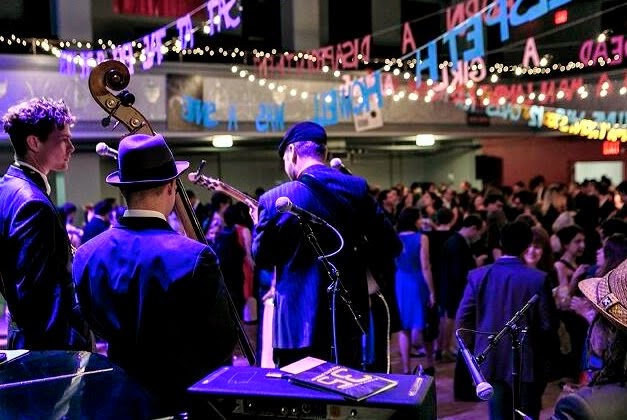
The Blue Vipers performing at the One Story Literary Debutante Ball
By Nick Fuller Googins
Brooklyn, NY, May 22, 2014

Hannah Tinti, co-founder and editor-in-chief of literary magazine One Story, is also a best-selling author and a teacher at Columbia’s MFA program. She’s a literary personality who wears many hats, and on the night of May 22, at funky Brooklyn performance space Roulette, her hat was of the miniature Edwardian ringmaster variety, bedazzled with black sequins and festooned with glittery silver butterflies. Her Converse All-Stars matched the butterflies, flashing smartly as she crossed the stage, stepped up to the microphone, and, politely, asked everyone to please shut up. Time for the debutante ball to begin.

But let me back up for a moment: One Story’s annual Literary Debutante Ball is a celebration of One Story authors who have published their debut books in the past year. The process of announcing these authors (seven of them this year, including Ben Stroud, whose collection, Byzantium, earned him the 2013 Story Prize Spotlight Award), their metamorphosis from mere mortals into literary debutantes, in no way resembles a traditional literary reading. It’s much, much more fun. As soon as I checked in, I was invited to grab a “Let the World Spin,” the evening’s custom, Colum-McCann-inspired cocktail (more on the man later).

This is how a proper Literary Debutante Ball warms up: Live band on stage. Tables of appetizers. Two open bars. A bartender dancing to swells of music. Garden lights strung overhead, along with strands of cut-out letters spelling the first line of each debutante’s recently published book. Clusters of elegantly dressed writers, editors, and lovers of literature. Burlesque-costumed women weaving through the crowd hawking framed commas, semicolons, and exclamation marks at $10 a pop.

It was quite a lot to take in.

I ate some appetizers, stood in line at one of the bars, walked the floor looking for debutantes, trying to match faces to what I remembered from author photos. I moved over to the other bar and struck up a conversation with a young guy who turned out to be a former student of Tinti’s at Columbia. (“Still writing?” I asked him. “Of course, you have to,” he said, as though it were an absurd question.) I was curious why people had come to the debutante ball, in what capacity. I asked another woman. We were standing side by side, admiring the wall of advice—framed, hand-written bits of writing-based knowledge and guidance from established writers and debutantes alike, available for purchase as part of a silent auction. The woman told me she was an agent. I asked if she represented any of the debutantes. She said she did not. Anyone, then, whom I may have heard of? "Jonathan Franzen?" she said. "Oh, sure," I said, "I’ve heard of him."

The Golden Thread

Jonathan Franzen’s agent and I parted ways. I continued down the wall of advice, examining the handwritten words of encouragement and inspiration from the likes of this year's Story Prize winner George Saunders and, yes, Jonathan Franzen. I especially liked Hannah Tinti’s advice, not only because of its mythological lyricism, “Your story is a puzzle—a maze. But your mind created it—so the answer, the key, the golden thread leading out is inside you. Unspool it and meet your minotaur,” but also because she’d encircled it in cartoony, serpent-like monsters. Elsewhere on the wall, interspersed with the words of encouragement and inspiration, were words of caution. From the pen of Lynne Tillman: “Don’t expect that being published will make you happy.” Other authors mined their personal role models for wisdom, such as debutante Molly Antopol, who quoted Grace Paley. Someone else cited John Updike. Michael Cunningham quoted a slightly less literary figure, but it was still excellent advice: “Don’t panic! (remember what Marilynn Monroe said—‘I wasn’t the prettiest, I wasn’t the most talented, I just wanted it more than anybody else’).”

At this point, I discovered that the debutantes’ books, arranged in handsome piles on tables throughout the theater, were not merely showcase pieces but meant for the taking, by us, the guests (meaning me). But I was not alone in my discovery. Books were going fast, flying off the tables. I had to move quickly. Luckily, I’d already read Ben Stroud’s Byzantium and Molly Antopol’s The UnAmericans, allowing me to skip those particular stations. I snagged Rachel Cantor’s A Highly Unlikely Scenario, James Scott’s The Kept, and Celeste Ng’s Everything I Never Told You. I stopped to say a quick hello to Tin House editor, Rob Spillman and did a double-take at the sight of author John Hodgman. Hodgman’s story, “Vilanova: Or How I Became a Former Professional Literary Agent,” has the distinction of comprising the debut issue of One Story. This evening he was dressed like unbearably snobbish author Louis Green, whom he played in HBO’s Bored to Death. I then nabbed David James Poissant’s The Heaven of Animals and Amelia Kahaney’s The Brokenhearted, completing my debutante reading list. It was good timing. Hannah Tinti had just taken the stage, tapped the mic, asked us in her own charming way to please quiet down.

To kick things off, Tinti and fellow co-founder Maribeth Batcha said a few words about One Story, now in its twelfth year of existence. (“Sort of our bar mitzvah,” Tinti said. “We are a man now!* An active participant in the world!”) One Story, which publishes a single short work of fiction every three weeks, and never publishes the same author twice, maintains a special commitment to encouraging writers at the beginning of their careers, a commitment that Tinti and Batcha said they were pleased to have strengthened over the years. With that, the One Story co-founders sat cross-legged on the side of the stage, making room for the honorees of the evening.
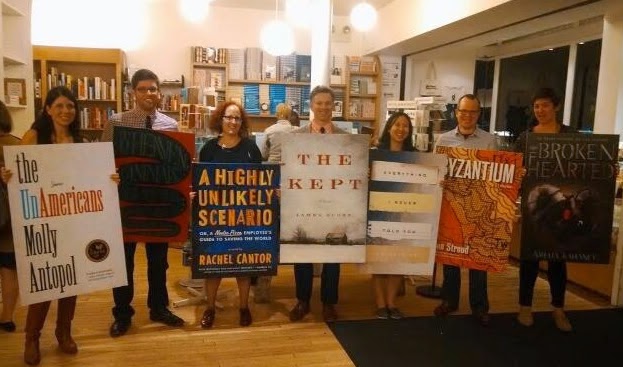
One Story's literary debutante's (L to R): Molly Antopol,
David James Poissante, Rachel Cantor, James Scott,
Celeste Ng, Ben Stroud, and Amelia Kahaney
The ceremony itself was brief yet meaningful. The debutantes were announced one by one, escorted down the “aisle” (parallel strands of rope held waist-high by glamorous volunteers) by a respective mentor, in some cases an editor, such as Amelia Kahaney’s escort, Sarah Landis. In other cases an established author, such as Rachel Kantor’s escort, Robin Black, a One Story alum and 2011 literary debutante herself, did the honors. As each debutante took the stage, the first line of his or her new book was read aloud, followed by general whooping, hollering, applause, and hoisted cocktails, all to celebrate the authors’ entrance into the literary community, to acknowledge thier current success, and to wish for them many future years of inspiration and sales. Amid this frenzy of jubilation, optimism, and cheer, came the gimlet-eyed first line of Ben Stroud’s collection: “I was born a disappointment.” It brought down the house.

Confusing Debs

Directly after the literary debutantes were announced and celebrated, One Story presented its 2014 “Mentor of the Year Award” to literary rock star Colum McCann, who teaches at Hunter College and is deeply involved in numerous literary organizations. McCann, keeping with the theme of the evening, devoted the majority of his acceptance speech to discussing his own literary heroes and mentors, one of whom was memoirist Frank McCourt. McCann recounted a visit to McCourt in a late stage of his life, when McCourt, unable to talk, communicated via white board and dry erase marker. The way McCann tells it, at one point he asked the ailing author, “Where will you go dancing next?” McCourt’s written reply: “Upstairs with the Great JC and Mary M and the twelve Hot Boys. And in the morning, all will be forgiven.”

McCann signed off, the party resumed, dancing commenced. I made a beeline to Ben Stroud, whom I wanted to congratulate and, more importantly, thank for writing Byzantium. His collection’s ten stories skip from ancient Mesopotamia to colonial West Indies to contemporary East Texas and other times and places. The first story, my favorite, follows an idle, fatherless man-child with a crippled hand (you’re correct in guessing this is the poor sap to declare himself “born a disappointment”). Summoned by the Byzantine emperor, the narrator is tasked with a top-secret mission: travel to a desert monastery outside Jerusalem, locate a particular monk, and castrate him. It sounds gruesome, and is, but more so it’s a moving, humorous, and entertaining story. I planned to relay this sentiment to Ben Stroud, but when I got to him, I didn’t have time for much more than a handshake and quick congratulations before he was swarmed by others. No matter, I knew when to move on. Anyway, I had another mission: Find Molly Antopol.

I intercepted her on her way to the dance floor. After congratulating Antopol, both on her newly anointed literary debutante status and on her recently published collection of stories, The UnAmericans, I wanted to talk about a compelling blog post of hers that I’d come across, “On Writing and Being a Parent,” which cleverly examines how parenthood affects the practice of writing, in some ways for the better. I told all this to Antopol in one long breath. She had no idea what I was talking about.

“What do you mean?” I said. “That’s not your blog?”

“I don’t think so,” Antopol said. “I’m pretty sure I’m not a mom.”

Ah! I’d mixed up debs! The most mortal of all debutante-ball sins! Had this been an episode of Gossip Girl, I would’ve been shunned from Upper East Side society for years, never again allowed to grace the Waldorf Astoria ballroom floor. Thankfully, this was Brooklyn, and Molly Antopol has a gracious way of alleviating uncomfortable situations. I believe she deserves another award for that.

Debutante Amelia Kahaney, I later discovered, is the author of the wonderful parenting-writing blog post. Sadly, I never found Kahaney in the crowd, never got to talk to her. Which brings up the only problem with One Story's Literary Debutante Ball: It's such a kick-ass party that it's impossible to talk to everyone in the room. Wisely, One Story continues the celebration through the following day, hosting a low key reading by the debutantes at Greenlight Bookstore in Fort Greene. The reading was scheduled for the evening, giving all participants eighteen-odd hours of recovery time, a good thing because after dancing through the night with Colum McCann and Hannah Tinti and seven happy literary debutantes, sure, all may be forgiven in the morning, but a hangover still hurts.

* Editor's Note: In fact, One Story will not be a man, according to Jewish tradition, until next year, when it turns 13.


Photos courtesy of One Story.

Tuesday, April 22, 2014

Interrogating the Story: George Saunders Gives Voice to His Work at Rutgers-Newark

By Nick Fuller Googins
Newark, NJ, April 15, 2014

Ventriloquist: Saunders reading at Rutgers-Newark
(photo by John Keene)
I learned something new about George Saunders when he visited Rutgers last week: In addition to his fearsome fiction-writing powers and his killer beard and his reputation as a really nice guy, he also has a preternatural knack for voices.

Don’t confuse “voices” with “voice,” as in, the unique tone and expression of a narrator or character. That Saunders knows “voice” goes without saying. I mean voic-es, plural, as in, the precise spoken-aloud voice of a bumbling teenage gentleman suitor. (“Let us go stand on the moon. Or, uh, in the moon. In the moonlight.”) Or the precious, cartoony voice of a baby deer trembling in the woods. (“Is my mom killed?”) Or the aristocratic, slightly-snobby voice of an apologetic hunter who has just killed poor trembling-baby-deer’s mom. (“If I could will life back into this fawn, I would do so, in hopes you might defer one tender kiss upon our elderly forehead.”)

Saunders willed life into all these voices and more on April 15th at Rutgers University’s Paul Robeson Gallery, where he capped off this season’s Writers at Newark Reading Series along with poet Matthea Harvey. Before reading from “Victory Lap”—the opening story in his Story-Prize-winning collection, Tenth of December—Saunders explained that the story is written in what he calls “third-person ventriloquism,” or, “third-person close, but you drop into the character’s diction as quickly as possible.” With that, he dropped in, broadcasting straight from the wandering mind of Alison Pope, an egregiously optimistic girl about to turn fifteen:
There was so much she didn’t know! Like how to change the oil. Or even check the oil. How to open the hood. How to bake brownies. That was embarrassing, actually, being a girl and all. And what was a mortgage? Did it come with the house? When you breast-fed, did you have to like push the milk out?

Alison, in the first section of “Victory Lap,” does nothing more than dance downstairs  (“hop over thin metal thingie separating hallway tile from living-room rug. Curtsy to self in entryway mirror…”) and into the kitchen for a handful of Cheez Doodles. Yet, through his “ventriloquism,” Saunders grants us immediate access to the inner-most reaches of Alison’s being without the need for lengthy passages of exposition or psychological description. He introduces Alison, as he does most of his characters, by sharing their thoughts with us, in real-time. And when those thoughts include an awkward gentleman suitor, a trembling baby deer, a snobby aristocratic hunter, and so on—all voiced by Saunders—they are not only delightful insights into a character’s psyche, but insanely funny as well. Saunders’s reading often felt more like a performance, and in this way he thwarted my attempt to capture a clean audio recording. I guess that’s something else I learned: One does not simply expect a George Saunders reading not to be laced with continual and uncontrollable laughter.

Hardly surprising, then, to hear that Saunders partially gauges the success of a story by measuring the amount of fun he has while writing. This came in response to a Rutgers MFA student who asked about the stuff that doesn’t work. How does George Saunders know, when writing a new piece, if it’s time to walk away, try something new?

“One useful barometer,” Saunders said, “is whether it’s fun. Is it fun and do you feel confident at any given minute? What happens to me is that if it gets less fun and I feel less confident, my thinking, conceptual mind comes in, and I’ll say, ‘Oh! This is about patriarchy!’ and then suddenly—in my case—you’re deciding from a dumber place than if you were just trying to follow the joy and confidence of it. I’ll often find myself getting locked up in a story and trying to think it out, and if I can catch myself that’s a good place to go to something else.”

The author's well-worn copy
To help get his point across, he paraphrased Norman Mailer: “You should never have sex if it’s not fun.” (“Maybe that’s kind of obvious,” Saunders added. “Why you’d want to take Mailer’s advice on sex, I don’t know.”)

He had similar advice for a question regarding endings. How does George Saunders know when to wrap up a story?

“Most of my writing process is rereading what I’ve already done and trying to react honestly to it: Am I liking it or not? Is it positive or negative? In a sense, finishing a story is trying to be able to get through it on a given day with that needle staying in the positive range. And being honest—if the needle comes down, don’t panic, just turn to the story and go, ‘Is there a problem?’ and the story will go, ‘Yeah, there is, I kinda suck on page three.’” (Saunders, evidently, plays ventriloquist not only for the characters in his stories, but also for his stories themselves. This particular story was whiney and mopey with a hint of self-indulgent defeatism). After honest evaluation—Saunders cautions—if your story really does admit to sucking on page three, it is important to avoid panic mode. Better to continue the interrogation.

“You’ll say, ‘What’s the matter?’ and your story will go, ‘I’m boring.’ So then you try to address it, and eventually you think it through to where you’re all right, until it’s polished off to the very last paragraph. And by then your subconscious is so deeply enriched in it that there probably is an ending.”

He added, later, “I thought the best definition of an ending is, stopping without sucking.”

As for the ending of “Victory Lap,” Saunders left us hanging, stopping after the first two sections of the story. It was a well-chosen moment that most definitely did not suck: radiant Alison Pope in serious and immediate danger. Some of us in the audience may have loudly groaned.

“It all turns out fine!” Saunders said, returning to the podium. He couldn’t help himself. He’s too nice a guy. “Don’t worry!”