Showing posts with label 2018 short story collections. Show all posts

Thursday, January 17, 2019

Half Gods by Akil Kumarasamy Is the Winner of The Story Prize Spotlight Award

Beyond naming three finalists each January, we also present The Story Prize Spotlight Award to a collection of exceptional merit. Selected books can be promising works by first-time authors, collections in alternative formats, or works that demonstrate an unusual perspective on the writer's craft. The award includes a prize of $1,000. 

We're pleased to announce that the winner for books published in 2018 is Half Gods by Akil Kumarasamy (Farrar, Straus and Giroux), a collection of ten stories set in the U.S. and Sri Lanka that center around a family that has a foot in each world. Although the book references the epic Hindu text the Mahabharata, these beautifully written and shaped stories are firmly grounded in the details of Kumarasamy's characters' everyday lives

This is the seventh time we've given out The Story Prize Spotlight Award. The six previous winners are: Drifting House by Krys Lee, Byzantium by Ben Stroud, Praying Drunk by Kyle MinorKilling and Dying by Adrian TomineHim, Me, Muhammad Ali by Randa Jarrarand Subcortical by Lee Conell. 

Congratulations to Akil Kumarasamy and Farrar, Straus and Giroux for winning The Story Prize Spotlight Award for short story collections published in 2018.

Wednesday, November 21, 2018

Sherrie Flick on Organizing a Book Tour

In the 28th in a series of posts from authors of 2018 books entered for The Story Prize, Sherrie Flick, author of Thank Your Lucky Stars (Autumn Press), offers advice to writers on putting together their own tours.


Your new book stands forlorn on the remote publishing island called No Marketing Department. It wants to be saved, but no pleasure boat skirts the horizon. My book Thank Your Lucky Stars escaped on a DIY reading tour to New Hampshire, Massachusetts, Ohio, Pennsylvania, Michigan, Missouri, Indiana, and Maryland. Here’s some advice.

It doesn’t start the moment you publish your book. It begins with its author living a good, empathetic life. Be a supportive writer friend to others. Attend readings. Buy books. Bake cookies. Some of these people will offer up a couch or a ride or a slot in their reading series in your future.

Some people call this Networking. Other people call it Not Burning Bridges. I call it Being a Nice Person.

After you’re a seasoned writer friend, and after you’ve gotten your manuscript accepted, you’ll need a website and a social media/newsletter presence that isn’t just about your book. This should be in place long before your publication date.

Work ahead. Many universities schedule a year in advance, as do many popular reading series and bookstores. When you query, even if it’s to a friend, practice good email etiquette. You never know where that email might be forwarded.

Be sure to have a readily available press sheet, a two-sentence pitch, and an e-ARC or hard copies ready to forward, if requested.

I contacted some venues cold, of course. Some never get back to me. Some requested a book and never got back to me. One university’s funding fell through, and one slot in a reading series was mysteriously revoked. Sometimes it’s impossible to sync up available reading dates with your driving schedule.

I choose not to dwell on the weird and sometimes disappointing circumstances around setting up a book tour. Some venues say yes, some say no. Look to the future. Maintain objective perseverance. Rejection is part of the game, just as it’s part of publishing.
When the going gets tough

Know that you’ll probably need a spreadsheet to keep all this straight and to keep your publisher in the loop.

Once you have some readings scheduled, always carry a box of books in your trunk or some extras in your luggage, even if you’re reading at a bookstore. For similar reasons, invest in a phone credit card swiper.

Think about funding. For I Call This Flirting, my debut chapbook, I was able to get a local Opportunity Grant to support the travel from Pittsburgh to Chico State for its release. For my current tour, my fourth, I have combined paying and non-paying gigs in each geographic region so there’s always a small net gain. Not all paying gigs are at university reading series. Sometimes you can tack on a university visit, a student conference, or a community center class to supplement your income stream.

Consider how much you like to spend time with strangers. I’m not an extrovert, which is why I try to set up readings where I have friends, which also increases attendance. But sometimes I splurge on a hotel instead of staying with my host or friends because I need to recharge.

Know what’s expected of you. Put details into your spreadsheet. Practice your reading in advance. Have a pre-set 10/20/30-minute reading ready in case your time changes once you arrive. Show up early. Never go over your time. Mark your pages so you don’t flip here and there saying: “I should’ve marked some pages.” A good reading sells books, and short organized readings sell more books than readings that are too long and disorganized.

Consider if you like long road trips. A book tour looks easier on the calendar than from rush hour on route 70.

Bring along things that make you happy. I bring my own coffee, Melitta, and a little jug of milk. My husband Rick loves to join me. Having a supportive partner is extremely helpful, but remember to orchestrate time away from the book events or you’ll both lose your minds.

Once you’re done reading, signing books, thanking your host in person, and going out for drinks and dinner, send a thank you card. Send a card to every venue and every person who hosts you. It will make both you and them feel good.

Be a nice person. Connect with friends. Travel the country. Plan a book tour. No search and rescue team is coming to save you and your book. Sometimes that’s okay. Build the boat yourself.

Friday, August 24, 2018

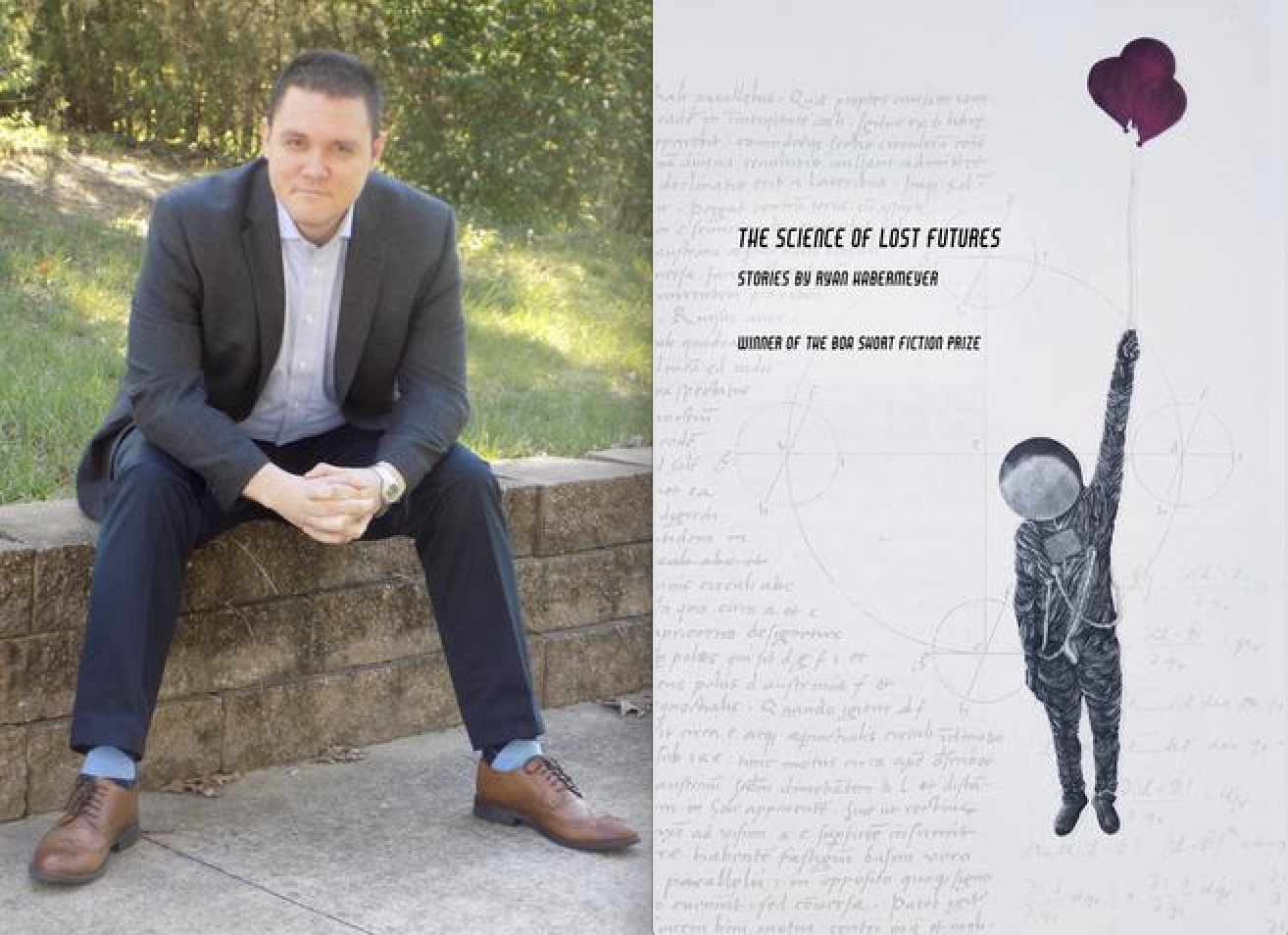
Ryan Habermeyer on (Re)Upholstering a Story

In the 16th in a series of posts from authors of 2018 books entered for The Story Prize, Ryan Habermeyer, author of The Science of Lost Futures (Louisiana State University Press), extolls the benefits of slowing down.


My wife is a self-taught seamstress. Somehow this factoid escaped me until after we were married. I came into the living room of our cramped apartment one day and found it a minefield of fabric bolts. At first she sewed little things: curtains, tablecloths, the occasional skirt. Over the last few years, she’s graduated to reupholstering couches and chairs, which should be required training in theological seminaries because reupholstery is a kind of resurrection—stripping the furniture to its frame and then painstakingly reconstructing it in a new fabric flesh. It’s a tremendous art and fascinating to watch. 

And watch I do. I’ve grown accustomed to seeing my wife spend hours sitting on the floor staring at her fabric. Before she ever reupholsters, she’ll spread the fabric down the hallway or hang it over a door and just look at it: tilting her head one side and then another, folding and unfolding it, occasionally placing little pins in it as if she is Napoleon and the fabric is her map of Europe. One time, like a fool of a husband, I joked it wasn’t going to reupholster itself and she reminded me you can’t uncut fabric. “I’m seeing the chair,” she said.

This seems about the right moment to take a not-so-subtle metaphorical turn (bet you didn’t see that one coming) on the writing life and the upholstery life. With reupholstering, my wife often doesn’t really know where she’s going or how she’s going to re-fabric a particular chair. So she’s got to see it first--a kind of Platonic, idealized chair--before constructing the thing itself. She spends a lot of time staring, figuring out what she doesn’t yet know she knows. Donald Barthelme has extolled the virtues of not-knowing for writers, so I won’t rehash that here, and besides: It’s not not-knowing that I’m really after. It’s the looking. The pausing. The wondering. Imagining the story in the mind, tinkering with it, before giving birth to it with words on the page. A kind of daydream. I like to daydream stories. It’s preferable to actually writing (or revising) them, which I find exhausting and frustrating.

My wife’s upholstering has taught me to pause more when I’m in the thick of writing. Slow down. Look. Wait. Stare out the window. Wait a little longer. Wait for the words right. As Raymond Carver says, “That’s all we have, finally, are the words, and they had better be the right ones, with the right punctuation in the right places so that they can best say what they are meant to say.” What does that mean, exactly? I think of the opening to Jorge Luis Borges’s story “The Circular Ruins”: “No one saw him slip from the boat in the unanimous night.” Unanimous? Such a peculiar adjective, and yet a wonderful counterpoint to the story that unfolds which questions the fabric of identity and reality. Or, there’s Gabriel García Márquez’s “A Very Old Man with Enormous Wings”: “The world had been sad since Tuesday.” Really? Since Tuesday? The melancholy of that line punches me in the chest every time. Without it, I’m not sure I’d feel the angelic old man’s misery as much as I do. Or from Karen Russell’s collection, Vampires in the Lemon Grove: “Samson was seventeen and had what Nal could only describe as a bovine charm.” I’ve never met a bovine personally, but when I do I will be invariably disappointed if it isn’t charming.

When I read fiction it’s not just characters and circumstance that should intrigue; I want the words to surprise, to startle, to provoke just as much as much as I want narrative leaps that bend the limits of reality. In fact, for those of us who traffic in fabulism—or magical realism, slipstream, surrealism, speculative, or whatever else the kids are calling it these days—having inventive syntax and diction (judiciously placed, of course) is of equal importance to me as a fantastical premise. It’s not just about turning a clever phrase. It’s about creating dynamic characters who, as Chuck Palahniuk says, speak with a “burnt tongue.” To create what I call sideways reality the words themselves had better compliment (or provide rich dissonance with) the impossible worlds we conjure.

Of course, sometimes meticulously plodding along at a snail’s pace is a bad idea. So write recklessly. Write mindlessly. Indulge every impulse. But don’t forget to pause, to lean back in the chair and just stare into empty space a little. It’s isolating, this writing thing, but don’t shy away from long bouts of silence. Slow down. Daydream. Wait for the right story to come along. In those quiet moments of waiting you’re likely to find seams to follow should the story come unstitched, as they so often do.

Friday, July 20, 2018

Vanessa Blakeslee's Eight Most Anticipated 2018 Story Collections

In the fifth in a series of posts from authors of 2018 books entered for The Story Prize, Vanessa Blakeslee, author of Perfect Conditions (Curbside Splendor Publishing), discusses 2018 short story collections she's looking forward to.


I have my eye on more than a few collections this year, and those that made my list include both debut authors and well-established voices. My literary tastes tend to reflect my nonfiction reading of late, which this year has included quantum gravity, the nature of time, and ecology; no surprise a few of these picks are influenced by the scientific realm. Others are shaped from place, a preoccupation with the fraught times we’re living in, or envision where we might find ourselves in a near future.

Unnatural Habitats by Angela Mitchell (WTAW Press, October)
I’ve been a fan of Angela Mitchell’s short fiction since I read her story, “Pyramid Schemes,” a few years ago in New South and have been looking forward to her debut collection for a long time. Mitchell is very much a contemporary Chekhov of the Ozarks, who writes the kind of gritty realism that I love—about ordinary people stumbling along as best they can, enduring the outcomes of their mistakes. And yet she’s not a regional writer; these stories, while rooted in setting, very much transcend their locale to illuminate the human condition.

The Amazing Mr. Morality by Jacob M. Appel (Vandalia Press, February)
Appel is one of our most lauded American short story writers, and this is his seventh collection. What compels me about Appel’s fiction is that he’s not afraid to step into the shoes of a wide array of characters, nor tackle a culture which is fond of both lying to itself and avoiding messy ethical questions. He’s a writer of imagination and courage, which we sorely need more of. Often disturbing, sometimes dystopian, Appel’s stories are provocative and surprising.

A Perfect Universe by Scott O’Connor (Gallery/Scout Press, February)
I’m drawn to story collections that center upon a particular place, and O’Connor’s is set around Los Angeles, his characters and their situations either in the midst of collapse or upon the precipice. While this collection isn’t described as dystopian in a futuristic sense, its themes and mood strike me as capturing the dystopia of the present day—that unnerving current running underneath our skins, warning us that the other shoe is going to drop at any moment. A bike thief, a movie star, a struggling mother and son—a rich variety of characters and social classes beckons in O’Connor’s world.

Ambiguity Machines and Other Stories by Vandana Singh (Small Beer Press, February)
Singh is a physicist, and her collection is peppered with philosopher-scientist characters in speculative situations. How we navigate the space-time continuum, totalitarian governments, and our own relationships, and how we might explore other ways of living, have earned Singh comparisons to Ursula K. Le Guin. I wonder how much Singh’s questioning of what it means to be human and the uncertainty of our journey within the quantum realm may have in common with Philip K. Dick, albeit in a style more poetic.

Come West and See by Maxim Loskutoff (Norton, May)
Another debut, this one revolves around place—an isolated corner of Idaho, Montana, and Oregon known in this near-future dystopia as the “Redoubt”— where desperate characters love and clash. In part an imaginative exploration of the real-life armed standoff at Oregon's Malheur National Wildlife Refuge in 2016, Come West and See emerged from Loskutoff’s haunting preoccupations with the rural-urban divide in the U.S. How does a rigidly libertarian survivalist movement play out in the American West? I’m eagerly looking forward to this linked collection, not only for its gripping and timely premise but also for Loskutoff’s elegant and gripping prose.

The Affliction by C. Dale Young (Four Way, March)
This debut novel-in-stories delves into the theme of invisibility and the paranormal, and how the bestowing of extraordinary powers may be at once a burden and bafflingly haphazard. How people disbelieve and shun what they can’t understand, and in other instances, come to worship and rely too heavily upon such “gifts,” characterize The Affliction.

Worm Fiddling Nocturne in the Key of a Broken Heart by Kimberly Lowjewski (Burrow Press, September)
Dark tales of misfits and fugitives inhabit the swamps of Lowjewski’s lush and mystical world. I’ve been anticipating this debut collection for awhile, and how Lowjewski, based in Florida, draws upon the beauty and harshness of this unique wilderness to weave her fiction. For those who are drawn to otherwise ordinary situations that are twisted with magical realism and folklore, this collection should prove a treat.

Florida by Lauren Groff (Riverhead, June)
I’d be remiss if I didn’t include Groff’s Florida—we live and write from within the same state, after all—and I’m looking forward to how she’s set about depicting the nuances and idiosyncrasies of our much-misunderstood peninsula. The tension between the ferociousness of nature—the hurricanes and thunderstorms, snakes and oppressive heat—and the built environment of Florida’s human inhabitants is a pervasive aspect of living here, and I expect Groff, a skilled writer, to capture that well.