Showing posts with label Claire Vaye Watkins. Show all posts

Wednesday, March 10, 2021

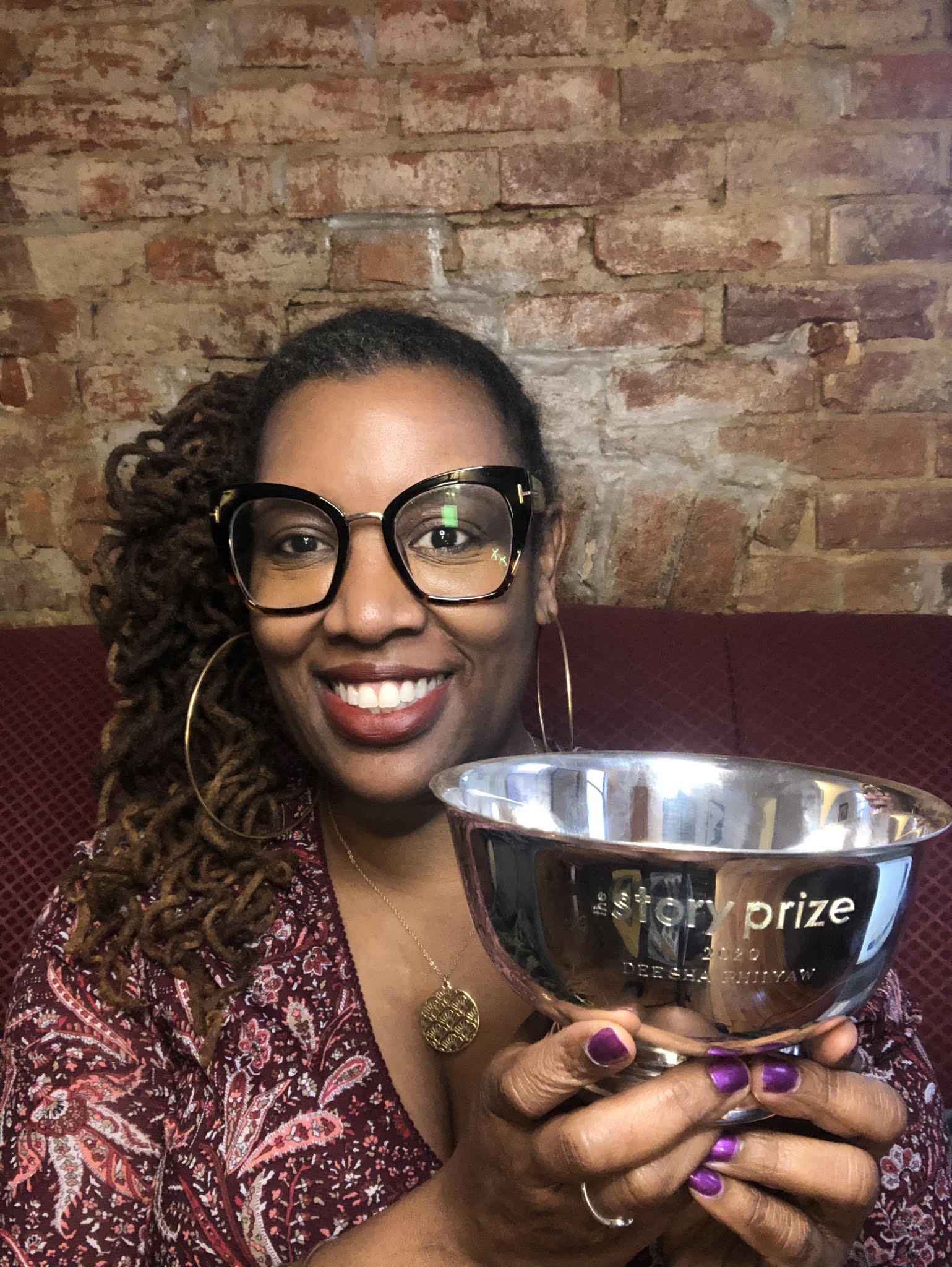
Deesha Phillyaw's The Secret Lives of Church Ladies Is the 17th Winner of The Story Prize!


The winner of The Story Prize for books published in 2020 is The Secret Lives of Church Ladies (West Virginia University Press) by Deesha Philyaw. This is the first time that The Story Prize winner has been published by a small or university press, and Philyaw is only the fourth debut writer to take the prize. The others were Patrick O'Keeffe, Daniyal Mueenuddin, and Claire Vaye Watkins.
 
A video we've posted on YouTube features readings by and interviews with Philyaw and the other two finalists for books published in 2020: The Office of Historical Corrections by Danielle Evans (Riverhead Books) and Likes by Sarah Shun-lien (Farrar, Straus and Giroux).
 
The Story Prize’s $20,000 top prize is among the largest first-prize amounts of any annual U.S. book award for fiction. Philyaw also received an engraved silver bowl, which The Story Prize presents to all winners. As runners-up, Evans and Bynum each received $5,000.

Director Larry Dark, and Founder Julie Lindsey selected the three finalists for The Story Prize, now in its 17th year, from among 121 books entered in 2020, representing 89 different publishers or imprints. Three judges—critic and author Ismail Muhammad, bookseller Margot Sage-EL of Watchung Booksellers, and writer and Williams College professor Karen Shepard—determined the winner from among the three books chosen as finalists. 

The Secret Lives of Church Ladies was also a finalist for The National Book Award for fiction and is a finalist for the PEN/Faulkner Award and a Los Angeles Times Book Award. In addition, the book is in development as an HBO series. 
 
Buy The Secret Lives of Church Ladies, Likes, and The Office of Historical Corrections from your local bookseller or on Bookshop.

Congratulations to Deesha Philyaw, and West Virginia University Press!

Thursday, March 21, 2013

Press Play: Media Coverage of The Story Prize Event

Claire Vaye Watkins, Dan Chaon, and Junot Díaz backstage
photo © Beowulf Sheehan
Here are some press accounts of The Story Prize event on March 13, at which eventual winner Claire Vaye Watkins and fellow finalists Dan Chaon and Junot Díaz read from and discussed their work onstage at The New School:


Friday, March 15, 2013

Video: The Story Prize Event on March 13, Dan Chaon, Junot Diaz, Claire Vaye Watkins

In case you missed it, here's video of The Story Prize event on March 13, at which we announced the winner for books published in 2012: Claire Vaye Watkins' Battleborn.

What The Story Prize Judges Had to Say About Claire Vaye Watkins' Battleborn

photo © Beowulf Sheehan
When the three judges for The Story Prize make their choices, they provide citations for the books. This year's judges were Jane Ciabattari, Yiyun Li, and Sarah McNally. We include the citations in congratulatory letters we present to each finalist, along with their checks ($20,000 to the winner, $5,000 to the other two finalists). To protect the confidentiality of the judges' votes and the integrity of the process, we don't attribute citations to any particular judge.

Here's what the judges had to say about Story Prize winner Claire Vaye Watkins' Battleborn:
“In the ten stories in her first collection, Claire Vaye Watkins takes an unflinching look  at the apocalyptic dimensions of our culture's boom-or-bust obsession. Her stories are set in the deserts and whorehouses and rockhound haunts of her home state of Nevada, long ago dubbed ‘Battle Born’ because it was founded during the Civil War. In her opening story,  ‘Ghosts, Cowboys,’ she delivers an artful and gutsy answer to the question, ‘How should a story begin?’, while writing of Reno’s Gold Rush days, the Spahn Ranch where 1950s Westerns were filmed, and the toxic love of the present-day narrator’s doomed parents. Watkins’s imaginative reach encompasses the ambivalent love of half-sisters, the grief at a mother’s suicide, the damage a Las Vegas party turned violent wreaks on two teenage girls, a young pregnant woman’s twisted connection to her own father, and the deadly repercussions of a nuclear test blast. She’s a fierce and original new writer, and Battleborn is an astonishing short story collection.”
“So rarely does a story collection triumph like a Beethoven symphony, so rarely is each story in the collection as ambitious as a novel, that readers of Battleborn must stop from time to time and wonder about its creator: what an audacious voice, what a visionary mind, what understanding—ruthless yet full of tenderness—she has toward her characters and the landscape they inhabit. Claire Vaye Watkins dazzles us with a perfect collection that is to be celebrated by lovers of short stories. What a glorious discovery!”

Thursday, March 14, 2013

Pictures from The Story Prize Event on March 13

 All photos © Beowulf Sheehan


The finalists: Junot Díaz, Claire Vaye Watkins, and Dan Chaon

Dan Chaon reads from his collection Stay Awake

Claire Vaye Watkins discusses Battleborn
with Story Prize Director Larry Dark
Junot Díaz discussing This Is How You Lose Her—and more

Story Prize Founder Julie Lindsey, winner Claire Vaye Watkins, and Larry Dark

Wednesday, March 13, 2013

Claire Vaye Watkins' Battleborn Wins The Story Prize

photo © Beowulf Sheehan
The winner of The Story Prize for short story collections published in 2012 is Claire Vaye Watkins for Battleborn (Riverhead Books). Watkins takes home a check for $20,000 and an engraved silver bowl. The runners-up, Dan Chaon and Junot Díaz, each take home $5,000. All three deserve a big round of applause: They wrote great books that made our judges' decisions difficult.

Battleborn is a collection of 10 stories set in the American West. Settings range from the California Gold Rush of 1849 to the founding of Reno in 1859 to the abandoned movie set that housed the notorious Manson family in the late 1960s to recent times haunted by these past events. The collection’s title refers to the state motto of Nevada, the author’s home state, where many of the stories take place.

Claire Vaye Watkins is the ninth ever winner of The Story Prize and first woman to win since Mary Gordon for The Stories of Mary Gordon in 2007—the third year of the award. Edwidge Danticat’s The Dew Breaker was the first ever winner in 2005. Watkins is also the third debut author to win. The other two were Patrick O'Keeffe for The Hill Road in 2006 and Daniyal Mueenuddin for In Other Rooms, Other Wonders in 2010.

In the days ahead, here and on our Web site, we'll post citations from the judges, photos from the event and the after party, and links to media coverage.

Tuesday, January 15, 2013

Here Are Your Story Prize Finalists: Dan Chaon, Junot Díaz, and Claire Vaye Watkins

Dan Chaon           Claire Vaye Watkins                Junot Díaz
We’re pleased to announce the books and authors we've chosen as this year's finalists for The Story Prize:


These are all outstanding short story collection by skillful and accomplished authors, whom we're thrilled to have as finalists for The Story Prize. We read 98 short story collections from 65 different publishers or imprints in 2012. Quite a few would have made excellent finalists. It’s always hard to choose just three books, and it will be just as difficult (if not more so) to compile a short list of other notable collections we read in 2012.

We're also excited to announce something new, The Story Prize Spotlight Award, a $1,000 prize to a book submitted for The Story Prize that we believe deserves further attention. This year's winner is Krys Lee for Drifting House (Viking).

The Story Prize’s annual event will take place at the New School’s Tishman Auditorium in New York City at 7:30 p.m. on Wednesday, March 13. General admission tickets are $14. That night, the finalists will read from and discuss their work onstage. At the end, Julie Lindsey (Founder of The Story Prize) will announce which of these three deserving authors gets the top prize of $20,000—the most of any U.S. annual book award for fiction. Our three judges—critic Jane Ciabattari, author Yiyun Li, and bookseller Sarah McNally—are reading the books and will determine the outcome.

Monday, January 7, 2013

Claire Vaye Watkins and the Myth of the Good Idea

In the 72nd in a series of posts on 2012 short story collections entered for The Story Prize, Claire Vaye Watkins, author of Battleborn (Riverhead Books), discusses bad ideas for bad stories and bad ideas for good stories.


What’s the worst idea for a story you ever had?
It’s difficult to determine the worst idea I ever had for a story, and not just because I’ve had so many. There was the one about a town that builds a rocket ship to colonize the moon, deciding to leave all the rabble-rousing feminists behind. There was the one about a stoner dropout whose absentee father recruits him to repair his failed marriage (the stoner agrees, inexplicably, and ends up with his dad, watching his stepmother have sex with her new lover atop a trampoline. Naturally, they watch from beneath said trampoline). There was the one about two brothers who ride bikes through town after a flash flood has garlanded the streets with carcasses of drowned tabby cats. A Judy Garland figure tries to seduce a young guest—a trailer park chubber named Jellyroll—at her ten year-old daughter’s birthday party. A couple travel to Fort Vancouver to nurture their last shred of love and respect for each other, which is, of course a literal shred that closely resembles menstruate, and which they keep in a Tupperware dish, for it is, yes, animate (chase scene!). There was the one—a comedy—about a mother who returns to college and chains her son to a boulder in their front yard because she suspects him of masturbating to an issue of Reader’s Digest she’s not yet read.
Titillating

Those are perhaps obviously rotten ideas, but what about the 9/11 story wherein a teenage girl allows her best friend to be gang raped? Or the story about a gay madam who falls for a foxy Italian tourist who holes up in his brothel when the Italian’s companion disappears in the desert? Or the one about the Forty-Niner who can see the future? Or the one where pretty much nothing happens except two abortions?

Those all sound pretty lousy, too, and they may be, but those are the ideas for some of the stories in Battleborn. My thinking is there’s no such thing as a bad idea for a story. Or perhaps what I mean is every idea for a story is bad until you make it good. Any time I’ve written anything good I’ve spent the vast majority of the composition process convinced it was an utter stinker. And they were stinkers, until they weren’t, at which point they were done. The only way to get from one to the other is work. That’s the tiny, tremendous membrane separating Joshua, the homesick and clairvoyant Forty-Niner in “The Diggings,” from poor lil’ Jellyroll.

Debunking the myth of the good idea is essential for the short story writer. It is, I think, essential for any writer working in any genre other than film or television. There’s a reason fiction writers don’t pitch their books (imagine Toni Morrison saying, “Picture this! Ghost baby has sex with her mom’s boyfriend! It’ll win a Nobel!”). The idea is a formality, mere permission. The triumph is what you do with it.

This post is dedicated to the memory of young Jellyroll. May he rest in peace.