Showing posts with label 2013 contributors' posts. Show all posts

Tuesday, January 28, 2014

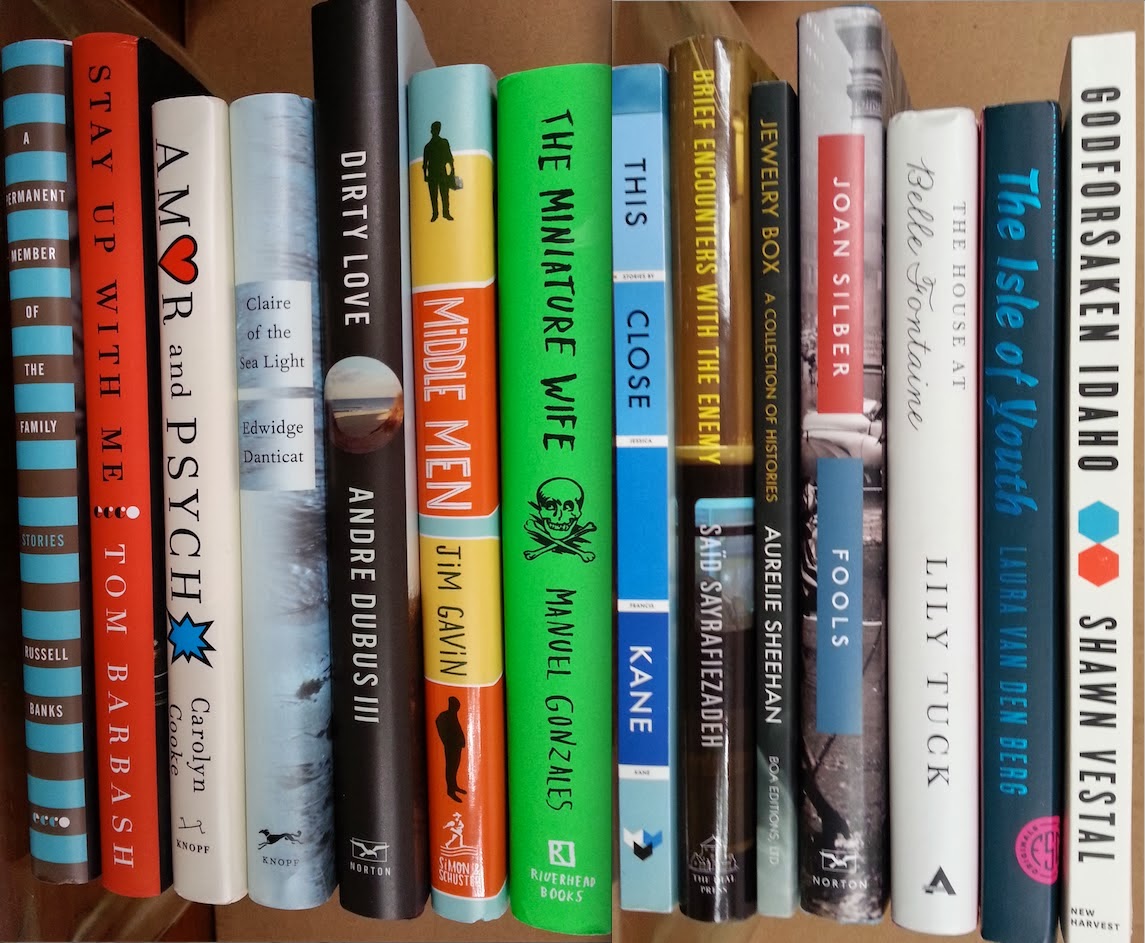
Other Outstanding 2013 Short Story Collections

We received 96 short story collections in 2013, many of them well worth reading. Beyond the three finalists and the winner of The Story Prize Spotlight Award, here is a long list of other collections that particularly stood out for us:


Keeping our long list to a reasonable length—14 books this time around—entailed drawing a somewhat arbitrary line that leaves out quite a few exceptional short story collections that might be on many other readers' lists. In the end, such choices are to a large degree personal and subjective.

Writing a story collection and seeing it through to publication is an immense accomplishment, and every author of every book we read in 2013 truly deserves to take a bow. We hope readers will explore the books on and beyond this list—along with the many fine short story collections that no doubt will be coming out this year.

* Titles link to IndieBound listings, author names to guest posts on this blog.

Monday, January 20, 2014

An Index of Posts from Authors of 2013 Story Collections

For the fourth straight year, in 2013 The Story Prize invited each author of a collection we received as an entry to contribute a guest post to our blog. Out of 94 authors, 62 chose to participate. We thank them for their thoughtful , interesting contributions. Since 2010, when we began doing this, TSP has featured 266 guest posts from 263 writers.


Popular posters: Walter and Danticat
According to Blogger's statistics, every author post received at least 100 page views, with most getting 300 or more and the most active page (Jess Walter's) so far drawing more than 1,200 hits. The posts with the second and third most hits this year were Edwidge Danticat's and George Saunders'. The links, in alphabetical order by the author's last name, are to each guest post.

A-B
Mary Akers Attends to the Details
Stevan Allred Populates a Town
Louise Aronson Answers "The Question"
Where David S. Atkinson Gets His Ideas
Ramona Ausubel and the Story About the Spool Farmer
Tom Barbash Zeroes in on a Quandary
Andrea Barrett's Science Fiction
Kevin Barry and the Deeply Esoteric

C-D
Elizabeth Cohen on What Her Stories Leave Out
Carolyn Cooke's Anti-House
Candace Coulombe's Flash Fabulism
Edwidge Danticat Gives the Reader a Story
Amber Dermont and the Incorrigible Student
Andre Dubus III Asks: What Would That Be Like?

E-G
B.C. Edwards and the Terrifying Malady
Jim Gavin: Some Notes on “The Partridge Festival” by Flannery O’Connor
Sarah Gerkensmeyer Learns to Tolerate Messes
Manuel Gonzales' Strange, Meandering Thought Process
Peter Grandbois Listens to Images
Allan Gurganus: A Few Words for the Novella

H-K
Cary Holladay's Reluctant Art Form
Jessica Hollander and the Naked Workout
Seth Johnson and the Anti-Story
Jessica Francis Kane vs. the Beautiful Chaos
Kristiana Kahakauwila Starts with an Image
Laura Kasischke: On Childish Things

L-M
Andrew Lam's American Beginning: Learning a New Language, Seeing a New Future
Rebecca Lee Gets an Offer She Can't Refuse
Norman Lock's Subconscious Needs
Kelly Luce Takes a Hatchet to Her Work
William Luvaas: How It All Starts
Donald Lystra and That Sense of Discovery
Courtney McDermott on Encountering Ideas Everywhere
Kate Milliken Builds a House

O-R
Chinelo Okparanta Paints the Truth
Peter Orner Walks Around with It
Sara Pritchard on Making Stories That Are Big on the Inside
Alex M. Pruteanu's Guerilla Writing Tactics
Jamie Quatro and the Anarchic Image
Victoria Redel's Secret Joke
Ethel Rohan Says: "Enough"
Ito Romo and the Lives of Others
Ethan Rutherford on Knowing When to Quit (and Not Quitting)
Jean Ryan and the Abandoned Story

S
George Saunders Talks Shop
Saïd Sayrafiezadeh and the Pressure of Having to Say Something
Katey Schultz on Writing What She Doesn't Know
Aurelie Sheehan Comes Out of Hiding
Ranbir Singh Sidhu Seeks to Broaden the Landscape
Joan Silber Makes Thematic Connections
Gregory Spatz Runs Hot and Cold
Susan Steinberg and the Story of the Twelve-Foot-High Chair
Ben Stroud Learns to Adapt

T-W
Susan Tepper on Making the Most of Insignificant Things
Johnny Townsend Asks "What If?"
Valerie Trueblood on the "When" of Stories
Laura van den Berg's Journey to "Antartica"
Anthony Varallo and "A Basket of Apples"
Shawn Vestal and the Artistic Takeover
Anthony Wallace and the Everyday Eternities
Jess Walter's "Process"
Guinotte Wise Gets Unstuck

Tuesday, January 7, 2014

Allan Gurganus: A Few Words for the Novella

In the 62nd in a series of posts on 2013 books entered for The Story Prize, Allan Gurganus, author of Local Souls (Liveright)—a collection of three novellas, advocates the form.


The novel is a forgiving form; its loose clothes can hide your extra ten to twenty pounds. But writing a novella means entering an Audrey Hepburn lookalike contest. There is no faking that caliber of leanness. "Less is more."—More work!

Still, I’m in love with the novella’s very difficulty, its requisite 400 crunches a day. For someone inherently longwinded, the discipline of condensation can lift from narrative generality certain hard-earned abs.

Pascal: No time for brevity
—“I have made this longer than usual only because I have not had the time to make it shorter.”

That famous statement, sometimes attributed to Woodrow Wilson, sometimes Mark Twain, really came from a letter mailed in 1657. It was written by Blaise Pascal. His insight into the painful value of compression sums up what’s most heroic about committing short fiction. No single chapter of a novel need claim formal perfection; the next chapter can take up the slack and promise more. But the novella—in its inexorable single-minded sweep—demands a tight-rope’s through-line economy, unwavering grace. How hard is that? Try reducing ten acres of French lavender into perfume’s single ounce.

What is one, a novella? Randall Jarrell’s all-purpose definition might suffice: “A work of a certain length that has something wrong with it.” If a story runs you up to fifty thousand words, it might have hatched into a novella. Single besieged central character offered with a novel’s depth of specific character.

A novella is more nearly the twin of a poem than the sib of any eight-hundred-page novel. If all novels come laden with saddle-bag asides, the novella must offer its everything at once. Bypassing distracting secondary characters, the novella can focus upon one character’s single wish ripening toward obsession. All the drama can hang upon one pile-driving need or love or mistake. Some might call this form the narrative equivalent of eating tuna fish from a can held over the sink, but it is closer to superb hand-sliced sushi. A novella, containing the best of poem and novel, gives us the whiplash of one and the echoes of the other.

Modern life has conspired to make this orphaned form the belle of our age. Our caffeinated restlessness seems allergic to the three-tier novel. The novella can answer, without compromise, the needs of our nation’s shortened attention spans. —If the death of the novel is wildly overstated every six months, the death of the church is underreported. And its demise has opened epic new terrain to us, the secular atheist fable-makers. So many eternal questions remain unaffiliated; so many comforting rituals go weekly un-enacted. Today’s wisest readers turn to fiction. They are seeking more than some playroom pinball annex to their homes and apartments. They are asking fiction for an eternal distraction from all our usual temporal distractions. Readers now seek some sort of meditated shelter and fresh challenge. Haven’t we all had enough of life’s grocery lists unprocessed? Aren’t we are sick to death of force-fed irony offered as a solution, a protein-substitute?

Every evening I must delete email offers from Christian dating services and Korean penis enlargers (do these outfits work in tandem?). Such purgation feels like nightly sweeping back the sea. As we move toward art, as we turn our backs on the junk unsolicited, we want concision, simplification, a last chance at, yes, purity. We crave a respite from the corrosive adolescent sarcasm that’s become American fiction’s defense against a world of true adult feeling.

On the page at least, we seek the sense that some form of human dignity is still possible on earth. And I’m convinced that fiction can provide what religion, so busy besmirching its choirboys, have epically failed to give.

The novella is the perfect form for this decade of our reading history. These days we all love speed. If we don’t, traffic crowds us off the road. We live overcommitted (against our wills) to multi-tasking. Shorter fiction must satisfy us as only long works used to. Poems show how much can be said in how few lines.

I just noted how many favorite novels are actually short, are really novellas: Heart of Darkness; Death in Venice; The Call of the Wild; So Long, See You Tomorrow; The Beast in the Jungle; Pnin; Billy Budd, Sailor; Animal Farm; The Old Man and the Sea; Ballad of the Sad Café; A Clockwork Orange; The Great Gatsby.

And these works are not simply steroidal stories or stunted novels. The Canadian writer George Fetherling states in an essay that defining a novella as little more than the short novel is like “saying a pony is a baby horse.” Far more than any protracted novel, the novella invokes human speech. As with tales exchanged aloud between living persons, the fictional transaction seems to happen in real time. (Not War and Peace time.) Novellas must complete themselves in a single fire-side sitting. The writer dares not let the reader leave her-his talking presence. There is an urgent button-holing quality in riveting short fiction that gives its best examples huge immediacy.

This very swiftness admits then complements the way we live now. Peter Taylor praised the novella as “a work you can pick up after dinner and finish by bedtime.”

Dr. Seuss: A man of few words
I feel proud of attempting more and more with fewer pages. (Dr. Seuss, remember, wrote his immortal The Cat in the Hat using only a fixed 236 words.) New York publishing continues to favor The Novel as our ideal American form, the basic unit of Fictional Retail. This seems short-sighted, conventional, corporate. It is the kind of non-thinking that often precedes a species’ extinction.

Meanwhile I propose that we live in a Golden Age of American Short Fiction. So much talent everywhere. But our musty fixation with some 1940s macho Great American Novel Blockbuster Doorstop hides from us the abundance everywhere of great gifts at the shorter forms. They are—Darwinian—shaped and carved surfboard smooth by those very tsunami forces battering us all. Forms rendered by and for our frantic if exciting age.

Henry James, whose own genius is most perfectly revealed in his shorter sprints, once praised the form as “the beautiful and blest nouvelle.” The English word “novella’ springs from the feminine Italian form “novello.” meaning “new.”

What renewed form of fiction do we need now? Antique novelty available in a dosage and sufficient wattage for our own keyed-up present-tense.

Yes, a novella remains insanely tough to write. You have one chance and all its musical notes are, as professional singers, say “exposed.” And yet, so many gifted voices now gravitate precisely toward performing with these risks and at this length. The raw test of emotional courage might be what makes the novella so rich for readers, so alluring for writers.

Finally, regarding the tortures of condensation, Woodrow Wilson, of all people, states: “If I am to speak ten minutes, I need a week for preparation. If fifteen minutes, just three days. If half an hour, two days. If an hour, I am ready now.”

We writers can therefore take more time trying to tell darker lyrical and layered truths in far fewer words. With no loss to literature. Till the world’s attention span slows again for the fattie-acid ten-course feast, we might do well to opt for single-sitting flashes of pure amazing protein.

It is the way we eat now. And live. And read.
Wednesday, January 1, 2014

Kevin Barry and the Deeply Esoteric

In the 61st in a series of posts on 2013 books entered for The Story Prize, Kevin Barry, author of There Are Little Kingdoms and Dark Lies the Island (Graywolf Press), discusses where he finds stories and how he puts a collection together.


How often does an idea for a story occur to you, and what triggers those ideas?
Increasingly now I think that stories come from their places. I think that human feeling – and very often it’s anguished or melancholy feeling—settles into the stones of a place, and it gives off a curious reverb, and as a writer you’re merely a set of antennae hoping to snag on some of these vibrations. The stories are out there, in other words, and you just have to listen hard and hear them. I hope this sounds properly esoteric because writing stories is a deeply esoteric business. The more you do it, the less you know about it. The closer in you get to the craft, the more the mystery of it deepens.

What's your approach to organizing a collection?
I pretend that it’s 1971 and I’m Marvin Gaye wearing a very dapper fur-trimmed leather trench coat as I put together the running order for What’s Going On. A good collection should ideally work like a favourite album—perhaps you open big, with a couple of sure-fire anthems, but only as a means of luring the reader into stranger territory. I want my themes and situations to work in the way that reprise and refrain work in music.

What's the worst idea for a story you've every had?
From the point-of-view of a hedgehog. Or maybe it’s the greatest story I’ll never finish. (There was a problem with the pace.)

What's the best story idea you've had that you've never been able to write to your satisfaction?
I have any number of unborn masterpieces bouncing inside my head at all times and taunting me.  I’ve been trying to write a story about a chicken farmer in Jamaica for years, having never farmed chickens or been to Jamaica. But it’s called “Chicken Mary,” and how am I supposed to give up on a story with a title like that?

Where do you do most of your work?
At this particular moment in time, in the Quebec National Library in Montreal, because I don’t have the WiFi password and so am spared the temptation to waste my life amid the evil inanities of the Internet. I’m more usually found in County Sligo, in Ireland, where I work at home, in a former police barracks dating from the 1840s, and which appears, tragically, to harbor no ghosts.

In what other forms of artistic expression do you find inspiration?
I write screenplays. It teaches you a tremendous amount about how much or how little of a narrative spine a particular story might need to function.

What's the best and worst writing advice you've ever gotten?
The worst is "write what you know," which admits defeat for the imagination. The best is to put the story in the drawer for a while after you’ve finished it. I try to leave it in the drawer for at least six weeks, and by then its merits or otherwise are usually quite clear.

What obstacles have you encountered as a writer, and what have you done to overcome them?
I tend to write in the high style, more often than not, with the ambition of making a charged and luminous prose, and it can be difficult to keep the language from overwhelming the story. The only tactic is to work like a demon, and to listen very intently to your own work, and in as many different moods and circumstances as you can summon.

What's the shortest time it has taken you to write a story?
The first story in my first book, a story called “Atlantic City,” was written in about four hours spread over two mornings, and with hardly any subsequent revisions.

What's the longest time it has take you to write a story?
The second story in my first book, a story called “To The Hills,” was written over a period of six years and went to fifty drafts. It’s the story of a love triangle among three hillwalkers hiking the Wicklow mountains in Ireland. For the first forty nine drafts, it was eight thousand words long and I couldn’t figure what was wrong with it. I showed it to a friend who said the people are terrific, but there’s lots of description of the mountains. Now these were the most magnificent descriptions of the Wicklow mountains ever committed to paper, but they were killing the story stone dead. The fiftieth draft took about half an hour. I just cut all the descriptions of the mountains. The story was three thousand words for a finish. Writers can be inordinately dumb about their own work sometimes.

Monday, December 30, 2013

Kristiana Kahakauwila Starts with an Image

In the 60th in a series of posts on 2013 books entered for The Story Prize, Kristiana Kahakauwila, author of This Is Paradise (Hogarth), contrasts a story that took her ten years to get right with one she wrote in a single night.


When I was an undergraduate at Princeton University I wrote a collection of short stories for my thesis. One of those stories centered on a relationship between a father and son, the former who is dying and the latter who wishes to reveal a secret. At the time, the story’s plot came together, but the narrative didn’t resonate on the page the way it did in my head. For the next decade—as I worked, went to graduate school, practiced writing, and moved from New Jersey to New York to Michigan to Hawai`i—I kept ruminating on this story about a son who wishes to confide in his father the one secret he knows will break his dad’s heart. I wanted to learn how to tell that story with the greatest honesty and resonance I could.

The first story I wrote for This is Paradise was “Thirty-Nine Rules for Making a Hawaiian Funeral into a Drinking Game.” I wrote the initial draft in a single night, as an email to a friend. The next morning I re-read the email I had sent, and I realized I had the beginnings of a story. Although the revision took me several months, that first draft came as a rush of emotion. I was, after all, just returning to O`ahu from my own grandmother’s funeral, and all the complexity of my feelings—sadness, loss, appreciation, elation to have been surrounded by so much family—drove my writing. In the center of all this emotion was a single image—of cane burning on the highway at night, and the sweet-acrid smell of the air.

My stories tend to spring from a single image that I can’t shake. Maybe the image is something real, such as a photograph or the scent of cane burning. Other times the image is something I’ve dreamt or imagined, but it lingers with me, inspiring an emotional response. Always, a question hovers over the story, and my writing is a way of attempting to articulate the question, and its possible answers, in some way.

Paniolo: Hawaiian cowboy
Which brings me back to that story I first wrote more than ten years ago. I returned to it when I was building This is Paradise, and I set out to better understand the father and son. I had this image of an old paniolo—a Hawaiian cowboy—in bed. He’s frail, but he’s commanding. He has a sharp sense of humor, like most Hawaiian men I know. On his bed is a woven blanket the colors of the ocean—blues and greens, undulating. His son hovers in the doorway of the bedroom, afraid to step all the way inside, while a male nurse carefully shaves the paniolo’s face.

When I decided to revisit this story, I started with this image of the father, his nurse, and the son. In lieu of the mother from the original version, I added a sister. The tension between siblings added a new element to the story, making it not just about a father and son but about a family, their ranch, and their relationship with land and legacy. Because I’d added a ranch, I then needed to describe the cows, the barn, and the land itself. And I had to see the characters interact with this land, with their legacy. When they did so, the story lengthened, tripling in size, and the characters’ desires gained complexity.

What remained the same was the central question that had driven the story in the first place: What secrets should we tell and which should we keep? The arc of the story, its central drive, didn’t change. But my process for negotiating that question, and the characters’ responses to it, was all new.

In the end, “The Old Paniolo Way,” took me a decade to complete, while “Thirty-Nine Rules” took me a single night. The rest of the stories were written within a two-year period that kicked-off with the drafting of “Thirty-Nine Rules.” I may have written intensely in that two years, but I was using the lessons of the previous decade, listening to my characters rather than myself, writing at the edge of my own emotions, and finding that the drive of each story—and the collection as a whole—lay in questions I sincerely wish to understand.

Sunday, December 29, 2013

Carolyn Cooke's Anti-House

In the 59th in a series of posts on 2013 books entered for The Story Prize, Carolyn Cooke, author of Amor and Psycho (Alfred A. Knopf), gives us a tour of her eccentric studio.


Where do you do most of your work? 
I work in an uninsulated cabin that sits alone on a hill, not quite visible from my house, which is by almost any American standard also a cabin. The cabin that is not my house—call it my anti-house—has nine recycled windows and looks out over redwoods, tanoak, bullpines, and the ocean. A wooden ladder rises to a loft, which holds a futon covered with sheets that never need to be changed and an important pillow made from one of my husband’s old shirts and embroidered with the words “I Love You Mom,” which I keep as I might keep a deed in a safe deposit box, as proof. I sleep better and harder here than anywhere I’ve ever slept, and dream higher-quality dreams.


The anti-house is furnished with discards from my other life. The only precious object is an antique card table with a bit of inlay work at the front. My desk chair, straight-backed and Puritan, has a hole in the seat and wisps of horsehair coming out. There’s also a lounge chair with a pony hide that went through a fire (here, in 1999, my fault). Next to the chair sits a reading table containing a white metal lamp of the kind that cost $2 in the 1970s, two dictionaries, and four ivory elephants. The elephants—they used to be five—are the last things my Nana asked about before she died: “Have you lost my ivory elephants already?” with a kind of resignation I might one day remember to practice. There’s a mug containing the same red pencils my grandfather used to correct my letters to him and three wood-and glass cases containing rocks and birds’ eggs. A canvas guest chair bought at Conran’s in New York in 1980 threatens constantly to rip, but I don’t worry about that because I rarely have guests. 

The cabin contains a minimum of everything (besides human company) I need to survive: hot plate, sink, coffee articles, cans of soup, and a jar of peanut butter bought from the co-op the year my daughter turned nine. There’s one fork, one spoon, a Buck knife, and a Ball jar. There’s a telephone, an olive-green typewriter bought in Hamburg, Germany, in 1991, a dog bed, and a dog.

The books here are those I wandered up the hill with—essays, novels, diaries and poetry: Woolf, Dostoevsky, Nabokov, Roth, Trevor, Joyce, Ellison, Davis, Munro, Paley, Jewett, Lahiri, Lopez, Gaitskill, Michaels, Chekhov, Sontag, Didion, Eliot, Glück, Robinson, Stevens, Whitman, and Yeats. There are letters of Flaubert and Bishop (this last a fat volume that went through the fire and smells strongly of ashes and pine) and also twenty or so binders of letters, notes, journals, and sketches, which I combine in an endless work called “The Cord” and pillage regularly.

My anti-house is a private shell, a container for things that seemed important enough to drag up the hill. Myself, for example. It contains the part of life I made out of nothing, out of sentences. When I make my way here and get to work, I leave myself for a while, forget what I am. Later I head down the hill blurry and disoriented, stumbling over pine roots.

Where does this obsession come from, to see life, to nail it down with words, essentially instead of living, or as a way of living? I have a friend who designed and built an art studio in one of the years it took me not to finish my second book. He dug holes, poured concrete, laid joists and beams, erected a shell, ran electric wire through the walls, hung sheet rock, painted and plumbed—while I constructed and tore down phrases. (Now he has an anti-house to face his demons in.)

The house I live in embraces what Roland Barthes has called “the spectacular pleasures of domestic life”: newspapers, Band-Aids, roast chickens, day lilies, brass polish, old address books, train sets, ski jackets, sheet sets, screw drivers, stamps, soaps, vitamins, constant wireless contact with the world and an evolving cast of people to whom I feel connected by ties of affection and duty. My anti-house says no to all that.

Friday, December 27, 2013

Ito Romo and the Lives of Others

In the 58th in a series of posts on 2013 books entered for The Story Prize, Ito Romo, author of The Border Is Burning (University of New Mexico Press), discusses the origins of a story, why he writes the way he does, and where he does his work.


Author photo: Ricardo Mario
On what triggers an idea for a story:
Most stories usually start with a brief but real-life incident that made an impression on me. In this collection, for instance, there is a story called “Redhead.” Here’s the first couple of paragraphs:

Her hair caught fire years ago, Christmastime, as she bent over to light a cigarette on the gas stove one night—stinking drunk. It never grew back right after that, patchy and frizzy and uncombable, so she shaved her head with disposable Bic razors in the shower every other morning.   
Since she could choose hair color now, she wore a red wig of real, human hair she found for thirty-five dollars at the Goodwill Thrift Store. It had been combed semi-professionally by women from the Goodwill’s back-to-work program. When she’d first seen it, she held it up in front of her and scrutinized it carefully, her eyesight already beginning to go from old age, then she had slipped it on and stared at herself in the mirror. One of the girls working close to the counter was cleaning out an old chest of drawers someone had donated; she looked at her and said, “That’s real nice, ma’am. Real nice.”
Two years later, she wore it still, though now it was uncombed and wild, kind of like the fire.  
In this particular instance, the story starts with something that happened to my grandmother’s twin sister. It was an image I had in my head for many years although I never really saw it take place. My grandmother, Carlota, and her sister, Dalila, were born at the turn of the century on the border between the U.S. and Mexico in Laredo, Texas. Seventh generation Texans, they, along with their two brothers and another sister, were really “old school.” They had grown up in the same home I grew up in—two-foot thick stonewalls, wooden beamed ceiling, a Spanish colonial home built around 1750. Lila, as we called her, left Laredo as a young woman to study in Austin (quite a feat for anyone from that region, much less a woman—and a Mexican-American at that), then taught elementary school in Robstown, Texas, where she moved after marrying and where she lived for the rest of her life. She had long silver hair, which she wore in a tight bun at the top of her head. When she’d come to Laredo from Robstown to visit my grandmother Carlota, I’d sometimes see her sitting in my grandmother’s living room, both watching a telenovela, while Lila combed and re-combed her hair, which, as long as I can remember, had been down to her waist.

Years later, after I’d left Laredo and gone off to college, one of my sisters told me that Lila accidentally set her hair on fire one morning as she lit the gas burner on her stove top. She was okay, had only minor burns on her scalp, but I imagined how horrible it must have been for her. This small but vivid imagined memory is what inspired the beginning of the story about Matilde in "Redhead."

On the reason for writing:
I recently read from my collection of short stories for a university audience, and after the reading, I asked if there were any questions or comments, and the first question came quickly from one of the students in the crowd, “Why do you write the way you write.” At first I said, “You know, that’s a really good question, existentially, but what exactly do you mean?” And the student said, “Well, the short, sometimes really short, stories; the short, tight sentences; the intense rhythm; you know, the vivid, really real images; all of those things.” And out of nowhere, without even thinking about it because I had never had a “reason” to write the way I do, I said, “I guess what I want is that for 7 to 10 minutes of your life (because that’s what it takes to read one of my stories), I want you to really feel what someone else is going through, to live, for just a few minutes, the lives of those people we hardly think about.” I used to think that to be able to do this, I needed long, frilly, complicated sentences, but after years and years of fine-tuning, I finally realized that the simpler and more direct writing gave me the immediacy I was looking for.
On where I write:
I write all of my stories at this roll top desk.  It belonged to my great-grandfather, Baldomero Chacon, Carlota and Lila’s father.

Those two are my dogs, Xuxa and Lalo.

Thursday, December 26, 2013

Kate Milliken Builds a House

In the 57th in a series of posts on 2013 books entered for The Story Prize, Kate Milliken, author of If I'd Known You Were Coming (University of Iowa Press), talks about organizing a collection and finding inspiration.


How often does an idea for a story occur to you, and what triggers those ideas?
Usually it’s the body language between two people, an overheard bit of dialog, or a sudden shift in atmosphere of a room—something that presents itself with a hint of subtext. I’ll wonder about that moment, that image, those characters, for a while before I start writing. I write down three or four of these story scraps a month and lose a whole lot more to the belief that I’ll remember them. 

What's your approach to organizing a collection?
A regard for the reader’s time is important, the need for changes in perspective and pace, an avoidance of echoing between stories, a balance of darkness and humor. And I want a kind of conversation to be happening between the stories. I most admire collections with a subtly identifiable lineage from the first story to the last—by character or location or theme. Here’s a metaphor: A book is a house. The ordering of the stories is your host, leading you from room to room, so that by the time you’ve reached the attic or the master bedroom, whatever the tour’s final resting place is—that final story—you feel a great intimacy with the whole of the place, but hopefully there’s a window there too, a view out to the world beyond the book. So that first story also has to act as an invitation in, a front door, a foyer with coat rack. I’ll put the metaphor away, but this is just to say that while every story matters, that first and last story have an added responsibility.

What's the worst idea for a story you've ever had?
It involves a wronged wife, the mistress hairdresser, a shampoo and a cut.

What's the best story idea you've had that you've never been able to write to your satisfaction?
It involves a wronged wife, the mistress hairdresser, a shampoo and a cut. 

What's the best and worst writing advice you've ever gotten?
Write What You Know has become a kind of bad ad campaign for creative writing. It’s easy to say, it looks simple enough on the blackboard, it’s inviting to the student who is new to writing. But then that student realizes they don’t know much of anything. Write What You’re Curious About. Write Your Obsessions. Write About What Plagues You. These are the slogans that keep me going back to the page and they invite the understanding that writing isn’t only an act of self-expression, but one of discovery.

In what other forms of artistic expression do you find inspiration?
All of them. But daily from photography, music, and film. I’ve learned a great deal about dramatic structure from film and I often visualize scenes as if through a camera lens. Possibly a side effect of Hitchcock and Woody Allen getting more play time in my childhood then Tom and Jerry. And my husband is a photographer and filmmaker, so his work keeps me attuned to visual story telling. I keep images up that I relate to characters or settings and I usually listen to music while I write. Cat Power or Bon Iver for a heartsick protagonist, Lykki Li or Coco Rosie for the object of her desire, Amjad Ali Khan when I’m stuck.


What obstacles have you encountered as a writer, and what have you done to overcome them?
My own immaturity-insecurity-lack of discipline. They feed one another. My twenties. I wasted a lot of writing time and time in general before having kids. Now the “obstacle” of having less time is what has made me more productive, more willing to run with an idea, to avoid excuses in favor of action. My inner critic I skirt by getting up earlier than she can. Four or five a.m. seems to keep her groggy and ineffectual enough. 

What's the shortest time it has taken you to write a story?
Two days. It was freakish. I wish I could bottle that feeling. Naturally line edits have happened in the years since, but paragraph for paragraph it’s the same. It must have been gestating, as I had a fifteen-minute phone conversation with someone and as soon as I hung up I realized the conversation had a dramatic arc and as I started fictionalizing, embellishing, the backstory, the last line, everything came to me in an uncanny rush. I’ve waited for that to happen again ever since. Never has, never will. 

What's the longest time it has taken you to write a story?
Well, years. But that’s not active writing time. Most stories take me four months to a year to bring to some polished state, but they all lay dormant for periods of time. However long it takes me to get objective, to let go of my initial intentions. I have one story that I started ten years ago, a story that has an ending, but not the proper ending. Line for line it’s a pretty rough read to me now. Someday I’ll write it all over again. So ten years and counting.

Tuesday, December 24, 2013

Jessica Hollander and the Naked Workout

In the 56th in a series of posts on 2013 books entered for The Story Prize, Jessica Hollander, author of In These Times the Home Is a Tired Place (University of North Texas Press), traces the origins of a story.


If you've ever written a story based on something another person told you would make a good story, what were the circumstances?
I’ve never written a story based directly on a story someone told me, but it’s surprising what people say that will grow into an idea for a story, which is why writers can’t be hermits no matter how much they might sometimes like to be.

Several years ago, my parents joined a gym. With my limited knowledge of who actually worked out in gyms, this seemed almost comic—my arty parents wouldn’t fit in beside the vain body-builders I’d assumed surrounded them. They’d gone a few times a week for a couple months when I visited, and they wanted me to come check it out. I resisted. I didn’t know what I would do there—run on a treadmill? Do a few sit-ups? Couldn’t I manage these things without equipment? I was skinny and shy; I liked exercising privately. I imagined all these tan, oiled body-builders watching me try to lift a ten pounder with my arms pathetically shaky.

Mom said it wasn’t like that; the gym-goers were mostly like her and Dad. She said the only weird thing was in the locker room, where some women walked around naked longer than necessary: brushing their hair, clipping their toenails. And there were plenty of curtained stalls, but Mom said for some reason these women wanted to be out in the middle of the locker room where other people could see them. And this interested me—both the behavior itself and Mom’s discomfort with seeing other people naked.

I did go to the gym with them, though I don’t remember much from the trip. I know it was nearly deserted. There were a lot of mirrors that multiplied the machines, so that it seemed there were so many more machines than humans. The customers were mostly middle-aged with normal or stocky builds, though there was one overly-muscled twenty-year-old young man strutting around. I remember feeling uncomfortable, as I suspected, and I believed it was a waste of time. No one was even in the locker room when Mom and I changed. But the seed was planted about this unspoken battle over space—who had the right to be comfortable: those who wanted to be naked or those who wanted everyone covered up?

A year later, I became friends with a writer who told me about a similar battle she witnessed on a private lake near her house, where nude beachers and clothed beachers would try to claim the space closest to the shoreline. These groups never mingled, and it was understood that they hated each other. Talking to her about this revived my interest in issues of space ownership and locker room politics. I began my story “The Year We Are Twenty-Three,” about a girl who worked in a gym.

My stories function in the hyper-real tradition, where everything is turned up a notch—colors are brighter, dialogue’s stranger, people are a bit more extreme than they would be in real life—with the intention of getting the reader to examine “reality” and the real strangeness that IS reality a bit closer. Things we don’t notice we might think about more if we see them portrayed in a strange or extreme way. So I moved the battle between the clothed and naked gym-goers out of the locker room and into the gym, where the narrator had to deal with half her customers working out in the nude.

One kind of person
The narrator in “The Year We Are Twenty-Three” is trying to make sense of her identity having graduated from college—she’s no longer a student, and she hasn’t gotten a respectable job; she’s living with a boy but she’s not married; everything in the world now makes her a little nervous because she doesn’t know her place in it. She deals with this by wanting to define everything in black and white terms: there are two kinds of people who live here: students and crazy people; there are two sets of beliefs: liberal and conservative; and there are two kinds of people at the gym: the nudists and the people who hate them. She tries to make sense of her world by breaking it into extremes, but doing so makes it even harder to figure out where she fits in.

Whatever little events take place in our daily lives, these intrusions, we have to deal with them and make sense of them in the context of the parts of our lives we really care about (family, relationships, careers, etc). These little events or interactions don’t stop the more macro parts of our lives; instead they are possibilities for slightly influencing how we see the world. The issue of space ownership mirrors the narrator’s crisis, when, floating between identities, she is comfortable in no space, physical or emotional. Seeing her crisis reflected in the gym-goers, she has a small amount of hope that they will reveal some insight about her own life. Like my character, I listen to what people say and witness, and I force myself to go out and witness things, too. It’s these everyday conversations and encounters, all these little pieces, that add up to the whole that is our lives and help us contextualize what we normally see as “important,” not to mention give us the material we need to write stories.

Monday, December 23, 2013

Shawn Vestal and the Artistic Takeover

In the 55th in a series of posts on 2013 books entered for The Story Prize, Shawn Vestal, author of Godforsaken Idaho (New Harvest), talks about often starting a story without an idea and taking one from Henry James.


How often does an idea for a story occur to you, and what triggers those ideas?
I almost never have story ideas. That is, I almost never have ideas for whole stories, or even parts of stories. Usually, when I begin, I don’t even have a decent, respectable portion of what you would call a story in mind—not even 2 percent of a story, say, or .82 percent of one. 

Almost always, for me, stories begin with the paltriest little bean—a scrap of language, a predicament, a joke, an attitude, a voice—and little more than my desire to see what kinds of flavors I can extract from it. Sometimes, inch by inch, a paragraph or two of real story will emerge out of the imaginative play and false starts and silly side roads and verbal goofing-off. The making-it-up. Very often, the making-it-up fails me. It will founder on an absence of character and authentic life, and after some time I will start with a new bean. 

I sometimes feel insufficient in this respect—many of my writer friends strike me as much more natural storytellers, as people who imagine narratives in whole—but I am coming to have faith in my ability to eventually discover a story idea, even if it doesn’t show up until late in the process, and even if several other ideas must wither for me to get there. 

If you've ever written a story based on something another person told you would make a good story, what were the circumstances?
I have never quite done that, but I often do something that feels similar to me: take an existing story or idea and retell it, turn it on its head, subvert it. In my collection, I did this with the story of the Mormon pioneers and the seagulls—a story that is an important part of the church mythology, and one that I had heard many times while growing up. In that version of events, a wave of crickets threatens to destroy the crops of the pioneers, recently settled in Utah, when a flock of seagulls comes and rescues the Saints from ruin by eating the bugs. 

Mythic Mormon seagulls
In my story, “Gulls,” I tried to take the pieces of that story, and make a new one—one with different meanings, different suggestions, different conclusions. An artistic takeover. Another story of mine, “Diviner,” is my own reinterpretation and fictionalization of some actual history regarding Joseph Smith, the founder of the Mormon Church. I find this very compelling, for whatever reason—the notion of taking someone else’s story, and breaking it apart, and putting it back together for myself and seeing what I end up with. I have a long-term goal to take the Henry James’ novel, “The Ambassadors,” and rewrite it as a crimey story set in Washington state, with my home of Spokane standing in for America and with Seattle standing in for Europe. I like to think of this less as stealing than as Henry James giving me a story idea. 

What's the best and worst writing advice you've ever gotten?
The best writing advice in the world is plain and unremarkable: Read a lot and write a lot and work hard. Keep going. And then keep going some more. 

Almost all other writing advice — write what you know, show don’t tell, appeal to at least three senses, make sure your main character undergoes a change, be sure to give the dog a name—is apt to range from excellent to atrocious, depending on the context of any single piece of writing. Most often, such advice is mediocre and obvious, but it is also the best we can do. 

The voice I often hear in my mind when I’m revising something is that of my friend, the author Sam Ligon, and he is saying: Can this do more? It is always the right question.

Friday, December 20, 2013

Jessica Francis Kane vs. the Beautiful Chaos

In the 54th in a series of posts on 2013 books entered for The Story Prize, Jessica Francis Kane, author of This Close (Graywolf Press), talks about good ideas and bad ideas, good advice and bad advice, inspiration and obstacles.


How often does an idea for a story occur to you, and what triggers those ideas? 
Lately I would say, not often enough. As for triggers, a little bit of everything: reading, history, autobiography, overheard conversations, worry, fear, misunderstanding, love.

If you've ever written a story based on something another person told you would make a good story, what were the circumstances?
I realize now only non-writers have ever told me to write something and said it would make a good story. I always cringe when that happens. I think writers know better. The one exception is my father. He’s not a writer, but he has a writer’s sense for good material and often tells me stories that wind up in my work one way or another.

What's the worst idea for a story you've ever had?
Possibly this story I tried to make work for years about a small country fair. It was going to be about a man who had trained a team of horses for the horse pull contest. I was obsessed with the nature of old-fashioned farm work for a time. I read and researched, even interviewed a man who had a horse team, but the story never got better. If you’re wondering why, I’ll tell you that there was going to be an ancient oak tree, and a storm, and the whole thing was called “Carnival of the Winds.” So many problems. Still, these were the early days of my story writing career, and I learned a lot from the constant failure of that story.

What's the best story idea you've had that you've never been able to write to your satisfaction?
I fear I can’t even summarize it here satisfactorily. I'm still hoping to persevere and get this one written.

Where do you do most of your work?
I have worked in libraries for about a decade, ever since my first child was born. It helped me then to get out of the house and work around other people. I still like to leave the house but lately am tired of battling undergraduates for the best desks, so I’ve joined a writers’ space in the city called Paragraph. I like it there and only wish it were called Whole Novel.

"Who was I kidding?" by Nicola Hicks
In what other forms of artistic expression do you find inspiration?
Music and art, most recently the sculptures of Nicola Hicks. She is an English artist who has an exhibit currently at the Yale Center for British Art. I saw it over Thanksgiving with my family and was transfixed. Her piece “Who was I kidding?”—based on the Aesop fable of the donkey dressed in a lion skin—is one of the saddest things I’ve ever seen. It is the very embodiment of shame. I’m fascinated by it and I know this means it will inform my writing somehow, but I don’t have any way of saying how yet. 

What's the best and worst writing advice you've ever gotten? 
The worst advice was when someone told me that the shortest story I’d written to date sounded the most like the opening of a novel. I wanted to write a novel and was casting about for a subject, so I latched onto this idea and spent a long time, too long, trying to turn that little thing into something longer. The best advice, interestingly, came from the same person. I was worrying a bit of description in a different story, and he said, “Leave the blue curtains alone.” Now I think of those words whenever I’m trying to push something in a story too hard. That some of the best advice and the worst advice came from the same person probably means that, at best, all writing advice is suspect. Ultimately, you find what you need and use it in your own way.

What obstacles have you encountered as a writer, and what have you done to overcome them?
The biggest obstacles have been the beautiful chaos of life with children and sustaining confidence over time. If I’ve overcome them, it’s news to me. It feels like a constant battle, but my trusty aides are an astonishingly supportive husband, a belief in routine, and the occasional retreat or residency.

What's the shortest time it has taken you to write a story?
The shortest period of time was a month, but it was based on an opening paragraph I’d written about six years earlier, so I don’t know if this counts. I had a voice in my head for a character who was based on the woman I was living across the street from at the time. I liked the voice, but after the first paragraph didn’t know where to go with it. I try not to throw anything away, though, so years later I opened the file, reread the paragraph, and just kept writing. A month later I had a new story. I wish more of them came like that.

What's the longest time it has take you to write a story? 
I don’t know yet, but sometimes I worry I’m likely to set a record. I still have things I hope to finish, other abandoned paragraphs and pages I plan to resurrect.