Showing posts with label writing process. Show all posts

Tuesday, November 28, 2017

Michelle Ross Asks: Is a Story Ever Finished?

In the 35th in a series of posts on 2017 books entered for The Story Prize, Michelle Ross, author of There's So Much They Haven't Told You (Moon City Press), contemplates the array of choices writing a story presents.
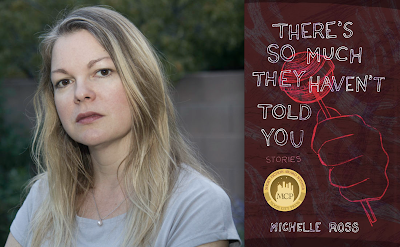

By nature, I’m an indecisive person. If I don’t bring leftovers to work with me in the morning, then I will deliberate for so long about what to get for lunch, that in the time I wasted trying to decide where to go, I could have been out and back and eating already.

Writing, of course, is an exercise in making choices. Every word is a choice. Every detail. Every action. In the process of writing any story, I make thousands of choices along the way.

I’m also a perfectionist, and I suspect this largely explains the indecisiveness. Maybe perfection exists on a small scale. There are perfect sentences, I think. But on a larger scale, perfection either doesn’t exist or, at the very least, I don’t think it’s a reasonable goal. That’s in part because while some writing choices feel easy and natural, as though I couldn’t have chosen any other way, many other choices involve more chance than that. I could have chosen differently and still ended up with a great story. Maybe it would have been a slightly different version of the story I wrote. Maybe it would have been a drastically different version of the story I wrote. Maybe so different, anyone else wouldn’t know the two stories had started with the same seed.
Decision tree: Chose your own story

So I remind myself that there isn’t one correct path I must stumble my way onto or else the story is doomed. There are many fine paths I could take, so I just need to relax, make a choice and another and another and keep going.

And then there’s the revision, of course, and so reconsidering choices, and choosing differently, which creates more and more choices to make.

Until, finally, the story is finished.

On one hand, I want to say that knowing when a story is finished is rather simple. It’s a gut feeling. I’ve put in the work, given myself time and distance from the story, reread the story again and again and found that nothing nags at me anymore. That’s when I know a story is finished.

But many times an editor who has accepted one of my stories for publication has requested edits. Was the story not finished when I sent it out?

When I put stories together to make this collection, I revisited work I’d published in journals a decade earlier in some cases. I found more edits to make—most of them copyedits, but also more significant edits. I cut whole paragraphs. I rearranged scenes. Were the stories not finished when they were published in journals?

My book has been a finished thing since February of this year. If ever my stories are truly finished, surely it is when they appear collected in a book that has my name on the spine, right?

Recently, an editor expressed interest in republishing a story from my book, only she wanted to know if I’d be willing to consider making some edits. In addition to being in my book, this story won a contest years earlier. A prize of $1,000, the most I’ve ever been paid for a story. I’ll admit I felt a little uncomfortable at first about editing this story now. Because to make changes seemed to be an admission that the version of the story in the book is less than perfect. But didn’t I know that already?

There’s that famous sentiment I’m not sure whom to credit: Art is never finished, only abandoned. The word “abandoned” feels a little harsh, but if by “finished,” we mean “perfect,” I’m inclined to agree that no story—or few stories anyway—are ever truly finished.

There’s something liberating and beautiful about that.

And so, yeah, I listened to this editor’s insightful suggestions, and I edited the story. And it’s a better story.

But it’s still not perfect.

Tuesday, September 5, 2017

Joseph Scapellato and the Story’s Intention

In the 15th in a series of posts on 2017 books entered for The Story Prize, Joseph Scapellato, author of Big Lonesome (Mariner Books), shares his process.


In the first year of my MFA at New Mexico State University, I was taught a concept that transformed my approach to writing and reading, a metaphor that I reach for every time I’m on the page.

I was in Robert “Boz” Boswell’s class. I was 22, with a tangle of facial hair that almost met the minimum requirements for “mustache,” with a tangle of short story drafts that almost met the minimum requirements for “readable.” I used every fiction assignment to try something different—I was writing to figure out what my writing was and wasn’t, what it could and couldn’t be, and despite the fact that nearly everything that came of this was caca, I was excited. I was in grad school: If I wasn’t failing, I felt, I wasn’t trying.

Someone asked a question, I don’t remember who, I don’t remember what.

Boz nodded. As usual, something in his posture said, “I’m sitting outside,” even though we were in a classroom. His body seemed to want to be at a baseball game. He stood up to write on the board.

“I only know a few things,” he said. “This is one of them.”

He wrote:

The Writer’s Intention

The Story’s Intention

"When we first write a story," he said, "we have one or more intentions for it. Our intentions might be vague and simple, or specific and complex."

(The following examples are not the ones Boz used.)

We might say to ourselves, “I want to write a story about baseball.”

Or, “I want to write a first person story where a mother and a daughter go to a baseball game.”

Or, “I want to write a third person multiple-viewpoint-character future tense story with a simile in every paragraph and lots of foreshadowing, and it’ll be about a mother and a daughter who go to a crosstown series baseball game in Chicago and discover that every player on the White Sox and on the Cubs is a werewolf, and so are they.”

Whatever our initial intention happens to be, that’s what Boz would call the Writer’s Intention. It’s what gets the story going.

As we continue to write the story, however, there can come a moment when the story starts to “want” to be about something else.

The story that you wanted to be about “baseball” begins to want to be about “loneliness.”

The story that you wanted to be about a mother and a daughter going to a ball game begins to want to be about the daughter’s relationship with her best friend, who also happens to be at the ball game, sitting one row up, with a stranger.

The story that you wanted to be a third person future tense multiple-viewpoint-character story about a mother, daughter, and ballplayers who are werewolves starts to want to be a first person past tense story, told in one paragraph, from the point of view of the mother of one of the ballplayers, who also happens to be a werewolf, a werewolf who eats other werewolves.

This isn’t to say that a story literally has desires, volition, or agency, but that’s how it feels when this happens—like the story is alive, like the story is coming to life.

Whatever the story starts to want to be or be about, that’s what Boz would call the Story’s Intention. It’s where the story’s going.

This distinction is important, Boz said, because whenever the story’s intention is in conflict with the writer’s intention, we need to abandon the writer’s intention in favor of the story’s intention.

“The story is smarter than you,” Boz said.

Listening to this, I felt like I was leaving my body. What I was hearing was the confirmation of a feeling that, until then, I’d had no vocabulary for. What I’d thought had been a crazy and inadvisable impulse to trust surprise—to trust the moments when the story that you’re writing raises the bar on itself, and at the same time, raises the bar on you, its writer—was, in fact, advisable, if not perhaps a little crazy. It was a process that I could trust.

I started trusting it right then and I’ve been trusting it since.

Without it, I wouldn’t have been as open to radically revising the beginnings, middles, and endings of every story in my story collection, over and over; I wouldn’t have stuck with the troublesome passages, poking them, prodding them, looking for ways to make them alive again; I wouldn’t have re-entered the stories I’d written six, seven, eight years ago, and with my editors’ help, used the old intentions to rework the stories from the inside out.

Above all, this metaphor reminds me that whatever I think the story is going to be is never as compelling as what the story wants the story to be. And if surprise, discovery, and delight are part of the process, for the writer, then maybe there’s a better chance that surprise, discovery, and delight can become a part of the product, for the reader.

Friday, December 2, 2016

Patricia D. Benke Says There's No Such Thing As Writer's Block

In the 47th in a series of posts on 2016 books entered for The Story Prize, Patricia D. Benke, author of Qudeen the Magnificent (Outskirts Press), explains why she thinks it's all part of the process.


The dictionary defines writing as the activity or skill of marking coherent words on paper and composing text. If you accept this terminology as explaining writing as foremost a physical process, then yes, you might say you have writer's block if you cannot get your hand to move and produce the words you are looking for. Writing though is something more complex. I believe it happens before, after, and while one marks paper with words.

For example, if you cannot find the right words to describe maple leaves falling go find maple trees and watch their leaves fall. Something inside you might expand your feelings and change the selection of words when you return to the pen and paper. You have been writing.
Falling leaves: Use your words

Writing likewise happens when you set aside attempts to describe the maple leaves and wait for your mind to organize on its own what’s in there waiting to emerge, which may happen while you are looking at lettuce in the grocery store.

Intense editing of what you’ve already written about the maple leaves is writing. Did you describe the colors and movement in just the way you want? Maybe the description of maple leaves needs to percolate for a while as you put the words aside and move somewhere else in the story, then come back. If you don’t come back, maybe it doesn’t belong. Maybe you want elm trees. Save it and move on.

Given a definition of writing that combines concrete technical skill and the more ethereal notions about where writing comes from, and how or when it may emerge, I subscribe to what others may think a startling idea: There is no such thing as writer's block.

It took me about eight years to come to this.

In 2008 I began writing what I just knew would become a masterpiece that traced the life of a young Arabic girl and the assimilation of her generation. My trusted friends and agent enthusiastically embraced the concept of the proposed book. But they viewed my rapidly growing manuscript much differently than I saw it. One prescient observer noted, "It starts and stops and starts and stops.” In my heart I knew the comment held a kernel of truth because my Prelude, intended as a window to the central theme of the book, never matched what I was actually writing. I set the novel aside and lamented I'd lost my way. I picked it up again then set it aside. And lamented some more. I continued to struggle over words, sentences, direction.

A friend who knew me well and read every ideation of my saga, persisted in offering a different perspective: the omniscient voice was too limiting, too distant. What I was trying to say needed to be told in first person. I resisted. It would become too personal, too probing, too reflective of my own family, my own experiences, some of which were more painful than I was ready to admit. It would be about me. I didn't want it to be about me. There was my “block.” It was about me. It had nothing to do with what words I chose to set on the paper. It was about whether I was ready to write the truth.

Once I switched to first person, something kind of magical happened for me. The work fell into a series of short stories, each told in the first person by unrelated characters in different regions of the country. It had started and stopped because it was more than one voice, more than one girl speaking. From my saga I pulled the individual stories that I needed to create the bigger themes. While each story comprised the individual experience of a single girl, together they told the bigger story I promised in the Prelude: the creation of an immigrant soul and the corollary deconstruction of it. It became what I call a novella of short stories, something new for me.

So here's my conclusion. That agonizing eight-year struggle was actually part of the writing process. I would even argue it was necessary, important. I would never call that struggle some strange malady that someone invented; something called writer's block. If you come to accept your writing as the holistic process of creation as well as application of technical skill, you might choose to allow yourself the struggle and give up the moniker writer’s block. Call it something else.

Tuesday, October 27, 2015

Kirstin Valdez Quade: All Work and No Play...

In the 23rd in a series of posts on 2015 books entered for The Story Prize, Kirstin Valdez Quade, author of Night at the Fiestas (W.W. Norton & Co.), discusses ways to keep herself engaged with her writing.


When I began writing, it was all play: make-believe and dress-up and What If? It was exhilarating to lose myself in a fictional world, then reemerge hours later, spacy and dazed, my voice creaky from disuse.

As my stories began to be published, as I began to earn my living from writing (or at least from teaching writing) that sense of play drained. I was getting what I wanted, but the fun was gone. On the most difficult days, writing began to feel deadly serious, and I’d approach my desk with anxiety—and as a result, it was harder and harder to achieve that immersion and loss of self.

And so, as in a marriage gone stale, I discovered I needed to spice things up, to make a game of it. I began to give myself challenges.

Often all I need to set my anxieties aside and to sink into the world of the piece is some specific, concrete problem to solve. Something manageable. The challenge might come as a formal constraint: to write in the omniscient point of view, to have the story take place in a single afternoon or in a single room. Or it might be based on content: say, to include a form of public transportation. Occasionally the challenges feel self-conscious, but the challenges are a tool, designed to get me into the world of the story. And once I’m there, I can do away with what isn’t working.

None of this is original. The same theory lies behind the exercises in introductory creative writing classes. But my point is that these challenges don’t have to just be for beginning writers. A writer I know puts an animal in each of her stories. Other writers make sure to include a list of specific words.

Not that the play is always fun, not exactly. The stakes still feel high, but they feel high because I am working through a puzzle, trying to understand my characters, and because I am invested in the work. The challenge diverts my attention and anxiety so that, almost in spite of myself, I can enter the dream of the story I am writing.

My favorite challenges are based on stories I love. For example, when I read Antonya Nelson’s “Soldier’s Joy,” I was blown away. She starts the story with a dream: “In her dream, her husband had written her a letter. It closed with the following sentence: I’ve looked at myself in the mirror—an admittedly warped and unreliable façade—and been keenly aware of how lucky I am that you still want to live with me.”

Wait a minute, I thought. We’re starting with a dream? Before we even get to know the character’s name, we’re being asked to spend time in her subconscious? Before we even get a sense of what is happening, we’re being told what definitely didn’t happen, except in some anonymous lady’s head? Also, aren’t we all agreed that we should never, ever, ever talk about our dreams in polite company, because other people’s dreams are BORING, and maybe the only thing worse than subjecting a listener to our own dreams is to subject them to the dreams of a person who doesn’t actually even exist?
MacGyver: Breaking into a story?

In Nelson’s story, the dream pays off. It reveals what the protagonist knows but doesn’t know she knows; it reveals her deepest wishes and insecurities.

At the time, I was working on a story called “Ordinary Sins,” about a young woman’s relationship with her priest. I was having trouble finding my way into the story so I set a challenge: to start the story with a dream. And the creepiness and the mystery of what I came up with became just the engine I needed to get the story off the ground.

Writing is always about problem solving. It’s about putting our characters in a situation with a particular set of props and limitations, and then watching them until they MacGyver their way to a story. And sometimes I need to give myself those props and limitations, too. Within constraints creative possibilities open up, and then I can get back to the serious work of make-believe.

Sunday, December 4, 2011

Lynne Barrett: My Writing Process, a Tango

In the 40th in a series of posts on 2011 short story collections entered for The Story Prize, Lynne Barrett, author of Magpies (Carnegie Mellon University Press), describes the "delicate negotiations between character, form, and tone" that occur when she writes a story.


A story, I’ve discovered, is an imp in disguise. At first, some happy morning at my writing desk, it promises to be easygoing. But soon it drags me from the table during dinner and drives me right past the turn for work. I fill scraps of paper with its slightest hints. While a friend is telling me about a sad situation, the imp suggests a character’s next move, and I have to muffle a laugh. 

I work at the story till there’s at least a full draft and preferably several overstuffed ones. I have learned it’s best not to question or criticize it too much till I have a lot amassed, because the story will, as I revise it, soon enough bring despair. Often, it has beckoned me to try some form I thought would be fun that turns out to be hellishly hard. To orchestrate a narrative that uses the links and “pages” of a website or to construct an abecedarian about a hurricane season is obviously a challenge. But what isn’t? To show two lovers awake during a thunderstorm, one telling the other a story from his past, seems simple, but the telling, the listening, the questions asked and answered, have to change the relationship forever, which isn’t simple at all. Nor is a tale that spirals through thirty years. And what’s to be done when a malicious gossip columnist spits out lizards? As I revise, I find that every invention and deletion involves delicate negotiations between the characters, form, and tone, and when I get impatient and yank, the imp tells me I’m going to ruin the whole thing if I keep that up.

At this point, I put the story aside, saying it must rest. I don’t think of this, you’ll notice, as me resting. No, the story has become alive enough that I worry it’s getting tired and confused, it’s stressed out and likely to succumb to some infection from drastic cutting or forced emotion, it’s in danger—from me. I’ll start something else that promises to be easy—a fast little riff that will just take 8 pages, won’t it? 

An undisguised imp
My old imp broods among its be-scribbled drafts in the crate called, optimistically, “new stories,” and shivers and simmers in the hard drive, waiting. Until (and this might take a week or a year), I hear it croon, “Hey, come take a look. Give me another chance.” And since that 8-page story has stretched to 33 and looks to have some very serious, possibly fatal, malady, I put it aside and return to the other, which, after all, may not have been so doomed as I thought. 

I take one fresh printed copy out of the house—this is my rule—ideally finding somewhere pleasant to sit among strangers. With no pen or pencil in my hand, I read it as coolly as I can. I may rediscover its old charms—there’s that sense of humor, and it’s got some muscle as it swings from one scene to another. But its balance has shifted. The story tells me, after our time apart, that it’s got some concerns I hadn’t been aware of. Let’s say it’s that abecedarian one, which I thought was about the mischief some men get up to at the warehouse they’re converting to a private hurricane shelter. It’s now about the exposures and mercies of a marriage, and it raises questions about anxiety and courage. The characters weren’t just goofing around; did I underestimate them? 

All this seems worth my renewed devotion. But I hesitate because I notice that something— a turn of the action, or a character’s voice, or simply one line—sticks out. It’s bolder than the rest, or stranger. Perhaps this was the problem all along. Should it go? Can I sand it down or lop it? No. Reluctantly, queasily, I see that what obtrudes is what I most need. It simply demands that everything else must match it. Sometimes, I’ve learned, this thing—this imp’s particular oddity, let’s call it—will be, when the story is published, what readers say they most like, though they don’t (unless they are writers) realize how much had to be done to deserve it. 

Again smitten, I follow the story home, ready to try to give it what it wants. 

And this, which I call my “writing process,” this tango of infatuation, fervor, frustration, abandonment, rediscovery, tenderness, antipathy, and surrender, I hope to keep dancing with the imps.

Saturday, October 29, 2011

What Is Your Writing Process Like, Alan Heathcock?

In the 26th in a series of posts on 2011 short story collections entered for The Story Prize, Alan Heathcock, author of Volt (Graywolf Press), reveals his current approach to writing.
Process is a curiosity to folks, and I understand the interest. People want a behind-the-scenes look into an author’s day, and want to know an artist’s mind. Sadly, though, I think many aspiring writers are looking for a mythical fountain-of-greatness, thinking that if they work in the manner of their favorite author then the quality of their work will match that of the author. This is why I feel the need to explain that my process is ever changing, and the process I use now has developed over my sixteen years of being a writer, and it may be different at this time next month. It’s my process. I believe the process of being a writer is that you must find your own process.

That said, here’s how I’ve been working lately, with a description of my last writing day as an example: 

STEP 1: Being a writer has ruined me to reading. I don’t really mind. I’m ruined because I always hold a yellow crayon or marker while reading, and as I read I highlight any passage I think has value. I might highlight a great line of dialog, a great image, a great noun or verb, an interesting mannerism, whatever.

I start off each writing day by going through what I’d read the day(s) before and hand-writing out every newly highlighted passage into a composition notebook. The idea is that I’m training my brain and eyes and hand to write at the same high quality as the highlighted passages. I have dozens of notebooks filled with passages, my own personal library of greatness. On this day, I entered passages from James Salter’s Dusk and Daniel Woodrell’s Winter’s Bone. Here’s a couple of examples of passages I jotted into my notebook:

From Salter: “In the harbor the boats lay still, not the slightest stirring of masts, not the softest clink of a sheave.”

From Woodrell: “Snow covered the tracks and made humps over the rails and the twin humps guided her.”


STEP 2: I decide my task for the day. I don’t believe in demanding a word count for myself, as I feel word counts are generally arbitrary and hedge toward quantity instead of quality. I try and choose a reasonable task, usually one scene or moment in the story. I usually write a story chronologically, so, naturally, I usually decide to write the next scene/moment in the narrative. On this day, I task myself to write a scene where my protagonist is floating in a house on the roiling currents of a great flood while talking with a recovering meth-addict/dealer, who’s telling her why he’s done certain bad things in his past.

STEP 3: I’m what I call an “empathetic writer,” which means I believe the most powerful place from which to write is through a character and to have as few touches of a narrator as possible. I work to fully inhabit my point-of-view characters, to see though their eyes, hear through their ears, think and feel and imagine, in full, as the character. Much of my day is working to get my imagination all the way into the place of empathetic truth. This means I need to fully realize the world and the events of the scene, the scene’s choreography and timing, and the sensory experiences and emotional content of the character.

The way I write has a closer kinship to acting than to journalism, though I use techniques from both disciplines. From my training as a journalist, I use research. On this day, I need to get my head around how floating in flood waters might feel and smell and look. I turn to videos online, watching home videos of floods from Alabama and Iowa, and I also look at a few videos from the tsunami that ravaged Japan. I take notes. I make sketches. From this, eventually the flood becomes realized in my imagination.

"I drink your milkshake."
Next, I have to figure out the content of the dialog, and specifically what the drug-dealer will offer up in terms of insight as to why humans do awful things like sell drugs to others or commit crimes of violence. I try to think of any books I’ve read, any plays or films or TV shows I’ve seen, that might help. On this day, I read a bit of Trainspotting, Ask the Dust, a bit of Flannery O’Conner, a touch of Nietzsche. I read the Sermon on the Mount. Then, I watch a bit of Sons of Anarchy, and scenes from Pulp Fiction and  There Will Be Blood. After all of this, I come away with the gist of the dialog, and the philosophical insight the dialog must convey (something I believe to be true and will attempt to prove with the scene). 

Finally, I try to place myself inside the character, which in this case is a twenty-three year old pregnant woman, a former Army mechanic, who is now, with her father incapacitated and her brother ill, in charge of the well being of this floating house/ark. I take the setting I’ve imagined, and the dialog written for the drug-dealer, and now must figure out how she might feel, think, and imagine, in this situation. I read a book on the Stanislavski System of method acting and find it very useful to take the emotional content of my own past and place those feelings into the character. I work all this out in my imagination, playing the scene in my mind over and over until it feels both true and dramatically potent.

Step 3 takes up most of my day.

STEP 4: I sit down at the computer and do my best to find the words to capture the empathetic experience of my character, as it’s vividly alive in my imagination.

STEP 5: I revise, scrutinizing every word, phrase, sentence, and paragraph, until I’ve delivered the scene into absolute truth and clarity.

STEP 6: I do whatever I need to disconnect from the empathetic experience of my character before my wife and kids get home. On this day, a beautiful autumn day in Idaho, I go for a long run while listening to the new Wilco album, and stop by the Gyros Shack for a little treat. I come home smiling.

Tuesday, July 26, 2011

Ann Packer Gets Some Distance

In the 11th in a series of posts on 2011 short story collections entered for The Story Prize, Ann Packer, author of Swim Back to Me (Alfred A. Knopf), runs us through her writing process.


Which story in your collection required the most drafts or posed the most technical problems?
"Things Said or Done" underwent the most significant changes as I moved from a first draft to the final version of the story. The characters retained their basic identities (that in fact originate in the piece that opens the book, the novella "Walk for Mankind," which takes place 35 years before the events of the story), but their circumstances changed and no scene from the first draft survived the revision process. I don't think I wrote more drafts than I usually do, but the changes felt more drastic.

What is your writing process like?
I begin with very little:  an image or a situation, or sometimes a voice, perhaps the narrator's or maybe that of one of the characters, speaking a line of dialogue. As I write the first draft, I start to figure out who the characters are and what they want, and as I work that out I get a sense of where the story is going. Once I've completed a full draft, I show it to a few writer friends, whose best help is sometimes just a description of what they see me trying to do. With that in hand, and with the distance I've acquired by stepping away from the piece for a little while, I begin to revise, and the analytical part of my mind becomes more active. Over several drafts I get closer and closer to a feeling of having done whatever it was I didn't at first know I was trying to do, until at last I decide I'm finished. It can take months or even years to arrive at that point, but once I've gotten there I rarely go back and start tinkering again.

What book or books made you want to become a writer?
Cheever's stories were very important, and then when I began to get serious about writing Alice Munro became a beacon to me.