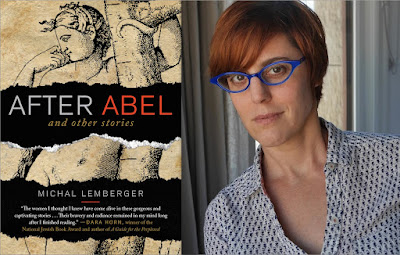
In the fourth in a series of posts on 2015 books entered for The Story Prize, Michal Lemberger, author of After Abel (Prospect Park Books) discusses how she came to write short fiction—and what she's learned.
Dear writer,
You asked what it takes to write? I’m no Rilke. In fact, it wasn’t long ago that I’d be the one asking that question. That’s because I never thought of myself as a fiction writer. I was, however, a devourer of fiction from a very early age, the kind of kid who hid books in the small space between my bed and the wall so I could read after bedtime and first thing upon waking. I appreciated fiction. I studied it for years. I admired those who could write it. I especially admired those who could write short stories. I just never imagined that all that reading would one day lead me to write short fiction, too.
I was a writer, though. Primarily a poet, but then I went to grad school and wrote academically. After that, there was a stint as a book reviewer, then a long fallow period, and then I sat back down—I’d like to say pen in hand, which is a lovely if outdated image—at my computer and began writing poetry, essays, and some reported pieces again. It never occurred to me to try my hand at fiction.
As it turns out, all that reading and writing—and teaching, which I didn’t mention above, but which was an important component, too—was leading to an outpouring of short stories. Which is to say: experience matters.
We sometimes fall into the trap of thinking that only certain things count as experience: travel, love affairs, poverty, addiction, kinky sex. For writers, reading counts as experience. We learn how to write by reading. And thinking counts as experience. I think about books a lot, about how authors construct their characters, how they keep the action moving, word choices, and paragraph breaks, plot points, images, and themes.
The phrase “write what you know” gets bandied about, but it needs to be banished, to be kicked in the ass so that it flies through a window with a cartoon whoosh. Lived experience will make its way into your writing. You may end up writing about travel, love affairs, poverty (or affluence), addiction (or recovery), kinky (or boring) sex, and so much more that you draw from your life. I began writing fiction after I had children. Being a parent informs every sentence I write. But the stories in my book are set in the ancient world, which was much more brutal, but also smaller, than the one we inhabit. I’ve never lived in a caravan of nomads, herded sheep, or even seen the Nile, except in photographs. It was reading, specifically a years-long, deep immersion in ancient texts and other people’s writing about the ancient world that allowed me to imagine myself into its landscapes and rhythms.
Which brings me to the next important aspect of writing fiction: empathy. Empathy so complete, so radical, it hurts. It is empathy that lies at the heart of the writer’s imagination, and it is, I think, the trait that writers share, because we have to enter into our characters’ minds. We have to become their brain stems, sending out the signals that will move them through the arc of the story. Those of us inclined to write are born with the capacity for that level of identification, but if it’s not nurtured it will disappear, like a predisposition to gymnastics or piano. There, too, reading is a crucial tool. All of human life can be found in literature, which means you can find in it every passing squall of temper, or that surge of love that seems to take over all your nerve-endings, or the moment confusion tips over into embarrassment. The empathy you naturally feel will grow stronger the more you read.
The people we encounter as we go about our day are closed to us. We can’t enter their minds. Even though I am writing this to you, I remain a mystery to you, as you are to me, because we give each other just slivers of ourselves, that 10% of the iceberg that juts out into the air. It’s in stories that we learn how to shimmy into another person’s consciousness, how to wrap ourselves in it. Only once we’ve learned to do that can we write something worth reading. Here, then, is the key lesson: what your characters do will advance your narrative. What they feel will be your story.
Yours,
M.L.
Dear writer,
You asked what it takes to write? I’m no Rilke. In fact, it wasn’t long ago that I’d be the one asking that question. That’s because I never thought of myself as a fiction writer. I was, however, a devourer of fiction from a very early age, the kind of kid who hid books in the small space between my bed and the wall so I could read after bedtime and first thing upon waking. I appreciated fiction. I studied it for years. I admired those who could write it. I especially admired those who could write short stories. I just never imagined that all that reading would one day lead me to write short fiction, too.
I was a writer, though. Primarily a poet, but then I went to grad school and wrote academically. After that, there was a stint as a book reviewer, then a long fallow period, and then I sat back down—I’d like to say pen in hand, which is a lovely if outdated image—at my computer and began writing poetry, essays, and some reported pieces again. It never occurred to me to try my hand at fiction.
As it turns out, all that reading and writing—and teaching, which I didn’t mention above, but which was an important component, too—was leading to an outpouring of short stories. Which is to say: experience matters.
We sometimes fall into the trap of thinking that only certain things count as experience: travel, love affairs, poverty, addiction, kinky sex. For writers, reading counts as experience. We learn how to write by reading. And thinking counts as experience. I think about books a lot, about how authors construct their characters, how they keep the action moving, word choices, and paragraph breaks, plot points, images, and themes.
 |
| Nomads: Been there? Done that? Not exactly... |
Which brings me to the next important aspect of writing fiction: empathy. Empathy so complete, so radical, it hurts. It is empathy that lies at the heart of the writer’s imagination, and it is, I think, the trait that writers share, because we have to enter into our characters’ minds. We have to become their brain stems, sending out the signals that will move them through the arc of the story. Those of us inclined to write are born with the capacity for that level of identification, but if it’s not nurtured it will disappear, like a predisposition to gymnastics or piano. There, too, reading is a crucial tool. All of human life can be found in literature, which means you can find in it every passing squall of temper, or that surge of love that seems to take over all your nerve-endings, or the moment confusion tips over into embarrassment. The empathy you naturally feel will grow stronger the more you read.
The people we encounter as we go about our day are closed to us. We can’t enter their minds. Even though I am writing this to you, I remain a mystery to you, as you are to me, because we give each other just slivers of ourselves, that 10% of the iceberg that juts out into the air. It’s in stories that we learn how to shimmy into another person’s consciousness, how to wrap ourselves in it. Only once we’ve learned to do that can we write something worth reading. Here, then, is the key lesson: what your characters do will advance your narrative. What they feel will be your story.
Yours,
M.L.


