Showing posts with label The New School. Show all posts
Showing posts with label The New School. Show all posts
Friday, March 8, 2019
Tuesday, February 26, 2019
Award Week!
The week of March 4 is going to be a busy one for The Story Prize. (Well, at least Monday-Wednesday will be busy.)
 The Story Prize event at The New School begins at 7:30 p.m. Finalists Jamel Brinkley, Deborah Eisenberg, and Jamel Brinkley will read from and discuss their nominated books. At the end of the evening, we'll announce the 15th winner of The Story Prize, who will receive $25,000 and an engraved silver bowl. But no one goes home empty-handed. Each of the other two finalists will receive $5,000. (And we guarantee that Green Book will not win.)
General admission tickets are $14. You can buy them in advance online or the evening of the event at The New School (66 W. 12 St.).
Monday, March 4
I will be a guest on WNYC 93.5 FM's "All of It," hosted by Alison Stewart, to discuss The Story Prize: 15 Years of Great Short Fiction, published by Catapult. If you don't live in the New York area, you can listen on WNYC's website, which streams live.Tuesday, March 5
This is the official publication date of The Story Prize anthology from Catapult. The book collects a short story from each of the 14 past winners of The Story Prize, set up by excerpts from the onstage interviews with each writer or their TSP blog posts or judges' citations.Wednesday, March 6
 The Story Prize event at The New School begins at 7:30 p.m. Finalists Jamel Brinkley, Deborah Eisenberg, and Jamel Brinkley will read from and discuss their nominated books. At the end of the evening, we'll announce the 15th winner of The Story Prize, who will receive $25,000 and an engraved silver bowl. But no one goes home empty-handed. Each of the other two finalists will receive $5,000. (And we guarantee that Green Book will not win.)
General admission tickets are $14. You can buy them in advance online or the evening of the event at The New School (66 W. 12 St.).


Tuesday, February 5, 2019
The Story Prize Event on March 6 at The New School: Get with the Program
Come to The Story Prize event on March 6 at The New School, and you'll not only get to see and hear writers Jamel Brinkley, Deborah Eisenberg, and Lauren Groff read from and discuss their work on stage but you'll also get to take home an eight-page, full-color program (cover below) designed by artist Calli Ryan.
At the event, you'll have the opportunity to buy from bookseller McNally Jackson signed copies of each author's short story collection, as well as copies of The Story Prize 15th anniversary anthology.
General admission tickets, which cost $14, are available online or at The New School Box office the evening of the event.

At the event, you'll have the opportunity to buy from bookseller McNally Jackson signed copies of each author's short story collection, as well as copies of The Story Prize 15th anniversary anthology.
General admission tickets, which cost $14, are available online or at The New School Box office the evening of the event.

Saturday, March 7, 2015
Video: The Story Prize Event on March 4 at The New School with Francesca Marciano, Elizabeth McCracken, and Lorrie Moore
In case you missed The Story Prize event on March 4 at The New School, here's the video. That night, the three finalists—Francesca Marciano, Elizabeth McCracken, and Lorrie Moore—read from and discussed their work on-stage. And at the culmination of the event, we announced the winner for books published in 2014: Elizabeth McCracken's Thunderstruck.
Wednesday, February 25, 2015
Please Join Us for The Story Prize Event on March 4 at The New School
Between the time we announce The Story Prize finalists in early January and the event at which we honor all three of them and present one with the $20,000 top prize, we spend a lot of time worrying about filling the seats in The New School auditorium. We always end up doing pretty well on that count (and probably would without worryng about it as much as we do), but we're still eager to have a substantial audience to support the three authors, The Story Prize, and the form we exist to promote—short fiction.
The authors always prove to be interesting and amusing, but it's also no secret that writers aren't necessarily the most outgoing bunch. We all know that their real performances take place when they are alone and writing, and that what matters most happens on the page and through the deeply personal experience of reading their work. So whether you plan to join us or not, we can't recommend too highly the three books we're honoring: The Other Language by Francesca Marciano, Thunderstruck by Elizabeth McCracken, and Bark by Lorrie Moore.
 You can watch the event later on YouTube or FORA.tv, and we post a lot of pictures in the days that follow, but it is, of course, impossible to reproduce the live atmosphere in the auditorium. Nothing can take the place of the authors' presence, the burst of laughter or buzz that comes from the room when one of them reads or says something funny or profound, or the feeling of suspense before we announce the winner, the electric moment when founder Julie Lindsey speaks that name, and the moving experience of seeing someone accept the prize—most often a hard-working, supremely talented, and deserving author who hasn't received a comparable honor before. (For instance, last year was the first time George Saunders had ever won a book award.)
Tickets are $14 (close to the same as a movie ticket). The event is a week from today, on March 4 at 7:30 p.m., at The New School auditorium at 66 W. 12th St. Please join us if you can.
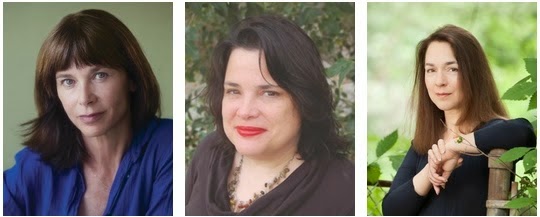 |
| (L to R: Francesca Marciano, Elizabeth McCracken, and Lorrie Moore) |
Tickets are $14 (close to the same as a movie ticket). The event is a week from today, on March 4 at 7:30 p.m., at The New School auditorium at 66 W. 12th St. Please join us if you can.
Tuesday, March 4, 2014
The Story Prize and McNally Jackson: It's All About the Books
The Story Prize event is tomorrow night (March 5) at 7:30 p.m. at The New School's auditorium at 66 West 12th Street. The three finalists, Andrea Barrett (Archangel), Rebecca Lee (Bobcat), and George Saunders (Tenth of December) will read from and discuss their work on-stage. At the end, we'll announce the winner. We hope you can join us.
The evening aims, most of all, to be a celebration of these three authors, their incredible books, and, more broadly, short story collections. We're pleased to have one of the top independent booksellers around, McNally Jackson, selling signed copies at the event. And McNally Jackson is making it especially easy for anyone there—and those who can't be—to get copies.
 |
| The McNally Jackson book table at last year's event (L to R, Brett Duquette, and booksellers Anna Chen and Javier Molea) photo © Beowulf Sheehan |
- Let's say you're at the event and want to buy signed copies of the books, but you don't want to lug them around all night (or are prone to accidentally leaving things behind, like some of us are). No problem: McNally Jackson will provide free shipping for anyone who buys three or more books. You walk out empty handed (or no more burdened than you were when you arrived), and the books show up later at your house.
- Let's say a book is sold out, and you want a copy. McNally Jackson will follow up by shipping it after the event.
- Let's say you can't make the event and still would like signed copies of Archangel, Bobcat, or Tenth of December. For one month after the event, McNally Jackson will ship signed copies of the three finalists' books for free (while supplies last) when ordered from their Web site. All you need to do to get free shipping is to type into the comment box at checkout: Free Shipping-The Story Prize.
We're very pleased that McNally Jackson is the official bookseller of The Story Prize. And last year, bookseller-in-chief Sarah McNally served as one of our judges. Our ultimate aim is to get more short story collections into readers' hands, particularly those of our finalists. Hats off to our bookseller for making it easier to buy these books—and, we hope, a little harder not to.
Tuesday, June 14, 2011
Whatever Happened to Eudora Welty?

Recently, I posted a status update on my Facebook wall and asked if anybody near New York would be interested in tagging along to a June 10, 2011 panel at The New School, moderated by Granta assistant editor Patrick Ryan. The event, entitled “Truly Yours,” offered perspectives on Eudora Welty from writers she has influenced. An acquaintance from high school responded to my status: “Does anybody know to whom you are referencing?” In short: I was flummoxed.(1) Who doesn’t know of Eudora Welty?
Apparently, far too many readers. Ryan opened the panel by saying that he recently had similar experiences, one with an intelligent college English major and another with a voracious, older, lifelong reader.
“Truly Yours” wasn’t exactly a Eudora Welty/new readers matchmaking session; the panel spoke to Welty lovers, not folks like my high school chum. But the panel’s participants—critic Maud Newton and novelist Sheri Holman—joined Ryan in explicating Welty’s unique importance to American fiction. Dramatic readings of some Welty excerpts, performed by actress Rhonda Keyser, punctuated their discussion.
“More than any writer I can think of,” Newton said, “Welty captures how people speak and the humor of situations.” Holman agreed, saying that “her dialogue is some of the funniest and truest you’ll ever read.” According to the panel, Welty’s interest in the inner, private life places her alongside Virginia Woolf and William Faulkner. Holman said that Welty’s concern for characters’ interior lives—their private dreams and desires—moves us “in and out of minds in so many ways.”
We need Welty, the panel argued, because she’s a regional writer whose pitch perfect sense of the human voice eclipses the limits of place. Her control of dialects and everyday language illustrates something essential about our behaviors. Ryan shared Welty’s description of Anton Chekhov’s plays, which describes Welty’s thoughts on conversations:
You know, in Uncle Vanya and The Cherry Orchard, how people are always gathered together and talking and talking, no one’s really listening. Yet there’s a great love and understanding that prevails through it, and a knowledge and acceptance of each other’s idiosyncrasies, a tolerance of them, and also an acute enjoyment of the dramatic.(2)
People talking and talking yet never really listening to each other—this is why today’s readers need Welty’s fiction. Smart phones seem to be surgically attached to people’s ears, and the lot of social media—MySpace, Facebook, Twitter—generate channels of emptiness, great voids into which we can shout while choosing to ignore the calls of others, the echoes of our own voices.(3)
Talking-across-purposes muddles relationships in “Why I Live at the P.O.,” even as the reader witnesses how the characters keep missing each other.(4) Voice works, here, in two key ways. First, we hear the snark-fueled appraisal of family life from the first-person narrator—the postmistress. Her Southern dialect rings honest, never farcical.(5) So, we want to trust her—even as we don’t know the others’ take on Stella-Rondo’s failed relationship with Mr. Whitaker. Second, the narrator is posturing herself against the rest of the family as her recently returned sister turns the entire clan against her. Really: the narrator and her family put the “fun” in “dysfunction.”
As Holman pointed out to the audience, “Everybody’s about power and position, and who has what on whom.” The whispered insults and misconceptions in “Why I Live at the P.O.” are simply how the narrator and Stella-Rondo keep lunging in front of each other. Yet, we need to be aware of these plays, especially in a twenty-first century where everything orbits around poignancy in 140 characters or less: “Powerlessness,” as Holman elaborated, “attunes you to what others are saying.” Welty’s characters, in their little power parades, perform the gamut of emotions and beliefs.
Not realizing this results in disaster. Nowhere in Welty’s short fiction is this truer than “Where Is the Voice Coming From?”—Welty’s only overtly political story.(6) Here, Welty inhabits the voice of a white man who assassinated an NAACP leader, a narrative arc lifted from the 1963 hate killing of Medgar Evers by Byron de la Beckwith. Welty slides deftly into this perspective, at once uncovering the terror of this racist crime while showing us how such a person justify that act. The story’s power stems from precisely this: Welty knows where that voice is coming from—a well of racism and hatred. And she’s brave enough to confront that attitude, in a way few short story writers can.
Where should new readers meet Welty? Newton directed the audience toward Welty’s Pulitzer Prize-winning novel The Optimist’s Daughter (1972), while Holman guided readers toward Welty’s second short story collection—The Wide Net (1943). Holman promoted The Wide Net because of Welty’s flexibility; the collection was written during the World War II years, and Holman asserted that few other books handle the consequences of shifting realities as powerfully as The Wide Net. Regardless, Welty offers today’s readers a guide to how we should communicate—so readers should unplug for a moment and hear what her stories relate.
(1) I somehow found it within myself to not deride his highfalutin diction.
(2) The complete interview is available online at The Paris Review Web site.
(3) My iPod, Kindle, Macbook, and Wii betray this much: I’m no enemy to our technological overlords. It’s just far too easy to get sucked into the virtual world they offer.
(4) The proof, the cliché goes, is in the pudding, and this story backs up Holman’s assertion on Welty: “Why I Live at the P.O.” goes down sweet, and when I read this story I can hear the syrupy dialect.
(5) Listen to Welty reading from “Why I Live at the P.O.”
(6) This story was first published in The New Yorker on July 6, 1963. An online subscription is required to read this digital version.
Thursday, February 11, 2010
Some True Stories About The Story Prize
 (L to R) Actresses Sonia Manzano, Jane Curtain, and Kate Burton
backstage at The Story Prize's inaugural event, Jan. 26, 2005
On March 3, The Story Prize will announce its sixth winner at the New School in New York City after finalists Daniyal Muenuddin, Victoria Patterson, and Wells Tower read from and discuss their work on-stage. In the meantime, here are some little known facts about the early days of the prize:
We almost called it The January Prize.
Julie Lindsey and I started to discuss creating a book award in April 2003, and one thing we had to figure out was what to call it. My plan was to announce our winner in January, because there were no other major book awards that month. So I suggested calling the award The January Prize. I thought the name had a nice ring to it. Fortunately, we settled on a more descriptive name. As it turned out, after the first two years we moved The Story Prize event to February, then last year pushed back into March. This has given us more time to read the books and to promote the prize. If we'd gone with The January Prize, we wouldn't have had that option.Our first event was slated to be at the 92nd Street Y with Sherman Alexie hosting.
When we announced The Story Prize in Jan. 2004, the press release said that the award ceremony was going to be at the 92nd Street Y with Sherman Alexie hosting. Instead, we ended up having it at Symphony Space, as part of the Selected Shorts program. Kathy Minton, the Directory of Literary Programs at Symphony Space, had gotten in touch with me after she received our press release. So Julie and I met with her and Artistic Director Isaiah Sheffer, and we agreed to have our award night as part of the Selected Shorts program. The big advantage for us was that it was a high-profile platform for the launch of The Story Prize, plus Symphony Space would handle all of the logistics. Sherman, who was doing us a favor by agreeing to host, didn't mind the change in plans.
Actors performed the finalists' stories, as part of Selected Shorts, at our inaugural event.
On Jan. 26, 2005, we had our first award event at Symphony Space as part of the Selected Shorts series. Jane Curtain performed "My Shape" by Joan Silber, Kate Burton read "Circus People" by Cathy Day, and Sonia Manzano (Maria on Sesame Street) read "The Book of Miracles" by Edwidge Danticat. (If you tune in to Selected Shorts on NPR, you might still hear these stories now and again.) At the end of the evening, Julie announced the winner, and Edwidge Danticat, pregnant with her first child, came up to the stage to accept The Story Prize.
We revamped our program to put the emphasis on the authors.
Although Selected Shorts was a prestigious partner for us, we decided to have our event elsewhere for several reasons. The main one was that we felt that the authors should be a bigger part of the event. The audience had caught only a fleeting glimpse of finalists Joan Silber and Cathy Day, who came up on stage and gave a wave to the audience after the performances of their stories. We wanted an event that featured the authors, not actors reading their work. We settled on our present format—author readings paired with on-stage interviews—and spent a few months checking out venues throughout Manhattan before someone steered us toward The New School. Robert Polito, Director of the Writing Program, graciously offered to host the event. This year's program, on March 3, will be our fifth at The New School's Tishman Auditorium, with the same format we've been using since 2006.
Subscribe to:
Posts (Atom)