Showing posts with label The Center for Fiction. Show all posts

Friday, June 1, 2012

Impaneled


(L to R) Story Prize Director Larry Dark (yours truly) with authors
Susan Minot, Rick Moody, and Elizabeth Strout (via Dusty Spines)
The three authors who participated in last night's tribute to The Stories of John Cheever at the Center for Fiction, turned out to have strong, sincere connections to Cheever's work. Elizabeth Strout read "The Worm in the Apple" and told how important the stories were to her development as writer. Rick Moody read from "The Jewels of the Cabots" and discussed how the late stories in the book convinced him that indirection could be an effective narrative technique for him. And Susan Minot brandished a faded, hardcover copy of the book with her ratings of various stories in the table of contents, ranging as high as seven stars. She noted that the story she was going to read from, "The Sorrows of Gin," only rated three stars back then, but her estimation of it had grown. I, too, brought my first copy of the booka 1978 mass market paperback with off kilter pages. And Rick Moody had his original copy, as well. He read the very Cheeverian inscription his father had written to him, suggesting that Rick, a mere teen at the time, might never be as good a writer as Cheeverkind of like saying he might not measure up to Chekhov.

The Center for Fiction did a great job with the event, which ended with a panel discussion and questions from the audience. I say we do it again in 25 years.


Monday, May 28, 2012

Happy 100th Birthday, Mr. Cheever

Yesterday—May 27—would have been John Cheever's 100th birthday, and I like to think that I have the day off form work for that reason. In fact, maybe Memorial Day should be an annual occasion to remember writers whose work is, well, memorable. After all, May is Short Story Month.

I would be remiss if I didn't also reiterate that this Thursday night, May 31, at the Center for Fiction, The Story Prize will be co-presenting a tribute to The Stories of John Cheever. Susan Minot will read from and discuss JC's "The Sorrows of Gin." Rick Moody will focus on "The Jewels of the Cabots." And Elizabeth Strout will read from "The Worm in the Apple." If you're going to be there (and I hope you are), I would highly recommend reading/re-reading these three stories.

The 92nd Street Y offered it's centennial tribute to John Cheever, with a focus on the man himself. With the exception of Michael Chabon's spirited reading of "The Enormous Radio," the program was almost entirely dedicated to the writer and not his work. Biographer Blake Bailey read excerpts that focused on Cheever grappling with his fame. Susan Cheever read from her father's diaries, admiring the gorgeous prose that permeated even work that wasn't written for publication. And Allan Gurganus, Cheever's former student and more, read the last few sentences of "Goodbye, My Brother," and spoke at length about personal encounters with his mentor.

I'm glad the 92nd Street Y did this. Now we can focus on the reason we even remember this man 100 years after his birth—his fiction and, in particular, his stories. Call me romantic, but I would be taking note of this occasion even if I'd never seen the photos of John Cheever's handsome, craggy face or heard recordings of his exaggerated patrician accent, or learned about his troubled family relationships and his personal demons. For most of us, the stories transcend the life.

Friday, May 11, 2012

Short Story Month: Minot, Moody, and Strout Read Cheever at The Center for Fiction on May 31

May is National Short Story Month, and this year (for once) The Story Prize has something planned. Thanks to New York's Center for Fiction, we're going to be co-presenting a reading to celebrate The Stories of John Cheever, a collection you'll find on the shelves of many passionate readers and writers of short fiction.

Why a Cheever reading now? Because he will have been 100 on May 27. John Cheever, the man, has gotten a lot of attention in recent years, with the release of his diaries and a highly-regarded biography by Blake Bailey. In fact, the 92nd Street Y is having an event on May 17 with Bailey, Michael Chabon, and writers and offspring Ben and Susan Cheever. So when The Center for Fiction's Executive Director, Noreen Tomassi, and I discussed having an event there, we decided to put the focus on what is probably Cheever's greatest legacy—his short stories.
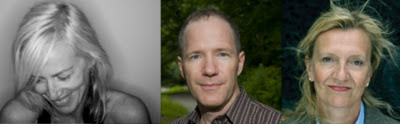
(L to R) Susan Minot, Rick Moody, and Elizabeth Strout
On May 31, at 7 p.m., at The Center for Fiction, authors Susan Minot, Rick Moody, and Elizabeth Strout will each read from and discuss a Cheever story. Minot's choice is "The Sorrows of Gin," Moody will read from "The Jewels of the Cabots," and Strout will focus on "The Worm in the Apple"—all interesting selections from among an oeuvre that includes "Goodbye, My Brother," "The Enormous Radio," "The Five-Forty-Eight," "Reunion," and "The Swimmer."

Susan Minot, Rick Moody, and Elizabeth Strout each have New England roots—as did Cheever. And the work of all three has affinities with his. I'm expecting a memorable and fitting tribute to a great writer with a continuing and widespread influence on other writers—a nice way, we hope, to close out a month celebrating the story form.

Friday, June 24, 2011

Tiphanie Yanique and Elizabeth Nunez at The Center for Fiction

By Phedra Deonarine

Tiphanie Yanique at The Center for Fiction, June 15, 2011
I recently went to The Center for Fiction’s conversation between Elizabeth Nunez and Tiphanie Yanique. The Center for Fiction is located on East 47th Street and has a wonderful bookstore full of new and used books. The discussion was held in a cozy room, which afforded a more intimate atmosphere between the audience and the two writers.

Yanique started the evening off by acknowledging the work that The Center for Fiction does for writers as “the only non-profit in the U.S. dedicated to celebrating fiction.” She read from the title story in her collection How to Escape from a Leper Colony. She then sat down to speak with Nunez, award-winning author of seven novels and fellow Caribbean writer.

Yanique’s first book spans the Caribbean, but Nunez pointed out a shared connection between the two writers: Both wrote about the Leper Colony located on the island of Chacachacare off the coast of Trinidad. It was interesting to hear these two writers speak of Chacachacare because even though I lived in Trinidad for eighteen years, I’ve never actually been to the island. Listening to Yanique describe the file cabinets located on that island made me think that perhaps I should visit one day.

Nunez requested that Yanique read a story that involved the beating of a young child. Both writers then discussed child abuse in the Caribbean and the role of the author in dealing with this charged issue. Nunez was also interested in Yanique’s choice of including a Caribbean jail cell in her story because the jails in the Caribbean are located near the sea and have the special torment of offering spectacular seaside views to the inmates.

Prompted by an audience member, Nunez discussed the seduction of writing in first person and the distance that writing in third person allows. Fielding a question from the audience, Yanique spoke on the burden placed on Caribbean writers to explain perceived strangeness in their stories. She used “calalloo” as an example and stated that if a reader was genuinely curious about calalloo they would research it. She went on to say that explaining such a dish would harm the authenticity of her characters who would never describe something so well known to them. This was a highly gratifying answer for me because I’m often confronted with the burden of explaining minor details in my own creative work.

Both writers also responded to audience questions on the benefits of MFA programs and the business of writing. The evening concluded, and I was able to ask Elizabeth Nunez to sign my copy of Grace, newly purchased from the Center for Fiction’s bookstore located on the ground floor.