Showing posts with label Becky Hagenston. Show all posts

Thursday, August 11, 2016

Becky Hagenston Wonders: What If?

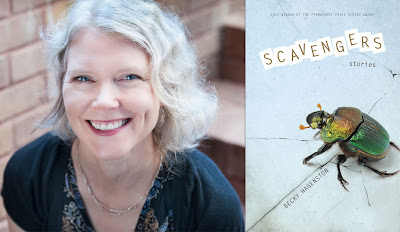
In the ninth in a series of posts on 2016 books entered for The Story Prize, Becky Hagenston, author of Scavengers (Univ. of Alaska Press), discusses where stories begin for her and how she knows when a story isn't working.

Where does a story begin for you? 
More and more, my stories begin with an annoyance in my daily life followed by this general thought: Wow, it would be really weird if this other thing happened. The title story of Scavengers came about because a stranger came to my door on a scavenger hunt, which I found both annoying and presumptuous—as if I’d give some stranger a pair of red socks, or whatever it was she wanted. I didn’t have what she was looking for, but then I thought: What if she’d asked for something really specific, that only I would have? Like the diary with a gnome on it that I kept when I was fourteen and still have somewhere in a box in the closet?

A more recent story started when the electricity went off for a few hours during a storm and I was really annoyed that I couldn’t watch my nightly Netflix. And then I thought: Well, what if the Internet never came back? And what if there’s an Internet troll out there who will not know what the hell to do with his life now? It’s a fun way to start a story, because I entertain myself trying to figure out what would happen.

What do you do when you get stuck?

The best way for me to get un-stuck is to read and read and read some more. I recently read Kelly Link’s Get in Trouble and it’s such a wild book that it made my brain feel fizzy. And I love to re-read Grimm’s Fairy Tales, which are so twisted and disturbing and have lately inspired me to write some very weird stories involving toads and chopped-off fingers.

How do you know when a story you’re in the process of writing is or isn’t working?
I can tell it’s not working if I already know what’s going to happen. If I’m three pages in and I think: Oh, right, this is where it’s going, then I lose interest. I also read out loud to myself a lot, and that’s a way to tell if there’s any energy there. If my mind starts to wander as I’m reading my own story out loud to myself, then I know it’s definitely not working.

Also, there’s something about that moment just after I hit Submit on Submittable that makes me suddenly very clear-headed about what I still needed to fix!

Describe an unfinished story that you want to go back to but haven’t quite figured out yet.
I have many, many of those. I have a first sentence that I’ve kept around for years: "Two years after the town was renamed in his honor, Roy decided to move away." I really want to know what’s up with Roy, but so far I haven’t gotten any further.

Wednesday, December 26, 2012

Valerie Fioravanti Embraces Hard Work

In the 63rd in a series of posts on 2012 short story collections entered for The Story Prize, Valerie Fioravanti, author of Garbage Night at the Opera (BkMk Press), relates a valuable lesson.


What’s the longest time it has taken you to write a story?
I began a couple of the stories included in Garbage Night at the Opera before I entered my MFA program in 2001, although the final versions are wildly different than those early drafts. Right now, I’m finishing up a second story collection, and I’ve been joking that once I’m finished, I promise to be faithful to my current novel project, Bel Casino, which continues the story of Franca and Lina from Garbage Night at the Opera as they reunite in Italy.

Chances are, I’ll cheat. I’ll want the more immediate gratification short fiction provides, or an essay topic I’ve been contemplating for years will finally coalesce. My writing process doesn’t appear to be naturally quick or monogamous. I need simmer time, and the most productive way through this seems to be to work on multiple projects concurrently. This makes it difficult to talk about how long I worked on something. It could be (if fortune shines upon me) that my second and third books follow quickly, giving the appearance that I am prolific, when the truth is that my book-length projects have been chugging quietly along for years.

When I arrived in Las Cruces (New Mexico) for grad school, one of the first people I met was the writer Becky Hagenston, who had recently published her story collection A Gram of Mars. We were the same age, and our upcoming birthdays so close that she graciously shared her party with me. As we celebrated together, I couldn’t help but compare our writing lives: Her work had found a home, and mine seemed stalled in the land of promise. Becky gave a reading a few weeks later, and afterward a man came up to her and asked, “So, how long did it take to write that story—a month?”

Becky’s chin lifted as she declared, “I worked on that story for five years.”

That man snorted and walked away, but Becky became my hero that night. In her place, asked that question, I would have lied. At the time, I thought a story was something you tinkered with for a few months and then abandoned if you couldn’t get it right. Talent meant the work came easy, right? As I watched my new friend read, my own desires intruded upon my happiness for her. I couldn’t quiet my envy, which fixated upon Why isn’t that me?

Well, had I ever worked on a story for that long? Question asked and answered. It was time to shut up and get to work. Five years was a generous timeframe that allowed me to take my work more seriously without the pressure I was putting on my work to be immediately and exceptionally well done, and Becky’s unflinching declaration helped me reset the image I had of talent as something that bypassed, rather than embraced, hard work. Even though it occurred outside the classroom, it was the most valuable lesson from my MFA experience.

What writer or writers have you learned the most from?
Well, clearly I learned a lot from knowing Becky Hagenston as a person, but I admire “Midnight, Licorice, Shadow” from her second collection, Strange Weather. I’m interested in her sideways storytelling, how two characters naming a cat reveals so much about other aspects of their lives.

When I was working on my story “Earning Money All Her Own,” I returned to Tim O’Brien’s “The Things They Carried” because my story had a refrain of factory closings in the neighborhood, and I wanted those closings, which put more and more people out of work, to build power via repetition.

Richard Bausch’s “What Feels Like the World” is another story I read compulsively while writing the title story of my collection. The fate of the grandfather/granddaughter relationship at the core of the Bausch story had my heart in a vise the first time I read it, and I wanted that same quality for the father and daughter in “Garbage Night at the Opera.”

Monday, August 9, 2010

Becky Hagenston on Serial Killers, Naming Cats, and Half Magic

In the 27th in a series of posts on 2010 short story collections entered for The Story Prize, Becky Hagenston, author of Strange Weather (Press 53), answers a few questions about her work.


Describe one of the stories in your collection.
In “Midnight, Licorice, Shadow,” a couple of serial killers adopt a cat (he belonged to one of their victims) and then can’t decide what to name it. The protagonist has no qualms about killing people (or letting her creepy boyfriend kill them), but she feels very protective of this abandoned cat, and it’s very, very important to her that they come up with a name that suits him, so they can keep him.

This story, like many of my stories, is a combination of two ideas that didn’t work on their own. The first idea came about when my husband and I adopted a black cat and spent days trying to figure out what to call him: Should we name him after a person? A drink? A candy? But that would make a terribly boring story. The other idea was about serial killers—something I’d never tried before because it seemed like it would be too easy to lapse into clichés and gun battles and police chases. But when I put these ideas together—serial killers adopt a cat—it somehow worked. I also discovered that the fate of the cat and of the protagonist are tied together in ways she doesn’t fully understand until the end of the story.

Have you ever written a short story in one sitting and not revised it later?
Many years ago, I stayed up all night, buzzed on caffeine and inspiration, just scribbling away (not even using a computer), got a few hours of sleep, woke up and re-read what I’d written. And it was complete and total crap. It wasn’t even salvageable for parts.

I need to work in stages--slow but steady. I’m usually working on three or four things at once, all at different stages of completion. When I get stuck on revising, I’ll go back to something I’m still figuring out. When I get stuck on that, I’ll move on to copy-editing something that’s almost finished. The fastest I’ve ever written a successful story is probably two weeks. And I once started a story in 1994 and about 50 drafts later, in 2009, it was finally publishable. But I also know when it’s okay to give up on a story and move on to something else!

At what stage do you start seeking feedback on your work, and from whom?
I’m usually ready to give a story to my husband and my trusted-reader-friends after about four drafts. If I tell someone about a story before I’ve written it, I probably won’t write it. If I give someone a first draft of a story, I probably won’t finish it. If I’m feeling totally unsure of what I’m doing, and my trusted-reader-friend says, “I think this should happen instead,” I may just give up. I have to be completely stuck/almost happy with a story before I can give it to someone. I have to be certain of what I hope is happening—and then I need others to tell me if it actually is.

What book made you want to become a writer?
When I was about eight or nine, my mother gave me her old copy of Half Magic, by Edward Eager, about four siblings who find a magic coin that grants only half of a wish. It takes the children a while to figure this out, and some ridiculous, hilarious things happen while they do: They wish their cat could talk, and it talks nonstop for thirty seconds, then falls silent for thirty seconds, then talks nonstop for thirty seconds, etc. They hit upon the brilliant plan of wishing the cat would say Music, hoping it will only say Mew—but the cat starts screaming, “Sick sick sick!” That book just utterly delighted me—and I wanted to create that delight for myself. So my first stories were about children who discover magic things and try to figure out the rules. I read all of Edward Eager’s books over the course of a summer, then E. Nesbit’s—so maybe more important than making me want to write, Half Magic is the book that made me obsessed with reading. I re-read it every few years, and I still love it.