Showing posts with label Tobias Wolff. Show all posts

Monday, February 14, 2011

Aint Nothing Like the Real Thing, Baby*

We get most of our information electronically, from our computers and handheld devices, from the digital signals our TVs pick up, and other sources. Many of us also socialize on the Web, via Facebook or Twitter or the like. And more and more people are reading on digital devices. (I confess: I am sometimes one of them.)

If you want to know more about the three finalists for The Story Prize, Google them. You'll find video, audio, interviews, excerpts, reviews. You can learn a lot about Anthony Doerr, Yiyun Li, and Suzanne Rivecca and their books via the Internet.

Or you can come and see them live. The Story Prize event on March 2, provides an opportunity that you can't experience electronically. Sure, there will be a Webcast you can watch ten days or so later. But seeing someone in three dimensions and sensing his or her presence, is a very different experience. Ask anyone who was there two years ago to hear Tobias Wolff read "Bullet in the Brain" in its entirety, and they will tell you that a Webcast is a poor substitute. There's also a certain energy in a room where hundreds of people gather to listen.

So if you love short stories, live in or close to New York City, and are available the night of The Story Prize event, I urge you to try to make it to the New School's Tishman auditorium (tickets are $14). You'll see and hear the authors read excerpts from their books and discuss their work on-stage. I try to make that discussion a conversation that the audience is overhearing. I don't write questions ahead of time, and the authors generally depart from their talking points and say things they haven't said before that reveal how they work and how they view the world. If you're there, you'll also feel the tension and energy in the room when Julie Lindsey, the founder of The Story Prize announces the winner.

Despite the suspense of that moment, I would add that the event is not just about the winning book for us. We aim to shine the spotlight equally on each author and to celebrate everyone's work—all three finalists, of course, but  also the authors on the long list, every author who wrote a short story collection in 2010, and everyone reading and writing short stories and keeping the form alive and kicking in the digital age.

* With apologies to Betsy Lerner for appropriating her blog headline style. (Betsy, consider it an homage.)

Friday, May 15, 2009

The Web Cast of The Story Prize Event: Jhumpa Lahiri, Joe Meno, and Tobias Wolff


For those who missed it (and those who want to see it again and again and again), the Web cast of The Story Prize event is up on FORA.tv. In case you've forgotten, Jhumpa Lahiri, Joe Meno, and Tobias Wolff (spoiler alert!)—the winner—read from their work and discussed it onstage. And by the way, that's novelist Helen Schulman introducing the event. She's head of the fiction writing department at the New School.

The evening is always a blur to me, so I'm glad that I can watch it later and critique my own performance. I don't prepare questions ahead of time, so I'm never quite sure what I've said.

Some things I didn't remember from my conversations with the three finalists:
  • Jhumpa Lahiri talking about how her children keep her grounded as a writer.
  • Joe Meno comparing his approach to writing to visual artists' approach to their work.
  • Tobias Wolff revealing that a real-life bank robbery a friend had witnessed inspired him to write "Bullet in the Brain."
I'm also struck by how much each writer has to say about their thought processes.

Friday, April 10, 2009

Another Short Story Prize for Amy Hempel (and One for Alistair MacLeod)

The winners of this year's PEN/Malamud Award are Amy Hempel and Canadian author Alistair MacLeod, whose work I confess I've never read (and whose name is misspelled on the PEN/Faulkner Web site). PEN/Malamud is an annual award "to honor excellence in the art of the short story" and not for a particular book. The Web site is not very specific about how winners are chosen or the rationale behind the pairing, nor does it specify what the prize amount is. All it says is: "A panel of PEN/Faulkner directors, together with representatives of Mr. Malamud’s literary executors, form the selection committee for the awards." I think literary awards should be as transparent as possible, and I wish PEN/Faulkner were more forthcoming about these details.

In October, Hempel also won the $30,000 Rea Award for The Short Story, which has a similar scope. A jury of three writers selects the Rea winner. By my reckoning, Hempel is only the fourth author to win both awards within the space of a year. The other three are Lorrie Moore (2004-05), Grace Paley (1993-94), and Eudora Welty (1992), which puts Hempel in good company. Nine other writers (for a total of 13) have won both the Rea and PEN/Malamud. They are: Ann Beattie, Andre Dubus, Stuart Dybeck, Richard Ford, Alice Munro, Joyce Carol Oates, Cynthia Ozick, John Updike, and Tobias Wolff. So far, the only writer to win these two awards and The Story Prize is Tobias Wolff, who scored the hat trick a month ago.

Friday, March 6, 2009

Tobias Wolff: What The Story Prize Judges Had to Say

When the judges for The Story Prize make their choices, they also write citations for the book or books they liked best. We include these in congratulatory letters we present to each finalist, along with their checks. They are unattributed to protect the confidentiality of the judges' votes. We're going to share them here because we think they offer insightful and interesting readings of the books. Here's one for Tobias Wolff's Our Story Begins, this year's winner of The Story Prize:

Our Story Begins will be ranked with the best collections of contemporary American (and Canadian) short stories published in recent—maybe even all—decades. Such writers as John Cheever, John Updike, Lorrie Moore, Mavis Gallant, Alice Munro, John Updike, Eudora Welty, William Maxwell, etc. will be proud to welcome him to their cohort. Well—he's really with them already, but this volume gives him eternal tenure.

“The previously uncollected pieces by Wolff in this new collection show an increasingly severe insistence on the most telling and specific detail as the author creates entire worlds, entire life stories, out of eloquent molecules of narrative. The emotional impact of these lapidary stories is specific and powerful: a teacher facing abduction from the angry Muslim parent of one of her students turns the tables on her captor without much in the way of a sense of victory; a father takes his ‘difficult’ son off to a boarding school and gets lost on the way to and from the place, filling himself with greater dread than he would have imagined possible. The strength of the content of these pieces, whose characters often end up in a kind of cosmic lostness tempered, occasionally, by kindness, should not be taken for granted.

“But it is Wolff's language, which has grown even more elemental and honest and unadorned than it was at the start of his career, that really impressed me here. It sounds almost physically palpable. ‘The factories were derelict’—what a gorgeous clause that is. ‘Neat piles of tall corn flicked past.’ Strict monosyllables. ‘She had no friends except for an equally friendless cousin.’ An entire canvas in a brushstroke. Many of the pieces in the book as a whole concentrate on plans and hopes derailed, but the stories themselves always stay on track, giving order to our lives’ disorder.”

photo credit © Eric Richards

Thursday, March 5, 2009

Scenes from The Story Prize: Joe Meno, Tobias Wolff, and Jhumpa Lahiri

photo © Eric Richards

In the days ahead, we'll be posting lots of pictures from The Story Prize event on our Web site. Here's one of this year's winner, Tobias Wolff, with fellow finalists Joe Meno and Jhumpa Lahiri at the post-event reception. Behind Lahiri, you can see her editor, Robin Desser.* The three finalists had never met before, but there was a nice feeling of fellowship among them, which you can clearly see in the photo. All three were incredibly nice, gracious, easy to talk to, smart, and truly interesting.

* Knopf's Desser also edits Edwidge Danticat and Nam Le, among others.

Wednesday, March 4, 2009

Our Story Begins Has a Happy Ending: Tobias Wolff Wins The Story Prize

Tobias Wolff has won The Story Prize for his extraordinary collection of previous and new work, Our Story Begins. Founder Julie Lindsey presented him with the $20,000 award and an engraved silver bowl at an event that took place at The New School in New York City on Wednesday night, March 4. The other finalists, Jhumpa Lahiri for Unaccustomed Earth and Joe Meno for Demons in the Spring, each received $5,000. All three authors read from and discussed their work onstage.

More details will follow, including the judges' citations for all three books. A Web cast will follow on FORA.tv in a few weeks. We'll post photos from both the event and reception on The Story Prize Web site in the days ahead and will also link to notable press coverage. We're grateful to all three writers for their participation and, most of all, for their wonderful books.

It was a pleasure talking to Jhumpa, Joe, and Tobias. And all three read beautifully.

Sunday, March 1, 2009

Howlin' Wolff

Here's Tobias Wolff chiming in with Mountain Goat John Darnielle.


The Story Prize event is only three days away. There are no plans for Wolff to sing--or Joe Meno or Jhumpa Lahiri, for that matter.

Saturday, February 21, 2009

Tobias Wolff Stories, Literally Word for Word

A San Francisco theater group called Word for Word stages performances of short stories. The name reflects the fact that they literally--and literarily--"perform every word the author has written." (I suppose without adding any of their own.)
That's the kind of reverence a writer can get behind. In fact, several have. Julia Alvarez, Sandra Cisneros, Richard Ford, Ellen Gilchrist, Daniel Handler, Barbara Kingsolver, Amy Tan, and Tobias Wolff are on the company's Authors Council.

Word for Word's current production is "More Stories from Tobias Wolff," which consists of performances of: "Sanity," "Down to Bone," and "Firelight" (pictured above). All three stories are included in Our Story Begins, one of the three story collections that are finalists for The Story Prize. The premier performance of "More Stories" was on Jan. 10 at Stanford University, where Wolff serves as the Ward W. and Priscilla B. Woods Professor in the School of Humanities and Sciences. The show will tour the Bay area from March 9-22 and go on to a five city tour of France from March 27 to April 10. We can only hope they bring it to New York some time.

Speaking of New York, you can see Wolff read from and discuss his work onstage at The New School on March 4, as part of The Story Prize award event.

Tuesday, January 27, 2009

So Long, John Updike

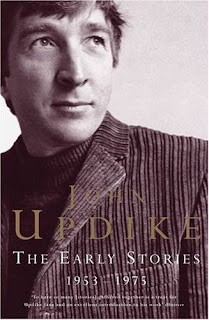
Literary giant John Updike died today. His last short story collection--My Father's Tears and Other Stories--will be coming out in June. It will be his twelfth book of short stories, including a retrospective, The Early Stories: 1953-1975, published in 2003. It goes without saying that he was and will remain an important American short story writer, novelist, memoirist, critic, and poet.

A great book to read about Updike is Nicholson Baker's 1992 book, U and I, which chronicles Baker's near obsessive interest in the U of the title. Readerville is a good source for links to various obituaries and articles on Updike, as well as a place to throw in your two cents about him.

The New Yorker's Book Bench blog is running a series of reminiscences and homages that some of its regular contributors have written. It's interesting that writers such as George Saunders and T. Coraghessan Boyle never met John Updike. I've always thought of him as very accessible, but I guess he didn't make the scene too often.

I did in fact meet Updike once. It was in early 2000 at a book party at a New York restaurant for Best American Short Stories of the Century. My wife, Alice, and I were invited because Updike had chosen her story, "In the Gloaming," for the anthology. We milled about before approaching him, toward the end of the evening. Alice had been eager to meet Updike but was feeling a bit reticent about elbowing her way forward. I literally pushed her toward him. He was, as you'd expect, gracious. It felt odd to be standing near someone whose face I'd seen a hundred times on the backs of books and book flaps. I almost felt like reaching out to touch his aquiline nose or shaggy eyebrows. Updike told Alice that her story was one of his favorites in the book, which bowled her over. After what couldn't have been more than five minutes, we backed out of the circle so someone else could take our place.

Believe it or not, this anecdote connects to two of this year's finalists for The Story Prize. I met a nice young writer named Jhumpa Lahiri at the same party. Interpreter of Maladies was out, but it hadn't yet won the Pulitzer Prize. I had included the title story in Prize Stories 1999: The O. Henry Awards, so it was nice to chat with her for a few minutes. I imagine Lahiri met Updike that night, too. The second connection is that Tobias Wollf (who wasn't there) was the guest editor who had chosen "In the Gloaming" for The Best American Short Stories 1994. Without that, we wouldn't have even been in the room.

I had corresponded with Updike before then and after. He had politely declined offers to be a judge for the the first volume of the O. Henry Awards I edited or for the first year of The Story Prize or to read at the 92nd Street Y for the 80th anniversary of the O. Henry Awards. He always replied politely, via typed postcards that usually included an amusing sentence or phrase. Although I always expected to get a no from him, I firmly believed that the first writer I should ask to do anything was John Updike.

In 1990, he had contributed to my first book, Literary Outtakes (long out of print, I'm afraid), the original ending to his memoir Self-Consciousness, which took the form of an imagined dialogue between Oppositional Other (O.O.) and Self. The gist of it was that O.O. felt Self was being, well, self-indulgent. Updike ultimately and wisely went with a more conventional ending. Here's the last part of the two-page outtake:
I am weary of Self-Consciousness. What I have written here discomfits me; it is indiscreet and yet inaccurate, a greedy squandering of life's minute-by-minute savings, a careless provisional raid upon the abyss of being. Fiction, which does not pretend to be true, is much truer. This stuff is embarrassing. The reviewers will jump all over it. I think I'll save myself a peck of trouble and not publish.
Self: Oh, go ahead. It was written, after all, only by Updike; it has nothing to do with me.

Wednesday, January 14, 2009

Listen As Sarah Shun-lien Bynum Discusses Ms. Hempel Chronicles

Author Sarah Shun-lien Bynum, appeared on KRCW radio on Jan. 15 to talk about her brilliant collection of connected stories, Ms. Hempel Chronicles (A 2008 Story Prize Notable Book) with Bookworm host Michael Silverblatt, who obviously gave the book a close reading (not all interviewers do). It's probably best to listen to this if you've read the collection, because while not presenting any real spoilers, the discussion points out some subtleties that would be more satisfying to discover on your own.


During the course of the interview, Bynum talks about her use of the "free indirect style," which James Wood advocates in How Fiction Works. Wood (a judge for The Story Prize in 2005) didn't invent this concept, and Bynum doesn't mention Wood, but I get the sense she's read his book and adopted the term to explain her technique. Of course, I could be wrong about this, but if not, it's interesting to see the influence of criticism on a writer's discourse.

Even more interesting, from the perspective of The Story Prize, is that in one of the stories in the collection, "Accomplice," the title character, a middle school teacher, has her class read finalist Tobias Wolff's memoir This Boy's Life, a subject that comes up in the KCRW interview. If we'd ended up choosing Ms. Hempel Chronicles as a finalist, it would have been really interesting to touch on this with Bynum and Wolff.

Thursday, January 8, 2009

The Story Prize Finalists Are Jhumpa Lahiri, Joe Meno, and Tobias Wolff

Well, we've chosen our finalists:

Unaccustomed Earth by Jhumpa Lahiri (Knopf)
Demons in the Spring by Joe Meno (Akashic Books)
Our Story Begins by Tobias Wolff (Knopf)

These are amazing books by extremely talented and accomplished authors. We're very much looking forward to The Story Prize Award event on March 4 at the New School. Details to follow.

This is just a placeholder, really. We'll provide more details and more detailed discussion of these books and authors in the days and weeks ahead. And we'll also soon put out our list of other notable short story collections published in 2008.

Thursday, November 20, 2008

Author Introductions to Story Collections? Yea or Nay?

Many of the reviews of Stephen King's short story collection, Just After Sunset, have referred to King's introduction to the collection, which talks about when he was first starting out as a writer and wrote short stories, how he got away from writing them, and how editing The Best American Short Stories 2007 reawakened his interest in the form.

It's interesting to see how King's own summation has framed much of the discussion of his work. Many reviewers don't know how to talk about a short story collection as a whole. So, in a sense, an introduction can make a collection more reviewer friendly.

Still, most of the short story collections that I read don't have introductions. And those that do, tend to veer toward a genre, such as science/speculative fiction, horror/suspense, or mystery/crime. In some cases, a prominent writer in that genre will introduce another writer's collection, for instance George Pelecanos introduces Laura Lippman's Hardly Knew Her. (My intention is not to disparage so-called genres but to make a factual observation.)

In so-called literary short fiction, authors will sometimes introduce their own selected or collected works. For instance, Tobias Wolff opens Our Story Begins with "A Note from the Author" that addresses the question of whether or not an author should revisit (i.e. tinker with) earlier stories when putting together selected stories. (Notice he doesn't call it an "Introduction.") Wolff did, in fact, revisit earlier stories--and that's the sole focus of his brief note. And, like King's introduction, it has helped frame reviewers' discussion of his book.

Of course, ultimately, stories have to speak for themselves. And anyone who doesn't want an introduction can skip it. In addition, a popular writer like King often has a very public, ongoing relationship with his readers, who are likely to appreciate insight into his creative process. Truth is, you could ask why more writers don't share their back story and their insights with their readers.

Still, call me a traditionalist, but I generally like short story collections better without introductions. How do you feel about it?

How do you feel about short story collections that have introductions?
I don't approve of introductions--the stories should speak for themselves.
An introduction is sometimes okay. I take it on a case-by-case basis.
I like to read introductions.
I don't care. Readers can skip them if they want.
Barack Obama
pollcode.com free polls