Showing posts with label J. Robert Lennon. Show all posts
Showing posts with label J. Robert Lennon. Show all posts
Friday, April 15, 2022
Video of The Story Prize event: Lily King, J. Robert Lennon, and Brandon Taylor (winner)
Here's the edited video of The Story Prize event held on April 13:


Thursday, April 14, 2022
What The Story Prize Judges Had to Say About Let Me Think by J. Robert Lennon
 |
| © Beowulf Sheehan |
When the three judges for The Story Prize make their choices, they provide citations for the books. This year's judges were writer and librarian Dev Aujla, critic, writer, and librarian David Kipen, and writer Kirstin Valdez Quade. We include the citations in congratulatory letters we present to each finalist, along with their checks ($20,000 to the winner, $5,000 to the other two finalists). To protect the confidentiality of the judges' votes and the integrity of the process, we don't attribute citations to any particular judge. Here's what the judges had to say about Let Me Think by J. Robert Lennon:
“In 1970, when Mr. and Mrs. Lennon brought their infant son home from a Pennsylvania hospital, it was already child abuse to name him John. Perhaps not surprisingly, John Robert Lennon grew up to become American fiction's premier measurer of the distance by which reality falls shy of perfection. He is our very own poet of the not-quite. In ‘The Museum of Near Misses,’ the umpteenth excruciatingly funny short story in Let Me Think, a narrator named J. Robert Lennon happens into a museum where the presidential election of 2016 has apparently gone a different way. There is simply no justice if this story doesn't win the 2021 Sidewise Award for Alternate History. (A real thing, by the way—but one for which, alas, recent reality is sadly ineligible.)
“Some of the stories in Let Me Think are so brief that including them almost makes the book shorter. Nano-vignettes like the title story, which first appeared in Barrelhouse, know more about family and parenthood than any pallet-load of humorless pop-psychology sludge. Some readers will follow the recurring couple at the heart of Lennon's ‘Marriage’ stories—who bicker over, for instance, the husband's suddenly suspicious lack of exclamation points in texts to his wife—and fight the urge to sweep their house for listening devices.
“As a critic once wrote of Lennon's hysterical, strikingly well-plotted novel The Funnies, the author is ‘fresh without reaching, funny without stooping.’ Once in a while in Let Me Think, ‘fresh’ comes perilously close to ‘experimental’—but no, wait, come back! As Lennon's namesake once wrote of a more radical sort of experiment, ‘If you go carrying pictures of Chairman Mao/You ain't going to make it with anyone anyhow.’ It's hard to say whom Lennon might be carrying pictures of. Barthelme? Nabokov? Roseanne Barr? Someday, aspiring writers may yet carry pictures of Lennon—and not the Liverpudlian one, either.
“In other words, please read Let Me Think.”
Saturday, April 9, 2022
Live-Stream The Story Prize Award Event on April 13 at 7:30 p.m.
We're having a private award night this year instead of the larger public events we held at The New School for 15 years (before the novel coronavirus came along). And because the event is invitation only, we're planning to live-stream it on YouTube on Wednesday night.
Here's the link.
What you'll see and hear is the three finalists for The Story Prize for books published in 2021—Lily King, J. Robert Lennon, and Brandon Taylor—read from and discuss their short story collections before we announce the winner and present that writer with an engraved silver bowl and the top prize of $20,000. The other two honorees won't walk away empty handed; they each take home $5,000.
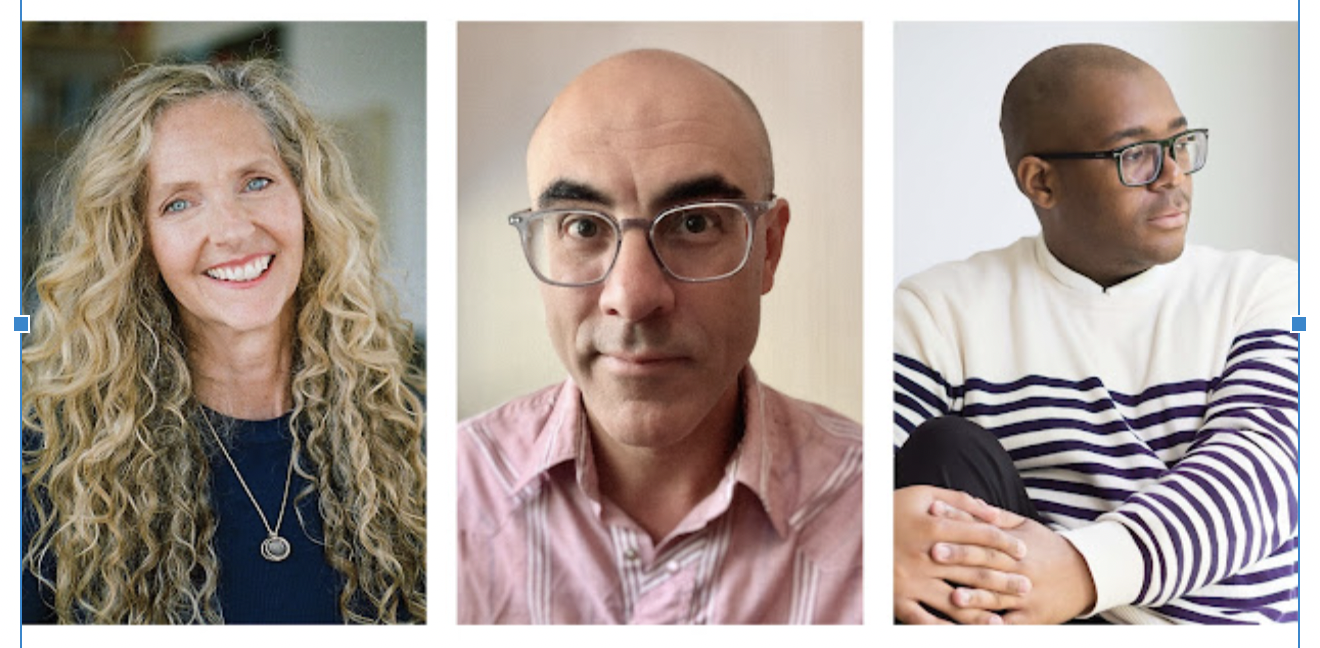 |
| Lily King, J. Robert Lennon, and Brandon Taylor |
Tuesday, February 8, 2022
The 2021/22 Finalists for The Story Prize Are Lily King, J. Robert Lennon, and Brandon Taylor
The Story Prize, now in its 18th year, is pleased to honor as its finalists three outstanding short story collections chosen from 119 submissions representing 90 different publishers or imprints. They are:

Five Tuesdays in Winter by Lily King (Grove Press)
Let Me Think by J. Robert Lennon (Graywolf Press)
Filthy Animals by Brandon Taylor
We will announce the winner of The Story Prize on the evening of Wednesday, April 13, at a private event featuring readings by and interviews with finalists King, Lennon, and Taylor, as well as the announcement of the winner and acceptance of the $20,000 top prize and the engraved silver bowl that goes with it. The runners-up will each receive $5,000. We plan to live stream the event starting at 7:30 p.m. and will post a link before then and a video the next day.
Story Prize Founder Julie Lindsey and Director Larry Dark selected the finalists. Three independent judges will determine the winner:
- Writer and librarian Dev Aujla,
- Critic, writer, and librarian David Kipen, and
- Author Kirstin Valdez Quade
In the weeks ahead, we'll announce this year's winner of The Story Prize Spotlight Award. We'll also publish a long list of other exceptional collections we read last year and information on how to watch the event.
Saturday, November 15, 2014
J. Robert Lennon and the Sweet Spot
In the 37th in a series of posts on 2014 books entered for The Story Prize, J. Robert Lennon, author of See You in Paradise (Graywolf Press), talks about putting the right amount of pressure on himself.

If you weren't a writer, what would you be doing?
Probably I’d be an unsuccessful musician with an office job.
Describe an unusual writing habit of yours.
I often wait until there is almost not enough time to finish something before I start it, then do it very, very fast, so that I don’t have time to think. I’m not a procrastinator, per se; if I give myself only a day or two to write, say, a book review, it's bad, and if I take a whole month to do it, it’s also bad. There’s a sweet spot that lets me work in near-panic at a high level of competence, and I try to spend a lot of time there.
Do you ever borrow characters or situations from real life, and has anyone ever confronted you about it, been angry or pleased?
I used to always say no to this question, but then I actually read what I’d written over the years and realized that there are plenty of repurposed real-life personality details. But no one has ever recognized himself. A few people have thought a particular character was them, but been wrong.
What one story that someone else has written do you wish you had written?
Pretty much all of Donald Barthleme. It’s tragic, trying to emulate him, because it was never the stuff he thought to write about that was so important; it was just the fact of his being Barthleme, which of course cannot be imitated. I’m also envious of Kelly Link’s story “Stone Animals.” It feels like the funnest imaginable thing to write. I liked that story very much as a reader, but as a writer, I find it inexhaustibly delightful.

Where do you do most of your work?
The living room sofa. Sometimes in bed. Sometimes at a coffee shop. Almost never at a desk, though there are four desks in my life where I do other things.
What do you do when you're stuck or have "writer's block”?
I give myself a prompt, or go do something that isn’t literature—play the guitar, play a videogame. I’m lucky to be able to get over writer’s block pretty easily. Often some assignment comes down the line—a book review or other piece of topical writing—and I am forced to write by circumstance. That helps a lot.
What advice do you have for aspiring writers?
Treasure nothing, be willing to throw out anything. The story you just wrote that you are proud of should not be coddled and worshipped. You can do it again. If your house burned down with all your work inside it, you would still be the writer you are, and you would continue to be worth something.
Monday, June 4, 2012
Sharma Shields on The Little Disturbances of Monsters
In the third in a series of posts on 2012 short story collections entered for The Story Prize, Sharma Shields, author of Favorite Monster (Autumn House Press) discusses her dark subject matter.

Like any other person who attends a horror movie, shrieking with lusty agony at the final bloody scenes, or who buys a Stephen King novel, hoping it’s as freaky and demented as his last, I enjoy being a little scared. Writing allows us myriad emotions: joy, terror, frustration, satisfaction, whathaveyou. Just so long as it’s not boredom. Good grief, anything but that.
In my graduate school workshops, inserting Polyphemus into a literary story would likely—and astutely —have been decried as a gimmick. And I admit it: monsters are gimmicky. No doubt the monsters in my collection sprang from supremely dorky childhood interests—D’Aulaires’ Book of Greek Myths, for example, and epic computer games like King’s Quest—but, origin-stories aside, I most likely employed them because they offered a tired narrative a bit of fun.
Some of my monsters are quite literal: a Cyclops working in a Seattle PR firm (“The McGugle Account”); a snake-haired playmate that turns a little boy to stone (“Brains and Beauty”). Most of the true monsters in the collection, however, are figurative: a teenage girl who would do anything for her new friend (“Sunshine and the Predator”); a mercilessly controlling wife (“The Chirp of the Cricket”). My collection is filled with regrets and misapprehensions and terrible, terrible mistakes. In many ways, these stories reflect my own desire to mature and forget and forgive. I am not one of those people who bellow absolute confidence, declaring she has no regrets in life. I believe almost anyone with a conscience carries within them one or two major regrets (and several more tiny ones) – the horrible way we treated a friend in seventh grade, perhaps, or that one awful act we committed when feeling insecure. Reading back on Favorite Monster, I can see my own fears and regrets surfacing, leviathans carefully obscured with a heavy fog of make-believe.
Amusingly, despite my dark subject matter, I have always found incredible joy while writing. There’s something about the complete dissolution of my conscious world that I find mysterious, thrilling, and yes, disturbing.
 |
| Goya's Saturn Devouring His Son |
I don’t think these joys and disturbances are mutually exclusive. I’m reminded of the three trips I’ve taken to the Museo del Prado in Madrid – all at very different times in my life (two of them with my Aunt Eusebia, who was born and raised in Spain, and once with my friend Sarah, who I met while studying abroad). I always visited and revisited El Prado, in particular to admire the paintings of Francisco de Goya. Wandering through the museum’s front rooms, I would marvel at his light and airy paintings of the aristocracy, some of them filled with a summery innocence, a joining of hands in a pastel meadow, for example, expertly rendered…but how much more I loved The Black Paintings in the museum’s dim basement—paintings of violence and despair, of monsters and witches, of demonic goats, of a drowning dog. I descend my own staircase, I think, when I explore the multifarious rooms of my own museum of creation, from well-lit, pleasant front rooms to spine-tingling, shadowy basements. And unearthing any of it is both joyous and frightening. Perhaps joyous because it is frightening.
Two awesome examples of this combination of joy and fright are Etgar Keret’s Suddenly, a Knock on the Door and J. Robert Lennon’s Pieces for the Left Hand. These story collections are funny and dark, terrifying and amusing. And, as disturbing as these stories can be, you always get the sense from them that their authors enjoy writing. That joy is fantastically contagious.
Like any other person who attends a horror movie, shrieking with lusty agony at the final bloody scenes, or who buys a Stephen King novel, hoping it’s as freaky and demented as his last, I enjoy being a little scared. Writing allows us myriad emotions: joy, terror, frustration, satisfaction, whathaveyou. Just so long as it’s not boredom. Good grief, anything but that.
Tuesday, November 17, 2009
Book Design: Flipping Through Pieces for The Left Hand
 We've received 76 entries for The Story Prize. Thanks to all who submitted books. That's a lot of short story collections, and we have our work cut out for is in the weeks ahead as we prepare to choose our finalists early in January.
Many of the collections we've received are well-designed. A few, in particular, stand out. One of these is J. Robert Lennon's Pieces for the Left Hand, published by Graywolf Press. The paperback book has an appealing small trim size. The cover is a paint-by-numbers image of a walking man that suits the contents well. On the bottom right corner of each page is a silhouette of a man in different stages of walking (I had to mangle the book a bit to scan in all five figures), and if you flip through the pages he glides through the motions. (This isn't the first time a literary work has used the flip book concept. The last 12 pages of Jonathan Safran Foer's 2005 novel Extremely Loud and Incredibly Close also makes use of this device.)
According to Erin Kottke, marketing manager at Graywolf:
"The idea for the walking man (the flip book part) came from Ethan Nosowsky, our editor-at-large and the editor of John’s book(s). Actually, the walking man itself was his idea. John immediately liked both ideas. After we decided on the figure, Rachel Holscher had an illustrator [Matt Schuler] draw it to match the image on the cover, which was Kyle Hunter’s (the cover designer’s) invention."Author J. Robert Lennon, had this to say:
"The original 'walking man,' when flipped, looked a little like he was doing a moonwalk—we had the artist go back and add a couple of 'frames' to make the walk more natural.In my view, Graywolf did a great job with this book. While big commercial publishers often solicit the author's response to cover designs, one of the advantages in working with small presses is that they're often more responsive to author ideas and more willing to take chances.
"Graywolf originally presented me with two possible covers—one of them had the 'walking man' strolling across a musical staff...the background was a photograph of a hand, I think. I didn't like it—it was too representational, too much like one of those CNN graphics that try to get every element of the news story into the picture. The cover we went with looked great to me—almost like something Scandinavian, from the seventies, if that makes any sense. It had an aura of ad hoc mystery to it, which I think represented the contents quite well. The image, as I'm sure you've been told, is from the Smithsonian paint-by-numbers collection—something I hadn't known existed.
"I think the whole package is just perfect, and I know the sales have exceeded Graywolf's expectations—I think it has a lot to do with the size and style of the book, the way it feels like a literary artifact, rather than merely a collection of writing."
By the way, beyond its clever packaging, Pieces for the Left Hand is an interesting collection of 100 very short stories, well worth reading.
Subscribe to:
Posts (Atom)