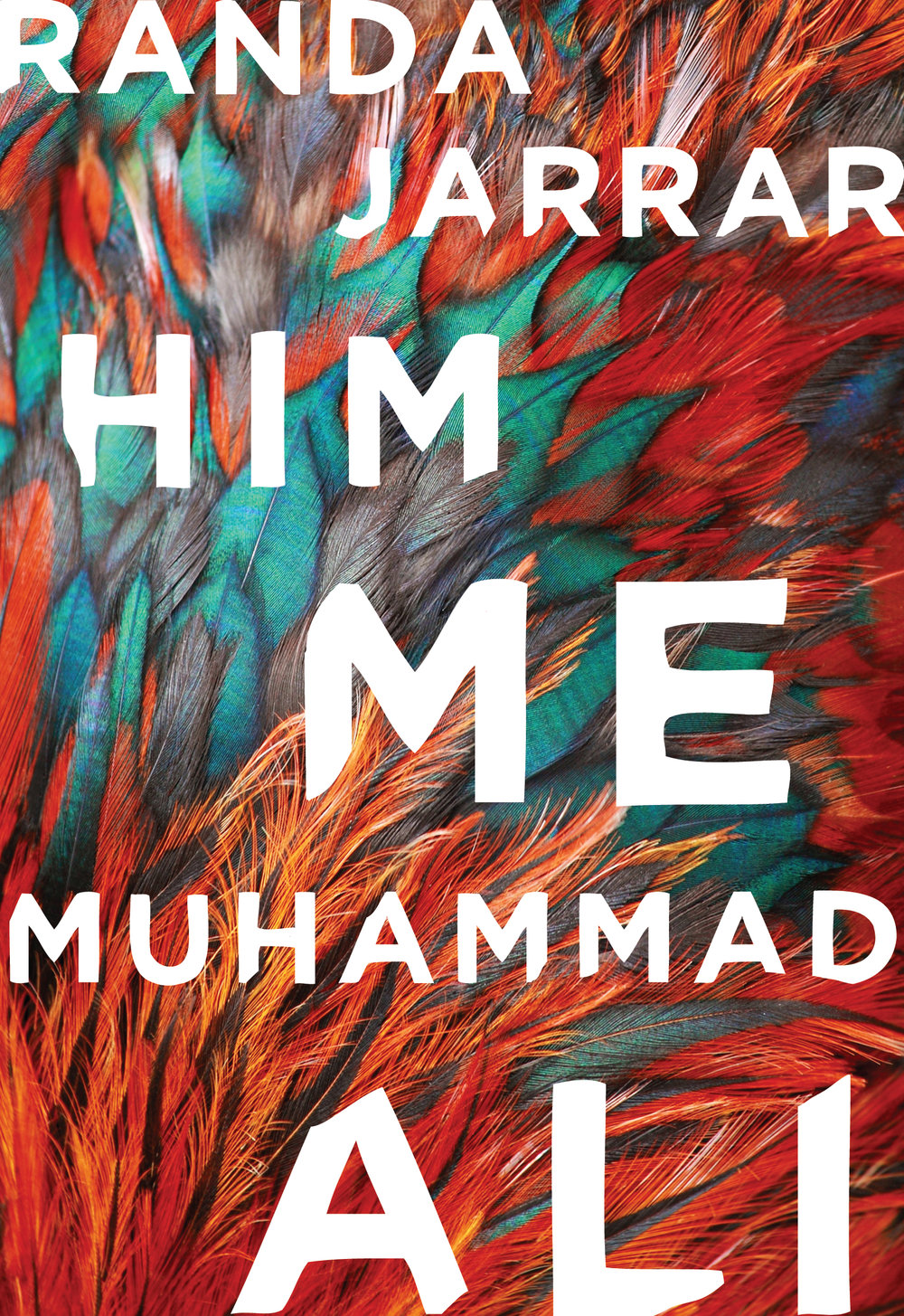
In the 40th in a series of posts on 2016 books entered for The Story Prize, Randa Jarrar, author of Him, Me, Muhammad Ali (Sarabande Books), discusses who she writes for and why.
One of my favorite short story writers was also my professor in graduate school a decade ago. Peter Ho Davies assigned us Frank O’Connor’s introduction to
The Lonely Voice and Gogol’s
“The Overcoat” in his form and theory class. Though I’d been obsessed with short stories my entire life, these texts helped me draw a personal poetics.
My first published book was a novel. Novels are allowed to be—even encouraged to be—messy and baggy. Short stories are controlled, sexy; every sentence counts. And in the story we find the little “man,” and her appeals to be treated fairly—to be seen as one’s sister, instead of the misfit, the outcast who, because she’s relegated to the fringes of society, seems destined to stay there, or to stay outside of society and therefore not privy to its perks, to fair and kind treatment. That is what the short story means to be too; the short story is like the little man; its aim is to make an appeal, on behalf of the misfit.
The short story humanizes those whom larger society would prefer to bury, to keep on the fringes. The short story is a revolution. This is not to say that the short story has to be gentle, to murmur, “Leave me alone! Why do you insult me?” the way Gogol’s Akaky Akakievich does, but it can also shout it, scream it. When I write about queers, fatties, Arab-Americans, Muslims, I’m writing characters that have been systematically ignored, or maligned, or misrepresented, in larger society and in the narratives it tells. My main goal is to craft a good story—the way I measure a good story is not just through language, and on a sentence by sentence level, but also through verisimilitude- does this story sound true? I want to tell these characters’ loneliness, and hopefully, to move someone—a reader who’s chosen to swallow the lie that larger society tells about my characters—to move them to empathy.
I lied. I write more for the characters and the people like them than I do for the ignorant; I write for the fatties and the queers and the Arabs, etc., and if those inside the circle are moved by the way I write about those outside of it, that’s just a bonus.

Every writer I love does this, in some way, and I grasp something different from every writer I love. I love Lydia Davis for her sentences, for teaching me how much I can do in a small space. I love Katherine Mansfield for the opposite—I re-read
“Prelude” every year. It’s a 17,000 word story. Bolaño taught me how much riffing a novelist can still do in a short story. I love Sam Lipsyte and Sherman Alexie for teaching me what humor can do in a short story. I love Percival Everett for his seriously playful concepts. Angela Carter is a magician who taught me you can tell a dozen stories with the same cast and setting and general set-up. So did Jamaica Kincaid, who, along with Margurite Duras, taught me that it was okay to be obsessed with my own story. Joyce and Babel taught me how to write about place and childhood and the two of those things, together. Babel threw war into the mix. James Baldwin is a prophet. Borges and Kafka taught me how to write dreams. Alice Munro taught me to always re-think where I end a story, and that female friendship is a topic worthy of literature.
Him, Me, Muhammad Ali is a love letter to loners and to short stories. It’s a book populated with marginalized characters, all yearning for pleasure, for safety, for sisterhood, for a place, both in the landscape of their lives and that of the contemporary short story.