Showing posts with label One Story. Show all posts

Saturday, May 31, 2014

One Story's Storied Literary Debutante Party

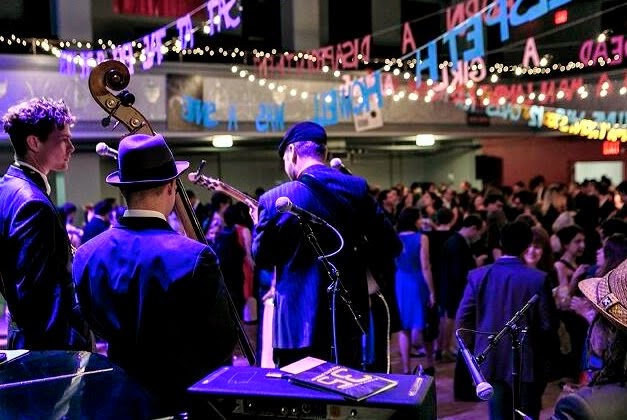
The Blue Vipers performing at the One Story Literary Debutante Ball
By Nick Fuller Googins
Brooklyn, NY, May 22, 2014

Hannah Tinti, co-founder and editor-in-chief of literary magazine One Story, is also a best-selling author and a teacher at Columbia’s MFA program. She’s a literary personality who wears many hats, and on the night of May 22, at funky Brooklyn performance space Roulette, her hat was of the miniature Edwardian ringmaster variety, bedazzled with black sequins and festooned with glittery silver butterflies. Her Converse All-Stars matched the butterflies, flashing smartly as she crossed the stage, stepped up to the microphone, and, politely, asked everyone to please shut up. Time for the debutante ball to begin.

But let me back up for a moment: One Story’s annual Literary Debutante Ball is a celebration of One Story authors who have published their debut books in the past year. The process of announcing these authors (seven of them this year, including Ben Stroud, whose collection, Byzantium, earned him the 2013 Story Prize Spotlight Award), their metamorphosis from mere mortals into literary debutantes, in no way resembles a traditional literary reading. It’s much, much more fun. As soon as I checked in, I was invited to grab a “Let the World Spin,” the evening’s custom, Colum-McCann-inspired cocktail (more on the man later).

This is how a proper Literary Debutante Ball warms up: Live band on stage. Tables of appetizers. Two open bars. A bartender dancing to swells of music. Garden lights strung overhead, along with strands of cut-out letters spelling the first line of each debutante’s recently published book. Clusters of elegantly dressed writers, editors, and lovers of literature. Burlesque-costumed women weaving through the crowd hawking framed commas, semicolons, and exclamation marks at $10 a pop.

It was quite a lot to take in.

I ate some appetizers, stood in line at one of the bars, walked the floor looking for debutantes, trying to match faces to what I remembered from author photos. I moved over to the other bar and struck up a conversation with a young guy who turned out to be a former student of Tinti’s at Columbia. (“Still writing?” I asked him. “Of course, you have to,” he said, as though it were an absurd question.) I was curious why people had come to the debutante ball, in what capacity. I asked another woman. We were standing side by side, admiring the wall of advice—framed, hand-written bits of writing-based knowledge and guidance from established writers and debutantes alike, available for purchase as part of a silent auction. The woman told me she was an agent. I asked if she represented any of the debutantes. She said she did not. Anyone, then, whom I may have heard of? "Jonathan Franzen?" she said. "Oh, sure," I said, "I’ve heard of him."

The Golden Thread

Jonathan Franzen’s agent and I parted ways. I continued down the wall of advice, examining the handwritten words of encouragement and inspiration from the likes of this year's Story Prize winner George Saunders and, yes, Jonathan Franzen. I especially liked Hannah Tinti’s advice, not only because of its mythological lyricism, “Your story is a puzzle—a maze. But your mind created it—so the answer, the key, the golden thread leading out is inside you. Unspool it and meet your minotaur,” but also because she’d encircled it in cartoony, serpent-like monsters. Elsewhere on the wall, interspersed with the words of encouragement and inspiration, were words of caution. From the pen of Lynne Tillman: “Don’t expect that being published will make you happy.” Other authors mined their personal role models for wisdom, such as debutante Molly Antopol, who quoted Grace Paley. Someone else cited John Updike. Michael Cunningham quoted a slightly less literary figure, but it was still excellent advice: “Don’t panic! (remember what Marilynn Monroe said—‘I wasn’t the prettiest, I wasn’t the most talented, I just wanted it more than anybody else’).”

At this point, I discovered that the debutantes’ books, arranged in handsome piles on tables throughout the theater, were not merely showcase pieces but meant for the taking, by us, the guests (meaning me). But I was not alone in my discovery. Books were going fast, flying off the tables. I had to move quickly. Luckily, I’d already read Ben Stroud’s Byzantium and Molly Antopol’s The UnAmericans, allowing me to skip those particular stations. I snagged Rachel Cantor’s A Highly Unlikely Scenario, James Scott’s The Kept, and Celeste Ng’s Everything I Never Told You. I stopped to say a quick hello to Tin House editor, Rob Spillman and did a double-take at the sight of author John Hodgman. Hodgman’s story, “Vilanova: Or How I Became a Former Professional Literary Agent,” has the distinction of comprising the debut issue of One Story. This evening he was dressed like unbearably snobbish author Louis Green, whom he played in HBO’s Bored to Death. I then nabbed David James Poissant’s The Heaven of Animals and Amelia Kahaney’s The Brokenhearted, completing my debutante reading list. It was good timing. Hannah Tinti had just taken the stage, tapped the mic, asked us in her own charming way to please quiet down.

To kick things off, Tinti and fellow co-founder Maribeth Batcha said a few words about One Story, now in its twelfth year of existence. (“Sort of our bar mitzvah,” Tinti said. “We are a man now!* An active participant in the world!”) One Story, which publishes a single short work of fiction every three weeks, and never publishes the same author twice, maintains a special commitment to encouraging writers at the beginning of their careers, a commitment that Tinti and Batcha said they were pleased to have strengthened over the years. With that, the One Story co-founders sat cross-legged on the side of the stage, making room for the honorees of the evening.
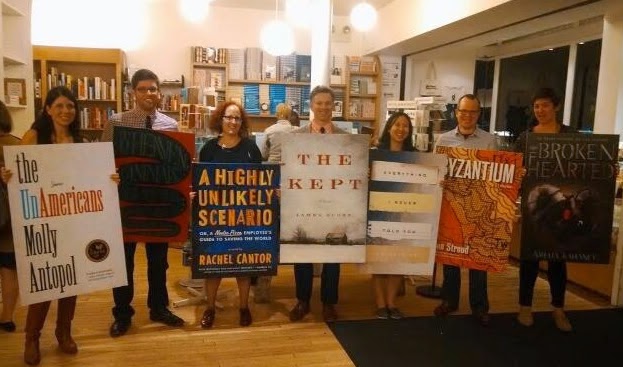
One Story's literary debutante's (L to R): Molly Antopol,
David James Poissante, Rachel Cantor, James Scott,
Celeste Ng, Ben Stroud, and Amelia Kahaney
The ceremony itself was brief yet meaningful. The debutantes were announced one by one, escorted down the “aisle” (parallel strands of rope held waist-high by glamorous volunteers) by a respective mentor, in some cases an editor, such as Amelia Kahaney’s escort, Sarah Landis. In other cases an established author, such as Rachel Kantor’s escort, Robin Black, a One Story alum and 2011 literary debutante herself, did the honors. As each debutante took the stage, the first line of his or her new book was read aloud, followed by general whooping, hollering, applause, and hoisted cocktails, all to celebrate the authors’ entrance into the literary community, to acknowledge thier current success, and to wish for them many future years of inspiration and sales. Amid this frenzy of jubilation, optimism, and cheer, came the gimlet-eyed first line of Ben Stroud’s collection: “I was born a disappointment.” It brought down the house.

Confusing Debs

Directly after the literary debutantes were announced and celebrated, One Story presented its 2014 “Mentor of the Year Award” to literary rock star Colum McCann, who teaches at Hunter College and is deeply involved in numerous literary organizations. McCann, keeping with the theme of the evening, devoted the majority of his acceptance speech to discussing his own literary heroes and mentors, one of whom was memoirist Frank McCourt. McCann recounted a visit to McCourt in a late stage of his life, when McCourt, unable to talk, communicated via white board and dry erase marker. The way McCann tells it, at one point he asked the ailing author, “Where will you go dancing next?” McCourt’s written reply: “Upstairs with the Great JC and Mary M and the twelve Hot Boys. And in the morning, all will be forgiven.”

McCann signed off, the party resumed, dancing commenced. I made a beeline to Ben Stroud, whom I wanted to congratulate and, more importantly, thank for writing Byzantium. His collection’s ten stories skip from ancient Mesopotamia to colonial West Indies to contemporary East Texas and other times and places. The first story, my favorite, follows an idle, fatherless man-child with a crippled hand (you’re correct in guessing this is the poor sap to declare himself “born a disappointment”). Summoned by the Byzantine emperor, the narrator is tasked with a top-secret mission: travel to a desert monastery outside Jerusalem, locate a particular monk, and castrate him. It sounds gruesome, and is, but more so it’s a moving, humorous, and entertaining story. I planned to relay this sentiment to Ben Stroud, but when I got to him, I didn’t have time for much more than a handshake and quick congratulations before he was swarmed by others. No matter, I knew when to move on. Anyway, I had another mission: Find Molly Antopol.

I intercepted her on her way to the dance floor. After congratulating Antopol, both on her newly anointed literary debutante status and on her recently published collection of stories, The UnAmericans, I wanted to talk about a compelling blog post of hers that I’d come across, “On Writing and Being a Parent,” which cleverly examines how parenthood affects the practice of writing, in some ways for the better. I told all this to Antopol in one long breath. She had no idea what I was talking about.

“What do you mean?” I said. “That’s not your blog?”

“I don’t think so,” Antopol said. “I’m pretty sure I’m not a mom.”

Ah! I’d mixed up debs! The most mortal of all debutante-ball sins! Had this been an episode of Gossip Girl, I would’ve been shunned from Upper East Side society for years, never again allowed to grace the Waldorf Astoria ballroom floor. Thankfully, this was Brooklyn, and Molly Antopol has a gracious way of alleviating uncomfortable situations. I believe she deserves another award for that.

Debutante Amelia Kahaney, I later discovered, is the author of the wonderful parenting-writing blog post. Sadly, I never found Kahaney in the crowd, never got to talk to her. Which brings up the only problem with One Story's Literary Debutante Ball: It's such a kick-ass party that it's impossible to talk to everyone in the room. Wisely, One Story continues the celebration through the following day, hosting a low key reading by the debutantes at Greenlight Bookstore in Fort Greene. The reading was scheduled for the evening, giving all participants eighteen-odd hours of recovery time, a good thing because after dancing through the night with Colum McCann and Hannah Tinti and seven happy literary debutantes, sure, all may be forgiven in the morning, but a hangover still hurts.

* Editor's Note: In fact, One Story will not be a man, according to Jewish tradition, until next year, when it turns 13.


Photos courtesy of One Story.

Saturday, March 1, 2014

Days Two and Three at AWP Seattle: A Hallucinatory Experience

With The Story Prize event just days away, we're unable to attend this year's AWP Conference—the Association of Writers & Writing Programs' annual gathering. So we've enlisted Molly Reid, a Portland-based writer, to report from the goings on in Seattle. 

AWP Conference, Seattle, 2014: Days Two and Three


Writing advice with a smile at the One Story booth (P34)
(L-R: author Marie-Helene Bertino, someone else)
It’s morning, day three of the conference, and I am hung over. But not in the traditional sense. New ideas, old friends, epiphanies, readings, and okay a little alcohol—combine to create a brand new kind of vertigo. There is a zombie quality now to the escalator throngs. The sort of daze that arrives after so much engagement. Everyone is ruffled at this point. Only Chang-rae Lee still looks dapper (at least as far as I could tell—he was on the other side of the bar surrounded by friends and fans).
 
After listening to people talk about novel structure and character-driven plot and the pure messy magic of ink, I realize I trust them, these panelists: They choose their words with such care. They say what I’ve thought but haven’t been able to articulate and also what I’ve never thought but is so true it’s accompanied by ache. Sure there are duds in the bunch, and standing-room only out the door at some panels (I was squeezed out of “Magic and the Intellect” with Rikki Ducornet, which I have a feeling would have changed my life), but I for one still feel like I’m getting my money’s worth. There is a genuine attempt to gather failure and success and impart something.    

One thing that’s great about AWP is that people don’t come to bag an agent or impress an editor, which makes it easier to see that there is such authentic warmth and support. People spend all day going to panels and manning tables at the book fair, and then they spend all night going to readings to hear people they love and those they admire and some they’ve never heard of read their work. Voluntarily. Exhausted. Hungry. They go, and they listen intently, and they clap and holler.

Literary journals host readings of the coolest writers you’ve never heard of, and their juxtaposition—these writers who live all over the country and are rarely in the same place at the same time—creates a lovely hallucinatory experience. At The Southern Humanities Review/Carolina Wren Press reading last night, a woman read an essay about a lucky dress worn to her husband’s surgery. This was immediately followed by a poet’s image of a man giving CPR to a lady gorilla. Another poet talked about the cities we build inside ourselves. Someone read from a novel about a Cuban-American family’s struggle with dreams and expectations.

As the night goes on, there is an exodus, as writers are kicked out of one place and move onto another, searching for one last piece of goodness, brilliance, laughter—from the bar to the Elliott Bay Book Company to the Hugo House, back to the bar. The Hugo House is so crowded the reading is piped in to the other rooms like commands from a submarine captain you can’t see.

Hint: His name rhymes with AWP
But it’s our submarine. We are the ones manning this ship—is it heading to the rocks, or open water? (Sorry about that metaphor, but I went to a panel yesterday called “From Sea to Sea: Poets on the Power of Water” and everything’s running together, in a good way.)
     —Molly Reid

Saturday, November 17, 2012

Marie-Helene Bertino Shares Some Story Love

In the 41st in a series of posts on 2012 short story collections entered for The Story Prize, Marie-Helene Bertino, author of Safe as Houses (University of Iowa Press), discusses what short stories in general and Symphony Space's Selected Shorts program in particular have meant to her.


I love short stories. I love the stuffy, classic ones that refuse to bow to whimsy. I love the experimental ones, when a writer tosses the form into the air and shoots it through with magic and risk. I love the feeling of coming to the end of an expertly executed story: the upshot of energy like taking a hill too fast in my car. I love short stories even though I don’t always understand how to craft them, even though they baffle me; like a cherished, elusive friend who once in a while bestows on me a stunning visit.

When I moved to New York ten years ago I had an overdeveloped dream to be a writer and an underdeveloped plan as to how. Every season I scrounged enough money together to attend “Selected Shorts” at Symphony Space on the Upper West Side. In that quiet auditorium I listened to William Hurt read Maile Meloy, Hope Davis read Jennifer Egan, Joe Morton read Jim Shepard, and countless other amazing performances. No matter what mood in which I entered Symphony Space, I always left excited to write.

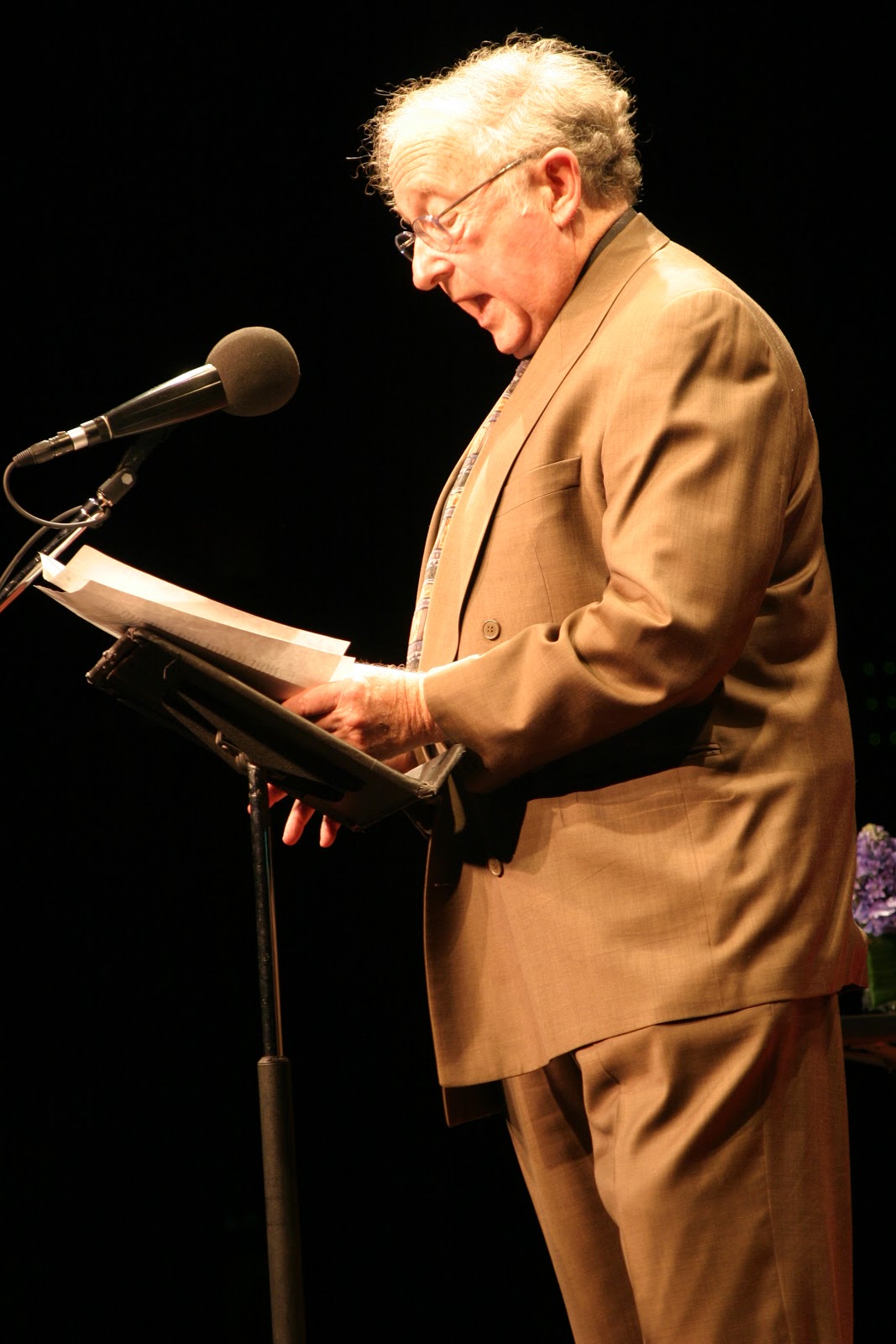
Isaiah Sheffer at the mike*
On Saturdays, “Selected Shorts” was broadcast on NPR. Every week, I listened while recording the show on cassette tapes (yep, cassette tapes). They are prized possessions—I’ve played them thin! I’ve listened to Lou Antonio reading the last paragraph of Tobias Wolff’s “The Night in Question,” fifty times or more. Every single time, the paralyzing windup to the devastating last line, “It’s okay, Franky. I’m here!” pushes tears into my eyes.

This was before my work with One Story, before my MFA, before I received the call from The University of Iowa Press. I hoped if I listened hard enough I would learn how to write a short story.

Isaiah Sheffer, the host of “Selected Shorts,” passed away last week, and the short story lost one of its best friends. I was lucky enough to meet him twice. The first time I was too nervous and couldn’t get my voice to work. The second time I was able to force out how much “Selected Shorts” means to me. He was kind and dear and oh, that voice! It is the voice I hear when I read short stories. It was thrilling to hear it in real life.

* At The Story Prize's first event, a Selected Shorts program at Symphony Space on Jan. 26, 2005.


Saturday, November 26, 2011

“The Spirit of Literary Independence” at the Old American Can Factory, Nov. 22, 2011

By Patrick Thomas Henry
Traveling to the Gowanus district of Brooklyn in the midst of a torrential downpour is like setting foot in the rain-lashed environs of a gothic novel. An “atmospheric tumult,” to pilfer Emily Brontë’s description of the weather at Wuthering Heights, battered the F train and jostled rain-soaked passengers together as it squealed along its tracks toward Brooklyn. Outside the 4th Avenue-9th Street Station, the crowd dispersed, and I headed northward, in the direction of the Old American Can Factory at 3rd Avenue and 3rd Street for the “Spirit of Literary Independence” celebration.

I entered the Old American Can Factory and mounted the stairs to the building’s upper levels. I glanced down the high-ceilinged corridors when I reached each landing. These hallways were gated with flung-open, vault-style doors. The night’s event was in the Issue Project Room on the third storey. Since 2003, the Issue Project Room has sought to build a creative hub for Brooklyn, with an emphasis on experimental art forms.

The “Spirit of Literary Independence” event worked toward that mission, through inviting independent publishers to present several of their authors. The night’s format—a reception and short breaks between readers—encouraged attendees to mingle and chat with the evening’s participants, creating a more intimate atmosphere than the usual question-and-answer format of such events. The co-sponsors were Akashic Books, Archipelago Books, the journals Habitus and One Story, and Ugly Duckling Presse.

Author Irena Reyn reads from a work in progress
The readings illustrated what independent and small publishers offer readers and the literary community, including evocative and beautifully conjured short story collections. In addition, the readings served as reminders that small presses can offer us considered and deft translations of foreign literatures, such as Ross Benjamin’s translation of Joseph Roth’s Job (Archipelago Books). Independently published journals also offer authors an opportunity to present works in progress. Rachel Cantor (One Story author) and Irina Reyn (Habitus author) both shared such work and referred to the valuable relationships they've developed with their editors and readers.

 Small presses have the leeway to engage with darker, more violent, more graphic content that may concern the big houses. Lonely Christopher’s short story “Milk,” from his collection The Mechanics of Homosexual Intercourse (Akashic Books), evinced this through a detailed—and gory—scene where shooting a horse parallels the family’s tensions. These publishers also offer opportunities for works that, though self-contained, are not book-length projects; John Surowiecki’s narrative poetry, which draws from his personal experiences and sensitive considerations of those affected by the Vietnam War, appears as the chapbook Mr. Z., Mrs. Z., J.Z., S.Z. (Ugly Duckling Presse).

Of course, mainstream publishers continue to print hundreds of powerful books a year, but small presses can explore literary terrain that may be foreign—or  seem unmarketable—to larger companies. And today’s small press titles can become literary classics in future decades. This isn’t just waxing poetic about the value of small presses: Literary milestones historically have their foundations in these humble origins. T.S. Eliot’s The Waste Land, for instance, was initially published in the journal The Criterion, and the poem’s initial appearance in book form was as a print run of 450 copies, produced by Leonard and Virginia Woolf’s Hogarth Press.

When I left the Old American Can Factory, I felt waterproofed in the evening’s layers: energetic readings, warm company, and the comfort of a few Brooklyn Lagers. The balmy rain, which still fell in chilling reels, seemed a bit less gothic, a bit less discouraging, after an evening spent amid the vibrant spirit of literary independence.

Sunday, August 7, 2011

Flannery O’Connor and the Mystery of Fiction


By Patrick Thomas Henry

“I’ll call anything a story in which specific characters and events influence each other to form a meaningful narrative,” Flannery O’Connor claims, with her characteristic tenacity. O’Connor’s attitude toward fiction welcomes reality—whatever that may be—as the originator of meaningful narratives. Fiction and reality, though disparate entities, are inextricably wound together. Stories are merely how we make sense of them.

An event on Aug. 4, sponsored by One Story, negotiated this line between fiction and reality, with O’Connor’s life and work as its hub. One Story editor Hannah Tinti and novelist Ann Napolitano discussed Napolitano’s new novel, A Good Hard Look, and O’Connor’s influence in the packed lower level of New York’s McNally Jackson. Napolitano set her novel, in which O’Connor is a pivotal character, in Milledgeville, Georgia, toward the end of O’Connor’s career. Napolitano riskily places her readers alongside O’Connor as the storied author struggles with the writing process.

One Story editor Hannah Tinti (right) listens as novelist
Ann Napolitano discusses her novel A Good Hard Look.
But the novel isn’t another how-to guide on literary craft. O’Connor’s presence as a person in this narrative binds her to the fictionalized Milledgeville community. Napolitano’s O’Connor forges relationships with imagined denizens of Milledgeville, including New Yorker Melvin Whiteson, who married former town belle Cookie Himmel, an ardent opponent of O’Connor’s seemingly clairvoyant prose. These ties lash an epiphany to O’Connor’s wrists: Life is a narrative, and somebody has to find meaning in it.

Tinti prepared the audience for the evening’s topic with O’Connor commenting on the art of the story:  “I have very little to say about short-story writing.... I hope you realize that your asking me to talk about story-writing is just like asking a fish to lecture on swimming.” O’Connor expands on her simile with the assertion that “nothing produces silence like experience.” The impression is that we must cope with experiences and histories by performing (and not simply recounting) those events in fiction. O’Connor does this in her prose, and Napolitano in turn dramatizes O’Connor and her struggle with lupus in a conceptualized Milledgeville.

O’Connor’s terminal experience with lupus provoked her to concentrate on writing before anything else, and her personal understanding of human frailty—both physically and psychologically—honed her prose into an honest reflection of humanity. She portrays this without transforming her characters into transparent avatars. Instead of a veiled retelling of her own life, O’Connor adapts her struggles to push her readers toward an understanding. In “Good Country People,” a tale at once cautionary and humorous, a con-man (posing as a Bible salesman) dupes a woman who has an artificial leg. Even with such apparent internal and external faults, these characters remain human in their own element, and nothing suggests a lament for O’Connor’s condition. O’Connor’s sentence-to-sentence precision, Tinti and Napolitano agreed, generates this effect in her stories.

Tinti commented that O’Connor’s fiction is “about trying to get to a moment of realization with her characters.” “With” is relevant here; astute readers can sense the author grappling for grace and redemption alongside the reader. O’Connor offers glimpses of salvation—even if the readers miss the textual clues—through a sequence of events that can, as Tinti said, “lead you to a strange place, but when you arrive, it feels perfectly right.” O’Connor attaches this journey to grace in describing her own work: “I have found that what is needed is an action that is totally unexpected, yet totally believable, and I have found that, for me, this is always an action which indicates that grace has been offered.”

Serendipity, grace, and influence all exist in the writing process, as well. Napolitano informed the audience that she owes A Good Hard Look to her copy of Flannery O’Connor’s letters, The Habit of Being. She read the book for an undergraduate writing project and, years later, saw it on her shelf while considering how to circumnavigate a roadblock involving the character Melvin Whiteson. The epiphany, for Napolitano, was that O’Connor had to be in the novel. Her previous experience with the personal, wry, and witty voice in O’Connor’s letters allowed her to shape a genuine, emoting O’Connor on the page.

Napolitano condenses O’Connor’s snide wisdom in A Good Hard Look, when O’Connor presents an address at a high school graduation ceremony. She offers the assembled crowd of students, parents, and teachers one token of advice, which doubles as a mantra for readers and writers of short fiction: “Take a good hard look at who you are and what you have…and then use it.”
  
†All direct O’Connor quotations come from the essays in O’Connor’s Mystery and Manners.

Tuesday, April 6, 2010

Going Long: Robin Black on Her Collection If I Loved You, I Would Tell You This

I met Robin Black in late 2000 at the University of Pennsylvania Writers Conference, and I agreed to read a few of her stories and give her a little general feedback. I was pleasantly surprised by her work. The stories were better than most of the 3,000 I read each year for the O. Henry Awards, and I was confident she'd be able to get them published if she persevered. Years passed. Then, over lunch with Hannah Tinti and Maribeth Batcha of One Story in early 2008, Robin's name came up. They were excited about publishing a story of hers, "Harriet Elliott." Later, I learned Robin had sold a collection to Random House. Her book, If I Loved You, I Would Tell You This, is just out, and I'm pleased that we've received it as an entry for The Story Prize. 

As the first in a series of posts about the story collections we're reading for The Story Prize this year, Robin Black offers her thoughts on her propensity to write short stories that are a bit on the long side.

"After writing steadily for a few years, there came a point at which it became difficult for me to tell a story in under thirty pages. But maybe that’s the wrong way to put it. That sounds so defeatist, as if every page over the twentieth were some kind of failure, which isn’t true, of course, though the realities of publishing can be punitive to the loquacious among us. Swell up over 20 pages, or around 6,000 words, and you’ll find a precipitous drop in the number of journals to which you can submit. So, in that way, long short stories often do feel like failures—failures of career planning, if nothing else. And there’s even something unfortunate about the term “long short stories,” with that contradiction built right in there, as though the work were clumsily pretending to be something it isn’t. Even the novella, underrated as it has long been in American literature, has its own name. A diminutive, yes, but infinitely more dignified than say, 'a puny long book.'

"Because they’re so impractical, nobody I know sets out to write long short stories, though some of us have accepted that we do. In my collection, five of the ten pieces are between 8,500 and 13,000 words and four of those make up all the short(ish) fiction I have written since 2006. What I’ve come to realize lately is that, with my stories anyway, the length is not a matter of extending timelines or of adding secondary plotlines, but of a more qualitative change in the nature of the work.

"One of the first things you’re told as a short story writer, just after 'write what you know' and 'chop out those adverbs ruthlessly,' is that everything in a short story should feel necessary—very much as though the writer were on a budget she has to defend. None of this was frippery, I promise! I didn’t buy anything I didn’t absolutely need. For me, the difference between writing a long short story and writing the regular kind is a step away from this requirement of requirement.  

"An example from my collection: In the story 'Tableau Vivant,' coming in at 8,500 words, there’s an early scene in which the central figure, Jean, crafts a sling out of a scarf so she can pretend to others that an arm weakened by a stroke has actually been sprained. The deception is necessary to the story, but it’s hard to argue that the scene itself is. The whole thing could be handled with a summary sentence: 'In the guest bedroom that morning, Jean had made a sling for herself out of the old turquoise scarf.'  

"So why keep it? Because while it isn’t necessary to the course of the story, it informs the reader’s relationship to the story, if on a largely unconscious level. The scene includes an image of Jean struggling to craft the sling with only one good hand while the fabric slips away from her, and that sense of being unable to hold on lies at the heart of the story. When Jean returns to the guest bedroom later to gauge some disturbances, the reader is not only told what has changed but, having been there before, experiences the differences. 

"The lure of resonances like those is a seductive one. But still this opens up the question—one I face all the time—of what justifies including elements that wouldn’t be missed by a reader with no knowledge of the original version. The answer for me comes in what sounds suspiciously like a mathematical formula but is actually, like so much in writing, a frustratingly vague combination of intuition, guesswork, and hope: The added length is only justified by an equal or greater added depth. 

"Not exactly Pythagoras, I know. And it’s a little scary to admit so publicly that I’ve opted to keep elements in stories that I know aren’t, strictly speaking, necessary. It feels dangerously close to saying yeah, this could have used some further editing, I know. Though that’s not what I’m saying, at all. Because, finally, for me, that sense of excess has its own beauty—just as the lean muscularity of other stories does. The aesthetic of spillover suits my intent more closely than the aesthetic of necessity. So maybe at this point it’s time for me to realize that I am writing long short stories purposely, after all—inconvenient career move though it may be. 

"I just wish we had a better name for the form." 

Note: Robin Black will be in Denver for the AWP conference:

Thursday, April 8, 6:30 pm
Reading & Signing
Tattered Cover Bookstore
2526 East Colfax (at Elizabeth Street)

Friday, April 9, Noon to 1:00
Signing
One Story's Book Floor Table: # L1