Showing posts with label Eudora Welty. Show all posts

Saturday, October 22, 2016

Valerie Trueblood on Eudora Welty's Matchless Book, The Eye of The Story

In the 26th in a series of posts on 2016 books entered for The Story Prize, Valerie Trueblood, author of Criminals: Love Stories (Counterpoint), writes about a literary touchstone.


“If these short sentences have the look of simplicity, let no simplifier try to copy what they do.”
That’s Eudora Welty, writing about Henry Green in her book The Eye of the Story, in which the essay “Henry Green: Novelist of the Imagination” is a literary education in sixteen pages. May every young writer, slow to begin or tempted by despair, find this book in time, with its adages and comforts, its revelations of a mind disciplined and enchanted by story. Just as this writer’s portraits of a plausible goodness move us in her stories, in the essays her profound respect for the books of others seems to come from another critical world, slower and more emotional than the one we have now with our fast strobes of enthusiasm and scorn. “I write about what I like.” Like! It is wonder she transmits in her reviews. In me she awakened the desire to read any book that had produced this luxurious submission, allowed her to possess its secrets as she did in all humility, and confirmed her belief in wonder as the purpose of art.
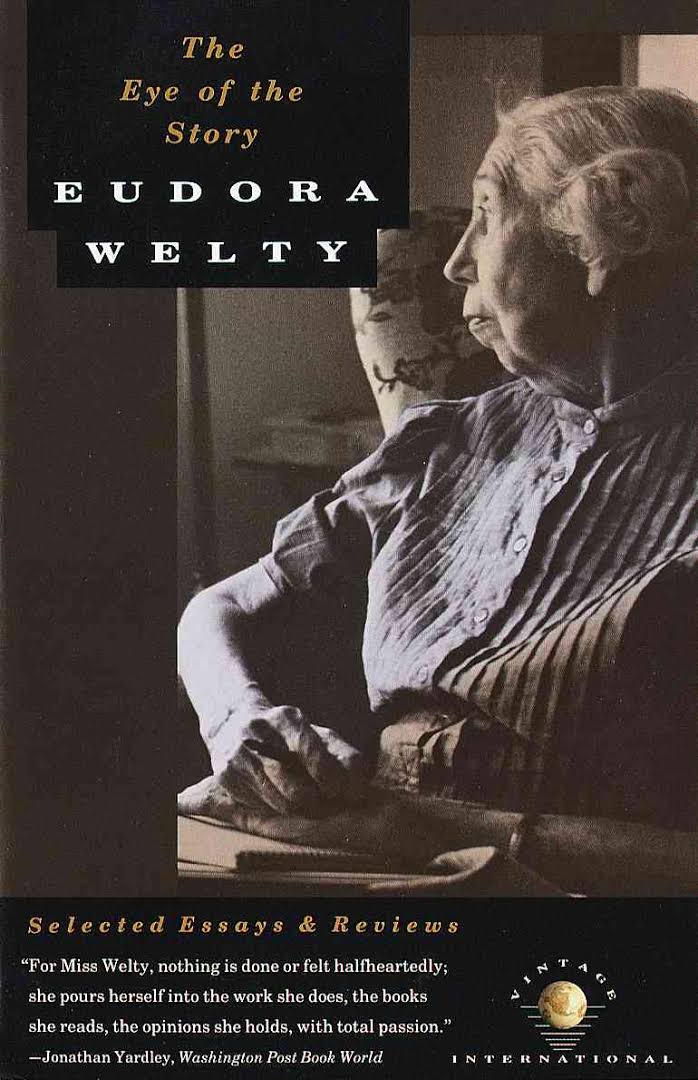
In the title essay, writing about how Katherine Anne Porter does without a certain kind of scene-setting, Welty finds nothing lacking in a story offering revelation in this degree. A character’s intense inner state has expanded to fill the space, and to Welty what matters is the story’s own path to its end. For her, nothing can hold a strong story back; it must do what it will.

In “Looking at Short Stories” she examines five in detail—by Crane, Hemingway, Chekhov, Lawrence, and Faulkner—and when she finishes, we’ve gone from technical matters into style into beauty. Speaking to us as like-minded seekers (reader and writer ought to be companionable, she says) rather than as a cohort in need of what she knows, she examines what makes us think something is beautiful. She goes into all this in an everyday voice. No gushing. Beauty is not, she says, “a blatant or promiscuous or obvious quality.”

In 1941 a reviewer struck by the beauty of the stories in Welty’s own first book refused to comment on their form, saying to do so was as hopeless as “saying a tree is right in form.” This rightness exists throughout her work and steers her criticism out of its surface matter-of-factness into vision.

Henry Green: "the look of simplicity"
Before I read The Eye of the Story I had some school-learning of her stories, often presented (as with the mysteriously oft-anthologized “Why I Live at the PO”) as comedies packed with that Southern knowledge of what people would do. “She would do that, wouldn’t she.” Asked about her progress as a writer, Welty said she improved “once I got some sense.” In the South you’re raised on the word. “He’s got no sense.” “What was the sense in that?” To a child listening to the marvelous litany of what people would do, “no sense” had an endless store of effects inside it like seeds in a pepper. Some of them were just flavor, some of them burned: desperate acts, rape and incest and murder, abrupt intensities in lives called ordinary—the ground of Welty stories. “Trouble, the backbone of literature,” she wrote. She was not a comedian at heart any more than Chekhov was. Our comic writers are funnier today, lacking her boundless sympathy. Our paranormal is thin compared to her normal, and much of our criticism, lacking her wonder, just advertisement. Not just her visionary stories but her way of reading enlarged my reading and my life. I go on and on learning from The Eye of the Story.

Tuesday, June 14, 2011

Whatever Happened to Eudora Welty?

by Patrick Thomas Henry

Recently, I posted a status update on my Facebook wall and asked if anybody near New York would be interested in tagging along to a June 10, 2011 panel at The New School, moderated by Granta assistant editor Patrick Ryan.  The event, entitled “Truly Yours,” offered perspectives on Eudora Welty from writers she has influenced. An acquaintance from high school responded to my status:  “Does anybody know to whom you are referencing?” In short:  I was flummoxed.(1) Who doesn’t know of Eudora Welty?

Apparently, far too many readers. Ryan opened the panel by saying that he recently had similar experiences, one with an intelligent college English major and another with a voracious, older, lifelong reader.

“Truly Yours” wasn’t exactly a Eudora Welty/new readers matchmaking session; the panel spoke to Welty lovers, not folks like my high school chum.  But the panel’s participants—critic Maud Newton and novelist Sheri Holman—joined Ryan in explicating Welty’s unique importance to American fiction. Dramatic readings of some Welty excerpts, performed by actress Rhonda Keyser, punctuated their discussion.

 “More than any writer I can think of,” Newton said, “Welty captures how people speak and the humor of situations.” Holman agreed, saying that “her dialogue is some of the funniest and truest you’ll ever read.” According to the panel, Welty’s interest in the inner, private life places her alongside Virginia Woolf and William Faulkner. Holman said that Welty’s concern for characters’ interior lives—their private dreams and desires—moves us “in and out of minds in so many ways.”

We need Welty, the panel argued, because she’s a regional writer whose pitch perfect sense of the human voice eclipses the limits of place. Her control of dialects and everyday language illustrates something essential about our behaviors. Ryan shared Welty’s description of Anton Chekhov’s plays, which describes Welty’s thoughts on conversations:

You know, in Uncle Vanya and The Cherry Orchard, how people are always gathered together and talking and talking, no one’s really listening. Yet there’s a great love and understanding that prevails through it, and a knowledge and acceptance of each other’s idiosyncrasies, a tolerance of them, and also an acute enjoyment of the dramatic.(2)

People talking and talking yet never really listening to each other—this is why today’s readers need Welty’s fiction. Smart phones seem to be surgically attached to people’s ears, and the lot of social media—MySpace, Facebook, Twitter—generate channels of emptiness, great voids into which we can shout while choosing to ignore the calls of others, the echoes of our own voices.(3)

Talking-across-purposes muddles relationships in “Why I Live at the P.O.,” even as the reader witnesses how the characters keep missing each other.(4) Voice works, here, in two key ways. First, we hear the snark-fueled appraisal of family life from the first-person narrator—the postmistress. Her Southern dialect rings honest, never farcical.(5) So, we want to trust her—even as we don’t know the others’ take on Stella-Rondo’s failed relationship with Mr. Whitaker. Second, the narrator is posturing herself against the rest of the family as her recently returned sister turns the entire clan against her.  Really:  the narrator and her family put the “fun” in “dysfunction.”

As Holman pointed out to the audience, “Everybody’s about power and position, and who has what on whom.” The whispered insults and misconceptions in “Why I Live at the P.O.” are simply how the narrator and Stella-Rondo keep lunging in front of each other. Yet, we need to be aware of these plays, especially in a twenty-first century where everything orbits around poignancy in 140 characters or less:  “Powerlessness,” as Holman elaborated, “attunes you to what others are saying.” Welty’s characters, in their little power parades, perform the gamut of emotions and beliefs.

Not realizing this results in disaster. Nowhere in Welty’s short fiction is this truer than “Where Is the Voice Coming From?”—Welty’s only overtly political story.(6)  Here, Welty inhabits the voice of a white man who assassinated an NAACP leader, a narrative arc lifted from the 1963 hate killing of Medgar Evers by Byron de la Beckwith. Welty slides deftly into this perspective, at once uncovering the terror of this racist crime while showing us how such a person justify that act. The story’s power stems from precisely this: Welty knows where that voice is coming from—a well of racism and hatred.  And she’s brave enough to confront that attitude, in a way few short story writers can.

Where should new readers meet Welty? Newton directed the audience toward Welty’s Pulitzer Prize-winning novel The Optimist’s Daughter (1972), while Holman guided readers toward Welty’s second short story collection—The Wide Net (1943).  Holman promoted The Wide Net because of Welty’s flexibility; the collection was written during the World War II years, and Holman asserted that few other books handle the consequences of shifting realities as powerfully as The Wide Net. Regardless, Welty offers today’s readers a guide to how we should communicate—so readers should unplug for a moment and hear what her stories relate.

(1) I somehow found it within myself to not deride his highfalutin diction.
(2)  The complete interview is available online at The Paris Review Web site.
(3)  My iPod, Kindle, Macbook, and Wii betray this much:  I’m no enemy to our technological overlords.  It’s just far too easy to get sucked into the virtual world they offer.
(4)  The proof, the cliché goes, is in the pudding, and this story backs up Holman’s assertion on Welty:  “Why I Live at the P.O.” goes down sweet, and when I read this story I can hear the syrupy dialect.
(5)  Listen to Welty reading from “Why I Live at the P.O.”
(6)  This story was first published in The New Yorker on July 6, 1963. An online subscription is required to read this digital version.

Tuesday, September 22, 2009

Genius Authors, Enduring Works, Book Club Choices, Best-Sellers, Award Winners

I can't keep up with all of the great things that are happening for short stories and short story writers, so for now, I'm just going to list the latest and hope to circle back later to discuss some of these at greater length. Here's what has been happening so far this month:

Two Short Story Writers Win MacArthur Foundation Fellowships.
Among this years "genius grant" recipients are short story writer Deborah Eisenberg (a pure play) and the first ever winner of The Story Prize, Edwidge Danticat, whose second short story collection, The Dew Breaker, is often classified as a novel.

Four of the Six Finalists for the Best of the National Book Awards Fiction Are Short Story Collections.
In 60 years, and out of 77 books, only 11 have been short story collections. But a panel of 140 writers chose four of those books among the six finalists. Those collections are: The Stories of John Cheever, The Collected Stories of William Faulkner, The Complete Stories of Flannery O'Connor, and The Collected Stories of Eudora Welty. Short story collections are, without a doubt, among the most enduring works of American literature.

The Latest Oprah's Book Club Selection Is a Short Story Collection.
On September 18, Oprah Winfrey announced that Say You're One of Them by Uwem Akpan is the next book club selection--the first time she's chosen a short story collection.

Soon There Will Be Three Short Story Collections on The New York Times Best-Seller List.
When Akpan's book hits The New York Times Best-Seller List for trade paperbacks, it's very likely that it will join two other short story collections: Olive Kitteridge by Elizabeth Strout and Unaccustomed Earth by Jhumpa Lahiri. Who says short story collections don't sell?

The Inaugural $50,000 St. Francis College Literary Prize Goes to a Short Story Collection.
On September 12, as part of the Brooklyn Book Festival, Aleksander Hemon's short story collection Love and Obstacles was announced as the winner of this new book award for mid-career authors.

In addition, the Frank O'Connor International Short Story Award just announced it's surprising winner, Simon Van Booy's Love Begins in Winter.

More on much of this later. For now, I rest my case.