Showing posts with label Elizabeth McCracken. Show all posts

Sunday, March 8, 2015

News Coverage of The Story Prize Event and Announcement

L to R: Story Prize winner Elizabeth McCracken, founder Julie Lindsey,
finalists Francesca Marciano and Lorrie Moore, and director Larry Dark

Here are some links to press accounts of The Story Prize event on March 4, at which eventual winner Elizabeth McCracken and fellow finalists Francesca Marciano and Lorrie Moore read from and discussed their work onstage at The New School, and Julie Lindsey announced the winner:

Reuters


Saturday, March 7, 2015

Video: The Story Prize Event on March 4 at The New School with Francesca Marciano, Elizabeth McCracken, and Lorrie Moore

In case you missed The Story Prize event on March 4 at The New School, here's the video. That night, the three finalists—Francesca Marciano, Elizabeth McCracken, and Lorrie Moore—read from and discussed their work on-stage. And at the culmination of the event, we announced the winner for books published in 2014: Elizabeth McCracken's Thunderstruck


Thursday, March 5, 2015

What the Judges Had to Say About Elizabeth McCracken's Thunderstruck

When the three judges for The Story Prize make their choices, they provide citations for the books. This year's judges were Arsen Kashkashian, Noreen Tomassi, and Laura van den Berg. We include the citations in congratulatory letters we present to each finalist, along with their checks ($20,000 to the winner, $5,000 to the other two finalists). To protect the confidentiality of the judges' votes and the integrity of the process, we don't attribute citations to any particular judge.


Here's what the judges had to say about Elizabeth McCracken's Thunderstruck, this year's winner of The Story Prize:
Elizabeth McCracken’s Thunderstruck is a tour de force of heartbreak, magic, beauty, and longing—all rendered in incandescent prose. Each story in the collection reads like a masterwork, rich and confident and surprising, and together they form an electrifying whole. Thunderstruck is one of those rare collections that will remain imbedded in my imagination for life.
It seems impossible that stories so filled with disillusionment, disappearance, and all manner of disconnection among such a flawed group of human beings could leave the reader feeling so hopeful, so renewed. How does Elizabeth McCracken manage to do this so beautifully in her extraordinary new collection, Thunderstruck? It's not only because sentence by sentence she is such an accomplished and wonderfully observant writer. It is not only because she is the master of the small and perfectly telling detail—the mother's light tap of a hand on her child's coffin, a suitcase fallen over like "a shot dog," "a pair of red and white espadrilles that had run in the rain." It is because she writes with such an open and compassionate heart, so that even the most damaged and lost of her characters thrum with life. In her work the ordinary becomes the transcendent, everyday sadnesses and losses are witnessed and honored, and the reader closes the book with the sense, that yes, life can be cruel and wanton and its losses devastating, but it is also profoundly beautiful.

Wednesday, March 4, 2015

The Winner of The Story Prize Is Thunderstruck by Elizabeth McCracken


Elizabeth McCracken's first story collection in 21 years proved to be a triumphant return to the form, as she took home the top prize of $20,000 and an engraved silver bowl as winner of The Story Prize for her collection, Thunderstruck (The Dial Press). After she and fellow finalists Francesca Marciano and Lorrie Moore read from and discussed their work on-stage at The New School in New York City on March 4, the Founder of The Story Prize, Julie Lindsey, announced McCracken as the winner, and the author took the stage to accept the award to enthusiastic applause from the audience.

In the days ahead, here and on our Web site (as well as on Instagram) we'll post more about the event, including citations from the judges, photos from the event and the after party, links to media coverage, and, eventually, video.

Wednesday, February 25, 2015

Please Join Us for The Story Prize Event on March 4 at The New School

Between the time we announce The Story Prize finalists in early January and the event at which we honor all three of them and present one with the $20,000 top prize, we spend a lot of time worrying about filling the seats in The New School auditorium. We always end up doing pretty well on that count (and probably would without worryng about it as much as we do), but we're still eager to have a substantial audience to support the three authors, The Story Prize, and the form we exist to promote—short fiction.

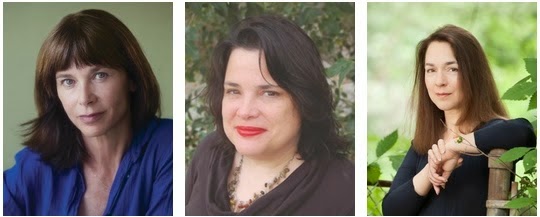
(L to R: Francesca Marciano, Elizabeth McCracken, and Lorrie Moore)
The authors always prove to be interesting and amusing, but it's also no secret that writers aren't necessarily the most outgoing bunch. We all know that their real performances take place when they are alone and writing, and that what matters most happens on the page and through the deeply personal experience of reading their work. So whether you plan to join us or not, we can't recommend too highly the three books we're honoring: The Other Language by Francesca Marciano, Thunderstruck by Elizabeth McCracken, and Bark by Lorrie Moore.

You can watch the event later on YouTube or FORA.tv, and we post a lot of pictures in the days that follow, but it is, of course, impossible to reproduce the live atmosphere in the auditorium. Nothing can take the place of the authors' presence, the burst of laughter or buzz that comes from the room when one of them reads or says something funny or profound, or the feeling of suspense before we announce the winner, the electric moment when founder Julie Lindsey speaks that name, and the moving experience of seeing someone accept the prize—most often a hard-working, supremely talented, and deserving author who hasn't received a comparable honor before. (For instance, last year was the first time George Saunders had ever won a book award.)

Tickets are $14 (close to the same as a movie ticket). The event is a week from today, on March 4 at 7:30 p.m., at The New School auditorium at 66 W. 12th St. Please join us if you can.

Monday, January 12, 2015

The Finalists for The Story Prize: The Other Language by Francesca Marciano, Thunderstruck by Elizabeth McCracken, and Bark by Lorrie Moore

The Finalists: (L to R): Marciano, McCracken, and Moore


We're pleased to honor as finalists for The Story Prize three outstanding books chosen from 129 entries representing 85 different publishers or imprints. They are:

  • The Other Language by Francesca Marciano (Pantheon)
  • Thunderstruck by Elizabeth McCracken (The Dial Press)
  • Bark by Lorrie Moore (Alfred A. Knopf)


The Other Language by Francesca Marciano collects nine stories about women and men in or just beyond the cusp of major life changes, in locales as diverse as Greece, Rome, Venice, Kenya, India, and New York. The nine stories in Elizabeth McCracken's Thunderstruck, her first collection in 20 years, delve into dark subjects with seriousness and wit, and deliver on their inventive premises. Lorrie Moore's collection, Bark, consists of eight stories set mostly in Middle America, about people in or approaching midlife who find themselves midway between speaking their minds and protecting their emotions by forming a hard shell around themselves.

This year's judges, Boulder (Colo.) bookseller Arsen Kashkashian, Center for Fiction Director Noreen Tomassi, and author Laura van den Berg will decide the outcome.

The annual award event will take place at the New School’s Auditorium at 66 West 12 Street in New York City at 7:30 p.m. on Wed., March 4. Tickets cost $14. That night, Marciano, McCracken, and Moore will read from and discuss their work on-stage. At the end of the event, Julie Lindsey will announce the winner and present that author with $20,000 (which remains the biggest top prize of any annual U.S. book award for fiction) along with an engraved silver bowl. The two runners-up will each receive $5,000.

In the weeks ahead, we'll publish an index of guest posts form 2014 authors, and a long list of other exceptional collections we read last year.

Thursday, July 24, 2014

Elizabeth McCracken's First 21st Century Short Story Collection

In the 12th in a series of posts on 2014 books entered for The Story Prize, Elizabeth McCracken, author of Thunderstruck (The Dial Press), discusses how and why she returned to writing short stories after more than twenty years.


It’s been 21 years since I last published a collection of short stories. More than two decades: last century, last millennium even. Around the time I was writing stories for that long-ago book, my friend Bruce Holbert told me that he’d heard that a short story was like a passionate love affair, and a novel a long marriage. I’m a pessimist and a complainer, so I translated this into terms I understood: A short story was a blow to the solar plexus, a novel like a long lingering illness I might never recover from.

Once I started writing novels, I discovered something: Novels are easier than stories, perhaps in the way that a long marriage is easier than a series of passionate love affairs. A novel, a good one, is forgiving. You can misstep, digress, dither. You can take time off. Things that bother you are not a reason to break up, as a reader or a writer. You think, True enough, I didn’t anticipate this long flashback that takes place in a terrible house in a dull town, but I’ve grown to love this novel: It can bore me a little if it wants to. As a reader, I not only forgive digressions, I love them. As a writer, I hope I’m not alone in that.

Rockin' it old school
So years ago, maybe 20, I decided I was done with short stories and would only write novels. To return to my own metaphor: You’re less likely to get punched in the solar plexus if you’re lying in bed with a lingering illness. 

Yet here we are in the 21st century, and I’ve published another collection of short stories. What happened: I wrote two novels that I threw out. By wrote, I mean finished multiple drafts over multiple years. Giving up on the first was difficult but eventually bracing; giving up on the second was something I’m not entirely sure I’m over yet. Or—to continue Bruce’s metaphor—over the past decade I went through two terrible divorces in a row and I wasn’t willing to commit to a long-term thing. I wanted to be able to jump in with both feet. I wanted to devote myself to what I was writing with my whole heart. I didn’t think I could do that with another novel, but with short stories I could, one at a time, and then I had a book’s worth.

The short stories I wrote in my late 40s are different, I guess, from the stories I wrote in my early 20s, though if I were to try to guess why I might unravel my writerly brain. Speaking, as we were, of love: love is different at different times of life. My first collection was nine stories, eight first person and one (the last written) in the third. My second collection is also nine stories, seven in the third person, one in the first person plural and one in the first person singular. What does this mean? Is it age, or is it just what I was interested in at the time?

I don’t believe that writers simply improve as they get older—though I hope I have in some ways. I do believe they change. There are things you can write when you’re 25 that you will never be able to write even five years later; I can’t explain it but I know it’s true. I couldn’t have written my second collection twenty years ago and I couldn’t write my first one now. Obsessions persist: falling apart houses; strange exhibitions of human beings; murder; the impossibility of knowing your parents, your children. I’m different, and I’m not different. I wrote a book. That’s the story of any writer’s life.