 |
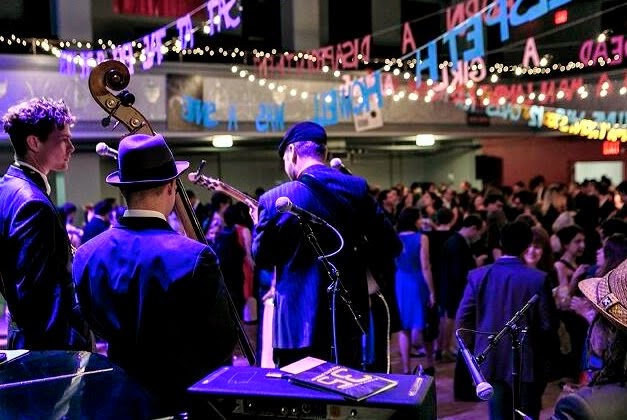
| The Blue Vipers performing at the One Story Literary Debutante Ball |
By Nick Fuller Googins
Brooklyn, NY, May 22, 2014
Hannah Tinti, co-founder and editor-in-chief of literary magazine One Story, is also a best-selling author and a teacher at Columbia’s MFA program. She’s a literary personality who wears many hats, and on the night of May 22, at funky Brooklyn performance space Roulette, her hat was of the miniature Edwardian ringmaster variety, bedazzled with black sequins and festooned with glittery silver butterflies. Her Converse All-Stars matched the butterflies, flashing smartly as she crossed the stage, stepped up to the microphone, and, politely, asked everyone to please shut up. Time for the debutante ball to begin.
But let me back up for a moment: One Story’s annual Literary Debutante Ball is a celebration of One Story authors who have published their debut books in the past year. The process of announcing these authors (seven of them this year, including Ben Stroud, whose collection, Byzantium, earned him the 2013 Story Prize Spotlight Award), their metamorphosis from mere mortals into literary debutantes, in no way resembles a traditional literary reading. It’s much, much more fun. As soon as I checked in, I was invited to grab a “Let the World Spin,” the evening’s custom, Colum-McCann-inspired cocktail (more on the man later).
This is how a proper Literary Debutante Ball warms up: Live band on stage. Tables of appetizers. Two open bars. A bartender dancing to swells of music. Garden lights strung overhead, along with strands of cut-out letters spelling the first line of each debutante’s recently published book. Clusters of elegantly dressed writers, editors, and lovers of literature. Burlesque-costumed women weaving through the crowd hawking framed commas, semicolons, and exclamation marks at $10 a pop.
It was quite a lot to take in.
I ate some appetizers, stood in line at one of the bars, walked the floor looking for debutantes, trying to match faces to what I remembered from author photos. I moved over to the other bar and struck up a conversation with a young guy who turned out to be a former student of Tinti’s at Columbia. (“Still writing?” I asked him. “Of course, you have to,” he said, as though it were an absurd question.) I was curious why people had come to the debutante ball, in what capacity. I asked another woman. We were standing side by side, admiring the wall of advice—framed, hand-written bits of writing-based knowledge and guidance from established writers and debutantes alike, available for purchase as part of a silent auction. The woman told me she was an agent. I asked if she represented any of the debutantes. She said she did not. Anyone, then, whom I may have heard of? "Jonathan Franzen?" she said. "Oh, sure," I said, "I’ve heard of him."
The Golden Thread
Jonathan Franzen’s agent and I parted ways. I continued down the wall of advice, examining the handwritten words of encouragement and inspiration from the likes of this year's Story Prize winner George Saunders and, yes, Jonathan Franzen. I especially liked Hannah Tinti’s advice, not only because of its mythological lyricism, “Your story is a puzzle—a maze. But your mind created it—so the answer, the key, the golden thread leading out is inside you. Unspool it and meet your minotaur,” but also because she’d encircled it in cartoony, serpent-like monsters. Elsewhere on the wall, interspersed with the words of encouragement and inspiration, were words of caution. From the pen of Lynne Tillman: “Don’t expect that being published will make you happy.” Other authors mined their personal role models for wisdom, such as debutante Molly Antopol, who quoted Grace Paley. Someone else cited John Updike. Michael Cunningham quoted a slightly less literary figure, but it was still excellent advice: “Don’t panic! (remember what Marilynn Monroe said—‘I wasn’t the prettiest, I wasn’t the most talented, I just wanted it more than anybody else’).”
At this point, I discovered that the debutantes’ books, arranged in handsome piles on tables throughout the theater, were not merely showcase pieces but meant for the taking, by us, the guests (meaning me). But I was not alone in my discovery. Books were going fast, flying off the tables. I had to move quickly. Luckily, I’d already read Ben Stroud’s Byzantium and Molly Antopol’s The UnAmericans, allowing me to skip those particular stations. I snagged Rachel Cantor’s A Highly Unlikely Scenario, James Scott’s The Kept, and Celeste Ng’s Everything I Never Told You. I stopped to say a quick hello to Tin House editor, Rob Spillman and did a double-take at the sight of author John Hodgman. Hodgman’s story, “Vilanova: Or How I Became a Former Professional Literary Agent,” has the distinction of comprising the debut issue of One Story. This evening he was dressed like unbearably snobbish author Louis Green, whom he played in HBO’s Bored to Death. I then nabbed David James Poissant’s The Heaven of Animals and Amelia Kahaney’s The Brokenhearted, completing my debutante reading list. It was good timing. Hannah Tinti had just taken the stage, tapped the mic, asked us in her own charming way to please quiet down.
To kick things off, Tinti and fellow co-founder Maribeth Batcha said a few words about One Story, now in its twelfth year of existence. (“Sort of our bar mitzvah,” Tinti said. “We are a man now!* An active participant in the world!”) One Story, which publishes a single short work of fiction every three weeks, and never publishes the same author twice, maintains a special commitment to encouraging writers at the beginning of their careers, a commitment that Tinti and Batcha said they were pleased to have strengthened over the years. With that, the One Story co-founders sat cross-legged on the side of the stage, making room for the honorees of the evening.
The ceremony itself was brief yet meaningful. The debutantes were announced one by one, escorted down the “aisle” (parallel strands of rope held waist-high by glamorous volunteers) by a respective mentor, in some cases an editor, such as Amelia Kahaney’s escort, Sarah Landis. In other cases an established author, such as Rachel Kantor’s escort, Robin Black, a One Story alum and 2011 literary debutante herself, did the honors. As each debutante took the stage, the first line of his or her new book was read aloud, followed by general whooping, hollering, applause, and hoisted cocktails, all to celebrate the authors’ entrance into the literary community, to acknowledge thier current success, and to wish for them many future years of inspiration and sales. Amid this frenzy of jubilation, optimism, and cheer, came the gimlet-eyed first line of Ben Stroud’s collection: “I was born a disappointment.” It brought down the house.
McCann signed off, the party resumed, dancing commenced. I made a beeline to Ben Stroud, whom I wanted to congratulate and, more importantly, thank for writing Byzantium. His collection’s ten stories skip from ancient Mesopotamia to colonial West Indies to contemporary East Texas and other times and places. The first story, my favorite, follows an idle, fatherless man-child with a crippled hand (you’re correct in guessing this is the poor sap to declare himself “born a disappointment”). Summoned by the Byzantine emperor, the narrator is tasked with a top-secret mission: travel to a desert monastery outside Jerusalem, locate a particular monk, and castrate him. It sounds gruesome, and is, but more so it’s a moving, humorous, and entertaining story. I planned to relay this sentiment to Ben Stroud, but when I got to him, I didn’t have time for much more than a handshake and quick congratulations before he was swarmed by others. No matter, I knew when to move on. Anyway, I had another mission: Find Molly Antopol.
I intercepted her on her way to the dance floor. After congratulating Antopol, both on her newly anointed literary debutante status and on her recently published collection of stories, The UnAmericans, I wanted to talk about a compelling blog post of hers that I’d come across, “On Writing and Being a Parent,” which cleverly examines how parenthood affects the practice of writing, in some ways for the better. I told all this to Antopol in one long breath. She had no idea what I was talking about.
“What do you mean?” I said. “That’s not your blog?”
“I don’t think so,” Antopol said. “I’m pretty sure I’m not a mom.”
Ah! I’d mixed up debs! The most mortal of all debutante-ball sins! Had this been an episode of Gossip Girl, I would’ve been shunned from Upper East Side society for years, never again allowed to grace the Waldorf Astoria ballroom floor. Thankfully, this was Brooklyn, and Molly Antopol has a gracious way of alleviating uncomfortable situations. I believe she deserves another award for that.
Debutante Amelia Kahaney, I later discovered, is the author of the wonderful parenting-writing blog post. Sadly, I never found Kahaney in the crowd, never got to talk to her. Which brings up the only problem with One Story's Literary Debutante Ball: It's such a kick-ass party that it's impossible to talk to everyone in the room. Wisely, One Story continues the celebration through the following day, hosting a low key reading by the debutantes at Greenlight Bookstore in Fort Greene. The reading was scheduled for the evening, giving all participants eighteen-odd hours of recovery time, a good thing because after dancing through the night with Colum McCann and Hannah Tinti and seven happy literary debutantes, sure, all may be forgiven in the morning, but a hangover still hurts.
At this point, I discovered that the debutantes’ books, arranged in handsome piles on tables throughout the theater, were not merely showcase pieces but meant for the taking, by us, the guests (meaning me). But I was not alone in my discovery. Books were going fast, flying off the tables. I had to move quickly. Luckily, I’d already read Ben Stroud’s Byzantium and Molly Antopol’s The UnAmericans, allowing me to skip those particular stations. I snagged Rachel Cantor’s A Highly Unlikely Scenario, James Scott’s The Kept, and Celeste Ng’s Everything I Never Told You. I stopped to say a quick hello to Tin House editor, Rob Spillman and did a double-take at the sight of author John Hodgman. Hodgman’s story, “Vilanova: Or How I Became a Former Professional Literary Agent,” has the distinction of comprising the debut issue of One Story. This evening he was dressed like unbearably snobbish author Louis Green, whom he played in HBO’s Bored to Death. I then nabbed David James Poissant’s The Heaven of Animals and Amelia Kahaney’s The Brokenhearted, completing my debutante reading list. It was good timing. Hannah Tinti had just taken the stage, tapped the mic, asked us in her own charming way to please quiet down.
To kick things off, Tinti and fellow co-founder Maribeth Batcha said a few words about One Story, now in its twelfth year of existence. (“Sort of our bar mitzvah,” Tinti said. “We are a man now!* An active participant in the world!”) One Story, which publishes a single short work of fiction every three weeks, and never publishes the same author twice, maintains a special commitment to encouraging writers at the beginning of their careers, a commitment that Tinti and Batcha said they were pleased to have strengthened over the years. With that, the One Story co-founders sat cross-legged on the side of the stage, making room for the honorees of the evening.
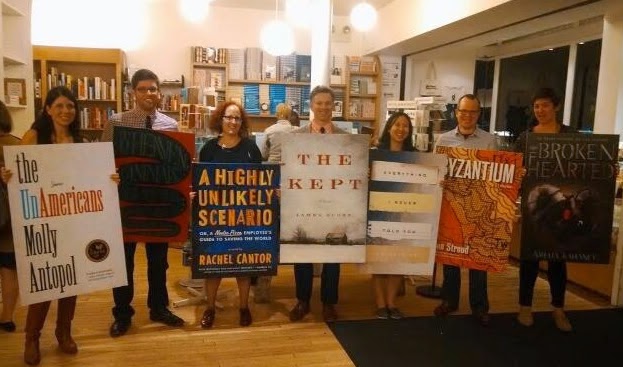 |
| One Story's literary debutante's (L to R): Molly Antopol, David James Poissante, Rachel Cantor, James Scott, Celeste Ng, Ben Stroud, and Amelia Kahaney |
Confusing Debs
Directly after the literary debutantes were announced and celebrated, One Story presented its 2014 “Mentor of the Year Award” to literary rock star Colum McCann, who teaches at Hunter College and is deeply involved in numerous literary organizations. McCann, keeping with the theme of the evening, devoted the majority of his acceptance speech to discussing his own literary heroes and mentors, one of whom was memoirist Frank McCourt. McCann recounted a visit to McCourt in a late stage of his life, when McCourt, unable to talk, communicated via white board and dry erase marker. The way McCann tells it, at one point he asked the ailing author, “Where will you go dancing next?” McCourt’s written reply: “Upstairs with the Great JC and Mary M and the twelve Hot Boys. And in the morning, all will be forgiven.”McCann signed off, the party resumed, dancing commenced. I made a beeline to Ben Stroud, whom I wanted to congratulate and, more importantly, thank for writing Byzantium. His collection’s ten stories skip from ancient Mesopotamia to colonial West Indies to contemporary East Texas and other times and places. The first story, my favorite, follows an idle, fatherless man-child with a crippled hand (you’re correct in guessing this is the poor sap to declare himself “born a disappointment”). Summoned by the Byzantine emperor, the narrator is tasked with a top-secret mission: travel to a desert monastery outside Jerusalem, locate a particular monk, and castrate him. It sounds gruesome, and is, but more so it’s a moving, humorous, and entertaining story. I planned to relay this sentiment to Ben Stroud, but when I got to him, I didn’t have time for much more than a handshake and quick congratulations before he was swarmed by others. No matter, I knew when to move on. Anyway, I had another mission: Find Molly Antopol.
I intercepted her on her way to the dance floor. After congratulating Antopol, both on her newly anointed literary debutante status and on her recently published collection of stories, The UnAmericans, I wanted to talk about a compelling blog post of hers that I’d come across, “On Writing and Being a Parent,” which cleverly examines how parenthood affects the practice of writing, in some ways for the better. I told all this to Antopol in one long breath. She had no idea what I was talking about.
“What do you mean?” I said. “That’s not your blog?”
“I don’t think so,” Antopol said. “I’m pretty sure I’m not a mom.”
Ah! I’d mixed up debs! The most mortal of all debutante-ball sins! Had this been an episode of Gossip Girl, I would’ve been shunned from Upper East Side society for years, never again allowed to grace the Waldorf Astoria ballroom floor. Thankfully, this was Brooklyn, and Molly Antopol has a gracious way of alleviating uncomfortable situations. I believe she deserves another award for that.
Debutante Amelia Kahaney, I later discovered, is the author of the wonderful parenting-writing blog post. Sadly, I never found Kahaney in the crowd, never got to talk to her. Which brings up the only problem with One Story's Literary Debutante Ball: It's such a kick-ass party that it's impossible to talk to everyone in the room. Wisely, One Story continues the celebration through the following day, hosting a low key reading by the debutantes at Greenlight Bookstore in Fort Greene. The reading was scheduled for the evening, giving all participants eighteen-odd hours of recovery time, a good thing because after dancing through the night with Colum McCann and Hannah Tinti and seven happy literary debutantes, sure, all may be forgiven in the morning, but a hangover still hurts.
* Editor's Note: In fact, One Story will not be a man, according to Jewish tradition, until next year, when it turns 13.
Photos courtesy of One Story.


